

Honey Saxena
Digital Marketing Expert
The Real Estate Email Marketing Playbook: Newsletters, Drip Sequences & Templates for 2026
Published August 18, 2026|10 min read
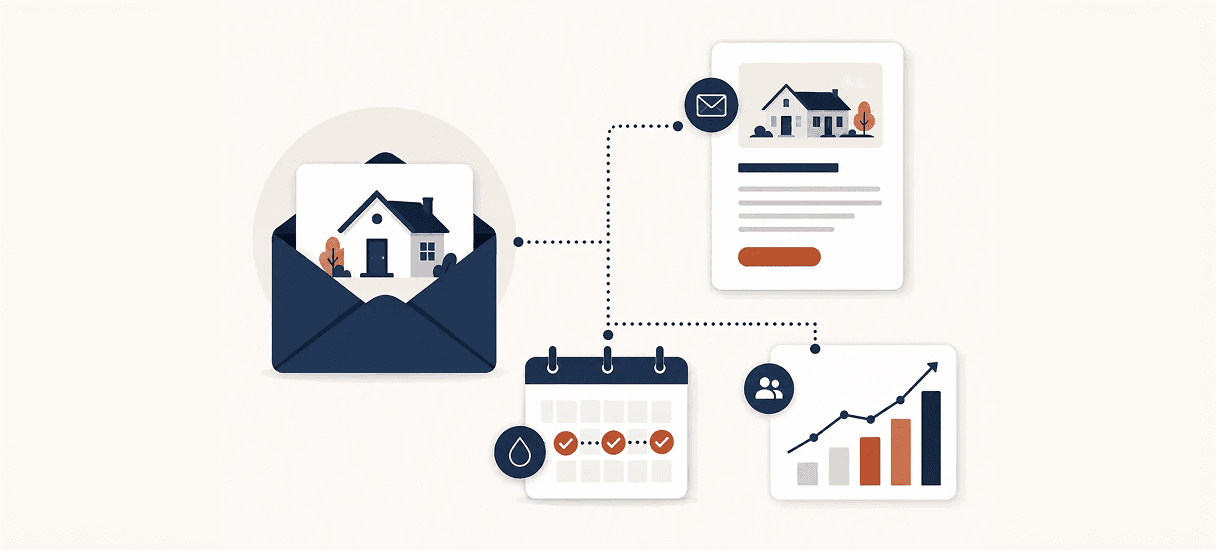
This blog lays out a full real estate email marketing playbook for 2026, covering newsletters, drip sequences, and reusable templates. It explains why click-through rate now matters more than open rate, especially with Apple's Mail Privacy Protection skewing open data. It breaks down three ready-to-adapt drip sequences for buyers, sellers, and past clients, plus a six-step process for building a newsletter people actually open. It compares DIY email marketing against hiring professional email marketing services, with real cost and speed benchmarks. It closes with the CAN-SPAM and Fair Housing compliance rules every agent needs to follow, common mistakes to avoid, and a 10-question FAQ section.
Here's the short answer. This real estate email marketing playbook comes down to three things. You need a newsletter people actually open, drip sequences that nurture leads without feeling robotic, and templates you can reuse instead of writing from scratch every week. Done right, email still returns more per dollar than almost any other channel real estate agents use. Done wrong, it just adds to the noise buyers already ignore.
That gap between "done right" and "done wrong" is bigger than most agents realize. I've built and audited email programs for brokerages and proptech platforms for years. The pattern is always the same. Agents either blast their whole list with the same generic update. Or they set up one welcome email and never touch it again. Neither approach earns trust. A client of ours switched from generic monthly blasts to a segmented, three-email nurture sequence. Buyer engagement jumped noticeably within weeks, without a single unsubscribe. Our case studies show similar results across other real estate clients. This guide walks through the newsletters, sequences, and templates that actually work in 2026. It also covers where most guides on this topic stop short.
What Is Real Estate Email Marketing and Why Does It Still Work in 2026?
Real estate email marketing is the practice of using newsletters and automated sequences to nurture leads and past clients over time. It still works in 2026 because agents own their email list outright. Social platforms and search algorithms can change overnight. A list you built yourself stays yours no matter what changes.
Email marketing is also unusually cheap for what it returns. Roughly 35% of companies see between $10 and $36 back for every dollar spent on email, according to Litmus' 2025 email ROI research. That's a return most real estate ad budgets can't touch. The catch: that return only shows up when the emails are actually relevant. A generic "here's what's happening in the market" blast won't get you there.
How Do You Build a Real Estate Newsletter People Actually Open?
A real estate newsletter people actually open mixes local market data, useful advice, and a bit of personality. Send it on a predictable schedule. Skip the generic "market update" template every other agent sends. Give readers something they'd bookmark even if they weren't buying or selling right now.
Here's the process I'd actually follow to build one from scratch.
Pick one clear theme per newsletter. A single strong topic, like a neighborhood spotlight or a rate update, beats five unrelated links crammed into one email.
Write subject lines like a headline, not a label. Nearly half of recipients decide whether to open an email based on the subject line alone. "March Market Update" won't cut it.
Keep it mobile-first. Most real estate email opens happen on a phone. Short paragraphs and one clear call to action matter more than a polished desktop layout.
Send on a predictable cadence. Monthly works for past clients. Weekly or biweekly works for active leads who are still deciding.
Always include one clear next step. Every newsletter needs exactly one obvious action, whether that's "see this week's new listings" or "book a 15-minute call."
Track what gets clicked, not just opened. Open rates get inflated by privacy tools now, so clicks tell you what content actually landed.
A short video clip embedded near the top of a newsletter often outperforms plain text alone. Our video marketing for real estate guide covers why that format earns more clicks. Our real estate SEO strategies guide covers how newsletter content and blog content can reinforce each other, instead of competing for the same ideas.
Real Estate Drip Sequences: The Templates That Actually Convert
A real estate drip sequence is a series of automated emails sent on a set schedule. Its job is to move a lead from first contact toward a closed deal. The best sequences run eight to twelve emails over roughly a year, spaced out instead of front-loaded. Rushing a lead with five emails in three days reads as desperate, not helpful. Our CRM and automation services handle this scheduling automatically, so no lead falls through the cracks.
The New Buyer Lead Drip Sequence
A buyer sequence should open with a warm welcome and what to expect next. From there, move into neighborhood guides, financing basics, and a soft check-in about their timeline. End each email with one question, not a wall of listings. That single question is what actually gets replies.
The Seller Lead Nurture Sequence
A seller sequence works best when it leads with local pricing data and recent comparable sales. Follow with staging tips, a breakdown of your marketing plan, and a direct ask to schedule a valuation call. Sellers respond to proof that you know their specific street, not generic advice.
The Past-Client and Referral Sequence
Past clients deserve a lighter touch: a home anniversary note, a seasonal maintenance tip, and one clear referral ask each year. This sequence is the cheapest lead source you'll ever build. These people already trust you. They just need a gentle reminder you're still in the business.
What Metrics Actually Matter for Real Estate Email Marketing in 2026?
Click-through rate matters more than open rate in 2026, because open rates no longer reflect real engagement. Apple's Mail Privacy Protection automatically loads email images for a large share of subscribers. That inflates open rates by an estimated 25% to 35%, whether someone actually reads the email or not.
Targeted, segmented real estate campaigns average open rates of 20% to 35%. Generic blasts sent to an entire list average just 1% to 2%. Click-through rates tell a similar story. Segmented campaigns average 2.5% to 3.6%, with top performers hitting 4% to 5%. Generic blasts barely clear 0.3%. That gap alone should be reason enough to stop sending one email to everyone on your list. Our AI and automation services can handle much of that segmentation work behind the scenes.
Metric | Generic Blast | Segmented Campaign | Top Performers |
|---|---|---|---|
Open Rate | 1% to 2% | 20% to 35% | 40% to 50% |
Click-Through Rate | 0.1% to 0.3% | 2.5% to 3.6% | 4% to 5% |
Reply Rate | Under 0.5% | 0.5% to 2% | 3% to 4% |
Should You Hire Email Marketing Services or Run Campaigns Yourself?
Hire email marketing services once you need consistent segmentation, design, and deliverability management across a growing list. Run it yourself if you have time to learn one platform well and only manage a few hundred contacts. Most growing teams land on a hybrid. A service handles strategy and setup, while an agent handles the personal touches.
Approach | Typical Cost | Speed | Best For |
|---|---|---|---|
DIY email marketing | Free to $50 a month for basic tools | Slow to set up, fast once running | Solo agents with a small, simple list |
Professional email marketing services | $500 to $5,000+ per month | Faster setup, ongoing optimization | Brokerages and proptech brands needing scale |
Hybrid model | Service-built templates plus agent-sent follow-ups | Moderate | Agents who want strategy support but a personal voice |
Our digital marketing and email automation team builds exactly this kind of hybrid setup for real estate clients. Real segmentation and automation come standard, with room left for an agent's own voice in every send.
Email Compliance Every Real Estate Agent Needs to Know
Real estate email marketing carries legal requirements that generic marketing advice skips. Two laws matter most. The CAN-SPAM Act governs every commercial email you send. The Fair Housing Act governs how you describe properties and buyers in that email.
CAN-SPAM Rules for Every Real Estate Email
The FTC's CAN-SPAM compliance guide requires accurate sender information and a truthful subject line. It also requires a real postal address and a working opt-out link that processes within ten business days. Violations can carry fines up to $53,088 per email. This isn't a minor detail to skip.
Fair Housing Rules for Email Content and Images
The Fair Housing Act prohibits discriminatory language or imagery in housing-related advertising. That includes your newsletter and drip emails, not just your listings. Avoid describing a neighborhood as ideal for a specific family type. Review stock photos in templates for the same issue. This is one of the most overlooked risks in real estate email marketing.
Common Real Estate Email Marketing Mistakes to Avoid
Even experienced agents repeat the same handful of errors.
Sending the same market update to buyers, sellers, and past clients with zero segmentation.
Front-loading a drip sequence with five emails in the first week, then going silent.
Chasing open rates instead of clicks, even though open rates are now unreliable.
Using stock templates with imagery that raises Fair Housing concerns.
Never testing subject lines, so the same underperforming pattern repeats every send.
Letting a purchased or scraped list replace a genuinely opted-in one.
Our real estate landing page optimization playbook pairs well here. Every email should point to a page built to convert the click you just earned.
Conclusion
A real estate email marketing playbook works when it treats email as a relationship channel, not a broadcast tool. Here's the one sentence to remember: segment your list, track clicks over opens, and space your drip sequence out over months. Do that, and email will keep outperforming almost everything else in your marketing budget.
Start this week if you haven't already. Pick one newsletter theme and write a real subject line for it. Map out eight to twelve emails for your buyer drip sequence instead of the three you have now. Check your templates for Fair Housing issues before your next send. If you want expert hands on the segmentation and automation, our proptech readiness check is a fast way to see where your current setup stands.
Whatever you fix first, treat your list like the asset it is. The agents and brokerages building genuine, segmented email relationships now are the ones buyers remember. When they're finally ready to make a move, your name is the one they recall.
- A real estate email marketing playbook combines newsletters, drip sequences, and reusable templates.
- Email marketing can return $10 to $36 or more per dollar spent, per Litmus research.
- Click-through rate matters more than open rate now, since Apple's privacy tools inflate opens.
- Segmented real estate campaigns average 20% to 35% open rates versus 1% to 2% for blasts.
- Drip sequences should run 8 to 12 emails over about a year, not front-loaded in days.
- Buyer, seller, and past-client sequences each need a different tone and call to action.
- Hiring email marketing services makes sense once a list outgrows simple DIY tools.
- CAN-SPAM violations can carry fines up to $53,088 per email.
- The Fair Housing Act applies to email content and imagery, not just listings and ads.
- Track replies and appointments booked, not just opens, to measure real ROI.
Why trust Noseberry
Our content is written by practicing real-estate and PropTech professionals, fact-checked by a dedicated editorial team, and reviewed against the latest industry data before publication.
- 10+ years of industry expertise
- All facts independently verified
- No sponsored rankings in guides
- Updated when the industry changes
Have Any Questions?
What is a real estate email marketing playbook?
A real estate email marketing playbook is a repeatable system of newsletters, drip sequences, and templates. It's built to nurture leads and past clients over time. It replaces one-off blasts with a structured, segmented approach. The goal is consistent engagement that turns into referrals and closed deals.
What should be included in real estate newsletters?
Real estate newsletters should include one clear theme, local market data, and a single obvious next step. Mixing five unrelated topics into one email dilutes engagement. A predictable send schedule, whether monthly or biweekly, matters more than length or design polish.
How is a real estate drip sequence different from a regular newsletter?
A drip sequence is triggered automatically based on a lead's behavior, like signing up for a home search. A newsletter goes out to your whole list on a fixed schedule. Drip sequences nurture a specific lead toward a specific action, while newsletters maintain broader, ongoing visibility.
Should I hire email marketing services or manage campaigns myself?
Hire email marketing services once your list grows past a few hundred contacts. The same goes once you need real segmentation and design support. Manage it yourself if you have time to learn one platform and your list stays small. Many agents land on a hybrid: a service builds the system, and the agent sends the personal follow-ups.
What is a good open rate for real estate email marketing?
Segmented real estate campaigns typically see open rates between 20% and 35%, while top performers reach 40% to 50%. Generic blasts sent to an entire list often fall to just 1% or 2%. Apple's Mail Privacy Protection also inflates open rates, so click-through rate is a more reliable measure.
Why isn't my real estate email marketing playbook converting leads?
The most common causes are zero list segmentation and front-loaded drip sequences that overwhelm new leads. Templates with no clear call to action are another culprit. Chasing open rates instead of clicks also hides the real problem. Review your last five sends for these issues before adding more emails.
How many emails should a real estate drip campaign include?
Most effective real estate drip campaigns run eight to twelve emails spread across roughly a year. Don't cram them into the first few days. Buyer and seller sequences should each end every email with one specific question. That single question drives far more replies than a list of new listings.
Is buying an email list legal for real estate marketing?
Buying or scraping an email list creates serious CAN-SPAM compliance risk. It also almost always produces low engagement and high spam complaints. The FTC requires accurate sender information and honest opt-out processes, which purchased lists rarely support cleanly. Build your list through genuine opt-ins instead.
Do Fair Housing rules apply to real estate email marketing?
Yes. The Fair Housing Act prohibits discriminatory language or imagery in any housing-related advertising, including newsletters and drip emails. Avoid describing a property or neighborhood as suited to a specific type of family or buyer. Review template stock photos for the same concern before every send.
What email marketing services fit best into a real estate email marketing playbook?
The best email marketing services combine CRM-level lead tracking with real segmentation and automation. A generic email design tool alone isn't enough for a real estate email marketing playbook. Look for a provider who understands drip sequences built around buyer and seller timelines specifically. Reporting tied to replies and appointments matters more than open rate dashboards alone.
Related insights
 Real Estate
What should a PMS do for small-scale property managers?
The ideal PMS for a small-scale property manager (typically 10 to 500 units) should do ten things well: capture every rent payment automatically, log every maintenance ticket with photo evidence and vendor dispatch, hold every tenant lease and document in one searchable place, generate owner and investor statements in one click, run automated rent reminders and late-fee escalation, screen tenants with credit and eviction history, sync with the operator's accounting stack (QuickBooks, Xero), work on mobile so field checks and unit walks happen on a phone, integrate with a website for listing marketing and online applications, and produce broker-visible dashboards that let the manager see occupancy, delinquency, and cash flow at a glance. AppFolio Property Manager Core, Buildium, DoorLoop, Rentec Direct, and Hemlane are the platforms most adopted at this scale in 2026, at $1.40 to $4 per unit per month. This post covers what the ideal PMS should do, which platforms actually deliver it, and how to pick without overpaying.
August 22, 2026 Real Estate
Which AI tools work best for real estate developers in 2026?
The best AI tools for real estate developers in 2026 fall into eight categories that map to the developer lifecycle: land sourcing and site selection (Cherre, Reonomy, HouseCanary, LandGate), feasibility and financial modelling (Northspyre, TestFit, custom Excel plus GPT), design and architectural planning (Autodesk Forma, Higharc, Cove.tool, Snaptrude), construction management and progress tracking (Procore AI, Autodesk Construction Cloud, Buildots, Doxel, OpenSpace), pre-launch marketing and renders (Restb.ai, MidJourney, Adobe Firefly), off-plan sales CRM (Salesforce, HubSpot, Follow Up Boss, Rechat), ESG and net-zero analytics (Measurabl, Enertiv, Aquicore), and handover to operations (BIM AI, tenant portal AI). Used well, they cut construction cost 10 to 20 percent, compress design cycles 30 to 50 percent, and lift off-plan sales conversion 20 to 40 percent. Used badly, they burn subscription budget and produce plans that do not build. This post walks through each category, which tools actually work, and how to sequence adoption.
August 22, 2026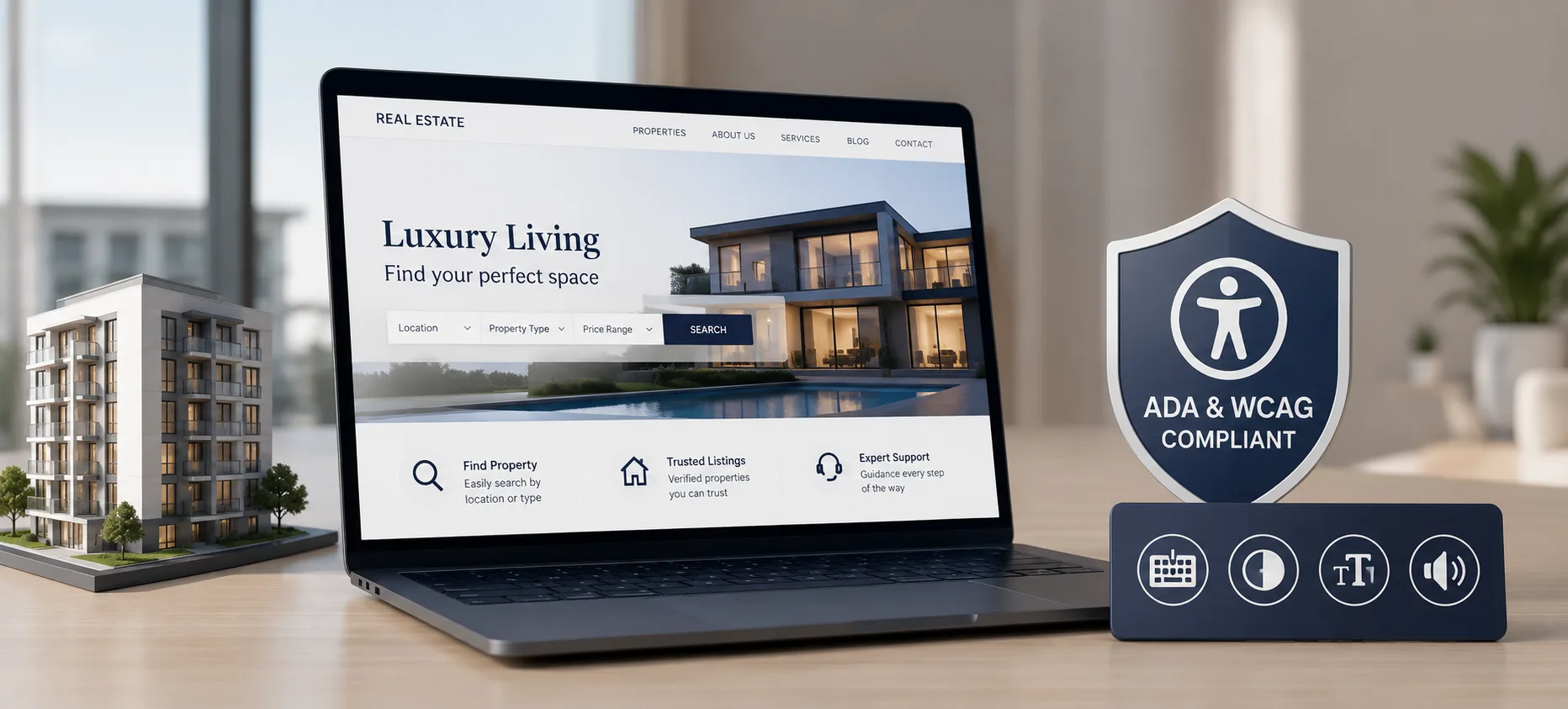 Real Estate
ADA & WCAG Accessibility Compliance for Real Estate Websites: What Operators Must Fix Before They Get Sued
This blog breaks down ADA and WCAG accessibility compliance for real estate websites, focused on what actually creates legal exposure. It explains why WCAG 2.1 Level AA has become the practical legal standard even without a formal Title III regulation for private businesses. It walks through the six accessibility failures responsible for 96% of all detected errors across the web, using real listing-page examples. It also warns against relying on accessibility overlay widgets, citing the FTC's 2025 action against accessiBe over deceptive compliance claims. The piece closes with a step-by-step audit process, an in-house versus compliance-partner comparison, and a 10-question FAQ section.
August 20, 2026
Ready to book a 30-minute strategy call?
We'll map the right digital moves for your real estate business, no pitch deck, no commitment.