
Real Estate & PropTech Blog - AEO, AI, CRM & Growth Frameworks
Long-form pieces on real estate technology, Answer Engine Optimization, brand systems, CRM, and growth marketing - written by the team actually shipping the work for 100+ operators across 14+ countries.

What should a PMS do for small-scale property managers?
The ideal PMS for a small-scale property manager (typically 10 to 500 units) should do ten things well: capture every rent payment automatically, log every maintenance ticket with photo evidence and vendor dispatch, hold every tenant lease and document in one searchable place, generate owner and investor statements in one click, run automated rent reminders and late-fee escalation, screen tenants with credit and eviction history, sync with the operator's accounting stack (QuickBooks, Xero), work on mobile so field checks and unit walks happen on a phone, integrate with a website for listing marketing and online applications, and produce broker-visible dashboards that let the manager see occupancy, delinquency, and cash flow at a glance. AppFolio Property Manager Core, Buildium, DoorLoop, Rentec Direct, and Hemlane are the platforms most adopted at this scale in 2026, at $1.40 to $4 per unit per month. This post covers what the ideal PMS should do, which platforms actually deliver it, and how to pick without overpaying.
August 22, 2026 · 1 min read
Which AI tools work best for real estate developers in 2026?
The best AI tools for real estate developers in 2026 fall into eight categories that map to the developer lifecycle: land sourcing and site selection (Cherre, Reonomy, HouseCanary, LandGate), feasibility and financial modelling (Northspyre, TestFit, custom Excel plus GPT), design and architectural planning (Autodesk Forma, Higharc, Cove.tool, Snaptrude), construction management and progress tracking (Procore AI, Autodesk Construction Cloud, Buildots, Doxel, OpenSpace), pre-launch marketing and renders (Restb.ai, MidJourney, Adobe Firefly), off-plan sales CRM (Salesforce, HubSpot, Follow Up Boss, Rechat), ESG and net-zero analytics (Measurabl, Enertiv, Aquicore), and handover to operations (BIM AI, tenant portal AI). Used well, they cut construction cost 10 to 20 percent, compress design cycles 30 to 50 percent, and lift off-plan sales conversion 20 to 40 percent. Used badly, they burn subscription budget and produce plans that do not build. This post walks through each category, which tools actually work, and how to sequence adoption.
August 22, 2026 · 1 min read
ADA & WCAG Accessibility Compliance for Real Estate Websites: What Operators Must Fix Before They Get Sued
This blog breaks down ADA and WCAG accessibility compliance for real estate websites, focused on what actually creates legal exposure. It explains why WCAG 2.1 Level AA has become the practical legal standard even without a formal Title III regulation for private businesses. It walks through the six accessibility failures responsible for 96% of all detected errors across the web, using real listing-page examples. It also warns against relying on accessibility overlay widgets, citing the FTC's 2025 action against accessiBe over deceptive compliance claims. The piece closes with a step-by-step audit process, an in-house versus compliance-partner comparison, and a 10-question FAQ section.
August 20, 2026 · 1 min read
The Real Estate Email Marketing Playbook: Newsletters, Drip Sequences & Templates for 2026
This blog lays out a full real estate email marketing playbook for 2026, covering newsletters, drip sequences, and reusable templates. It explains why click-through rate now matters more than open rate, especially with Apple's Mail Privacy Protection skewing open data. It breaks down three ready-to-adapt drip sequences for buyers, sellers, and past clients, plus a six-step process for building a newsletter people actually open. It compares DIY email marketing against hiring professional email marketing services, with real cost and speed benchmarks. It closes with the CAN-SPAM and Fair Housing compliance rules every agent needs to follow, common mistakes to avoid, and a 10-question FAQ section.
August 18, 2026 · 1 min read
What are the biggest mistakes agents make implementing AI for lead gen?
The ten biggest mistakes real estate agents make implementing AI for lead generation in 2026 are: buying tools before defining the problem, deploying chatbots with no human handoff, skipping fair-housing review on AI-driven ad targeting and screening, sending paid traffic to social profiles instead of an owned landing page, trusting AI-generated listing copy without human review, optimising for vanity metrics (impressions, followers) instead of pipeline, adopting six tools at once instead of sequencing, letting leads sit unanswered in DMs while the AI stack runs elsewhere, ignoring speed to lead as the primary lever, and never measuring cost per acquired client per tool. Each mistake is preventable, and each costs an agent 20 to 60 percent of the ROI they should be capturing from the AI stack. This post walks through each mistake, what it looks like in practice, and how to avoid it.
August 13, 2026 · 1 min read
AI technology benefits for real estate brokerage
AI technology benefits real estate brokerages in ten specific ways in 2026: faster lead conversion through automated speed-to-lead and qualification, higher agent productivity through content and admin automation, better broker-level reporting and closed-deal attribution, stronger recruiting through visible tech-stack differentiation, lower operational cost through back-office automation, more consistent client experience through templated AI outputs, improved compliance through document-review AI, higher retention of top agents through modern tools, better transaction coordination through AI deadline tracking, and compounding data advantages as the brokerage's own historical data trains better models. Together, these lift closed deals per agent by 20 to 40 percent and cut brokerage operating cost per closed deal by 15 to 30 percent on disciplined deployments. Bad deployments produce subscription sprawl, fair-housing risk, and adoption failure. This post walks through each benefit, what it looks like in practice, and how to sequence adoption.
August 13, 2026 · 1 min read
How to calculate real estate portfolio-level IRR
Portfolio-level IRR (Internal Rate of Return) is the discount rate that sets the net present value of a real estate portfolio's projected cash flows to zero, measured across all assets combined rather than asset by asset. To calculate it, aggregate every cash flow the portfolio produces (equity contributions, operating income, capex, refinancings, and disposition proceeds) into a single monthly or quarterly time series, then solve for the discount rate that makes those cash flows sum to zero. The Excel formula is =IRR(range) for annual periods or =XIRR(range, dates) for irregular periods. Levered IRR uses cash flows after debt service; unlevered IRR uses cash flows before debt. Gross IRR is before fund fees and promote; net IRR is what LPs actually receive. Institutional real estate funds in 2026 typically target 12 to 18 percent net IRR on value-add strategies and 6 to 9 percent on core.
August 13, 2026 · 1 min read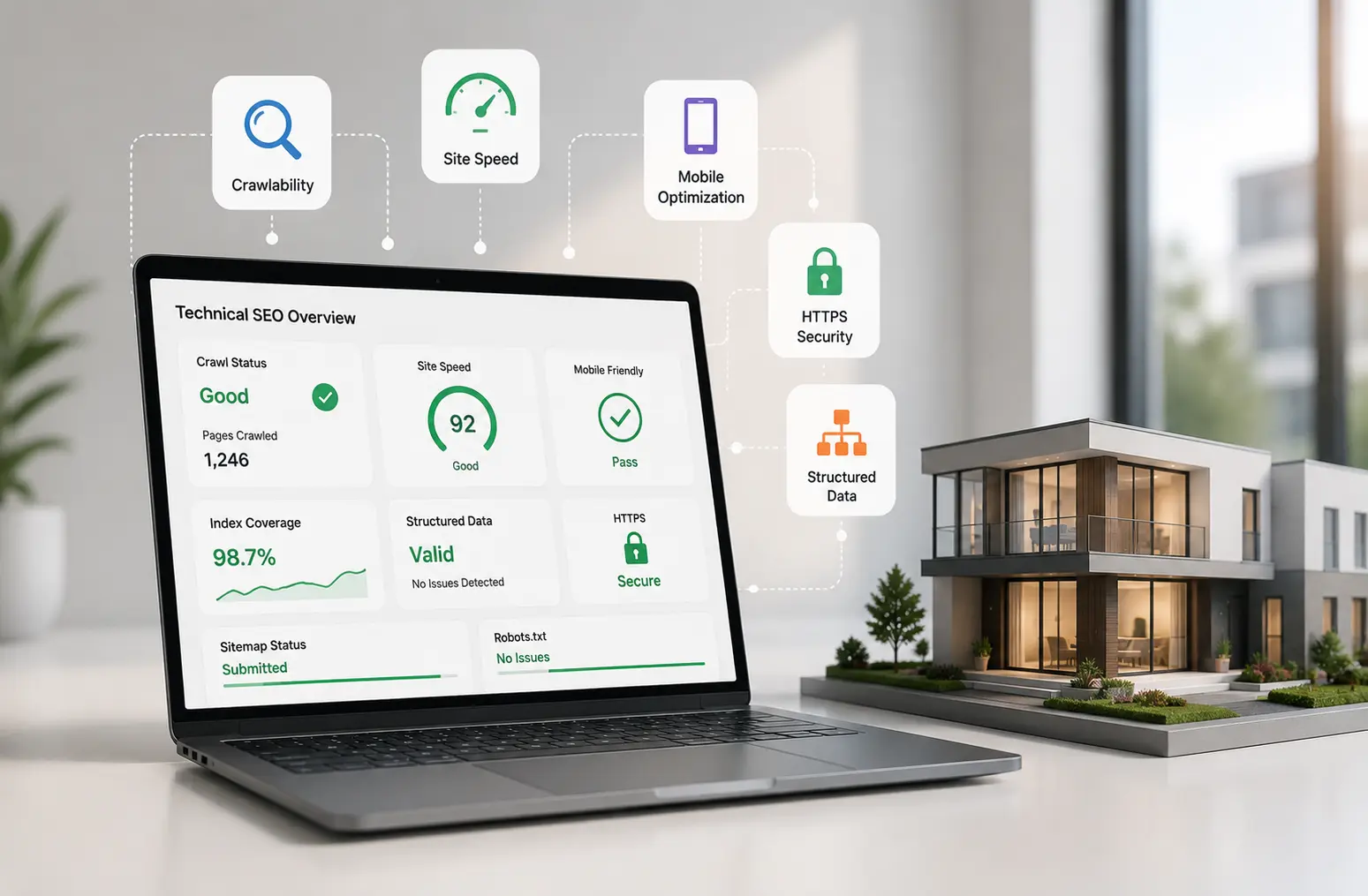
Technical SEO for Real Estate Websites: Core Web Vitals, Schema Markup and Structured Data
This blog breaks down technical SEO for real estate websites, covering the code, speed, and structure that decide whether Google and AI engines can actually crawl and trust a site. It explains Core Web Vitals in plain terms, including why INP replaced FID and what LCP and CLS mean for slow, jumpy listing pages. It walks through the schema markup and structured data types real estate sites need most, like RealEstateListing, LocalBusiness, and FAQ schema. It also gives a practical, step-by-step audit process built specifically for MLS and IDX-fed sites carrying thousands of listings. The piece closes with a clear comparison of DIY versus agency fixes, common technical mistakes to avoid, and a 10-question FAQ section for fast answers.
August 12, 2026 · 1 min read
AI in real estate asset management: tools that work and ones to skip
AI in real estate asset management works when it targets specific workflows with structured data, clear ROI, and low regulatory exposure. The tools that produce measurable returns in 2026 are portfolio-level AVMs (Cherre, HouseCanary, CoreLogic), data unification platforms (Cherre, VTS, Yardi Elevate), predictive maintenance (Enertiv, Aquicore, Measurabl), ESG analytics (Measurabl, Aquicore, WegoWise), deal sourcing and screening (Reonomy, CompStak), lease abstraction (Kira, Leverton), and demand forecasting inside CRE data platforms. The tools to skip in 2026 are consumer-grade AI for LP reports without human review, standalone AI pricing without CRM and PMS integration, AI-driven tenant screening without disparate-impact audit, and "AI-powered" wrappers that turn out to be rules-based scripts with marketing spin. This post walks through what works, what to skip, and how to sequence AI adoption at institutional scale.
August 11, 2026 · 1 min read