

Mayank Pokharna
COO, Noseberry Digitals & Industry Expert
ADA & WCAG Accessibility Compliance for Real Estate Websites: What Operators Must Fix Before They Get Sued
Published August 20, 2026|12 min read
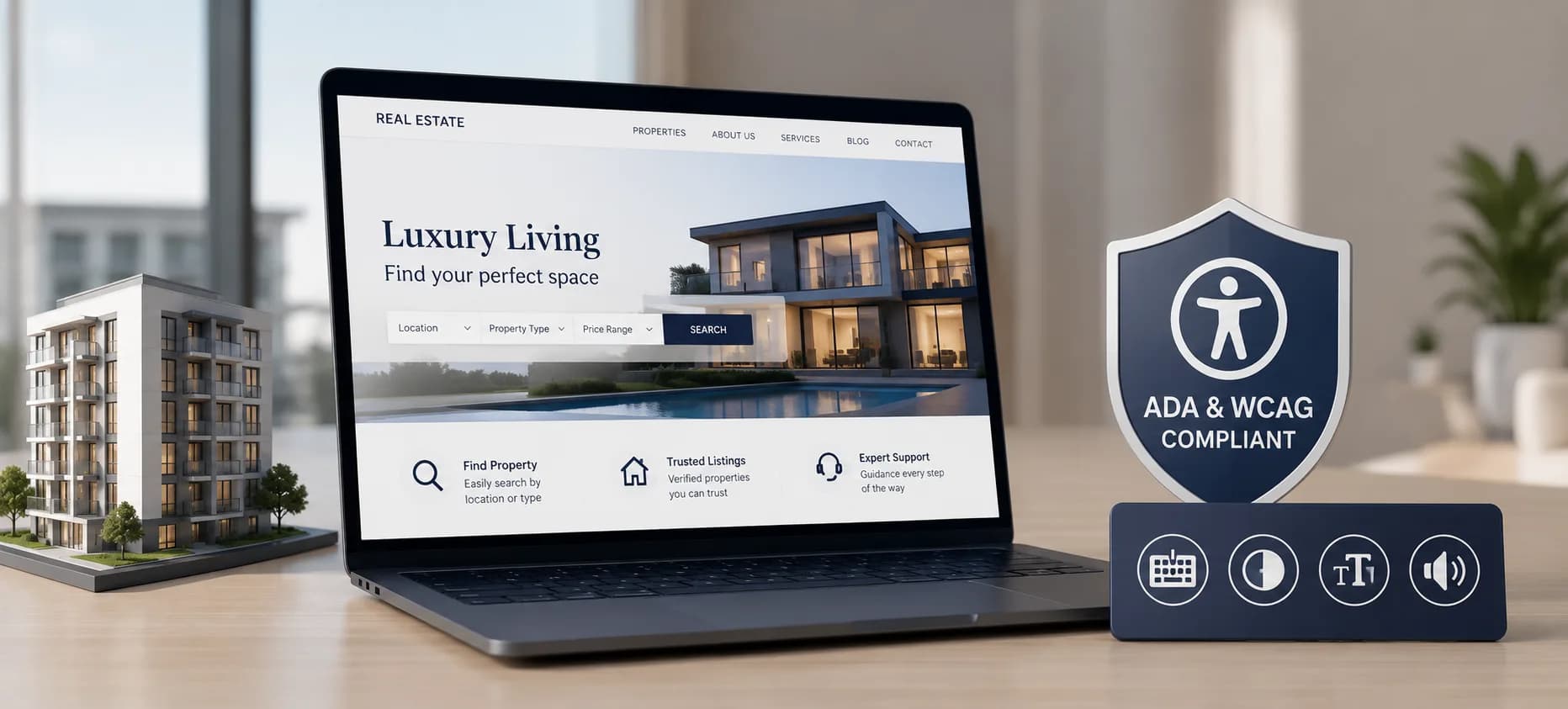
This blog breaks down ADA and WCAG accessibility compliance for real estate websites, focused on what actually creates legal exposure. It explains why WCAG 2.1 Level AA has become the practical legal standard even without a formal Title III regulation for private businesses. It walks through the six accessibility failures responsible for 96% of all detected errors across the web, using real listing-page examples. It also warns against relying on accessibility overlay widgets, citing the FTC's 2025 action against accessiBe over deceptive compliance claims. The piece closes with a step-by-step audit process, an in-house versus compliance-partner comparison, and a 10-question FAQ section.
Here's the short answer. ADA & WCAG accessibility compliance for real estate websites means meeting the Web Content Accessibility Guidelines. The current version is WCAG 2.1 Level AA, and it exists so people with disabilities can actually use your site. Courts treat that standard as the practical benchmark for ADA lawsuits. There's no single federal regulation spelling it out for private businesses yet, but skip it and you're not just excluding buyers. You're sitting on real legal exposure.
That exposure is bigger than most operators realize, and it's growing again after a few flat years. I've audited real estate and proptech sites for years. The same five or six issues show up almost every time: low contrast text, missing photo alt text, and form fields with no labels. One brokerage client had over 40 IDX search fields with zero labels, invisible to anyone using a screen reader. We fixed the labels in a week. That fix cost far less than a single lawsuit settlement would have. This guide isn't legal advice, so talk to an attorney about your specific situation. It will still show you exactly what to fix first and why real estate sites get targeted so often.
What Is ADA & WCAG Accessibility Compliance for Real Estate Websites?
ADA & WCAG accessibility compliance for real estate websites means a site meets the Web Content Accessibility Guidelines. That's what lets people using screen readers, keyboard navigation, or other assistive technology browse listings and complete forms without barriers. The ADA is the law. WCAG is the technical standard courts and regulators point to when deciding whether a site meets it.
The ADA itself never mentions websites, since it was written in 1990, well before the modern web existed. Courts have filled that gap. They treat a real estate site as a "place of public accommodation" under Title III, the same category as a physical office. WCAG 2.1 Level AA has become the de facto yardstick in settlements and consent decrees, even without a formal Title III regulation. Here's an important nuance: there's no fixed federal deadline for private real estate sites the way there is for government ones. The legal risk is just as real either way.
Can a Real Estate Website Actually Get Sued Over Accessibility?
Yes, and it happens often. Federal courts saw 8,667 ADA Title III lawsuits filed or removed in 2025, according to Seyfarth Shaw's ADA Title III tracker. That's roughly three times the filing volume from 2013. Website accessibility remains one of the most common triggers.
Real estate sits squarely in the target zone. Public-facing listing pages, photo galleries, and search forms are exactly the kind of content plaintiffs' firms look for. Over 61 million U.S. adults, about one in four, report living with a disability, according to CDC data from 2022. That's a large potential plaintiff pool and a large group of buyers a broken site is quietly turning away.
Which States File the Most Accessibility Lawsuits
California led with 3,252 federal filings in 2025. Florida followed at 1,823, and New York came in at 1,471. New York's federal courts have tightened standing requirements recently. That pushed some plaintiffs toward state courts instead. If your brokerage operates in any of these states, accessibility should sit near the top of your risk list.
The Six Accessibility Failures Behind Most Website Lawsuits
Six issue types account for 96% of all detected accessibility errors across the web, according to the WebAIM Million report, which scans the top one million homepages every year. Fixing just these six closes most of the gap between a risky site and a genuinely usable one.
Low contrast text, found on 83.9% of pages, often on price badges or light gray call-to-action buttons.
Missing alt text for images, found on 53.1% of pages, a chronic problem for listing photos and hero banners.
Missing form input labels, found on 51% of pages, common in IDX search widgets with unlabeled dropdowns.
Empty links, found on 46.3% of pages, often icon-only social links with no accessible name.
Empty buttons, found on 30.6% of pages, frequently map controls or filter toggles.
Missing document language tags, found on 13.5% of pages, a one-line HTML fix most sites never make.
This year's report found 95.9% of home pages had at least one detectable failure, up from 94.8% the year before. Average errors per page rose to 56.1. Accessibility on the web is getting worse, not better. That makes fixing these six issues even more urgent for a real estate brand.
Why Real Estate Websites Face Unique Accessibility Challenges
Real estate sites carry accessibility baggage most other industries don't. Heavy reliance on third-party IDX feeds, embedded maps, and virtual tours is the reason. A lot of the code on your site isn't even yours to fix directly. That's especially true for real estate marketplaces and portals running thousands of listings from multiple feeds at once.
IDX and MLS Widgets Nobody Fully Controls
IDX search widgets are usually licensed from an MLS vendor and dropped into a site as an embed. Those widgets frequently fail basic accessibility checks. The brokerage using them often has no way to edit the underlying code. Working with a partner who understands both real estate software integrations and accessibility standards matters more here than in almost any other industry.
Photo Galleries, Virtual Tours, and Interactive Maps
Listing photo carousels, 3D virtual tours, and interactive neighborhood maps are core to how real estate sells homes. All three are also notoriously hard to make accessible. Photo galleries need real alt text on every image, not a filename. Virtual tours need a text-based alternative or transcript. Maps need keyboard-operable controls, not just mouse-driven pins.
Do Accessibility Overlay Widgets Actually Fix Compliance?
No, not reliably. Overlay widgets bolt a script onto your existing site and claim to fix accessibility automatically. They don't touch the underlying code causing most WCAG failures. Courts and regulators have increasingly treated them as a red flag rather than a defense.
The FTC ordered accessiBe to pay $1 million in refunds in 2025. The company had made deceptive claims that its widget could make any site ADA and WCAG compliant, without evidence to back that up. Businesses using overlay-only fixes have continued to face lawsuits at high rates. Plaintiffs' testing tools simply catch the same underlying code problems the overlay never addressed. A real fix touches your actual HTML, contrast ratios, and form markup. A widget layered on top rarely does.
How Do You Audit a Real Estate Website for ADA & WCAG Compliance?
A real audit for ADA & WCAG accessibility compliance for real estate websites starts with an automated scan, then moves to manual verification. Automated tools only catch a portion of real WCAG issues. Real accessibility work always needs a human pass, especially for anything involving images, video, or interactive widgets.
Run an automated scan first. Free tools flag obvious issues like missing alt text and contrast failures within minutes.
Test keyboard navigation manually. Tab through your entire site without a mouse, including IDX search forms and map filters.
Check every image for real alt text. Listing photos need a description, not a blank tag or the filename.
Review all form fields for labels. Every search filter and contact form input needs a label a screen reader can announce.
Test with an actual screen reader. Automated tools miss context problems that only show up when you listen to the page.
Document every fix as you make it. A written remediation record helps if a demand letter ever arrives.
Free and Paid Tools to Run a First Accessibility Scan
Free browser extensions like WAVE and axe DevTools catch a meaningful share of issues in minutes, and cost nothing to try today. Paid platforms add ongoing monitoring and legal documentation. That matters once your site is complex enough to need continuous checks. Our technical SEO and accessibility audits cover both automated scanning and manual review for real estate clients.
In-House Fixes vs. Hiring an Accessibility Compliance Partner
Fix accessibility in-house if your developer already understands WCAG and your site is relatively simple. Hire a compliance partner once you're running MLS feeds or custom IDX integrations. The same goes for a multi-market portal with thousands of listing pages.
Approach | Typical Cost | Speed | Best For |
In-house developer fixes | Existing salary, plus training time | Slow without WCAG expertise | Small sites with a technically strong dev team |
Accessibility compliance partner | $2,000 to $15,000+ depending on site size | Faster, structured remediation plan | Brokerages, portals, and proptech platforms at scale |
Overlay widget only | $30 to $500 a month | Fast to install, weak on real fixes | Not recommended as a standalone solution |
Noseberry Digitals works directly with real estate and proptech operators on exactly this kind of remediation. The team pairs website development with the technical fixes that actually hold up if a site gets tested. Our case studies show what that process looks like across different platform sizes. Noseberry Digitals treats ADA & WCAG accessibility compliance as part of a real estate site's core technical health, not a separate afterthought project.
Conclusion
ADA & WCAG accessibility compliance for real estate websites isn't optional anymore. Treating it as a checkbox item is how operators end up in court. Here's the one sentence to remember: fix the six failure types behind most lawsuits first, skip the overlay shortcut, and get real code-level remediation done. Do that before a demand letter forces the issue instead of after.
Start this week. Run a free scan with WAVE or axe DevTools on your homepage and your top listing page. Tab through your IDX search form without touching your mouse. Check whether your last ten listing photos have real alt text or none at all. If the scope looks bigger than an afternoon fix, Noseberry Digitals can walk through a full remediation plan built for real estate and proptech platforms specifically.
Whatever you fix first, don't wait for a complaint to force your hand. The operators who treat accessibility as ongoing maintenance, not a one-time scramble, come out ahead. They're the ones who won't be reading a demand letter next quarter.
- ADA & WCAG accessibility compliance means meeting WCAG 2.1 AA, the practical legal standard courts use.
- 8,667 ADA Title III lawsuits were filed in federal courts in 2025, three times the 2013 volume.
- Six issue types cause 96% of all detected web accessibility errors, per the WebAIM Million report.
- Low contrast text and missing alt text are the two most common failures, found on over half of homepages.
- IDX and MLS widgets are a unique accessibility risk since brokerages often can't edit that code directly.
- Accessibility overlay widgets don't fix underlying code and have drawn FTC action for deceptive claims.
- A real compliance partner engagement typically costs $2,000 to $15,000 or more.
- The 2024 DOJ rule requiring WCAG 2.1 AA applies to government sites, not private real estate businesses.
- Courts still apply WCAG 2.1 AA informally in Title III lawsuits against private companies.
- This content is informational only; consult an attorney about specific compliance obligations.
Why trust Noseberry
Our content is written by practicing real-estate and PropTech professionals, fact-checked by a dedicated editorial team, and reviewed against the latest industry data before publication.
- 10+ years of industry expertise
- All facts independently verified
- No sponsored rankings in guides
- Updated when the industry changes
Have any questions?
What is ADA & WCAG accessibility compliance for a real estate website?
ADA & WCAG accessibility compliance means a real estate website meets the Web Content Accessibility Guidelines. The current version is 2.1 at Level AA. That's the point where people using assistive technology can use the site fully. The ADA is the underlying law, and WCAG is the technical standard courts reference. Meeting it reduces legal risk and expands who can actually use your site.
Can my real estate website get sued for not being ADA compliant?
Yes. Federal courts saw 8,667 ADA Title III lawsuits in 2025, and website accessibility remains a common trigger among them. Real estate sites are frequent targets because of heavy image use, IDX search forms, and public-facing listing content. This is informational, not legal advice, so consult an attorney about your specific exposure.
What WCAG level should a real estate website meet?
Most courts and settlement agreements treat WCAG 2.1 Level AA as the practical standard for real estate websites. WCAG 2.2 has since added further success criteria and represents current best practice. There is no single formal Title III regulation yet. WCAG 2.1 AA is still the benchmark plaintiffs and regulators consistently reference.
Do accessibility overlay widgets provide ADA & WCAG accessibility compliance?
No, not reliably. Overlay widgets add a script on top of a site but don't fix the underlying code causing most WCAG failures. The FTC ordered accessiBe to pay $1 million in refunds in 2025 over deceptive compliance claims about its widget. Real remediation touches your actual HTML, contrast, and form markup.
What are the most common accessibility problems on real estate websites?
The most common issues are low contrast text, missing alt text on listing photos, and unlabeled form fields in IDX search widgets. Empty links, empty buttons, and missing document language tags round out the list. Together, these six account for 96% of all detected accessibility errors across the web. Fixing them closes most of the gap.
Why is my real estate website failing accessibility scans?
Third-party IDX and MLS widgets are a frequent cause, since brokerages often can't edit that embedded code directly. Photo galleries without real alt text and unlabeled search forms are the next most common culprits. Run a free scan with WAVE or axe DevTools to see exactly which issues your site has right now.
Should I hire an accessibility compliance partner or fix issues in-house?
Fix issues in-house if your developer already understands WCAG and your site is relatively simple. Hire a compliance partner once you're managing MLS feeds, custom IDX integrations, or a large multi-market portal. Many operators use a hybrid: an outside audit followed by internal implementation of the fixes.
How much does ADA & WCAG accessibility compliance cost for a real estate website?
A full compliance partner engagement typically runs $2,000 to $15,000 or more. The exact price depends on site size and how many custom widgets need fixing. Overlay-only tools cost far less, often $30 to $500 a month. They don't address the underlying code issues that actually create legal risk. Budget for real remediation, not just a script install.
Does the 2024 DOJ web accessibility rule apply to real estate businesses?
No. The DOJ's 2024 rule under Title II requires WCAG 2.1 AA for state and local government websites specifically. Deadlines fall in April 2026 and April 2027, depending on entity size. Private real estate businesses fall under Title III instead, which has no equivalent formal deadline yet. Courts still apply WCAG 2.1 AA as the practical standard in Title III litigation.
How do I start fixing accessibility issues on my real estate website?
Start with a free automated scan using a tool like WAVE, then manually test keyboard navigation and screen reader compatibility. Check every listing photo for real alt text and every form field for a proper label. Document each fix as you go, since a written remediation record can matter if a demand letter arrives later.
Related insights
 Real Estate
What should a PMS do for small-scale property managers?
The ideal PMS for a small-scale property manager (typically 10 to 500 units) should do ten things well: capture every rent payment automatically, log every maintenance ticket with photo evidence and vendor dispatch, hold every tenant lease and document in one searchable place, generate owner and investor statements in one click, run automated rent reminders and late-fee escalation, screen tenants with credit and eviction history, sync with the operator's accounting stack (QuickBooks, Xero), work on mobile so field checks and unit walks happen on a phone, integrate with a website for listing marketing and online applications, and produce broker-visible dashboards that let the manager see occupancy, delinquency, and cash flow at a glance. AppFolio Property Manager Core, Buildium, DoorLoop, Rentec Direct, and Hemlane are the platforms most adopted at this scale in 2026, at $1.40 to $4 per unit per month. This post covers what the ideal PMS should do, which platforms actually deliver it, and how to pick without overpaying.
August 22, 2026 Real Estate
Which AI tools work best for real estate developers in 2026?
The best AI tools for real estate developers in 2026 fall into eight categories that map to the developer lifecycle: land sourcing and site selection (Cherre, Reonomy, HouseCanary, LandGate), feasibility and financial modelling (Northspyre, TestFit, custom Excel plus GPT), design and architectural planning (Autodesk Forma, Higharc, Cove.tool, Snaptrude), construction management and progress tracking (Procore AI, Autodesk Construction Cloud, Buildots, Doxel, OpenSpace), pre-launch marketing and renders (Restb.ai, MidJourney, Adobe Firefly), off-plan sales CRM (Salesforce, HubSpot, Follow Up Boss, Rechat), ESG and net-zero analytics (Measurabl, Enertiv, Aquicore), and handover to operations (BIM AI, tenant portal AI). Used well, they cut construction cost 10 to 20 percent, compress design cycles 30 to 50 percent, and lift off-plan sales conversion 20 to 40 percent. Used badly, they burn subscription budget and produce plans that do not build. This post walks through each category, which tools actually work, and how to sequence adoption.
August 22, 2026 Real Estate
The Real Estate Email Marketing Playbook: Newsletters, Drip Sequences & Templates for 2026
This blog lays out a full real estate email marketing playbook for 2026, covering newsletters, drip sequences, and reusable templates. It explains why click-through rate now matters more than open rate, especially with Apple's Mail Privacy Protection skewing open data. It breaks down three ready-to-adapt drip sequences for buyers, sellers, and past clients, plus a six-step process for building a newsletter people actually open. It compares DIY email marketing against hiring professional email marketing services, with real cost and speed benchmarks. It closes with the CAN-SPAM and Fair Housing compliance rules every agent needs to follow, common mistakes to avoid, and a 10-question FAQ section.
August 18, 2026
Ready to book a 30-minute strategy call?
We'll map the right digital moves for your real estate business, no pitch deck, no commitment.