

Mayank Pokharna
COO, Noseberry Digitals & Industry Expert
Real Estate Landing Page Optimization: The Conversion Rate Playbook for 2026
Published July 28, 2026|13 min read
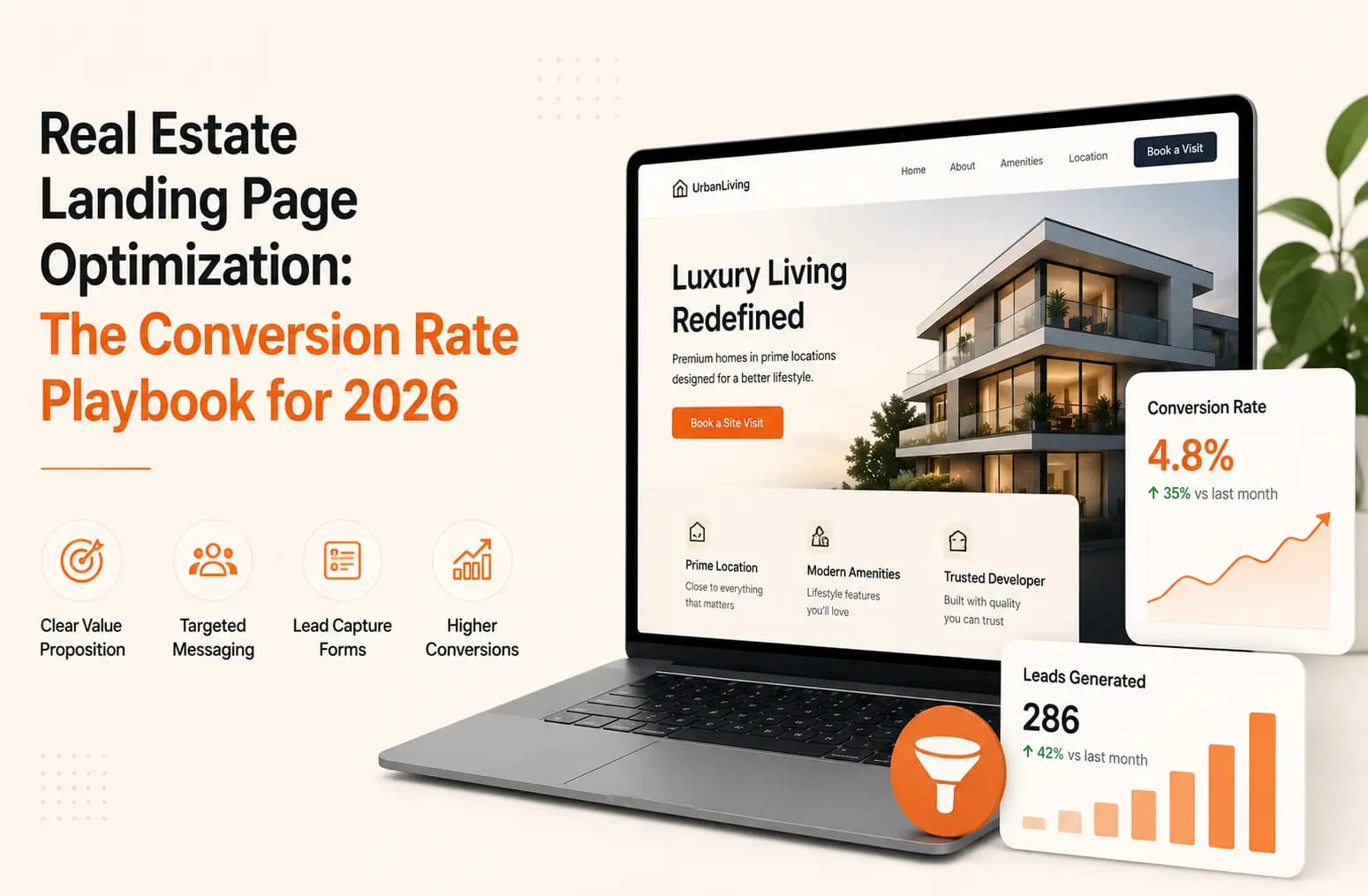
Most real estate landing pages convert at 2.7% while the top 25% convert at 11.45% or higher, and the gap has nothing to do with budget or design talent. This playbook breaks down exactly how to close that gap in 2026 through the nine structural elements every high-converting property landing page shares, a 15-point CRO audit you can run today, and a traffic source-specific optimization strategy that treats Google Search visitors, Meta cold audiences, and email traffic as the completely different conversion challenges they are. You'll also get the post-click architecture blueprint that connects your landing page to your CRM, automated response, and lead scoring system so conversions become pipeline, not just form fills sitting in a spreadsheet. Every section is built around measurable outcomes with specific benchmarks you can test against. If you're spending money driving traffic to a landing page that isn't hitting 5% or above, this is the playbook that fixes it.
Real estate landing page conversion rate optimization is the practice of systematically improving every element of a dedicated property page so more visitors take the one action you want, whether that's submitting an inquiry form, booking a site visit, or downloading a project brochure. The median real estate landing page converts at just 2.7%, according to Unbounce's 2026 Conversion Benchmark Report. But the top 25% of pages convert at 11.45% or higher. That gap is not budget. It's not design talent. It's architecture, intent matching, and post-click systems.
Most property businesses approach landing pages the wrong way. They treat them like miniature websites: navigation menus, multiple CTAs, links to social profiles, a footer full of options. Every additional link is a leak. Every unnecessary choice reduces conversion. A landing page has one job. One action. One visitor type. One offer. When that focus is maintained from ad click to form submission, conversion rates climb fast.
In my decade working with property operators across 14+ countries at Noseberry Digitals, the single most consistent finding from hundreds of landing page audits is this: the page is rarely the only problem. The form submits but the CRM doesn't catch it. The page loads in 6 seconds on mobile. The headline doesn't match the ad that sent the visitor. Fixing the page without fixing the system around it produces half the results. This playbook covers both.
What Is Real Estate Landing Page Conversion Rate Optimization and Why Does It Matter?
Real estate landing page conversion rate optimization (CRO) is the structured process of testing, measuring, and improving a landing page so a higher percentage of visitors complete the intended action, because in a market where paid traffic costs $5-$50 per click, even a 2% lift in conversion rate can reduce your cost per lead by 30-50%.
The math makes this concrete. If you're spending $3,000 per month on paid ads and your landing page converts at 3%, you're generating approximately 60 leads per month (assuming 2,000 clicks at $1.50 average CPC, which is optimistic for most competitive property markets). Lift that conversion rate to 8% and you generate 160 leads from the same spend. Same budget. Same traffic. 2.6 times more leads.
That multiplier compounds further down the funnel. More leads mean more qualified prospects for your agents to call. More calls mean more site visits. More site visits mean more closed deals. A landing page is not a cost center. It's the conversion point that determines the ROI of every marketing channel feeding it.
The industry benchmarks clarify the opportunity. <cite index="26-1">The average conversion rate for real estate landing pages is 7.4%, while the median is 2.6%.</cite> <cite index="33-1">The top 25% of pages convert at 11.45% or higher, and a few well-built agent pages have hit 34% on Facebook traffic.</cite> Most property businesses sitting at 1-3% aren't there because their market is harder. They're there because their pages haven't been built or tested with conversion as the primary objective.
What Is the Difference Between a Real Estate Landing Page and a Website?
A real estate landing page is a single, focused web page built for one specific traffic source, one audience segment, and one conversion action, because that focus removes the distraction and optionality that causes visitors to bounce from general website pages without converting.
Your website tells the full story of your business. It has a homepage, an about page, listings, blog content, contact details, and navigation. That's appropriate for organic visitors who are exploring and researching. It's completely wrong for paid traffic.
When a buyer clicks your Google ad for "2BHK apartments in [Neighborhood]" and lands on your website homepage, three things happen simultaneously. They see navigation menus that distract. They see content irrelevant to their specific search. And the page load time is almost certainly higher than a dedicated landing page because of all the extra assets the homepage carries. The result: they bounce. You paid for that click.
<cite index="33-1">Removing site navigation from a landing page can lift conversions by up to 100% because focus beats choice. Your website tells your story; your landing page closes the visitor.</cite>
A real estate landing page, built correctly, contains exactly one thing: a compelling reason to take one action, presented to one specific audience. No navigation. No footer links. No social media buttons that pull visitors off the page. Just the offer, the evidence, and the form.
What Are the Real Estate Landing Page Conversion Rate Benchmarks for 2026?
Before optimizing, you need to know what you're optimizing toward. Conversion rate benchmarks vary significantly by traffic source, offer type, and market, and comparing your page to the wrong benchmark is a mistake that leads to either false satisfaction or unnecessary panic.
Here's the 2026 breakdown by traffic source:
Traffic Source | Realistic Baseline | Optimized Page Target |
Google Search (high intent) | 4-6% | 8-15% |
Google Display / Retargeting | 1-3% | 4-8% |
Meta Ads (Facebook/Instagram) | 1-3% | 5-10% |
Click-to-WhatsApp Ads | 15-25% (conversation start) | 30-45% (conversation start) |
Organic SEO traffic | 1-2% | 3-6% |
Email campaign traffic | 3-6% | 8-15% |
Direct/referral traffic | 2-4% | 5-10% |
<cite index="34-1">For high-intent Google Search traffic with a strong dedicated page, 8 to 15 percent is a healthy range. Cold Meta or YouTube traffic converts lower because the visitor is earlier in the journey, so judge each page against the intent of its traffic rather than a single universal number.</cite>
The most common benchmarking mistake is comparing paid social traffic to Google Search benchmarks. A Meta ad converts colder audiences who weren't actively searching. A 5% conversion rate on Meta traffic is genuinely excellent. A 5% rate on high-intent Google Search traffic means your page has significant room to improve.
Know your traffic source. Set the right benchmark. Then optimize against it.
The 9 Elements of a High-Converting Real Estate Landing Page
Every high-converting real estate landing page is built from the same nine structural components. Change one without fixing the others and you often see no measurable lift. Nail all nine together and conversion rates move fast.
Element 1: Message Match Between Ad and Page
<cite index="33-1">Never send paid traffic to your homepage. Send paid traffic from Facebook, Google, or Instagram ads to a dedicated landing page that matches the ad's message exactly: same headline, same offer, same audience. This is called message match, and it is one of the highest-leverage conversion optimizations available. Generic homepages convert paid traffic at 1-2%; matched landing pages routinely hit 8-15%.</cite>
Message match means that if your ad headline says "2BHK Apartments in Business Bay, Starting AED 1.2M," your landing page H1 should say something within 5 words of that. Not a generic "Discover Premium Apartments in Dubai." The visitor's brain does a split-second check when a page loads: "Is this what I clicked for?" If the answer is uncertain, they're gone in under 3 seconds.
Element 2: A Single, Unmissable Headline
Your headline is doing more work than any other element on the page. It needs to communicate: who this page is for, what they get, and why they should care, in under 10 words. The best real estate landing page headlines are specific and outcome-focused, not clever or brand-focused.
Weak headline: "Welcome to Prestige Residences" Strong headline: "3BHK Sea-View Apartments in Palm Jumeirah. Ready to Move In."
Specificity does the work. "Sea-view" is not decoration. It's the qualifier that tells the right buyer they're in the right place and tells the wrong buyer they don't need to read further. That pre-qualification inside the headline improves not just conversion rate but lead quality.
Element 3: Visual Proof That Earns Trust Instantly
Property buyers are making decisions worth hundreds of thousands of pounds, dirhams, or rupees. They do not take visual evidence lightly. Your hero image or video is the emotional hook that bridges the gap between a click and a form submission.
High-performing real estate landing pages use actual photography of the property, not stock imagery or renders unless the project is off-plan and photorealistic renders are the only option. For off-plan developments, a short 30-60 second video walkthrough in the hero section consistently outperforms static images, with some operators seeing 20-40% higher form submission rates on video-first pages versus image-first pages.
Drone footage adds spatial context that ground photography can't provide. A buyer who can see the property's relationship to the beach, the metro station, or the city skyline from an aerial shot makes a faster decision than one working only from interior shots.
Element 4: A Short, Friction-Free Lead Form
Form length is one of the most tested elements in real estate landing page optimization, and the data is consistent: fewer fields convert more visitors. The question is always how few is too few for your sales process.
For a standard property inquiry form, three to four fields is the sweet spot: name, phone number, email, and one qualifying question (budget range or preferred unit type using a dropdown). Every additional field reduces conversion rate. An eight-field form asking for address, employment status, and financing pre-approval status will generate fewer but more pre-qualified leads. A three-field form generates more volume. Choose based on your funnel stage and what your agents need to start a productive conversation.
Place the form above the fold on desktop so it's visible without scrolling. On mobile, the form should be accessible with a single tap from anywhere on the page through a sticky CTA button.
Element 5: Social Proof That Converts Skeptics
Real estate transactions involve significant financial risk for the buyer. Social proof reduces perceived risk and accelerates the decision to fill out a form. Effective social proof on a real estate landing page takes four forms:
Client testimonials with a name, photo, and transaction type: "Sold my 3BHK in Marina in 18 days, 8% above asking price." Not generic "Great service!" quotes.
Transaction volume or track record: "126 properties sold in 2025. Average time on market: 23 days."
Press mentions or certifications: Third-party validation signals credibility without you having to claim it yourself.
Review platform ratings: A Google 4.8/5 badge or Trustpilot score sits on the page as a continuous trust signal.
Position social proof immediately below the headline or alongside the form, not buried at the bottom of the page. Trust signals need to be visible at the moment a visitor is deciding whether to submit their details.
Element 6: One Clear, Specific Call-to-Action
Your CTA button text is a micro-commitment. "Submit" asks for nothing and promises nothing. "Get Pricing and Floor Plans" tells the visitor exactly what they receive in exchange for their contact details.
Specific CTA text outperforms generic text consistently. In split tests across real estate landing pages, CTAs that name the specific deliverable ("Send Me the Brochure," "Book a Private Viewing," "Get the Investor Pack") outperform generic CTAs ("Submit," "Contact Us," "Learn More") by 15-40% in most documented tests.
Make the button large, high-contrast, and visually distinct from everything else on the page. The visitor's eye should move naturally from headline to form to button without confusion.
Element 7: Mobile-First Design and Speed
<cite index="27-1">A poor user experience, such as confusing navigation, slow load times, or cluttered layouts, can further decrease conversion rates by frustrating or confusing visitors.</cite> In real estate, where mobile devices drive over 60% of property search traffic globally, this is not a secondary consideration. It's the primary one.
A landing page that loads in 5 seconds on mobile loses approximately 90% of its visitors before they see the headline, according to Google's 2025 mobile speed research. Every second of additional load time costs you conversion rate points. Core Web Vitals compliance (LCP under 2.5 seconds, FID under 100ms, CLS under 0.1) is the technical baseline for any landing page competing in 2026.
Mobile-first design means the form, the CTA button, and the hero image are all optimized for a phone screen first, then adapted upward to desktop. Not the other way around.
Element 8: Urgency and Scarcity Signals
Real estate has genuine scarcity. Units sell out. Prices change. Launch pricing ends. These aren't manufactured pressure tactics. They're real conditions that buyers need to know about to make informed decisions.
"Only 4 units remaining at launch pricing" is not manipulative if it's true. It's useful information that helps a motivated buyer act now rather than deferring a decision until the unit they wanted is gone. Countdown timers for genuine offer deadlines, inventory indicators for limited unit configurations, and launch-phase pricing windows all increase urgency legitimately when the underlying conditions are real.
Don't fabricate scarcity. Buyers who feel manipulated do not become clients. But don't hide genuine scarcity either. If your project is 80% sold, say so. A buyer who knows inventory is limited acts faster than one who assumes infinite availability.
Element 9: Instant Post-Submission Experience
What happens after a visitor submits your form determines whether they become a lead or a statistic. The post-submission experience is the most neglected element in real estate landing page optimization.
The minimum acceptable post-submission experience in 2026: an immediate thank-you message or redirect page that confirms receipt, sets an expectation for when and how someone will contact them, and delivers the promised asset (brochure, pricing sheet, floor plan) immediately. An instant automated WhatsApp or SMS message in the next 60 seconds, referenced in the thank-you message, turns the post-submission experience into the first step of a relationship.
The post-submission step connects your landing page to your real estate CRM. If the form submission doesn't create a CRM lead record automatically, your optimization work produces leads that fall into a gap between your page and your pipeline. That gap is where most property businesses lose the leads they paid to generate.
How Does A/B Testing Work for Real Estate Landing Pages?
A/B testing for real estate landing page optimization is the practice of showing two versions of a page to split traffic simultaneously, measuring which version produces more conversions, and implementing the winner, because without testing, you're making optimization decisions based on opinion rather than evidence.
Run A/B tests in this order of impact:
Headline test first. Your headline has more impact on conversion rate than any other single element. Test a specific outcome-focused headline against a more brand-forward version. Run for at least 200 conversions per variant before declaring a winner.
CTA button text second. "Get the Floor Plan" vs. "Book a Viewing" vs. "See Pricing" can produce meaningfully different results depending on where your buyer is in the decision process. Test one change at a time.
Form length third. Three-field form versus five-field form. The shorter form will almost always produce more submissions. The question is whether those additional leads convert at a high enough rate downstream to justify the volume gain.
Hero image or video. Static hero image versus short video walkthrough. For off-plan developments specifically, this test frequently shows significant lifts for video variants.
Social proof placement. Testimonials above the fold alongside the form versus below the fold as supporting evidence. Test both positions.
The most important A/B testing rule for real estate: run tests one element at a time. Changing the headline, hero image, and form simultaneously makes it impossible to know which change drove the result. Single-variable testing produces actionable learning. Multi-variable changes produce noise.
For teams running paid campaigns alongside landing page tests, our post on real estate ad creative and landing pages covers how to align your ad creative tests with your landing page tests so both improve together as a system.
The Real Estate Landing Page CRO Audit: A 15-Point Checklist
Run this audit on every landing page before spending a single pound, dirham, or rupee driving paid traffic to it. Each item is a conversion leak when missing.
Message and clarity:
Does the headline match the ad that sent this traffic exactly?
Is it clear within 3 seconds who this page is for and what they receive?
Is there exactly one CTA on the page (no competing actions)?
Is all navigation removed from the page?
Visual and trust:
Does the hero image or video show the actual property (not stock)?
Are there genuine client testimonials with names and transaction specifics?
Is there a visible review rating or trust badge?
Is the property location and key specifications stated clearly above the fold?
Form and friction:
Does the form have four fields or fewer?
Is the form visible above the fold on desktop?
Is there a sticky CTA button on mobile?
Does the CTA button text specify what the visitor receives?
Technical performance:
Does the page load in under 2.5 seconds on a 4G mobile connection?
Does the form submission connect automatically to the CRM?
Does an automated WhatsApp, SMS, or email fire within 60 seconds of submission?
If you score fewer than 12 out of 15, the page has meaningful conversion leak before optimization. Fix the missing items before running any A/B tests or scaling ad spend.
Our SEO and AEO services include landing page technical audits as part of organic and paid traffic optimization. For pages serving both SEO and paid traffic purposes, the technical foundation needs to satisfy Google's Core Web Vitals for ranking AND the page speed requirements for paid conversion simultaneously.
Traffic Source-Specific Landing Page Optimization Strategies
A landing page is not a one-size-fits-all asset. The same page that converts Google Search traffic well will typically underperform with cold Meta traffic, and vice versa, because visitor intent is completely different by channel.
For Google Search traffic:
Search visitors have already expressed specific intent through their query. They're looking for something. Your page must deliver exactly that thing immediately. Match the headline to the search intent. Lead with the specific detail they searched for (location, property type, price point). Minimize explanatory content and maximize evidence and CTA. These visitors already want what you have. Your job is to remove friction, not to persuade.
For Meta (Facebook/Instagram) traffic:
Social visitors are browsing. They weren't searching for your property. They saw an ad that caught their attention. These pages need more persuasion: a stronger visual hook, a lead magnet that provides value before asking for contact details (a market report, a neighborhood guide, an investor yield comparison), and a lower-commitment initial CTA ("Download the investor pack" rather than "Book a site visit"). Convert to a lead first. Qualify to a site visit second.
For WhatsApp-led traffic:
If you're running Click-to-WhatsApp campaigns, the "landing page" is the automated conversation flow, not a web page. Optimize it using the principles from our WhatsApp lead generation for real estate playbook: three qualifying questions maximum, Quick Reply buttons to reduce friction, and asset delivery within the conversation rather than redirecting to a web page.
For email campaign traffic:
Email visitors already know your brand. They subscribed or were on your database. These pages can move faster to the offer because you don't need to establish credibility. Skip the extended social proof section. Get to the specific offer, the specific unit, and the specific CTA immediately.
Post-Click Architecture: How to Connect Landing Page Conversions to Your CRM and Automation Stack
The landing page converts the visitor. The system behind it determines whether that conversion becomes revenue. Most real estate businesses optimize the page and ignore the post-click architecture, which means they improve lead volume without improving lead-to-sale conversion.
Here's what the full post-click architecture looks like when it's working:
Step 1: Form submission fires immediately to CRM. No manual export. No email notification that someone has to process. The lead appears in the CRM with source tagged (which ad, which campaign, which landing page), timestamp logged, and any form field answers written to structured data fields.
Step 2: Automated acknowledgment fires within 60 seconds. WhatsApp message if you have their number. SMS if not. Email as a minimum. The message confirms receipt, delivers the promised asset (brochure, pricing sheet), and sets an expectation: "One of our team will call you within the next hour."
Step 3: Lead score is assigned automatically. Based on the qualifying field they filled in (budget, property type, timeline), the CRM assigns an initial lead score. High-score leads trigger an immediate agent notification. Medium-score leads enter a nurture sequence. Low-score leads enter a long-term drip.
Step 4: Agent task is created with a deadline. The assigned agent receives a task: "Call [Name] within 60 minutes. They submitted from [Landing Page Name] for [Property]. Budget: [X]. Preferred unit: [Y]." The agent starts the call with full context.
Step 5: Nurture sequence activates automatically. Regardless of whether the agent reaches the lead on the first call, an automated email and WhatsApp sequence activates, keeping the lead warm over the following days and weeks.
When this architecture is running, a landing page form submission at 9pm on a Saturday produces a CRM lead, an instant WhatsApp acknowledgment with brochure, a lead score, a Monday morning agent task, and the start of a 60-day nurture sequence, all automatically, before anyone at your company manually touches the inquiry.
Our real estate marketing automation workflows post covers each automation step in detail, including the exact CRM trigger logic and nurture sequence structure that turns landing page conversions into closed deals.
For teams building this architecture from scratch, our real estate website builds include CRM-connected form infrastructure as a non-negotiable specification. A website or landing page that doesn't fire to a CRM automatically is a conversion system that works half the time, at best.
What Kills Real Estate Landing Page Conversion Rates: The 8 Most Common Mistakes
From auditing landing pages for property businesses across multiple markets, these eight mistakes appear repeatedly and consistently drag conversion rates below industry median:
Mistake 1: Sending paid traffic to the homepage. The homepage is built for exploration, not conversion. Every paid traffic click deserves a dedicated, message-matched landing page.
Mistake 2: Too many CTAs competing for attention. "Book a viewing," "Download the brochure," "Call us now," and "Follow us on Instagram" on the same page is not choice. It's paralysis. One CTA. Always.
Mistake 3: A slow mobile load time. If the page takes more than 3 seconds to load on mobile, you've lost the majority of your visitors before they've seen a word of your copy. Page speed is conversion rate. Treat it that way.
Mistake 4: Generic stock photography. A buyer considering a property worth hundreds of thousands needs to see the actual property. Stock images of happy families and handshakes signal that you don't have real evidence to show. Use real photography.
Mistake 5: Form submission going nowhere useful. A thank-you message that says "We'll be in touch" with no specific timeline and no immediate asset delivery tells the lead that you're slow and disorganized before they've even spoken to your team.
Mistake 6: No mobile-specific form optimization. A form designed for desktop that requires pinching and scrolling on mobile is losing leads on every mobile submission. Every form should be tested on an iPhone with one hand before going live.
Mistake 7: Weak or missing social proof. "Great team to work with!" attributed to no specific person, with no transaction detail, contributes nothing. Specific testimonials with names, property types, and outcomes do the work.
Mistake 8: Not split-testing anything. A landing page that has never been tested is operating at whatever conversion rate it landed on at launch. That rate almost certainly has significant room to improve. Run at least one A/B test per month on your highest-traffic pages.
For teams running digital marketing campaigns at scale, landing page quality directly determines campaign efficiency. The best targeting and the best ad creative can't overcome a landing page that loses visitors at the conversion point.
Conclusion
Real estate landing page conversion rate optimization is one of the highest-ROI activities available to any property business running paid traffic or organic campaigns. The median page converts at 2.7%. The top quartile converts at 11.45% or higher. That gap represents 3-4 times more leads from the same traffic and the same ad spend, compounding into significantly more pipeline and more closed deals every month.
The key takeaway from this entire playbook: landing page optimization is not a design project. It's a systems project. The page itself must be built with message match, a single CTA, genuine social proof, fast mobile load times, and a frictionless form. But the system behind it, the CRM integration, the instant automated response, the lead scoring, the nurture sequence, must run flawlessly from the moment a form is submitted.
Start with the 15-point audit. Score your current highest-traffic landing page honestly. Every item you can't tick off is a conversion leak you're paying for with every ad click.
Then fix the most impactful gap first. If your page has no message match with the ad sending traffic to it, fix that before touching anything else. If the form submission doesn't connect to your CRM automatically, fix that before optimizing the CTA button text. Sequence matters. Fix the biggest leaks first, then optimize the remaining conversion rate systematically.
If you want a team to audit your current landing pages, rebuild the post-click architecture, and configure the automation stack that turns conversions into pipeline, Noseberry Digitals has done exactly this for property operators across 14+ countries at every scale.
- The median real estate landing page converts at 2.7% (Unbounce 2026 Benchmark), while the top 25% convert at 11.45% or higher. That gap is architecture and testing, not budget.
- Message match between your ad headline and your landing page headline is the single highest-impact CRO change available, lifting paid traffic conversion from 1-2% to 8-15%.
- Removing site navigation from a landing page can lift conversions by up to 100%, because focus beats choice every time.
- A real estate landing page form should have three to four fields as a starting benchmark, since every additional field reduces conversion rate measurably.
- Mobile-first design and sub-2.5-second load times are non-negotiable for 2026 since mobile drives over 60% of property search traffic globally.
- Specific CTA button text ("Send Me the Brochure") consistently outperforms generic text ("Submit" or "Contact Us") by 15-40% in documented split tests.
- Post-click architecture (CRM integration, 60-second automated WhatsApp response, lead scoring, nurture sequence activation) determines whether landing page conversions become revenue or statistics.
- Traffic source-specific pages are essential: Google Search traffic, Meta cold traffic, email campaign traffic, and WhatsApp traffic each require a different page structure optimized for their visitor's intent level.
- The 15-point CRO audit covers message clarity, visual trust, form friction, and technical performance; pages scoring below 12/15 have meaningful conversion leaks to fix before scaling ad spend.
- A/B testing should follow a fixed order of impact: headline first, then CTA text, then form length, then hero image, always one variable at a time for actionable results.
Why trust Noseberry
Our content is written by practicing real-estate and PropTech professionals, fact-checked by a dedicated editorial team, and reviewed against the latest industry data before publication.
- 10+ years of industry expertise
- All facts independently verified
- No sponsored rankings in guides
- Updated when the industry changes
Have any questions?
What is real estate landing page conversion rate optimization?
Real estate landing page conversion rate optimization is the practice of systematically testing and improving every element of a property landing page so a higher percentage of visitors submit their contact details or take the desired action. The industry median conversion rate is 2.7% according to Unbounce's 2026 benchmark report, while optimized pages in the top quartile convert at 11.45% or higher. The gap is achieved through message match, focused design, fast mobile load times, and strong social proof.
What is a good conversion rate for a real estate landing page in 2026?
A good conversion rate for a real estate landing page in 2026 is 8-15% for high-intent Google Search traffic on a well-optimized dedicated page. For Meta (Facebook/Instagram) cold traffic, 5-10% is a strong result. The industry median sits at 2.7%, so any page consistently converting above 5% is already outperforming the majority of competitors. Judge your benchmark against your specific traffic source rather than a single universal number, since intent varies significantly by channel.
How can I improve my real estate landing page conversion rate?
Improve your real estate landing page conversion rate by applying nine key elements: message match between your ad and page headline, a single specific CTA, genuine property photography or video in the hero section, a form with four fields or fewer, client testimonials with transaction specifics, mobile-first fast-loading design, urgency signals based on real scarcity, a sticky mobile CTA button, and an instant automated response post-submission connected to your CRM. Removing navigation from the landing page alone can lift conversions by up to 100%.
Why is my real estate landing page not converting visitors?
A real estate landing page fails to convert for several common reasons: the headline doesn't match the ad that sent traffic, the page loads slowly on mobile losing visitors before they read anything, there are multiple competing CTAs creating decision paralysis, the form has too many fields creating friction, social proof is generic rather than specific, or the page sends traffic to a homepage instead of a dedicated single-offer page. Run the 15-point CRO audit to identify which leaks are present on your specific page before testing individual elements.
How does message match affect real estate landing page conversion rates?
Message match is the alignment between the exact language in an ad and the headline and content of the landing page it links to. When visitors see the same offer, headline, and audience framing they clicked on in the ad, they immediately confirm they're in the right place. Generic homepages convert paid traffic at 1-2% while message-matched dedicated landing pages routinely achieve 8-15%, according to 2026 industry benchmarks. Message match is consistently one of the highest-impact single changes available in real estate landing page optimization.
Should I use a video or a static image on my real estate landing page?
Use a video in the hero section of your real estate landing page when you have an actual property walkthrough or drone footage available, because short 30-60 second video walkthroughs consistently produce 20-40% higher form submission rates on off-plan and luxury property pages compared to static hero images. For standard residential listings pages where video production isn't practical at scale, high-quality professional photography of the actual property outperforms both stock imagery and renders. Always test your specific audience before committing to one format permanently.
How many form fields should a real estate landing page have?
A real estate landing page form should have three to four fields as a starting benchmark: name, phone number, email, and one qualifying question such as budget range or preferred unit type using a dropdown. Every additional field reduces conversion rate. An eight-field form will generate significantly fewer submissions than a three-field form, though the leads may be more pre-qualified. Choose based on your funnel stage: high-volume top-of-funnel pages benefit from shorter forms; late-stage retargeting pages can support slightly longer forms because the visitor is already engaged.
How do I connect my real estate landing page to my CRM?
Connect your real estate landing page to your CRM by using your landing page platform's native integration (most platforms like Unbounce, ClickFunnels, and WordPress support HubSpot, Zoho, and Salesforce connectors), or through a Zapier or Make webhook that fires on every form submission. The integration should create a new lead record automatically with source, timestamp, and all form field answers mapped to structured CRM fields. Configure an automated WhatsApp or SMS response to fire within 60 seconds of submission, and a lead score to assign based on qualifying answers. Never rely on manual import between your landing page and your CRM.
What is A/B testing for real estate landing pages and how do I start?
A/B testing for real estate landing pages is the practice of showing two versions of a page to split traffic simultaneously, measuring which converts more visitors, and implementing the winning version. Start by testing your headline first, since it has the highest impact on overall conversion rate. Run each test until you have at least 200 conversions per variant for statistical significance. Test one element at a time: headline, then CTA button text, then form length, then hero image. Multi-variable changes produce results you can't attribute to a specific improvement.
How does landing page optimization connect to my overall real estate marketing performance?
Landing page optimization connects directly to overall real estate marketing performance because every paid ad, SEO ranking, email campaign, and WhatsApp broadcast ultimately sends traffic to a page that either converts it or loses it. Improving landing page conversion rate by 3-5 percentage points multiplies the ROI of every upstream marketing channel simultaneously. It also reduces cost per qualified lead across all channels because the same ad spend produces more leads. Combined with a CRM integration that nurtures conversions automatically, landing page optimization is the single intervention that compounds across your entire marketing stack.
Related insights
 Real Estate
What are use cases for machine learning and AI in real estate?
Machine learning and AI in real estate have ten proven use cases in 2026: automated valuation models (AVMs), lead scoring and prioritisation, generative listing content, image and virtual-tour enhancement, predictive maintenance for property management, tenant and buyer screening (with fair-housing caveats), demand forecasting, chatbots and conversational agents, document and contract review, and portfolio-level investment analytics. Together they cover the full stack from marketing to leasing to operations to capital markets. Not every use case delivers equal ROI. AVMs, lead scoring, generative listings, and predictive maintenance produce the fastest returns; screening and forecasting carry more risk and need more oversight. This post walks through what each use case does, what it is worth, and where the returns are already showing up.
July 28, 2026 Real Estate
Where is AI making a surprising impact on real estate support services?
AI is quietly reshaping the back-office of real estate, not just the front-office. The most surprising impact in 2026 is in support services that most operators still treat as manual: transaction coordination, escrow and title, property-management admin, compliance document review, vendor coordination, tenant communications, and bookkeeping. These functions absorb 30 to 40 percent of an operator's staff hours, and AI tools built for them now cut that load by 40 to 70 percent per workflow. Unlike front-office AI (listing generation, pricing, agent-side content) where the risk and disclosure burden is heavy, back-office AI has clearer economics, lower client-trust exposure, and faster payback. This is where operators are quietly capturing most of their real AI value in 2026, while everyone else is still debating whether ChatGPT should write listing descriptions.
July 28, 2026 Real Estate
What are the risks and challenges of using AI in real estate?
AI in real estate carries ten real risks that operators need to price in before they scale it: hallucinated property facts and pricing, fair-housing and discrimination liability, personally identifiable information leaking into public models, vendor lock-in and model deprecation, prompt injection and cybersecurity, unclear regulation across SEC, HUD, FTC, and GDPR, over-reliance that de-skills agents, hidden token and inference costs, broken attribution, and client trust damage when disclosure is missing. The technology is genuinely useful for the right jobs. The risk profile only becomes manageable when operators run AI inside a human-review layer, keep client and financial data out of public models, and treat every high-stakes output (pricing, tenant screening, offer terms) as a draft, not a decision. This post walks through each risk, what it looks like in practice, and the specific controls that reduce it.
July 28, 2026
Ready to book a 30-minute strategy call?
We'll map the right digital moves for your real estate business, no pitch deck, no commitment.