

Mayank Pokharna
COO, Noseberry Digitals & Industry Expert
Which AI tools work best for real estate developers in 2026?
Published August 22, 2026|10 min read

The best AI tools for real estate developers in 2026 fall into eight categories that map to the developer lifecycle: land sourcing and site selection (Cherre, Reonomy, HouseCanary, LandGate), feasibility and financial modelling (Northspyre, TestFit, custom Excel plus GPT), design and architectural planning (Autodesk Forma, Higharc, Cove.tool, Snaptrude), construction management and progress tracking (Procore AI, Autodesk Construction Cloud, Buildots, Doxel, OpenSpace), pre-launch marketing and renders (Restb.ai, MidJourney, Adobe Firefly), off-plan sales CRM (Salesforce, HubSpot, Follow Up Boss, Rechat), ESG and net-zero analytics (Measurabl, Enertiv, Aquicore), and handover to operations (BIM AI, tenant portal AI). Used well, they cut construction cost 10 to 20 percent, compress design cycles 30 to 50 percent, and lift off-plan sales conversion 20 to 40 percent. Used badly, they burn subscription budget and produce plans that do not build. This post walks through each category, which tools actually work, and how to sequence adoption.
Who are "real estate developers" and how is their AI stack different?
Real estate developers are the operators who take property from land through design, construction, and initial lease-up or sale. This includes homebuilders (Lennar, DR Horton, Toll Brothers), off-plan developers in residential and commercial, BTR (Build-to-Rent) and BTS (Build-to-Sell) developers, coliving developers, mixed-use and master-planned community developers, and boutique urban infill developers.
The developer AI stack is materially different from an agent, brokerage, or asset manager stack because the developer lifecycle spans land acquisition through post-completion handover, involving disciplines (feasibility, design, construction, marketing, sales) that most other real estate participants do not touch directly. A developer needs AI across all of them.
Three characteristics define what makes AI genuinely useful for developers in 2026. Deep integration into design and construction tools (Autodesk, Procore, BIM 360) rather than standalone SaaS. Data-heavy models trained on comparable-project data (unit economics, cost per square foot, absorption rates) rather than generic training data. And human-in-the-loop review on every decision that touches capital allocation, because a wrong feasibility number costs materially more than a wrong listing description.
For the broader AI framing, see our companion blogs on AI in real estate and AI tools for real estate agents in 2026.
Which AI tools help with land sourcing and site selection?
Land sourcing is the earliest developer workflow and one of the fastest to see AI ROI. Five platforms lead in 2026.
Cherre. Real estate data platform that aggregates ownership, transaction, permit, zoning, and market data. Enables AI-driven site scoring against user-defined criteria (yield thresholds, zoning fit, comparable performance). Best for institutional developers with $500M+ AUM.
Reonomy. US commercial and multifamily data platform with strong ownership and off-market opportunity identification. Best for developers targeting off-market acquisitions and joint-venture partners.
HouseCanary. AVM-driven platform with strong residential focus. Combines ownership data with AVM output to score potential land and infill opportunities. Best for residential and SFR developers.
LandGate. Specialist in land rights and asset data (mineral, water, solar, wind, land use). Best for developers considering complex land opportunities where surface use is not the whole value.
CoStar. Enterprise commercial real estate data platform with AI-driven market intelligence. Best for institutional commercial developers with existing CoStar subscriptions.
Typical cost: $5K to $30K per month depending on platform and coverage. Used well, these tools compress site-selection cycles from 90 to 180 days down to 30 to 60 days.
Which AI tools help with feasibility and financial modelling?
Feasibility modelling is where developers decide whether a project is worth building. AI tools in this category augment traditional Excel-based modelling rather than replace it.
TestFit. AI-powered site planning and feasibility tool that generates massing, unit mix, and preliminary financial models for multifamily, mixed-use, and industrial sites. Best for developers running rapid site studies before deeper design work.
Northspyre. Development management platform with AI-driven cost forecasting, budget tracking, and vendor management. Widely used at mid-market to enterprise developers running multiple projects.
Argus Enterprise. The traditional commercial real estate cash-flow modelling platform (Altus Group). Increasingly integrating AI features for scenario analysis and comparable benchmarking. Best for commercial and mixed-use developers.
ChatGPT Enterprise or Claude for Enterprise. For scenario analysis, market memo drafting, and comparable-sale summarisation on top of the developer's own data. Best used with retrieval-augmented generation (RAG) against proprietary project archives.
Custom Excel + AI models. Most developers still run their core feasibility in Excel, increasingly augmented with GPT-driven scenario generation, sensitivity analysis, and narrative-memo drafting.
The mistake to avoid: trusting AI-generated feasibility numbers without human review. AI models hallucinate on numeric outputs at measurable rates. Every cost, absorption, or yield assumption needs verification against comparable data before it goes into a capital-approval package.
Which AI tools help with design and architectural planning?
The design layer is where AI has moved fastest in 2026. Generative design tools now handle massing, unit layout, and preliminary architectural design in fractions of the time a human architect would take.
Autodesk Forma (formerly Spacemaker). Generative urban design platform. Runs thousands of design variations against site constraints (setbacks, view corridors, sun exposure, wind, noise) and surfaces the top-scoring options. Integrated with Autodesk Revit for downstream architectural work.
Higharc. AI-driven residential floor plan and elevation design tool used by homebuilders. Produces buildable plans with structural, MEP (mechanical, electrical, plumbing), and cost information integrated. Best for volume homebuilders.
Cove.tool. AI-driven building performance analysis (energy, daylight, water) integrated into early-stage design. Best for developers with ESG or net-zero commitments.
TestFit. Overlaps with feasibility (see above) and design; strong on early-stage massing and unit-mix optimisation.
Snaptrude. Web-based generative design and BIM platform gaining adoption in 2024-2026 for early-stage design.
The category is maturing quickly and vendor landscape is still fluid. Autodesk has consolidated meaningful market share through the Spacemaker acquisition and continued Forma investment. Best fit depends on project type (residential, commercial, mixed-use) and existing BIM stack.
Which AI tools help with construction management?
Construction management is the highest single-ROI AI category for developers in 2026. Five platforms lead.
Procore + Procore AI. The dominant US construction management platform, now with AI features across submittals, RFIs, safety, and cost forecasting. Best for mid-market to enterprise US developers running Procore as their construction platform of record.
Autodesk Construction Cloud. Direct competitor to Procore with deep BIM integration and growing AI features. Best for developers already on Autodesk's design tools.
Buildots. AI-driven construction progress tracking via 360-degree cameras mounted on hard hats. Compares actual progress against schedule and BIM automatically. Reports 10 to 20 percent cost reduction on projects deploying it systematically.
Doxel. Similar to Buildots on progress tracking, using AI computer vision on site photos and drone imagery.
OpenSpace. 360-degree site capture and AI-driven progress tracking. Strong for developers wanting a lower-friction alternative to Buildots.
The value proposition across all five: catch schedule and cost overruns weeks earlier than manual reporting would. On a $50M project with a typical 10 to 15 percent cost overrun risk, saving 3 to 5 points on that risk pays for the tool many times over.
Which AI tools help with pre-launch marketing and renders?
Pre-launch marketing for off-plan projects has been transformed by AI-generated renders, virtual staging, and marketing automation.
MidJourney, DALL-E, Adobe Firefly. Generative AI for concept renders, mood boards, and marketing imagery. Best used as first-draft creative before human artists refine for final marketing.
Restb.ai. Specialised AI for real estate listing photography and image enhancement. Handles decluttering, virtual staging, sky replacement, and image upscaling.
VirtualStagingAI, BoxBrownie AI. Specialised virtual staging platforms for empty unit photography, priced at $16 to $32 per image with turnaround in hours.
ChatGPT Enterprise or Claude. For drafting brochure copy, market narratives, buyer emails, and launch-campaign content. Human review on every high-stakes claim (unit dimensions, pricing, projected returns) is essential.
Meta and Google AI-driven ad platforms. Automated audience optimisation, bid management, and creative rotation. Best used with disparate-impact auditing on targeting to avoid Fair Housing Act exposure.
The mistake to avoid: publishing AI-generated renders that materially misrepresent the finished product. This creates misrepresentation liability. Use AI renders for concept development; commission real renders for buyer-facing marketing.
Which AI tools help with off-plan sales and CRM?
Off-plan sales workflows are increasingly AI-augmented, particularly on speed to lead and CRM-driven nurture across the long buyer decision cycles (6 to 18 months typical for luxury and mid-market off-plan).
Salesforce Sales Cloud with Einstein AI. Enterprise-tier off-plan sales CRM with deep customisation and AI-driven lead scoring, next-best-action, and forecasting. Best for enterprise developers with multiple projects and integration requirements.
HubSpot with Breeze AI. Alternative enterprise CRM with strong marketing muscle and AI features. Best for developers wanting integrated marketing and sales in one platform.
Follow Up Boss with AI features. Best-in-class speed-to-lead CRM increasingly adopted by off-plan sales teams for its automated first-response workflows and mobile-native experience.
Rechat. AI-enabled real estate CRM used by developers and brokerages managing off-plan and resale together.
Structurely, Ylopo AISA. Specialist chatbot platforms handling website enquiry qualification, DM triage, and appointment booking. Integrate with the CRMs above.
Typical stack cost for a developer: $500 to $5,000 per month per project depending on team size and CRM tier. Speed-to-lead automation is the single highest-ROI AI use case in off-plan sales.
For the CRM selection framework, see our guide on choosing a CRM for real estate agents and brokers.
Which AI tools help with ESG and net-zero performance?
ESG and net-zero analytics have moved from optional to underwrite-able value in 2026 for institutional-grade developers.
Measurabl. The category leader for ESG reporting and emissions analytics. Handles CSRD (EU), SEC climate rule (US, subject to litigation), and UK EPC reporting. Best for institutional developers with formal ESG obligations.
Enertiv. ESG plus predictive maintenance in one platform. Best for developers who will operate the completed asset rather than dispose.
Aquicore. Real-time energy and water monitoring with AI-driven consumption analytics. Best for commercial and mixed-use developers with meaningful operating exposure.
Cove.tool. Overlaps with design (see above) and post-construction; strong for developers with net-zero targets integrated at concept stage.
Typical cost: $2K to $10K per month per portfolio depending on asset count and coverage. ROI comes from lender covenant compliance (sustainability-linked loans), regulatory reporting efficiency, and increasingly the underwrite-able value premium on top-ESG-quartile assets.
For the broader ESG framing, see our blog on real estate asset management trends 2026.
How much does the AI stack cost for a real estate developer in 2026?
Total AI stack cost for a developer in 2026 falls into three tiers.
Boutique developer tier ($3K to $10K per month). Land sourcing platform (single subscription), Northspyre or Argus for feasibility, ChatGPT Enterprise for team, one chatbot for off-plan enquiries, one construction management platform (Procore or ACC starter tier). Best fit for boutique developers with 1 to 3 active projects.
Mid-market developer tier ($10K to $50K per month). All of the above plus generative design tool (Autodesk Forma or Higharc), AI-driven construction progress tracking (Buildots, Doxel, or OpenSpace), ESG analytics (Measurabl or Enertiv), enterprise CRM for off-plan sales (Salesforce, HubSpot, or Follow Up Boss at team scale). Best fit for developers with 3 to 15 active projects.
Enterprise developer tier ($50K to $250K+ per month). All of the above plus custom AI implementations, deeper integrations across the design-through-construction-through-marketing stack, and specialist consulting. Best fit for national homebuilders, institutional off-plan developers, and multi-project mixed-use platforms.
Total cost of ownership including implementation, training, integration, and vendor management typically runs 1.5 to 2.5 times the sticker licence in year one. Budget for the full TCO at signing, not at renewal.
What are the risks and mistakes to avoid?
Three categories of risk matter enough to price in before scaling any AI initiative at developer scale.
Hallucinated feasibility and pro-forma numbers. LLM-powered tools generate confident but wrong numeric outputs at measurable rates. A hallucinated cost-per-square-foot or absorption assumption baked into a feasibility model can produce material capital-allocation errors. Human review on every numeric output before it enters a capital-approval package is essential.
Fair-housing exposure on marketing AI. AI-driven ad targeting on demographic proxies (postcode, name origin, interest categories that correlate to protected classes) can trigger Fair Housing Act enforcement. HUD guidance (2023) explicitly treats targeted-advertising algorithms as subject to Fair Housing Act enforcement. Off-plan developers running Meta and Google campaigns need documented disparate-impact review on targeting.
Subscription sprawl and adoption failure. Developers accumulate 10 to 20 AI subscriptions across 12 months. Total spend can hit $10K to $50K per month with no measurable pipeline or cost impact if adoption is not enforced. 40 to 60 percent CRM adoption failure rates apply to AI tools as well.
For the full risk framework, see our blog on risks and challenges of AI in real estate.
How should developers sequence AI adoption?
Four-phase sequencing over 12 months produces materially better outcomes than trying to adopt eight tools at once.
Phase 1 (months 1 to 3): land sourcing and feasibility. Deploy one land data platform (Cherre, Reonomy, or CoStar depending on segment) and one feasibility tool (Northspyre or Argus with GPT augmentation). Get to a faster site-selection and go/no-go workflow before any other AI investment.
Phase 2 (months 4 to 6): design and pre-launch marketing. Layer in one generative design tool (Autodesk Forma or Higharc) at concept stage and AI-driven render and marketing content tools for pre-launch campaigns. Ensure disparate-impact review on marketing before any Fair Housing Act exposure emerges.
Phase 3 (months 7 to 9): construction management. Deploy AI-driven construction progress tracking (Buildots, Doxel, or OpenSpace) on the highest-value active project. This is where the biggest single ROI landing zone is; sequenced deployment ensures the change-management capacity exists to actually adopt it.
Phase 4 (months 10 to 12): off-plan sales, ESG, and enterprise-tier AI. CRM AI scoring and chatbot capture for off-plan sales. ESG analytics platform if the project has lender covenants or regulatory requirements. Enterprise ChatGPT or Claude for team productivity on non-regulated outputs.
The mistake most developers make is trying to adopt seven AI tools at once. Sequenced adoption over 12 months produces better outcomes than a big-bang rollout that overwhelms the change-management capacity of the organisation.
For scoped implementation support, see our real estate AI solutions service and the PropTech platform architecture guide.
Ready to build the AI stack that actually works for your development pipeline?
Book a working session with the Noseberry Digitals team. We will audit your current development lifecycle from land sourcing through post-completion handover, identify the two or three highest-ROI AI investments for your specific pipeline, and hand back a 12-month sequenced roadmap with vendor shortlists, TCO models, and adoption milestones.
- Developer AI value is measurable and large. McKinsey estimates $110 to $180 billion of AI value at stake in real estate by 2030, with the earliest returns for developers landing in land sourcing, feasibility, construction management, and marketing.
- Construction management AI is the highest single-ROI category. Buildots, Doxel, and OpenSpace studies show 10 to 20 percent construction cost reduction on projects deploying AI-driven progress tracking and schedule optimisation.
- Off-plan sales AI compounds with speed to lead. Responding within 5 minutes lifts conversion up to 9 times versus a 30-minute response, per Harvard Business Review. Off-plan campaigns with AI chatbot capture and CRM AI scoring materially outperform manual workflows.
- The design layer is where AI is moving fastest. Autodesk Forma (formerly Spacemaker), Higharc, Cove.tool, and Snaptrude have moved generative design from experiment to production in 2024-2026 for residential and small-to-mid commercial projects.
- The risks are real and manageable. Hallucinated feasibility numbers, fair-housing exposure on marketing AI, and subscription sprawl are the three most common failure modes. Human review on high-stakes outputs, disparate-impact auditing on marketing, and 90-day tool reviews are the primary controls.
Why trust Noseberry
Our content is written by practicing real-estate and PropTech professionals, fact-checked by a dedicated editorial team, and reviewed against the latest industry data before publication.
- 10+ years of industry expertise
- All facts independently verified
- No sponsored rankings in guides
- Updated when the industry changes
Frequently Asked Question
Which AI tools work best for real estate developers in 2026?
Eight categories produce measurable ROI: land sourcing (Cherre, Reonomy, HouseCanary, LandGate), feasibility (Northspyre, TestFit, Argus), design (Autodesk Forma, Higharc, Cove.tool, Snaptrude), construction management (Procore AI, Autodesk Construction Cloud, Buildots, Doxel, OpenSpace), marketing and renders (MidJourney, Adobe Firefly, Restb.ai, VirtualStagingAI), off-plan sales CRM (Salesforce Einstein, HubSpot Breeze, Follow Up Boss, Rechat), ESG analytics (Measurabl, Enertiv, Aquicore), and handover to operations.
What is the single highest-ROI AI category for developers?
AI-driven construction management and progress tracking (Buildots, Doxel, OpenSpace). Studies show 10 to 20 percent construction cost reduction on projects deploying it systematically. On a $50M project with typical 10 to 15 percent overrun risk, saving 3 to 5 points on that risk pays for the platform many times over.
How much does the AI stack cost for a real estate developer?
Boutique developer tier (1 to 3 active projects) runs $3K to $10K per month. Mid-market tier (3 to 15 projects) runs $10K to $50K per month. Enterprise tier (national homebuilders, institutional off-plan) runs $50K to $250K+ per month. Total cost of ownership including implementation and training typically runs 1.5 to 2.5 times the sticker licence in year one.
What are the biggest risks of using AI in real estate development?
Three main risks: hallucinated feasibility and pro-forma numbers that can produce material capital-allocation errors, fair-housing exposure on AI-driven marketing targeting (HUD guidance, DOJ v RealPage precedent), and subscription sprawl leading to $10K to $50K per month of unused tools. Human review on numeric outputs, disparate-impact auditing on marketing, and 90-day tool reviews are the primary controls.
How should a developer sequence AI adoption?
Four phases over 12 months. Months 1-3: land sourcing and feasibility. Months 4-6: design and pre-launch marketing. Months 7-9: construction management progress tracking. Months 10-12: off-plan sales CRM, ESG analytics, and enterprise-tier AI. Higher-risk workflows come after the foundational stack is running.
Related insights
 Real Estate
What should a PMS do for small-scale property managers?
The ideal PMS for a small-scale property manager (typically 10 to 500 units) should do ten things well: capture every rent payment automatically, log every maintenance ticket with photo evidence and vendor dispatch, hold every tenant lease and document in one searchable place, generate owner and investor statements in one click, run automated rent reminders and late-fee escalation, screen tenants with credit and eviction history, sync with the operator's accounting stack (QuickBooks, Xero), work on mobile so field checks and unit walks happen on a phone, integrate with a website for listing marketing and online applications, and produce broker-visible dashboards that let the manager see occupancy, delinquency, and cash flow at a glance. AppFolio Property Manager Core, Buildium, DoorLoop, Rentec Direct, and Hemlane are the platforms most adopted at this scale in 2026, at $1.40 to $4 per unit per month. This post covers what the ideal PMS should do, which platforms actually deliver it, and how to pick without overpaying.
August 22, 2026 Real Estate
ADA & WCAG Accessibility Compliance for Real Estate Websites: What Operators Must Fix Before They Get Sued
This blog breaks down ADA and WCAG accessibility compliance for real estate websites, focused on what actually creates legal exposure. It explains why WCAG 2.1 Level AA has become the practical legal standard even without a formal Title III regulation for private businesses. It walks through the six accessibility failures responsible for 96% of all detected errors across the web, using real listing-page examples. It also warns against relying on accessibility overlay widgets, citing the FTC's 2025 action against accessiBe over deceptive compliance claims. The piece closes with a step-by-step audit process, an in-house versus compliance-partner comparison, and a 10-question FAQ section.
August 20, 2026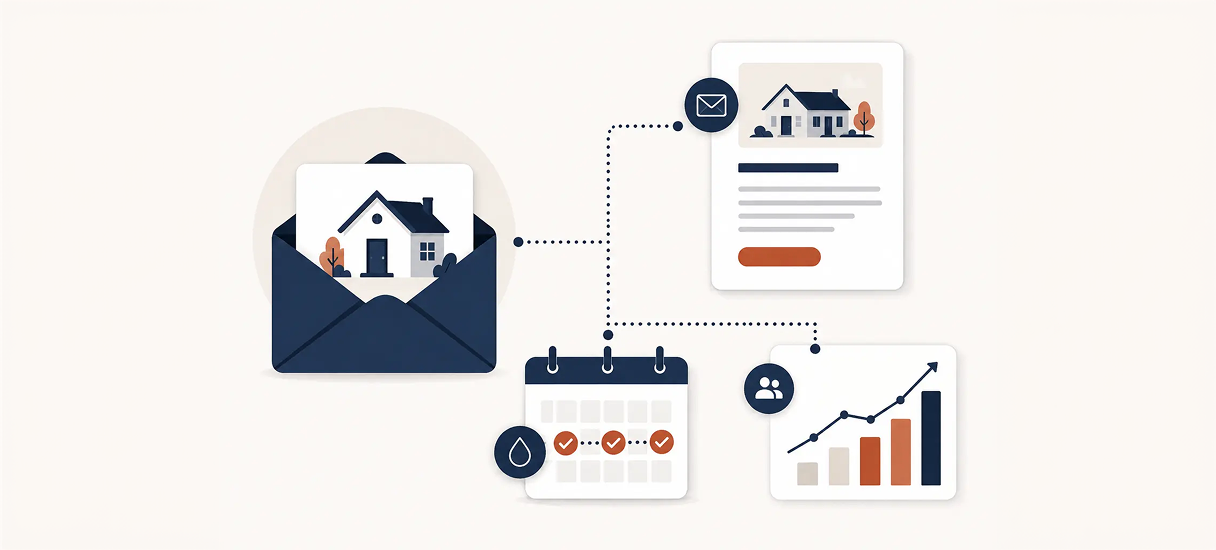 Real Estate
The Real Estate Email Marketing Playbook: Newsletters, Drip Sequences & Templates for 2026
This blog lays out a full real estate email marketing playbook for 2026, covering newsletters, drip sequences, and reusable templates. It explains why click-through rate now matters more than open rate, especially with Apple's Mail Privacy Protection skewing open data. It breaks down three ready-to-adapt drip sequences for buyers, sellers, and past clients, plus a six-step process for building a newsletter people actually open. It compares DIY email marketing against hiring professional email marketing services, with real cost and speed benchmarks. It closes with the CAN-SPAM and Fair Housing compliance rules every agent needs to follow, common mistakes to avoid, and a 10-question FAQ section.
August 18, 2026
Ready to book a 30-minute strategy call?
We'll map the right digital moves for your real estate business, no pitch deck, no commitment.