
AI integration and embedding for real estate.
From sandbox to production.
If your AI is working in a sandbox but not yet inside the business, this is the bridge. We embed AI agents and models into the systems already running your real estate business — ERP, CRM, leasing platforms, facility management, and the data layer that ties them together.
Integrations delivered
Countries covered
Platforms integrated
Production is where AI pays back.
Most AI in real estate dies in the gap between a working pilot and a live business. AI integration and embedding exists to close that gap with the architecture, discipline, and operating handover that turn a sandbox demonstration into a daily capability.
Trusted by 50+ operators, PropTech companies & digital-first brands


























Three questions this engagement is built to answer.
01
Which systems does our AI need to live inside?
If your AI works in a sandbox but not yet inside the operating business, this is the right place to start. We map every place the AI needs to connect — ERP, CRM, leasing platforms, property management, facility tools, and the data layer that ties them together.
An integration map across the platforms in scope
The data contracts each integration needs to honour
A sequenced plan that names what gets connected first and why
02
How do we wire AI in without breaking what works?
If the existing systems are running the business and the AI cannot afford to disrupt them, this is where we step in. We design the integration patterns, the staging environment, and the rollback paths so the business stays operational at every step.
Non-disruptive integration patterns by system class
A staging and rollout plan with rollback at every step
Operational continuity guaranteed through the launch window
03
How do we keep the integration alive as systems change?
If your platforms upgrade, your data model evolves, and your vendors deprecate features on their own schedule, this is the work to commission. We design the integration as a living system, not a one-time wire-up.
Version-tolerant integration architecture
Monitoring and alerting on every connection
Change-management discipline across vendor updates
A structured engagement, run in stages.
Four stages, each with a defined output and a senior advisor accountable for it. Typical engagement length is eight to sixteen weeks for architecture and primary connections, with optional ongoing operating support.
- 01
MapWeek 1
We map the systems the AI will sit inside, the data flows that already exist, the gaps that need to be closed, and the integration contracts each connection has to honour. The output is a connection blueprint the rest of the work runs against.
- 02
ConnectWeeks 2 to 5
We build the integrations themselves. AI agents wired into ERP and CRM, models wired into leasing and property management, and a data layer that ties everything together. Every connection ends with a test, a contract, and an owner.
- 03
EmbedWeeks 6 to 8
We embed the integrated AI into the operating business. Workflow changes, team training, governance hand-off. The AI moves from staging into live operations with explicit gates at every step.
- 04
StabiliseWeeks 9 to 12
We stay involved through the first quarter of live operation. Most integrations fail in the first ninety days because the team is back to running the business and the connection has nobody watching it. We watch it for you.
Where this practice adds the most value.
This work pays back fastest in six kinds of situation. If your integration gap sits anywhere here, the engagement is built for you.
- 01
Operators with AI working in a sandbox
When the AI pilot has proven the concept but the connection into the operating systems is the remaining gap before the value can land.
- 02
PE-backed platforms scaling AI across the stack
When the investment thesis depends on AI working in production across multiple systems and the integration cost has to be predictable.
- 03
Operators replacing legacy ERP or CRM
When new platforms are being installed and the AI layer has to be wired in alongside, not bolted on six months later.
- 04
Multi-platform corporate real estate teams
When AI capabilities are spread across leasing, facility, finance, and asset systems and the integrations need to be coherent across them.
- 05
Teams after a failed integration attempt
When a previous integration did not land and the next attempt has to be made with the discipline and architecture the first cycle lacked.
- 06
Newly built platforms wiring AI from day one
When the business is being built from scratch and AI integration is part of the initial architecture, not a later retrofit.
The five ways AI integrations quietly fail in real estate.

What should a PMS do for small-scale property managers?
The ideal PMS for a small-scale property manager (typically 10 to 500 units) should do ten things well: capture every rent payment automatically, log every maintenance ticket with photo evidence and vendor dispatch, hold every tenant lease and document in one searchable place, generate owner and investor statements in one click, run automated rent reminders and late-fee escalation, screen tenants with credit and eviction history, sync with the operator's accounting stack (QuickBooks, Xero), work on mobile so field checks and unit walks happen on a phone, integrate with a website for listing marketing and online applications, and produce broker-visible dashboards that let the manager see occupancy, delinquency, and cash flow at a glance. AppFolio Property Manager Core, Buildium, DoorLoop, Rentec Direct, and Hemlane are the platforms most adopted at this scale in 2026, at $1.40 to $4 per unit per month. This post covers what the ideal PMS should do, which platforms actually deliver it, and how to pick without overpaying.

Which AI tools work best for real estate developers in 2026?
The best AI tools for real estate developers in 2026 fall into eight categories that map to the developer lifecycle: land sourcing and site selection (Cherre, Reonomy, HouseCanary, LandGate), feasibility and financial modelling (Northspyre, TestFit, custom Excel plus GPT), design and architectural planning (Autodesk Forma, Higharc, Cove.tool, Snaptrude), construction management and progress tracking (Procore AI, Autodesk Construction Cloud, Buildots, Doxel, OpenSpace), pre-launch marketing and renders (Restb.ai, MidJourney, Adobe Firefly), off-plan sales CRM (Salesforce, HubSpot, Follow Up Boss, Rechat), ESG and net-zero analytics (Measurabl, Enertiv, Aquicore), and handover to operations (BIM AI, tenant portal AI). Used well, they cut construction cost 10 to 20 percent, compress design cycles 30 to 50 percent, and lift off-plan sales conversion 20 to 40 percent. Used badly, they burn subscription budget and produce plans that do not build. This post walks through each category, which tools actually work, and how to sequence adoption.
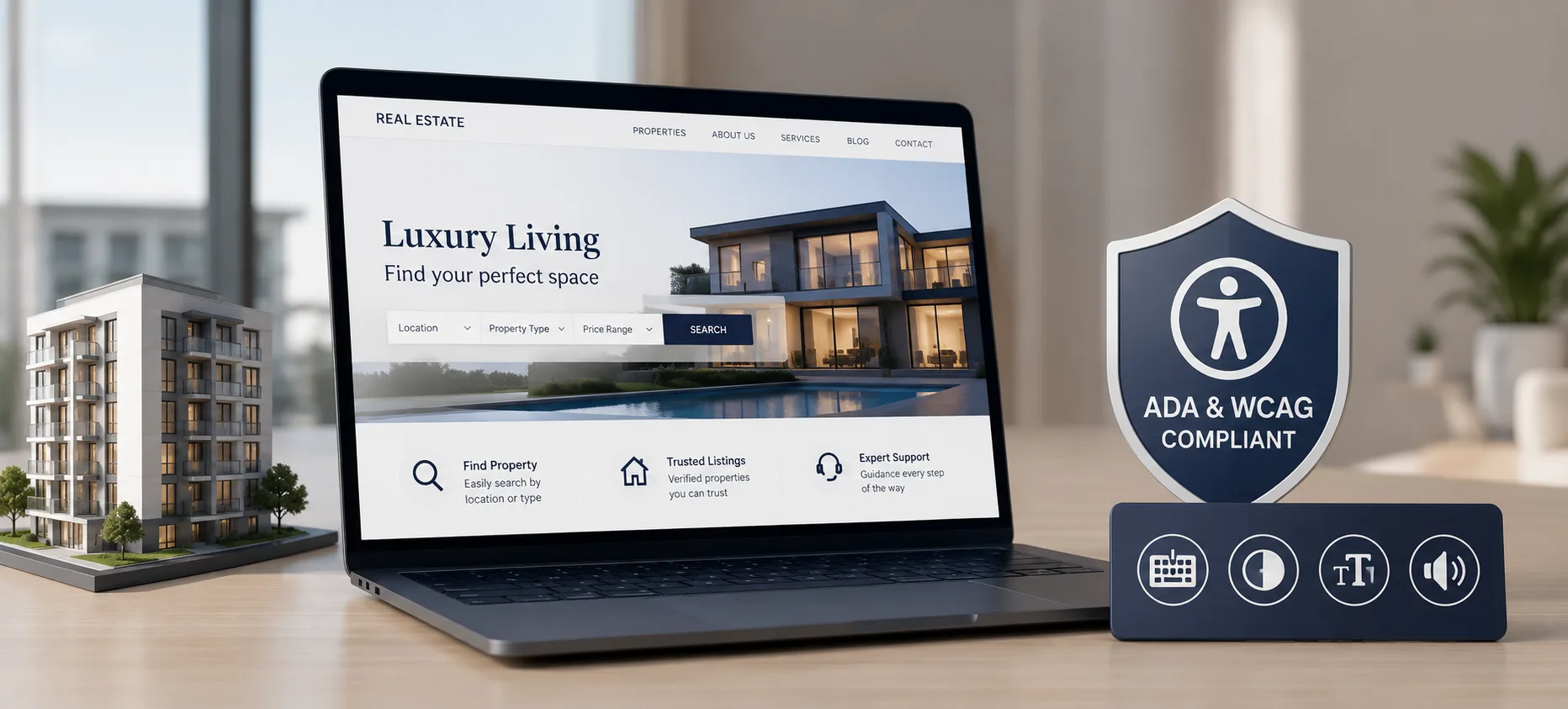
ADA & WCAG Accessibility Compliance for Real Estate Websites: What Operators Must Fix Before They Get Sued
This blog breaks down ADA and WCAG accessibility compliance for real estate websites, focused on what actually creates legal exposure. It explains why WCAG 2.1 Level AA has become the practical legal standard even without a formal Title III regulation for private businesses. It walks through the six accessibility failures responsible for 96% of all detected errors across the web, using real listing-page examples. It also warns against relying on accessibility overlay widgets, citing the FTC's 2025 action against accessiBe over deceptive compliance claims. The piece closes with a step-by-step audit process, an in-house versus compliance-partner comparison, and a 10-question FAQ section.
Have an AI integration question worth getting right?
Tell us about the AI you want in production, the systems it has to live inside, or the integration in front of you. We respond within one business day with a clear point of view and, if there is a fit, a written scope.
No slides. No sales pitch. Just a focused strategy call.
Frequently asked questions
What does AI integration and embedding actually include?
The end-to-end wiring of AI agents and models into the systems already running the business. ERP, CRM, leasing, property management, facility tools, and the data layer that ties them together. The work covers integration architecture, the connections themselves, testing, and operational embedding.
How is this different from a generic systems integration project?
Generic SI projects move data between systems. AI integration wires intelligence into those systems. Different patterns, different data contracts, different failure modes, different success metrics. The methodology is built around AI-specific concerns from end to end.
Which systems do you typically integrate AI into?
ERP and finance, CRM and leasing, property and facility management, asset management, customer service platforms, document and contract management, and the data warehouse or lakehouse that sits underneath them all.
How long does the engagement run?
Integration projects run eight to sixteen weeks for the architecture and primary connections, with optional ongoing operating support for three to twelve months after launch.
Will the integration disrupt our existing operations?
No. Integration is staged behind feature flags, rolled out in defined windows, and rollback-tested at every step. Operational continuity is part of the design, not an afterthought.