

Honey Saxena
Digital Marketing Expert
How digital marketing helps your real estate job in 2026
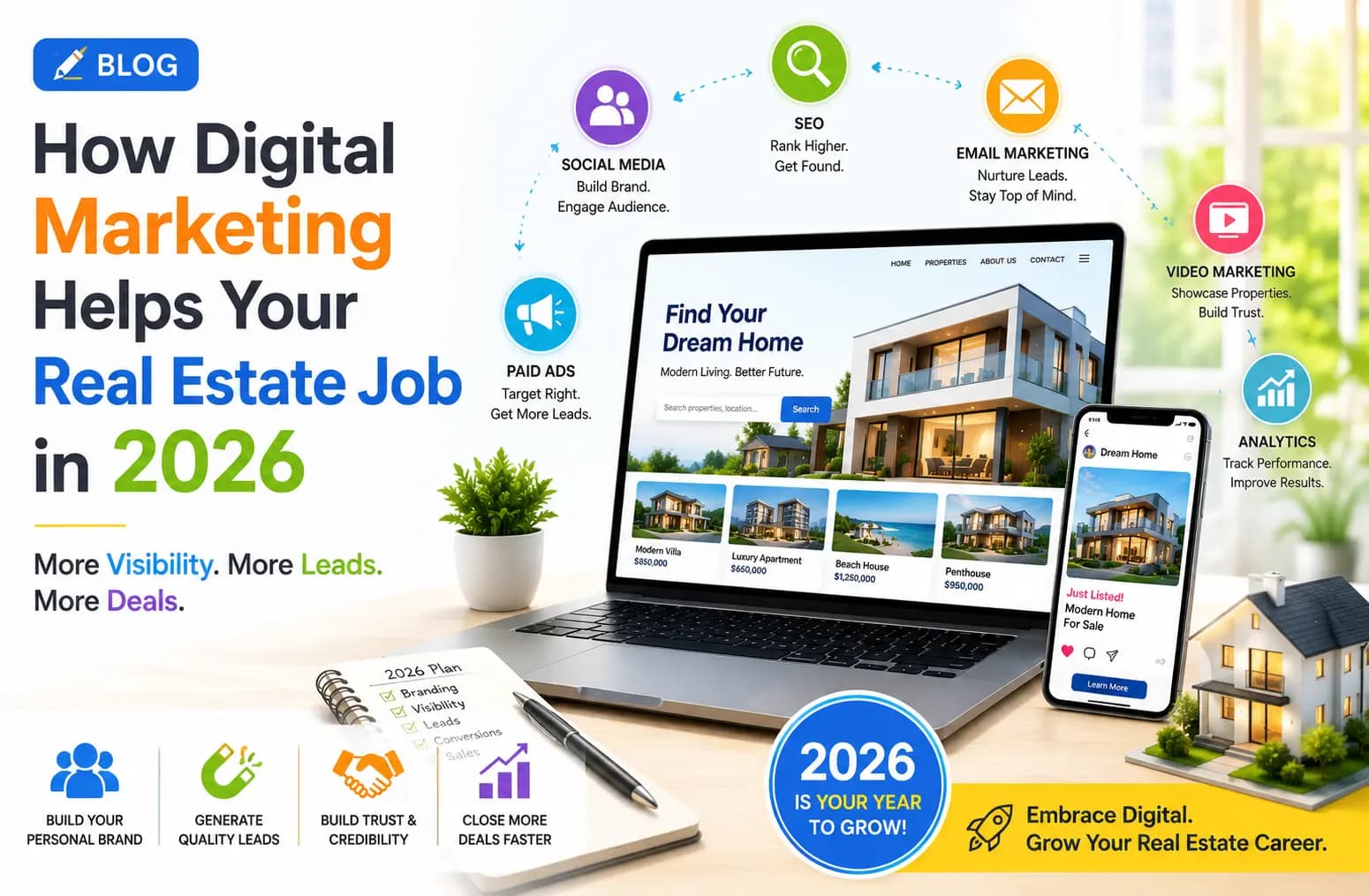
Digital marketing helps real estate agents in three ways. It builds the personal brand that makes buyers and sellers pick you over the next agent. It produces a steady flow of leads through online channels like Google, Instagram, YouTube, and LinkedIn, so you stop relying only on cold calling and door knocking. And it builds the referral network that compounds over the years, so by year three, you are getting more inbound leads than you can handle. The strongest agents in 2026 spend 8 to 15 percent of their gross commission income on digital marketing and recover 4 to 8 times that investment in attributed closed deals.
How does digital marketing help real estate agents?
Digital marketing helps a real estate agent in five specific ways.
1. It puts you in front of buyers when they start their search. According to the NAR 2024 Profile of Home Buyers and Sellers, 96 percent of buyers start looking online before they ever talk to an agent. If your name does not show up in that early search, you are not in the conversation.
2. It builds your personal brand 24 hours a day. Your website, your Instagram, your YouTube channel, your LinkedIn profile, all of them work while you sleep. A buyer who watches your neighbourhood tour at 11 pm is a buyer who calls you the next morning.
3. It produces leads at a known cost per lead. Paid ads on Google and Meta typically cost USD 18 to USD 55 per qualified lead for most residential markets. That is a predictable number, which means you can plan your business around it.
4. It compounds over time. A blog post you wrote two years ago can still bring in leads today. A YouTube video can rank for buyer searches for 36 months or more. Cold calling produces a lead this hour and zero leads tomorrow. Digital marketing produces a lead this hour and more leads next year from the same effort.
5. It builds the referral network that becomes the business after year three. Past clients who follow you on Instagram, watch your YouTube videos, and read your newsletter remember you when their friend wants to buy. The strongest agents in any market run mostly on referrals by year five. Digital marketing is how that referral base is built.
The fuller picture of what digital marketing is and how it works lives in our " What is digital real estate marketing guide.
What digital marketing tactics work best for real estate agents in 2026?
Five tactics produce the majority of measurable pipeline for real estate agents this year.
Tactic 1, hyperlocal content
Write or film about the specific neighbourhoods you serve. A 10-minute YouTube tour of Bandra West, a 5-slide Instagram carousel about Bangalore's Whitefield commute, and a 1,500-word blog on schools in Indiranagar. This content ranks in Google search and YouTube search for 24 to 60 months after publishing. Every search produces a lead.
Tactic 2: paid Google Ads for high-intent queries.
When a buyer searches "2 bhk for sale Bandra", they are weeks away from a viewing, not months. Google Ads puts you at the top of that search instantly. The expected cost per lead is USD 22 to USD 48 for most metro markets. The setup and ongoing management are covered in detail in our real estate Google Ads service.
Tactic 3, Instagram Reels and YouTube Shorts
Property walkthroughs in vertical video format. Shot on phone, edited in 15 minutes, posted as a Reel and a Short on the day of listing. Performance benchmarks: 3 to 5 percent click-through to the listing page, 0.4 to 0.8 percent conversion to scheduled showing. The full Instagram playbook lives in social media marketing for real estate agents.
Tactic 4, email and WhatsApp nurture
Past clients, leads who did not buy this year, and friends-of-friends all go into a list. Once a month, send a market update. Once a quarter, send a neighbourhood deep dive. The list compounds. The cost is near zero. Email lists return USD 36 to USD 42 per dollar spent, according to HubSpot's 2025 State of Marketing Report, the highest ROI of any channel.
Tactic 5, LinkedIn for commercial and high-net-worth
If you serve commercial buyers, luxury residential, or institutional investors, LinkedIn is the highest-leverage platform in 2026. A weekly market commentary post, monthly long-form market analysis, and personal outreach to decision makers produce 2 to 3 qualified conversations per month for most agents.
Which platforms should real estate agents prioritise?
Pick three platforms maximum. Spreading effort across five or six platforms is the most common reason agents fail at digital marketing.
For most residential agents, the right three are:
Instagram (50 percent of effort). According to the NAR 2025 Member Profile, 80 percent of NAR members use Instagram as their primary social platform. Carries the broadest residential buyer audience.
YouTube (30 percent of effort). The long-term compounding channel. Real estate searches on YouTube grew 56 percent year on year, according to Think with Google. Videos rank in both YouTube and Google search, which gives them double the value.
LinkedIn (15 percent of effort). Best for B2B, commercial, luxury, and referral marketing to past colleagues and HNW networks.
For commercial real estate agents, swap the order. LinkedIn 50 percent, YouTube 30 percent, Instagram 15 percent. For coliving and BTR operators, swap again. Instagram 60 percent, YouTube 25 percent, TikTok 10 percent.
The remaining 5 percent of effort goes to whichever platform fits your specific niche. Facebook Groups for hyperlocal neighbourhood marketing. TikTok for first-time buyer content. Twitter or X for industry commentary. The full platform analysis is in our social media marketing service.
How much should a real estate agent spend on digital marketing?
The working rule is 8 to 15 percent of gross commission income on digital marketing.
For a solo agent earning USD 150,000 a year, that translates to USD 12,000 to USD 22,000 per year, or USD 1,000 to USD 1,800 per month. The split inside that budget typically runs:
60 percent on paid ads (Google plus Meta)
20 percent on content production (video, blog, design)
10 percent on tools (CRM, scheduling, analytics)
10 percent on agency or freelance support
For an agent earning under USD 100,000 a year, focus the budget on paid Google Ads plus CRM tooling. Skip the agency support layer until you can afford it. For an agent earning over USD 500,000 a year, hire an agency or in-house marketing person. The opportunity cost of your time is too high to do this yourself.
Below USD 500 per month total, results are inconsistent. Above that floor, every additional dollar tracked through a CRM compounds.
How do you measure digital marketing success as a real estate agent?
Four metrics tell you whether your digital marketing is working. Track them weekly.
Metric 1: cost per qualified lead. A qualified lead is someone whose budget, timeline, and location match what you sell. Aim for a USD 30 to USD 60 cost per qualified lead in most markets. If you are above USD 100, something in the funnel is broken.
Metric 2 leads to the closed deal ratio. Of every 100 qualified leads, how many close inside 12 months? Industry average is 2 to 4 percent. Strong agents hit 5 to 8 percent. The lever is not lead volume, it is lead response time and nurture sequence.
Metric 3: cost per closed deal. Total marketing spend divided by the number of closed deals. Aim for the cost per closed deal to be less than 15 percent of the average gross commission per deal. If you spend USD 5,000 to close a deal that pays USD 8,000 in commission, the math is broken.
Metric 4, attributed gross commission income. The total commission earned from deals that started with a digital marketing touch. This is the number that decides whether your budget should grow next year or shrink.
You cannot measure any of these without a CRM that captures lead source on every contact. Set this up before you spend a dollar on ads. Our CRM implementation service builds this layer for agents and brokerages.
How long does digital marketing take to deliver results?
Different channels deliver results on different timelines.
Paid Google Ads. First leads in 24 to 72 hours. Full attribution clarity at 60 to 120 days.
Paid Meta Ads. First leads in 48 hours. Best results compound after the retargeting audience reaches 5,000+ people, usually 30 to 60 days.
Instagram organic. First meaningful engagement at 4 to 8 weeks. Compounding pipeline contribution at month 6.
YouTube organic. First search rankings from months 3 to 6. Compounding pipeline at months 9 to 12. The longest curve, but also the highest ceiling.
SEO and content. Indexation in 5 to 10 days. First rankings in months 3 to 6. Meaningful inbound at month 12 to 18.
Email nurture. Immediate ROI on existing list. List growth and compounding ROI at month 6 onward.
The mistake most agents make is judging a digital marketing programme at month 1 or month 2. Real estate sales cycles run 60 to 180 days, which means even a fast channel like Google Ads needs one complete sales cycle before the data is honest.
Common mistakes real estate agents make with digital marketing
Mistake 1: Posting everywhere with no platform priority. Five platforms with mediocre execution lose to two platforms with great execution. Pick three. Master them.
Mistake 2: No CRM source attribution. Without tracking which channel produced which lead, you cannot prove what works. Most agents end up cutting the budget on what actually closed deals because they cannot see the connection.
Mistake 3: slow lead response. Harvard Business Review research on lead response time shows leads contacted within 5 minutes are 21 times more likely to qualify than leads contacted after 30 minutes. Most agents respond within hours. Marketing budget burns when the sales response is slow. The fix lies in how to reduce lead leakage in real estate.
Mistake 4, stopping in week 4 because it is not working yet. Real estate sales cycles are long. A campaign needs one complete sales cycle (60 to 120 days for residential) before you can judge it honestly.
Mistake 5, optimising for follower count and likes. Vanity metrics. Optimise for cost per qualified lead and cost per closed deal. Followers are a leading indicator, not a result.
Mistake 6, ignoring AEO. Buyers increasingly start their search in ChatGPT, Perplexity, Claude, and Google AI Overviews. Agents whose content is structured for AI citation get found by the next generation of buyers. Agents whose content does not become invisible.
Ready to map digital marketing to your real estate business?
Share your current marketing setup, your target deal volume, and your gross commission goal. A 30-minute audit covering channel mix, CRM attribution, content cadence, and CAC benchmarks comes back within 5 business days. No commitment, no slides, just a clear view of where the leverage is and what to ship first.
- Digital marketing replaces 60 to 80 percent of the cold outreach an agent used to do, and produces higher-quality leads at a lower cost per closed deal.
- Three platforms drive most of the pipeline for residential agents in 2026: Instagram, YouTube, and LinkedIn. Pick three, master them, ignore the rest.
- Posting cadence beats perfection. Agents publishing 3 to 5 pieces of content per week consistently outperform agents posting daily without a plan.
- 96 percent of home buyers start their search online. The agent who shows up first in that search wins the first conversation, which is usually the conversation that closes.
- Without a CRM that captures lead source, the agent cannot prove which marketing actually produces deals. Without that proof, the budget drifts toward what feels busy, not what works.
Why trust Noseberry
Our content is written by practicing real-estate and PropTech professionals, fact-checked by a dedicated editorial team, and reviewed against the latest industry data before publication.
- 10+ years of industry expertise
- All facts independently verified
- No sponsored rankings in guides
- Updated when the industry changes
Frequently asked questions
Can a real estate agent do digital marketing without an agency?
Yes, in year one. Solo agents earning under USD 200,000 a year can learn the platforms personally. From year two onward, the opportunity cost of agent time usually makes hiring an agency or marketing manager cheaper per closed deal.
Which is more important for real estate agents, SEO or paid ads?
Both. Paid ads produce pipeline now. SEO and content produce pipeline that compounds over the next 5 years. Run paid for immediate results while you build the organic foundation.
How many social media platforms should a real estate agent be on?
Three. Spreading effort across five or six platforms is the single most common reason agents fail at digital marketing.
Does digital marketing work for new real estate agents with no clients?
Yes, and it works faster than for established agents in some ways. A new agent posting consistent neighbourhood content for 6 months will outrank a 20 year veteran who has never published anything online.
How much time per week should a real estate agent spend on digital marketing?
6 to 10 hours per week for content production and engagement if doing it yourself. Less if you outsource production to a contractor or agency.
What is the easiest digital marketing tactic to start with?
Two-minute Instagram Reels of your active listings. Shot on phone, posted within 24 hours of getting the listing, captioned with the address and one neighbourhood detail. The lowest barrier to entry, the highest leverage of any single tactic.
Should real estate agents use AI to write content?
AI is the right tool for outlines and first drafts. It is not the right tool for the final published piece without significant editorial layering. Pure AI content gets ranked and cited at far lower rates than content with substantial human author voice.
Related insights
 Real Estate
What are use cases for machine learning and AI in real estate?
Machine learning and AI in real estate have ten proven use cases in 2026: automated valuation models (AVMs), lead scoring and prioritisation, generative listing content, image and virtual-tour enhancement, predictive maintenance for property management, tenant and buyer screening (with fair-housing caveats), demand forecasting, chatbots and conversational agents, document and contract review, and portfolio-level investment analytics. Together they cover the full stack from marketing to leasing to operations to capital markets. Not every use case delivers equal ROI. AVMs, lead scoring, generative listings, and predictive maintenance produce the fastest returns; screening and forecasting carry more risk and need more oversight. This post walks through what each use case does, what it is worth, and where the returns are already showing up.
July 28, 2026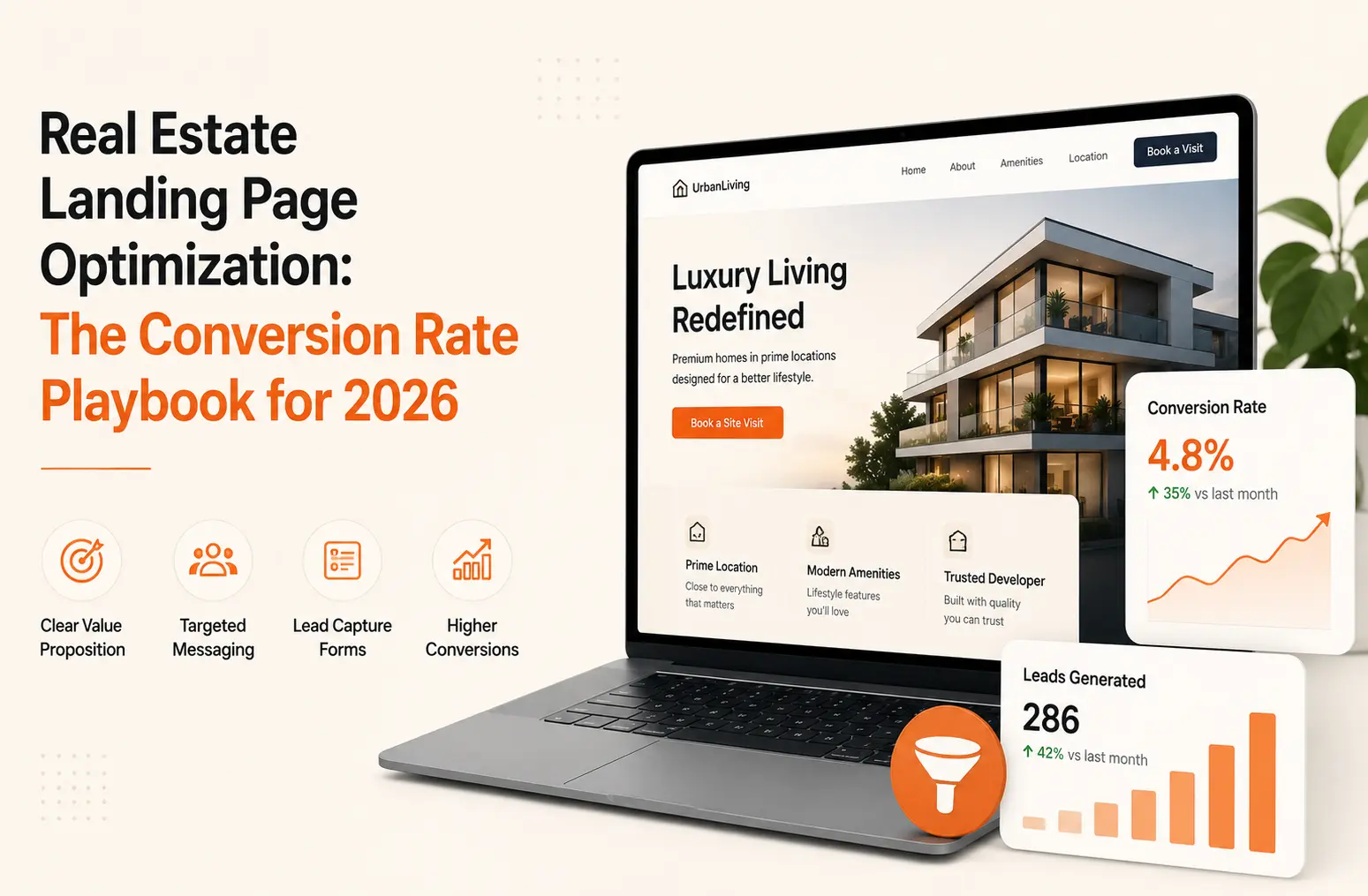 Real Estate
Real Estate Landing Page Optimization: The Conversion Rate Playbook for 2026
Most real estate landing pages convert at 2.7% while the top 25% convert at 11.45% or higher, and the gap has nothing to do with budget or design talent. This playbook breaks down exactly how to close that gap in 2026 through the nine structural elements every high-converting property landing page shares, a 15-point CRO audit you can run today, and a traffic source-specific optimization strategy that treats Google Search visitors, Meta cold audiences, and email traffic as the completely different conversion challenges they are. You'll also get the post-click architecture blueprint that connects your landing page to your CRM, automated response, and lead scoring system so conversions become pipeline, not just form fills sitting in a spreadsheet. Every section is built around measurable outcomes with specific benchmarks you can test against. If you're spending money driving traffic to a landing page that isn't hitting 5% or above, this is the playbook that fixes it.
July 28, 2026 Real Estate
Where is AI making a surprising impact on real estate support services?
AI is quietly reshaping the back-office of real estate, not just the front-office. The most surprising impact in 2026 is in support services that most operators still treat as manual: transaction coordination, escrow and title, property-management admin, compliance document review, vendor coordination, tenant communications, and bookkeeping. These functions absorb 30 to 40 percent of an operator's staff hours, and AI tools built for them now cut that load by 40 to 70 percent per workflow. Unlike front-office AI (listing generation, pricing, agent-side content) where the risk and disclosure burden is heavy, back-office AI has clearer economics, lower client-trust exposure, and faster payback. This is where operators are quietly capturing most of their real AI value in 2026, while everyone else is still debating whether ChatGPT should write listing descriptions.
July 28, 2026
Ready to book a 30-minute strategy call?
We'll map the right digital moves for your real estate business, no pitch deck, no commitment.