

Honey Saxena
Digital Marketing Expert
Where is AI making a surprising impact on real estate support services?
Published July 28, 2026|12 min read

AI is quietly reshaping the back-office of real estate, not just the front-office. The most surprising impact in 2026 is in support services that most operators still treat as manual: transaction coordination, escrow and title, property-management admin, compliance document review, vendor coordination, tenant communications, and bookkeeping. These functions absorb 30 to 40 percent of an operator's staff hours, and AI tools built for them now cut that load by 40 to 70 percent per workflow. Unlike front-office AI (listing generation, pricing, agent-side content) where the risk and disclosure burden is heavy, back-office AI has clearer economics, lower client-trust exposure, and faster payback. This is where operators are quietly capturing most of their real AI value in 2026, while everyone else is still debating whether ChatGPT should write listing descriptions.
What counts as support services in real estate, and why are they under-noticed?
Support services are the operational functions that keep a real estate business running but do not appear in the client's line of sight. Transaction coordination, escrow and title admin, property-management back-office, compliance and document review, vendor coordination, tenant communications, bookkeeping, insurance and inspection scheduling, MLS input, and reporting.
They are under-noticed because nobody markets them. Agents pitch listings. Brokerages pitch agents. PropTech founders pitch products. The people who fix a broken vendor invoice at 6pm on a Friday are not on any marketing page. But they are where 30 to 40 percent of operator hours actually get spent, per NAR and Buildium benchmarks, which is why AI applied here produces some of the strongest returns.
How is AI transforming transaction coordination?
Transaction coordination is the mid-transaction work of chasing signatures, scheduling inspections, coordinating with title and escrow, and keeping every party moving toward close. In 2026, AI tools are handling three specific parts of this: extracting key dates from contracts and populating a shared timeline automatically, drafting first-version status emails to buyers and sellers, and flagging documents that are missing signatures or initials before the transaction hits closing week.
Industry productivity studies now put the time savings at 5 to 8 hours per closed deal, which for a mid-size brokerage running 400 to 800 closings a year is thousands of hours reclaimed. Just as important, transactions with AI-assisted coordination hit fewer closing-week fire drills, because the AI catches missing items on day 30 rather than day 89.
Why is escrow, title, and closing work being automated?
Escrow and title are document-heavy, deadline-driven, and largely template-based. Every one of those characteristics makes them ideal for AI. In 2026, closing coordinators are using AI to compare title reports against prior reports for the same property, to draft first-version closing statements, to summarise 200-page lender packages into a two-page action list, and to check that every disclosure form matches the state's current template.
The impact is not that escrow officers get replaced. It is that a single officer can now cleanly close 40 to 60 percent more transactions in the same week, because the box-checking is automated and the human attention lands on the exceptions. Regulated professions rarely get replaced by AI; they get amplified by it.
What is AI doing in property-management back-office?
Property management is the support services category where AI has moved fastest, because the admin volume is enormous and the client trust exposure is lower than in sales. AI tools now handle tenant lease renewal reminders and first-version drafts, maintenance ticket categorisation and vendor dispatch, rent reconciliation across bank feeds, delinquency chase sequences, and monthly owner statements.
Buildium's operator surveys have consistently shown property managers spending 30 to 40 percent of their time on admin. AI does not eliminate all of that, but 40 to 60 percent reductions on the specific workflows above are now typical after 90 days of implementation. For a coliving or BTR operator running 200 units, that translates to one to two full-time equivalents redirected from admin toward community and asset value.
For the operational side of this, see our CRM implementation service and the coliving software development service.
How is AI helping with compliance and document review?
Compliance is quietly the highest-value AI use case in real estate. Every lease, every purchase agreement, every disclosure form, every syndication document, and every AML file requires review. Historically this took a licensed professional an hour to a full day per document.
AI-assisted compliance review, using retrieval-grounded models against known-good templates, now catches missing clauses, mismatched dates, incorrect party names, and non-standard risk language in a fraction of the time. JLL and Deloitte studies in 2024 and 2025 have put the time reduction at 60 to 70 percent on standard commercial-lease and residential-agreement packages, with equal or better catch rates than manual review.
The human still signs off. But the human's time is spent on the 10 percent of documents that need real thinking, not on the 90 percent that were routine.
Where else is AI quietly making an impact?
Four more back-office areas producing real returns in 2026.
Vendor coordination. AI drafts and triages vendor emails, matches invoices to work orders, and flags anomalies against historical spend. Facility managers report 30 to 50 percent time savings on vendor admin.
Tenant and buyer communications. First-response drafting on inbound enquiries, appointment scheduling, and follow-up templating. Not full autonomous replies. Drafts a human sends after a 10-second review.
Bookkeeping and reconciliation. Bank-feed categorisation, expense matching, month-end reconciliation. Real-estate-specific bookkeeping AI (from Yardi, AppFolio, and newer entrants) is now materially faster than a junior accountant on routine categorisation.
Insurance and inspection scheduling. Automated quote requests, calendar coordination, and follow-up. Removes one of the most frustrating friction points in the transaction.
Together these compound. An operator implementing AI across five of the seven support-service categories typically sees a 25 to 40 percent reduction in total operations headcount growth over 18 months without cutting service quality.
Why is the risk profile different from front-office AI?
The risk profile of back-office AI is materially cleaner than front-office AI, which is why smart operators are deploying here first. Client trust exposure is limited because the client never sees the AI output directly. Fair-housing exposure is limited because the AI is processing existing contracts and documents rather than making housing decisions. Regulatory exposure is limited because the human licensed professional still signs off on every regulated output.
The risks that remain — hallucinated document summaries, data leakage into public tools, and vendor lock-in — are the same risks covered in our blog on the risks and challenges of AI in real estate. They are manageable with enterprise-tier deployments, human review checkpoints, and standard vendor due diligence.
What should operators do to capture these wins?
Three specific moves. First, map the seven support-service categories against your current headcount and identify where 30 percent of your team's hours are actually going. Most operators find one or two categories dominate. Second, pilot AI on a single high-volume, low-risk workflow (usually rent reconciliation, vendor invoice matching, or maintenance ticket triage) before scaling across the back office. Third, budget for the enterprise-tier AI stack from day one, because pasting client and tenant data into public tools is a compliance problem you do not want.
For a scoped audit of your support-service AI opportunity, see our real estate AI solutions service, the companion AI in real estate blog, and the digital marketing service for the customer-facing side.
Ready to find the AI wins hiding in your operations?
Book a working session with the Noseberry Digitals team. We will map your seven support-service categories against your current headcount, identify the two or three highest-return AI pilots for your operation, and hand you a 90-day roadmap for a controlled rollout.
- The value is in the back office, not the shop window. Support services absorb 30 to 40 percent of operator staff hours, per NAR and Buildium benchmarks. AI cuts that by 40 to 70 percent per workflow.
- Transaction coordination is the biggest quiet winner. AI-assisted transaction coordination saves 5 to 8 hours per closed deal, per industry productivity studies.
- Compliance and document review are being transformed. JLL and Deloitte studies show AI-assisted document review cutting time by 60 to 70 percent on standard lease and contract packages.
- The risk profile is lower than front-office AI. Back-office use cases carry less client-trust exposure, fewer fair-housing traps, and clearer ROI than customer-facing AI.
- The playbook is the same regardless of asset class. Residential, commercial, coliving, BTR, and PropTech operators all get similar payback because the underlying admin work is similar.
Why trust Noseberry
Our content is written by practicing real-estate and PropTech professionals, fact-checked by a dedicated editorial team, and reviewed against the latest industry data before publication.
- 10+ years of industry expertise
- All facts independently verified
- No sponsored rankings in guides
- Updated when the industry changes
Have any questions?
Where is AI making the biggest surprise impact in real estate support services?
Transaction coordination, escrow and title work, property-management back-office, and compliance document review. Each of these absorbs significant staff hours today and each has AI tools in 2026 that cut the load by 40 to 70 percent. The impact is bigger than front-office AI because volume is higher and risk exposure is lower.
How much time can AI save on transaction coordination?
Industry productivity studies put savings at 5 to 8 hours per closed deal for AI-assisted transaction coordination. For a mid-size brokerage closing 400 to 800 deals a year, that is 2,000 to 6,400 reclaimed hours annually.
Is AI reliable enough for compliance document review?
Yes, when used with human sign-off. JLL and Deloitte studies show AI-assisted compliance review cutting time by 60 to 70 percent on standard packages with equal or better catch rates than manual review. The licensed professional still signs off; the AI handles the routine 90 percent.
Which property management workflows benefit most from AI?
Rent reconciliation, maintenance ticket categorisation and vendor dispatch, tenant lease renewal drafting, delinquency chase sequences, and monthly owner statements. These are the highest-volume, most template-based workflows and see 40 to 60 percent time reductions after 90 days of implementation.
Is the risk profile really lower than front-office AI?
Yes. Back-office AI carries less client-trust exposure (the client rarely sees the output), fewer fair-housing traps (the AI processes existing contracts rather than making housing decisions), and clearer ROI. Standard risks around hallucinations, data leakage, and vendor lock-in remain but are manageable with enterprise-tier deployments.
Related insights
 Real Estate
What are use cases for machine learning and AI in real estate?
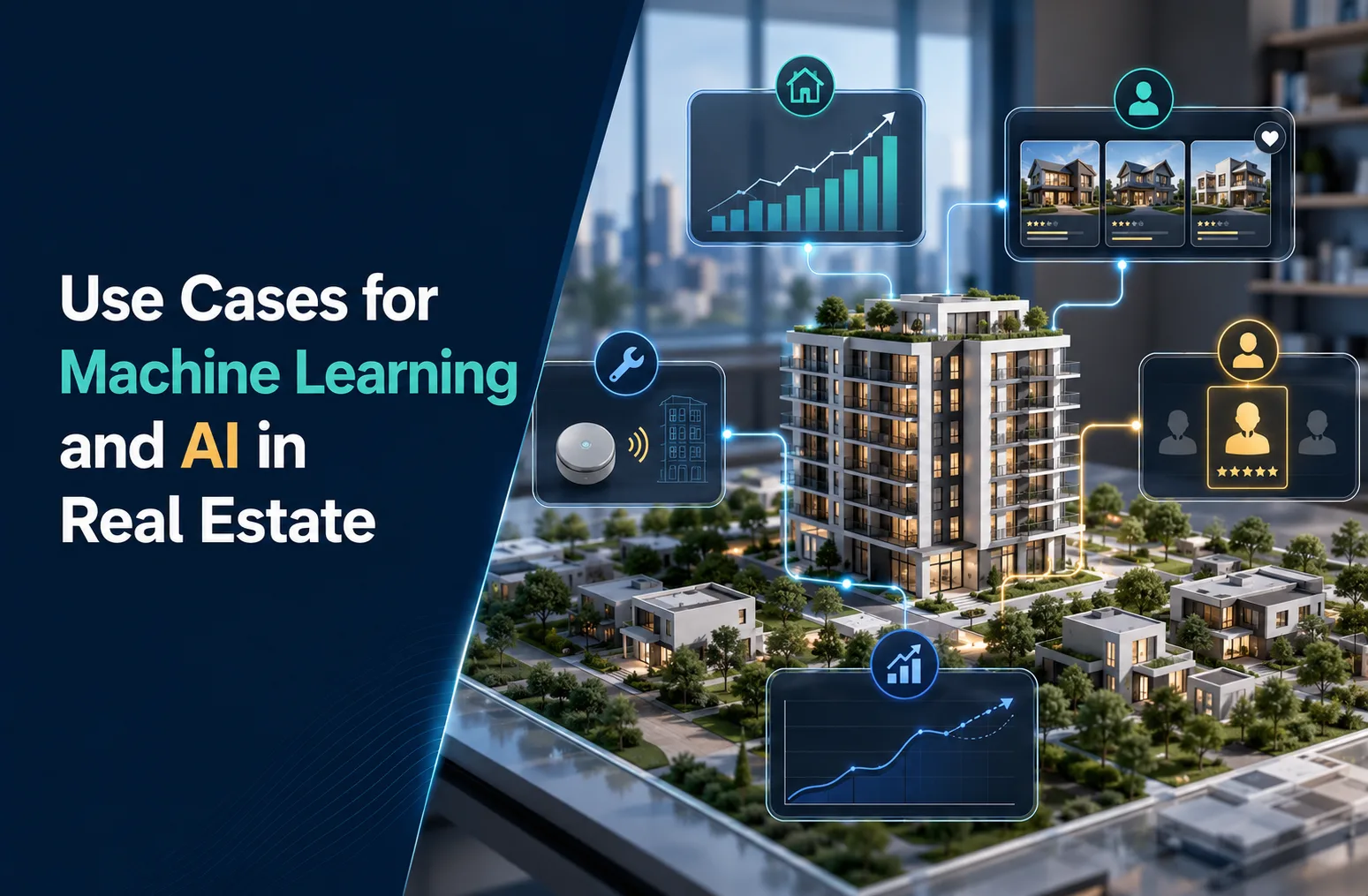
Machine learning and AI in real estate have ten proven use cases in 2026: automated valuation models (AVMs), lead scoring and prioritisation, generative listing content, image and virtual-tour enhancement, predictive maintenance for property management, tenant and buyer screening (with fair-housing caveats), demand forecasting, chatbots and conversational agents, document and contract review, and portfolio-level investment analytics. Together they cover the full stack from marketing to leasing to operations to capital markets. Not every use case delivers equal ROI. AVMs, lead scoring, generative listings, and predictive maintenance produce the fastest returns; screening and forecasting carry more risk and need more oversight. This post walks through what each use case does, what it is worth, and where the returns are already showing up.
July 28, 2026 Real Estate
Real Estate Landing Page Optimization: The Conversion Rate Playbook for 2026
Most real estate landing pages convert at 2.7% while the top 25% convert at 11.45% or higher, and the gap has nothing to do with budget or design talent. This playbook breaks down exactly how to close that gap in 2026 through the nine structural elements every high-converting property landing page shares, a 15-point CRO audit you can run today, and a traffic source-specific optimization strategy that treats Google Search visitors, Meta cold audiences, and email traffic as the completely different conversion challenges they are. You'll also get the post-click architecture blueprint that connects your landing page to your CRM, automated response, and lead scoring system so conversions become pipeline, not just form fills sitting in a spreadsheet. Every section is built around measurable outcomes with specific benchmarks you can test against. If you're spending money driving traffic to a landing page that isn't hitting 5% or above, this is the playbook that fixes it.
July 28, 2026 Real Estate
What are the risks and challenges of using AI in real estate?
AI in real estate carries ten real risks that operators need to price in before they scale it: hallucinated property facts and pricing, fair-housing and discrimination liability, personally identifiable information leaking into public models, vendor lock-in and model deprecation, prompt injection and cybersecurity, unclear regulation across SEC, HUD, FTC, and GDPR, over-reliance that de-skills agents, hidden token and inference costs, broken attribution, and client trust damage when disclosure is missing. The technology is genuinely useful for the right jobs. The risk profile only becomes manageable when operators run AI inside a human-review layer, keep client and financial data out of public models, and treat every high-stakes output (pricing, tenant screening, offer terms) as a draft, not a decision. This post walks through each risk, what it looks like in practice, and the specific controls that reduce it.
July 28, 2026
Ready to book a 30-minute strategy call?
We'll map the right digital moves for your real estate business, no pitch deck, no commitment.