

Honey Saxena
Digital Marketing Expert
What is digital real estate marketing? A 2026 guide
Published June 13, 2026|8 min read
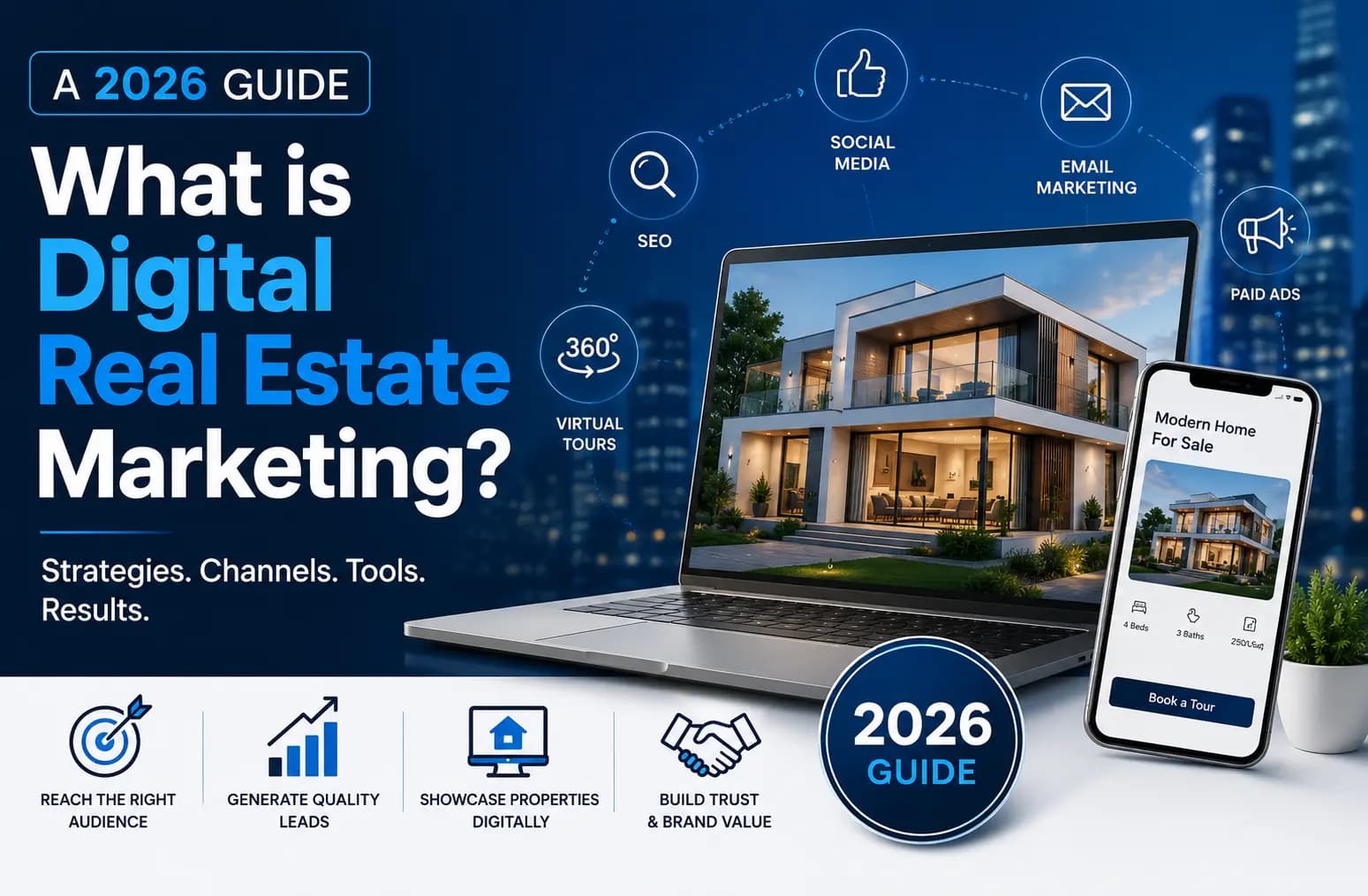
Digital real estate marketing is the use of online channels, search, social, video, email, and content, to attract buyers, tenants, and investors to a property business. The discipline covers SEO, paid ads on Google and Meta, content marketing, email automation, and CRM-attributed lead generation. Most operators allocate 1 to 3 percent of project sales value or 4 to 8 percent of monthly revenue to digital marketing, and the strongest programmes return 3 to 5 times that investment in attributed pipeline inside the first 90 days.
What is digital real estate marketing?
Digital real estate marketing is everything a property business does online to attract buyers, tenants, and investors. It includes the website, the search rankings, the paid ads on Google and Meta, the social media content, the email newsletters, and the AI search citations. It is the modern replacement for newspaper ads, billboard hoardings, and printed brochures.
The reason digital real estate marketing matters in 2026 is simple. Most property buyers no longer start their journey at an open house or a real estate office. They start on a phone, in a Google search, on Instagram, or inside a ChatGPT query. The operator who appears first in that online journey owns the first conversation. The first conversation is usually the one that closes the deal.
You can read the broader playbook in our digital marketing service page, but the short version is this: digital real estate marketing is how property businesses find and convert buyers in 2026.
How does digital real estate marketing work?
Digital real estate marketing works in three steps that connect into one funnel.
Step 1, attract. The operator publishes content, runs paid ads, and optimises for search so the right buyers find the business online. This is where SEO, AEO, Google Ads, Meta Ads, YouTube, and social media all play a role.
Step 2, convert. Once the buyer lands on the website or follows the social account, the funnel needs to turn them into a lead. This is where landing pages, lead forms, WhatsApp automation, and live chat do the work.
Step 3, close. The lead goes into a CRM. The sales team follows up within 5 minutes. The lead is nurtured through email, SMS, and retargeting ads until they book a viewing, sign a deposit, or close the transaction.
A digital real estate marketing programme that ignores any of those three steps leaks pipeline at that stage. The operators who win are the ones running all three steps in sync. We cover the lead side of this in how to reduce lead leakage in real estate.
What channels does digital real estate marketing use?
There are seven channels every real estate operator should know in 2026. Most operators run 4 to 5 of them at any time, weighted by their asset class.
1. SEO (search engine optimisation). Getting found in Google search for queries like "3 bhk apartment Bandra" or "coliving spaces in Bangalore". The long-term compounding channel.
2. AEO (answer engine optimisation). The newer cousin of SEO. Getting cited inside ChatGPT, Perplexity, Claude, and Google AI Overviews. This is where buyers increasingly start their property research in 2026.
3. Paid search (Google Ads). Paying for top placement when buyers search high-intent queries. Cost per lead between USD 18 and USD 55 across most markets.
4. Paid social (Meta Ads, LinkedIn Ads). Putting ads in front of buyers on Instagram, Facebook, and LinkedIn. Stronger for top-of-funnel and retargeting than for cold acquisition.
5. Content marketing. Producing blogs, neighbourhood guides, market reports, and videos that earn trust and rank long-term. The compounding asset every real estate business should own.
6. Email marketing. Newsletter, nurture sequences, and transactional emails sent to leads and clients. The cheapest channel by cost per closed deal, once a list is built.
7. Social media (organic). Posting on Instagram, YouTube, LinkedIn, and TikTok to build an audience and authority. We cover this in detail in social media marketing for real estate agents.
The right mix depends on the operator. A residential developer leans heavily on paid search and project microsites. A coliving operator leans heavily on Instagram and Meta retargeting. A PropTech founder leans heavily on LinkedIn and content.
How much does digital real estate marketing cost?
Budget rules of thumb for 2026:
For developers, 1 to 3 percent of the project's gross sales value across the active sales window. For a USD 50 million project, that translates to USD 500,000 to USD 1.5 million across 12 to 18 months.
For operators (coliving, BTR, property management). 4 to 8 percent of monthly revenue. A coliving operator earning USD 100,000 a month spends USD 4,000 to USD 8,000 a month on digital marketing.
For brokerages and agents, 8 to 15 percent of gross commission income. A solo agent earning USD 150,000 a year spends USD 12,000 to USD 22,000 a year.
For PropTech founders. 25 to 50 percent of operating expenses in the early stage, dropping to 15 to 25 percent as the business matures.
Below those budgets, the results are inconsistent. Above them, the marketing function tends to outpace the sales team's ability to follow up. The right split between paid and organic typically runs 70 percent paid plus 30 percent organic in year one, shifting to 50/50 by year three as the organic foundation compounds.
How is digital real estate marketing different from traditional marketing?
Three structural differences separate digital real estate marketing from the print, radio, billboard, and direct mail world it replaced.
Measurement. Every dollar of digital marketing can be traced back to a specific channel, campaign, and lead source. Traditional marketing is judged on broad metrics like "circulation" or "drive-bys". According to HubSpot's 2025 State of Marketing Report, 78 percent of marketers say measurability is the single biggest reason they shifted budget from traditional to digital.
Speed. A digital marketing campaign can go from concept to live in 48 hours. A billboard or print campaign takes 4 to 8 weeks. The faster feedback loop means digital programmes compound learning week over week.
Targeting. Digital marketing puts the right message in front of the right buyer at the right moment. Traditional marketing is broadcast: everyone sees the same ad whether they are buying property or not.
Cost flexibility. Digital marketing budgets can scale up or down by 10 percent in a day. Traditional commitments are usually locked for the campaign window.
The downside of digital is that it requires more discipline. The data is real-time, which means decisions must be made faster. Operators that treat digital like traditional, set the budget and check in quarterly, leak 30 to 50 percent of their spend.
What ROI should real estate operators expect from digital marketing?
Strong real estate digital marketing programmes return 3 to 5 times their ad spend in attributed pipeline within the first 90 days. The multiple climbs to 6 to 10 times by month 12 as the brand layer and remarketing audiences compound.
According to the NAR 2024 Profile of Home Buyers and Sellers, 96 percent of buyers now start their property search online. The operators who show up first in that search consistently report 30 to 50 percent higher conversion rates than operators relying on traditional channels alone.
ROI depends on three things. The quality of the funnel below the ad (landing page, CRM, response time). The match between the channel and the asset class. The cadence of optimisation. Operators who reconcile the pipeline back to the source weekly outperform operators who review monthly by roughly 2 times on the same budget. The fuller view lives in our real estate performance marketing playbook.
How do you measure digital real estate marketing?
The cleanest ROI metric is attributed to gross revenue divided by total marketing spend, reconciled monthly through the CRM. Four instrumentation layers need to be in place to measure properly:
Layer 1, GA4 with server-side tagging. Captures every user interaction on the website and survives browser privacy controls.
Layer 2, UTM tagging on every link. Identifies the channel, campaign, and creative each lead came from.
Layer 3, CRM source capture. Every lead form on the website passes UTM data into the CRM record at lead capture time. Built through our CRM implementation service.
Layer 4, weekly attribution reconciliation. Every Monday, marketing leadership reviews closed deals from the prior week and traces each one back to its first-touch source. Channels producing pipeline get more budget. Channels producing nothing get cut.
Without all four layers, marketing measurement collapses within 6 to 9 months. Budget gets reallocated against the wrong channels, and the wrong creative gets scaled.
Common mistakes real estate operators make with digital marketing
Mistake: treating digital marketing as a one-time project. Digital marketing is a continuous operating discipline. A 6-week campaign produces a spike. The compounding only kicks in after 12 to 18 months of consistent investment.
Mistake 2: Optimising for cost per lead instead of cost per qualified site visit. The cheapest lead is rarely the highest quality lead. Optimise for the metric that maps closest to closed revenue.
Mistake 3, ignoring AEO. Buyers increasingly start their research in ChatGPT, Perplexity, Claude, and Google AI Overviews. According to Gartner research cited in our SEO and AEO 2026 guide, 25 percent of organic search traffic is projected to shift to AI chatbots by the end of 2026.
Mistake 4: No CRM attribution. If leads land in a shared inbox or a spreadsheet rather than a CRM with source capture, the team cannot prove which channels actually produce deals.
Mistake 5: slow lead response. Harvard Business Review research on the short life of online sales leads shows leads contacted within 5 minutes are 21 times more likely to qualify than leads contacted after 30 minutes. Most operators respond within hours. Marketing budget burns when the sales response is slow.
- Digital real estate marketing replaces or supplements traditional channels like newspaper ads, billboards, and direct mail with measurable online channels tied to closed pipeline.
- The seven channels every real estate operator should know are SEO, AEO, paid search, paid social, content, email, and CRM-attributed retargeting. Most operators run 4 to 5 of them at any time.
- Budget rule of thumb is 1 to 3 percent of project gross sales value for developers, or 4 to 8 percent of monthly revenue for operators. Below that, results are inconsistent.
- 96 percent of home buyers now start their search online (NAR 2024). The operator who shows up first in that search owns the first conversation, which is usually the conversation that closes.
- ROI is judged on attributed gross revenue divided by total marketing spend, reconciled through CRM. Anything else is a vanity metric.
Why trust Noseberry
Our content is written by practicing real-estate and PropTech professionals, fact-checked by a dedicated editorial team, and reviewed against the latest industry data before publication.
- 10+ years of industry expertise
- All facts independently verified
- No sponsored rankings in guides
- Updated when the industry changes
Frequently asked questions
What is digital real estate marketing in simple words?
It is everything a property business does online to attract buyers and close deals. Includes the website, Google search, social media, paid ads, email, and content.
Is digital real estate marketing worth the money?
For most operators, yes. Strong programmes return 3 to 5 times ad spend inside 90 days and 6 to 10 times by year one. The exception is operators below USD 50,000 in annual marketing budget, where the agency overhead can outweigh the lift.
Can a real estate agent do digital marketing themselves?
For solo agents, year one DIY is feasible if the agent learns the platforms. From year two onward, the opportunity cost of agent time usually makes hiring an agency or a marketing manager cheaper per closed deal.
How long does digital real estate marketing take to deliver results?
Paid ads produce leads in week one. Organic content compounds at month 3 to 6. CRM-attributed pipeline that survives a board review typically arrives at month 3 to 4. The compounding effect kicks in fully at month 12 to 18.
What is the difference between digital marketing and performance marketing in real estate?
Digital marketing is the broader category covering SEO, content, social, email, and paid. Performance marketing is the subset focused only on paid channels measured against cost per outcome.
Which is the most important channel for digital real estate marketing in 2026?
There is no single most important channel. The right answer is the channel that produces the cheapest cost per closed deal for your specific asset class. For most residential operators that is Google Search plus Instagram. For PropTech founders it is LinkedIn plus content. The mix matters more than the platform.
Do I need a separate website for digital real estate marketing?
Yes. Without a conversion-tuned landing page, paid traffic converts 50 to 70 percent worse than it should. We build these websites through our website development service.
Related insights
 Real Estate
What are use cases for machine learning and AI in real estate?
Machine learning and AI in real estate have ten proven use cases in 2026: automated valuation models (AVMs), lead scoring and prioritisation, generative listing content, image and virtual-tour enhancement, predictive maintenance for property management, tenant and buyer screening (with fair-housing caveats), demand forecasting, chatbots and conversational agents, document and contract review, and portfolio-level investment analytics. Together they cover the full stack from marketing to leasing to operations to capital markets. Not every use case delivers equal ROI. AVMs, lead scoring, generative listings, and predictive maintenance produce the fastest returns; screening and forecasting carry more risk and need more oversight. This post walks through what each use case does, what it is worth, and where the returns are already showing up.
July 28, 2026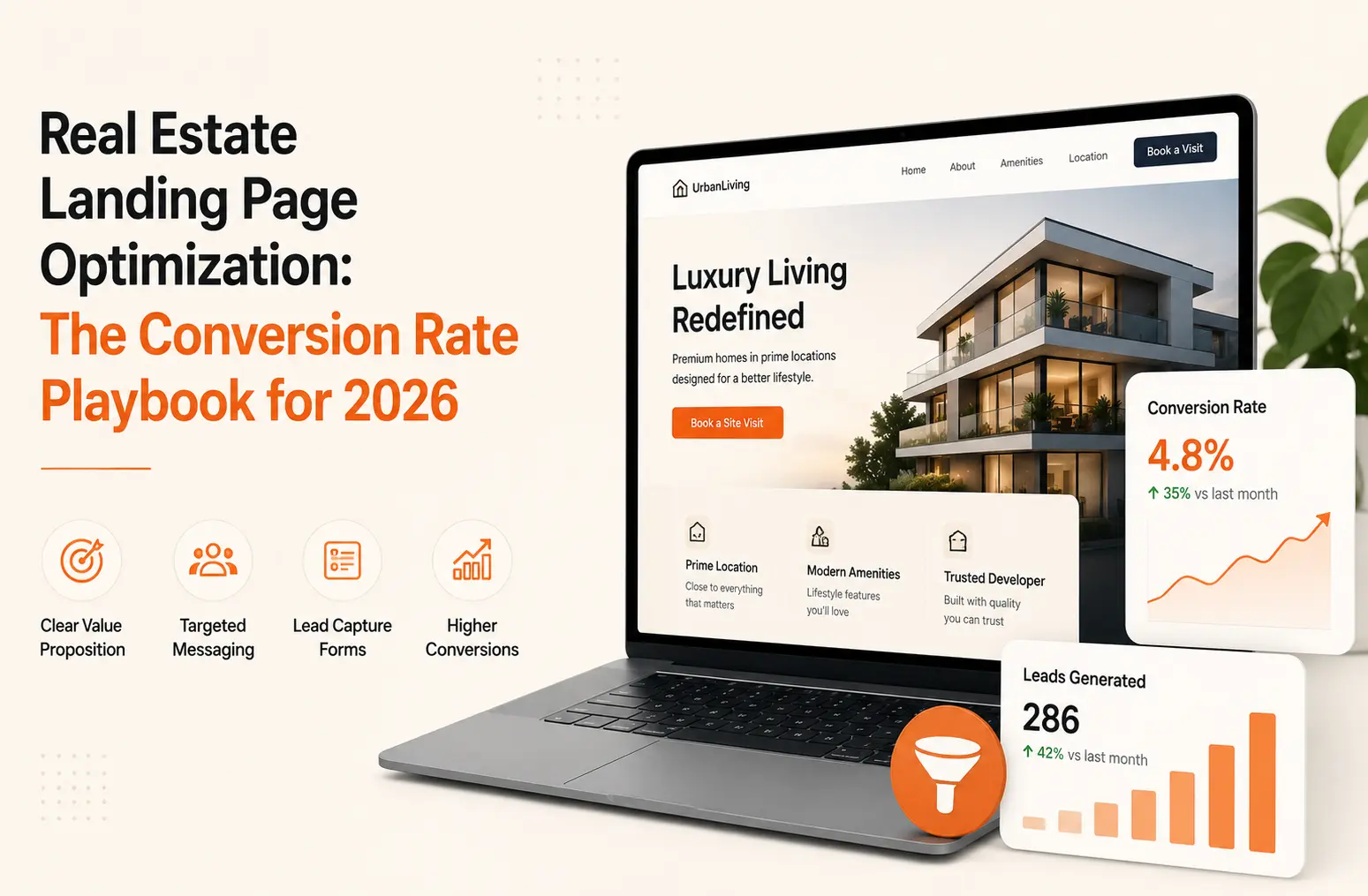 Real Estate
Real Estate Landing Page Optimization: The Conversion Rate Playbook for 2026
Most real estate landing pages convert at 2.7% while the top 25% convert at 11.45% or higher, and the gap has nothing to do with budget or design talent. This playbook breaks down exactly how to close that gap in 2026 through the nine structural elements every high-converting property landing page shares, a 15-point CRO audit you can run today, and a traffic source-specific optimization strategy that treats Google Search visitors, Meta cold audiences, and email traffic as the completely different conversion challenges they are. You'll also get the post-click architecture blueprint that connects your landing page to your CRM, automated response, and lead scoring system so conversions become pipeline, not just form fills sitting in a spreadsheet. Every section is built around measurable outcomes with specific benchmarks you can test against. If you're spending money driving traffic to a landing page that isn't hitting 5% or above, this is the playbook that fixes it.
July 28, 2026 Real Estate
Where is AI making a surprising impact on real estate support services?
AI is quietly reshaping the back-office of real estate, not just the front-office. The most surprising impact in 2026 is in support services that most operators still treat as manual: transaction coordination, escrow and title, property-management admin, compliance document review, vendor coordination, tenant communications, and bookkeeping. These functions absorb 30 to 40 percent of an operator's staff hours, and AI tools built for them now cut that load by 40 to 70 percent per workflow. Unlike front-office AI (listing generation, pricing, agent-side content) where the risk and disclosure burden is heavy, back-office AI has clearer economics, lower client-trust exposure, and faster payback. This is where operators are quietly capturing most of their real AI value in 2026, while everyone else is still debating whether ChatGPT should write listing descriptions.
July 28, 2026
Ready to book a 30-minute strategy call?
We'll map the right digital moves for your real estate business, no pitch deck, no commitment.