

Honey Saxena
Digital Marketing Expert
AI in Real Estate: 20 Powerful Applications in 2026
Published June 19, 2026|9 min read
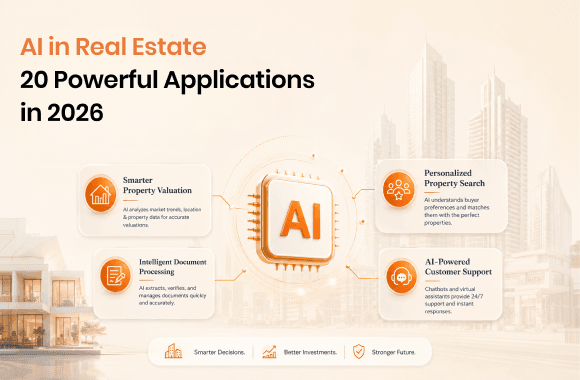
This guide breaks down AI in real estate in 2026 with 20 practical applications grouped by who uses them, from buyers and agents to investors and developers. It pairs real, attributed statistics with a clear comparison of AI versus traditional methods. You will see where AI delivers measurable gains and where it still falls short. Most useful of all, it gives a simple 30-day plan to start without wasting money on tool sprawl.
AI in real estate is software that analyzes property data, predicts market behavior, and automates manual tasks so buyers, agents, and investors make faster, smarter decisions. In 2026 it touches almost every step of a deal, from the first property search to the final maintenance ticket after move-in. If you have priced a home, screened a tenant, or shopped for a mortgage this year, you have probably already used it.
The shift has been quick. Roughly 15% of agents used AI tools in 2023. By February 2026 that figure reached 82%, according to industry adoption tracking compiled by AdAI News. I have spent more than a decade watching tech promises wash over this industry, and most fizzled. This one did not. Below are the 20 applications actually moving the needle in 2026, grouped by who uses them, plus an honest look at where AI still falls short.
What is the role of AI in real estate?
The role of AI in real estate is to turn messy, scattered property data into clear decisions. It values homes, screens leads, drafts listings, forecasts rents, and flags maintenance before something breaks. In short, AI removes guesswork because it spots patterns across millions of data points that no person could hold in their head.
Think of it like a tireless analyst sitting beside every agent and investor. It does not replace human judgment. It sharpens it. A seasoned agent still closes the deal, but AI tells them which 10 leads out of 500 are worth a call today. That focus is the whole point.
Why is AI in real estate growing so fast in 2026?
AI in real estate is growing fast because the financial upside is now proven, not theoretical. McKinsey reports that real estate companies have gained 10% or more in net operating income through AI-driven operating models, better tenant retention, and smarter asset selection. When a tool pays for itself, adoption follows.
The numbers tell the story. The global AI in real estate market is projected to grow at a compound annual rate near 35% through 2030, per The Business Research Company. McKinsey separately estimates that generative AI could create $110 billion to $180 billion or more in value across the sector. Meanwhile, a 2025 Realtor.com survey found that 82% of Americans now use AI for housing market information. Demand is pulling supply.
"We have seen real estate companies gain over 10 percent or more in net operating income through more efficient operating models, stronger customer experience, tenant retention, new revenue streams, and smarter asset selection." (McKinsey & Company)
The 20 powerful applications of AI in real estate
Here is the full list at a glance, then a breakdown of each group. These are the applications I see clients adopt first because they pay back quickly.
AI property search and recommendations
Automated valuation models (AVMs)
Virtual staging and photo enhancement
AI-powered virtual tours
Mortgage and financing pre-qualification
Lead scoring and nurturing
Auto-generated listing descriptions
Agentic CRMs
24/7 chatbots and client support
Automated comparative market analysis
Predictive market analytics
Deal sourcing and underwriting
Portfolio risk assessment
Rental yield forecasting
Dynamic rent pricing
Predictive maintenance
AI tenant screening
Energy optimization in smart buildings
Site selection and feasibility studies
Generative architectural design
How buyers and sellers use AI in real estate
Buyers and sellers feel AI first at the search and pricing stage. AI property search learns what you click, then surfaces listings that match your taste, not just your filters. Automated valuation models (AVMs) are AI systems that estimate a home's value because they analyze dozens of data points at once, from recent sales to school ratings. Modern AVMs match human appraisers within 2% to 3% on standard residential homes.
Sellers lean on virtual staging, which digitally furnishes empty rooms in minutes for a fraction of physical staging cost. AI virtual tours let serious buyers walk a home from their couch, and they tell listing teams exactly who is engaging. On the financing side, AI pre-qualification reads income and credit data to give buyers a realistic budget before they fall for a house they cannot fund. For a deeper walkthrough, see our home selling guide and property valuation explainer.
How agents and brokerages use AI in real estate
Agents use AI to win back time. Lead scoring ranks prospects by likelihood to transact, and AI-powered lead nurturing increases conversion rates by roughly 40% versus manual follow-up. That single shift changes how a small team competes with a big one.
Listing descriptions that once took 30 minutes now take 30 seconds. Agentic CRMs go further: they are projected to be used by nearly 89% of top agents in 2026, and they aim to lift conversion by around 67% while cutting admin work. Chatbots answer buyer questions at 2 a.m. so no lead goes cold. Automated comparative market analysis pulls comparable sales and prices a listing in minutes. Our real estate lead generation tips and CRM setup guide cover the rollout details.
How investors use AI in real estate
Investors use AI to find deals and dodge bad ones. Predictive analytics forecast which neighborhoods will appreciate, drawing on permits, migration, and rent trends. Deal sourcing tools scan thousands of listings overnight and flag the few that fit a buy box.
Underwriting models stress-test a deal's cash flow before a dollar moves. Portfolio risk assessment spots concentration risk across markets, and rental yield forecasting projects returns under different vacancy and rate scenarios. In my own work auditing investor workflows, the teams using AI underwriting close more deals simply because they say no faster. Browse our investment property analysis resource for templates.
How property managers use AI in real estate
Property managers use AI to protect margins. Dynamic rent pricing analyzes demand, seasonality, and leasing history to set rates that maximize revenue without hurting occupancy. Predictive maintenance is the quiet hero: by reading sensor and repair data, it forecasts equipment failure before a tenant ever calls.
AI tenant screening reviews applications consistently and flags risk, though it must be used carefully to stay fair-housing compliant. Energy optimization in smart buildings trims utility waste automatically, which both cuts cost and helps green targets. See our property management automation and predictive maintenance guides.
How developers use AI in real estate
Developers use AI to de-risk big bets. Site selection tools weigh zoning, foot traffic, demographics, and cost to rank locations objectively. Generative design software produces and tests hundreds of floor plans against budget and code, then surfaces the strongest options for a human architect to refine. These tools shorten feasibility work from weeks to days.
AI in real estate vs traditional methods: a quick comparison
The fastest way to see the value is side by side. The table below shows how AI changes everyday tasks.
Task | Traditional method | With AI in real estate |
Property valuation | Manual comps, several days | AVM in seconds, 2-3% margin |
Lead follow-up | Agent calls when free | Auto-nurture, ~40% higher conversion |
Listing copy | 30+ minutes per listing | Drafted in under a minute |
Rent pricing | Annual review, gut feel | Daily dynamic adjustment |
Maintenance | Fix after it breaks | Predicted before failure |
The pattern is consistent. AI compresses time and replaces gut feel with data, while humans keep judgment and relationships.
How do you start using AI in real estate?
Start small with one painful task, prove the value, then expand. Pick a single bottleneck like slow lead follow-up or listing copy, test one tool for 30 days, and measure the result against your old baseline. This works because narrow wins build trust faster than a giant platform rollout.
Here is a simple path I give every client:
Audit where your team loses the most hours each week.
Choose one tool that targets that exact task.
Set a clear metric, such as response time or conversion rate.
Run a 30-day pilot with a small group.
Keep what beats your baseline and drop what does not.
Skip the urge to buy ten tools at once. Tool sprawl kills adoption. For a structured rollout, our proptech adoption guide maps each step.
What are the risks and limits of AI in real estate?
The biggest risk is assuming adoption equals impact. It does not. While 82% of agents have integrated AI tools, only about 17% report a significant positive impact, and 46% see no noticeable difference, according to AI adoption tracking. Buying the tool is the easy part. Changing the workflow around it is the hard part.
Other limits are real. AVMs struggle on unique or rural properties with few comparables. Tenant screening models can encode bias if trained on skewed data, which raises fair-housing exposure. AI also writes confident nonsense at times, so a human should review anything client-facing. As McKinsey put it, generative AI can change real estate, "but the industry must change to reap the benefits." Treat AI as a power tool, not autopilot, and you stay on the right side of that line.
The bottom line on AI in real estate
The key takeaway is simple: AI in real estate now drives measurable gains across pricing, lead conversion, property management, and development, but only for teams that redesign their workflow to use it well. The 20 applications above are not future predictions. They are in production today, and adoption is heading toward an estimated 90% of agencies by 2030.
If you take one action this week, pick the single task that wastes the most of your time and test one AI tool against it for 30 days. That small experiment will teach you more than any vendor demo. The agents and investors pulling ahead in 2026 are not the ones with the most tools. They are the ones who picked the right few and rebuilt their process around them.
You do not need a data science team to begin. You need one clear problem, one tool, and a willingness to measure honestly. The technology has crossed from hype into habit, and the gap between firms that use it well and those that ignore it is widening every quarter. Start now, start small, and let the results decide your next move. Ready to map your own AI plan? Explore our real estate technology hub and free AI readiness checklist to take the next step.
- AI in real estate moved from hype to daily habit, with 82% of agents using it by early 2026.
- The market is growing near 35% per year and could create $110B to $180B in sector value (McKinsey).
- Modern AVMs value standard homes within 2% to 3% of human appraisers.
- AI lead nurturing lifts conversion by about 40% versus manual follow-up.
- The 20 applications span buyers, agents, investors, property managers, and developers.
- Adoption does not equal impact: only ~17% of agents report significant gains so far.
- The fix is workflow change, not more tools; pilot one tool for 30 days.
- Adoption is projected to reach roughly 90% of agencies by 2030.
Why trust Noseberry
Our content is written by practicing real-estate and PropTech professionals, fact-checked by a dedicated editorial team, and reviewed against the latest industry data before publication.
- 10+ years of industry expertise
- All facts independently verified
- No sponsored rankings in guides
- Updated when the industry changes
Frequently Asked Questions
What is AI in real estate in simple terms?
AI in real estate is software that analyzes property and market data to automate tasks and predict outcomes. It values homes, scores leads, writes listings, prices rent, and forecasts maintenance. The goal is faster, data-backed decisions. In 2026, about 82% of agents use it daily for everyday work.
What is the role of AI in real estate for everyday agents?
The role of AI in real estate for agents is to save time and lift conversion. It ranks leads, drafts listings, runs market analysis, and answers client questions around the clock. AI-powered nurturing raises conversion by roughly 40% over manual follow-up, letting small teams compete with much larger brokerages.
Is AI in real estate going to replace real estate agents?
No, AI in real estate is not replacing agents in 2026. It removes repetitive tasks so agents focus on negotiation, relationships, and judgment. McKinsey notes that real estate must change its workflow to benefit from AI, which means humans stay central. AI handles the data; people still close the deal.
How accurate are AI property valuations?
AI property valuations are quite accurate on standard homes. Modern automated valuation models (AVMs) match human appraisers within 2% to 3% on typical residential properties. Accuracy drops for unique, rural, or luxury homes with few comparable sales. For those, treat the AVM as a starting point and confirm with a professional appraisal.
AI in real estate vs traditional methods: which is better?
AI wins on speed and scale; traditional methods win on nuance and trust. AI prices homes in seconds, nurtures leads automatically, and predicts maintenance, while humans handle negotiation and judgment. The strongest results in 2026 come from combining both, using AI for data work and people for relationships and final decisions.
Related insights
 Real Estate
Choosing Real Estate App Tech Stack: A Developer's Guide
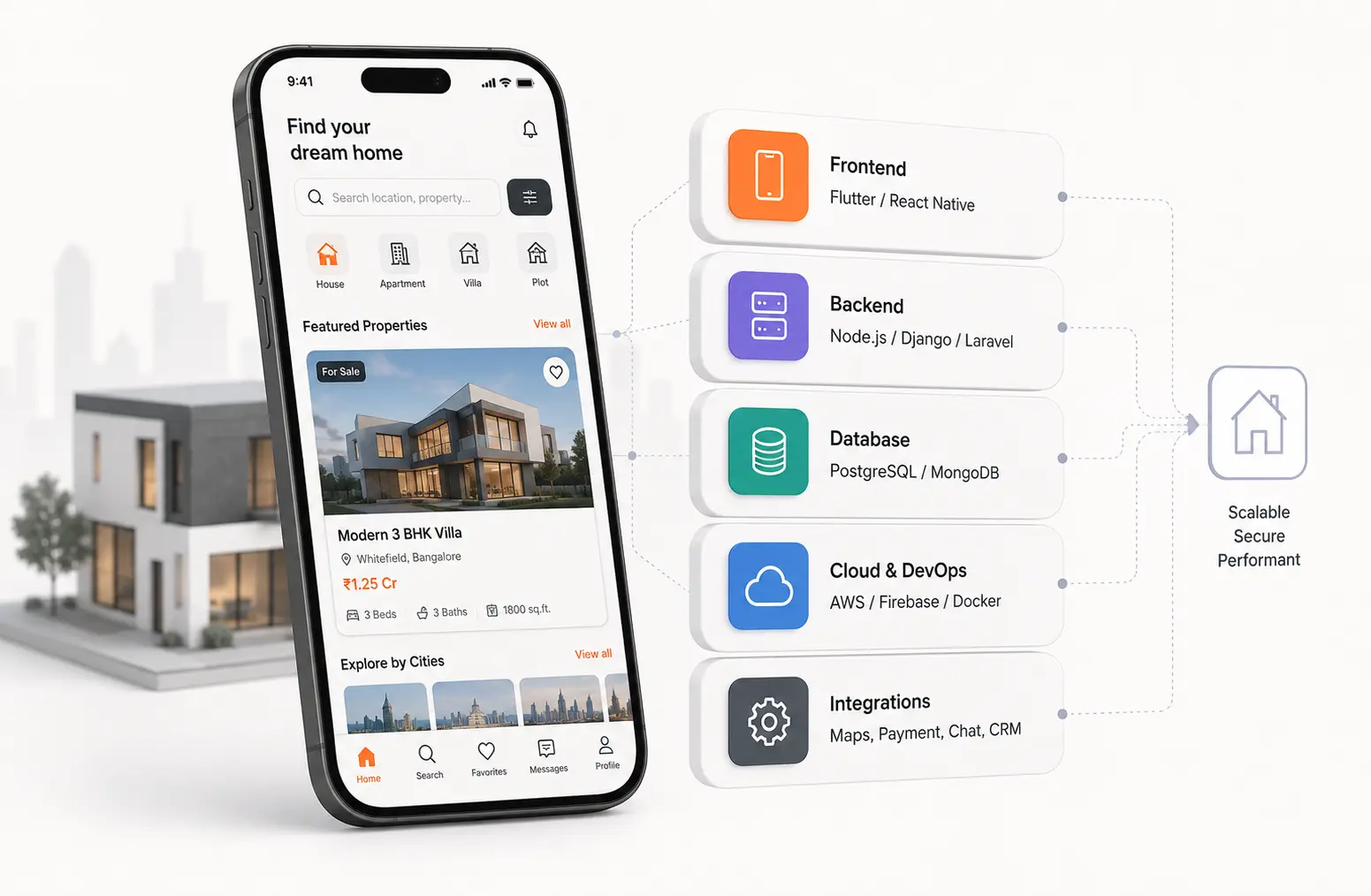
Most real estate app tech stack guides hand you a framework list and call it done, skipping the domain-specific decisions that actually determine whether your app scales or gets rebuilt in year two. This guide takes a developer-first approach to every layer of the stack, explaining why each choice matters specifically for real estate's hardest technical problems: geospatial search at scale, real-time listing data, MLS integration complexity, and AI-powered features that buyers now expect. You'll get a complete layer-by-layer breakdown from frontend through DevOps, a direct MVP-vs-production comparison table, and the most common stack mistakes that cost property app teams six figures to fix after launch. Whether you're building a consumer property search app, a brokerage CRM, or a developer sales platform, this is the guide that makes the architecture decision defensible before you write a single line of code.
July 30, 2026 Real Estate
What are use cases for machine learning and AI in real estate?
Machine learning and AI in real estate have ten proven use cases in 2026: automated valuation models (AVMs), lead scoring and prioritisation, generative listing content, image and virtual-tour enhancement, predictive maintenance for property management, tenant and buyer screening (with fair-housing caveats), demand forecasting, chatbots and conversational agents, document and contract review, and portfolio-level investment analytics. Together they cover the full stack from marketing to leasing to operations to capital markets. Not every use case delivers equal ROI. AVMs, lead scoring, generative listings, and predictive maintenance produce the fastest returns; screening and forecasting carry more risk and need more oversight. This post walks through what each use case does, what it is worth, and where the returns are already showing up.
July 28, 2026 Real Estate
Real Estate Landing Page Optimization: The Conversion Rate Playbook for 2026
Most real estate landing pages convert at 2.7% while the top 25% convert at 11.45% or higher, and the gap has nothing to do with budget or design talent. This playbook breaks down exactly how to close that gap in 2026 through the nine structural elements every high-converting property landing page shares, a 15-point CRO audit you can run today, and a traffic source-specific optimization strategy that treats Google Search visitors, Meta cold audiences, and email traffic as the completely different conversion challenges they are. You'll also get the post-click architecture blueprint that connects your landing page to your CRM, automated response, and lead scoring system so conversions become pipeline, not just form fills sitting in a spreadsheet. Every section is built around measurable outcomes with specific benchmarks you can test against. If you're spending money driving traffic to a landing page that isn't hitting 5% or above, this is the playbook that fixes it.
July 28, 2026
Ready to book a 30-minute strategy call?
We'll map the right digital moves for your real estate business, no pitch deck, no commitment.