

Anmol Sharma
SEO Expert
What Role Does SEO Play in Lead Generation for Real Estate Agents?
Published July 3, 2026|14 min read
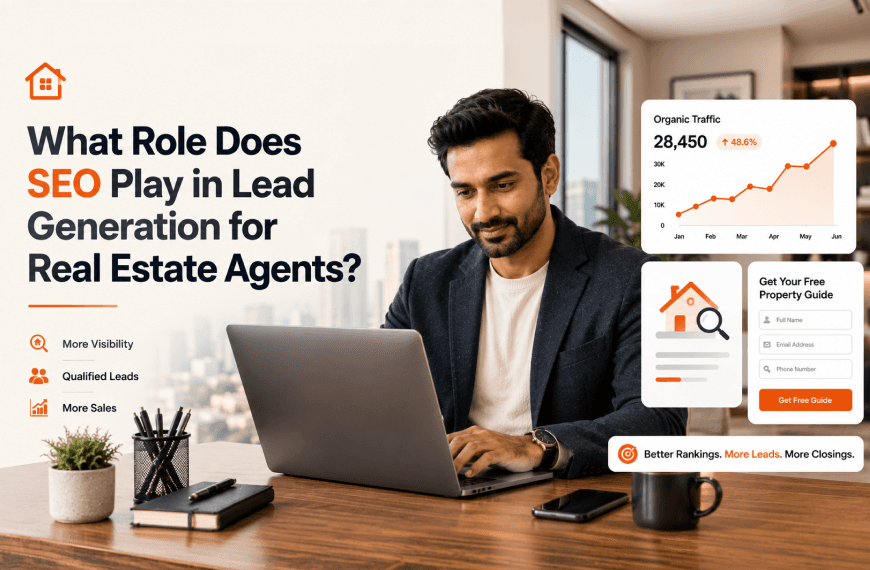
Most real estate agents either ignore SEO entirely or treat it as a branding exercise with no connection to their actual pipeline. This guide breaks down exactly what role SEO plays in lead generation for real estate agents, from the moment a buyer types a search query to the moment they book a call with you. You'll get the specific hacks that move map pack rankings, a clear comparison of SEO versus paid ads, and an explanation of AEO and GEO, the new lead sources that most agents haven't discovered yet. Every tactic is mapped to a sales outcome, not just a traffic metric. If you want an organic pipeline that keeps producing leads whether or not you're running ads, this is where you start.
SEO plays a direct role in lead generation for real estate agents by putting your website and listings in front of buyers and sellers the moment they start searching online, before they call anyone, visit a portal, or click a paid ad. It works because 97% of home buyers use the internet during their property search, according to NAR research, and the agent who ranks on page one captures that intent. The one who doesn't, simply doesn't exist in that buyer's world.
Here's the stakes. Zillow dominates paid and organic real estate search with over 230 million page views per month, according to HousingWire. Most agents accept that and pay for leads on platforms like Zillow Premier Agent. That's fine as a short-term tactic. But the moment you stop paying, the leads stop. SEO builds a lead pipeline that doesn't switch off when your budget runs out. In my decade working with property businesses at Noseberry Digitals, the agents who invest consistently in SEO are the ones who become less dependent on paid channels every year, not more. That independence compounds in value every month.
This guide covers exactly how SEO works as a lead generation engine, what the real estate SEO hacks are that agents actually use, and how to connect organic traffic to a system that converts it into booked appointments.
What Is Real Estate SEO and Why Does It Generate Leads?
Real estate SEO is the process of optimizing your website, content, and online profiles so they rank in search engine results when buyers and sellers search for properties or agents in your area, because ranking in those moments puts you in front of people who have already decided they want to transact.
This matters because search intent in real estate is high. A person typing "3 bedroom apartment near Canary Wharf" or "best real estate agent in Dubai Marina" isn't browsing casually. They're actively in a decision-making process. When your website appears at that moment, the lead comes to you pre-warmed. No cold calling, no ad retargeting, no interruption required.
Compare that to a billboard, a social media post, or even a paid ad. Those formats reach people regardless of whether they're interested in buying or selling right now. SEO, by contrast, only surfaces your content to people who are already asking the question you've answered. That's the core lead quality advantage.
According to a 2024 BrightEdge Organic Search study, organic search drives 53% of all website traffic across industries. In real estate, where a single conversion is worth thousands in commission, that traffic share translates into a significant and repeatable revenue stream for agents who build their organic presence properly.
How Does SEO Help with Lead Generation for Real Estate Agents, Step by Step?
SEO helps with lead generation for real estate agents by creating a clear chain of events: a buyer or seller searches, your content ranks, they click through, your website converts them into a form submission or phone call, and your CRM captures and follows up with that lead automatically. Every link in that chain must work.
Here's the full funnel broken down, step by step:
Keyword research identifies what buyers and sellers are actually typing. Not what you assume they're typing, but what they're actually searching for. Terms like "homes for sale in [neighborhood]," "how much is my flat worth in [city]," and "best real estate agent for first-time buyers [city]" all have different search intents and different conversion rates.
On-page SEO makes your content eligible to rank. Title tags, meta descriptions, heading structure, image alt text, internal linking, and page load speed all signal to Google that your page is the right answer for a given search.
Local SEO puts you in the map pack. For most agents, the Google Maps "3-pack" is more valuable than a page-one ranking. It shows your name, phone number, rating, and location instantly. Optimizing your Google Business Profile is the single fastest SEO win available to most agents.
Content answers the questions that bring buyers in early. Blog posts about neighborhood guides, school zones, market updates, and buying process questions attract buyers in the research phase, long before they're ready to call an agent. That early touch builds recognition and trust.
Conversion elements turn visitors into leads. A ranking page that has no contact form, no call to action, or a 5-second load time is a wasted opportunity. SEO and conversion optimization must work together.
CRM integration captures and nurtures every lead. Organic visitors who fill out a form need an instant automated response and a long-term nurture sequence. Without this, your real estate CRM and your SEO work in separate silos that never produce a compounding result.
When I work with a new real estate client, this is the audit I run first. Usually, the content is decent but steps 5 and 6 are broken. Traffic arrives, visitors bounce without converting, and the agent concludes that "SEO doesn't work for real estate." What's not working is the conversion layer, not the SEO itself.
What Are the Real Estate SEO Hacks for Agents Looking to Get More Leads?
The real estate SEO hacks that actually generate more leads are not shortcuts. They're the specific strategies that deliver outsized impact compared to the time they take. Here are the ones that consistently move the numbers:
Local SEO is where most agents should start:
Fully complete your Google Business Profile. Name, address, phone, website, business hours, property categories, a description with your target keywords, and at least 10 quality photos. An incomplete profile is an invisible profile.
Collect reviews consistently. Google reviews directly influence local search rankings. A 2025 BrightLocal survey found that 87% of consumers read online reviews before choosing a local service. In real estate, that number is likely higher given the financial stakes. Reviews with location and transaction type keywords (like "sold my apartment in Shoreditch quickly") act as keyword signals that support your local rankings.
Build neighborhood-specific landing pages. Instead of one generic "properties for sale" page, create dedicated pages for every neighborhood or area you cover. "Properties for sale in [Neighborhood Name]" pages rank for hyper-local searches that national portals rarely target well.
Answer long-tail questions in blog content. Queries like "is it a good time to buy property in [city] in 2026" or "what fees do buyers pay when purchasing a property in [country]" have lower competition than generic keywords and attract buyers earlier in their journey, when relationship-building is easiest.
Optimize for AEO (Answer Engine Optimization). Search engines increasingly pull direct answers from pages that structure information clearly. Use H2 question headings followed by 40-60 word direct answers. This is exactly how this post is written, because it works for ranking in featured snippets, voice search, and AI answer engines like ChatGPT and Perplexity.
Fix technical issues first. A beautiful website that loads in 6 seconds will not rank. Core Web Vitals (page load speed, visual stability, interactivity) are confirmed Google ranking factors. Most agents don't know their site speed score, let alone how to fix it.
Local SEO: The Highest-ROI SEO Channel for Real Estate Agents
Local SEO is high-ROI for real estate agents because property buying and selling are inherently local actions, and Google prioritizes local results when it detects location intent in a search query. The map pack appears above standard organic results, meaning a local SEO win is more visible than a standard page-one ranking.
Here's the practical picture. A buyer in your target area searches "real estate agent near me" or "top estate agents in [city]." Google returns three local results with star ratings, reviews, and click-to-call buttons. If your Google Business Profile is optimized, you appear there. If it isn't, a competitor does. You don't even need to outrank anyone in organic results. You just need to win the map pack.
The factors that determine local SEO ranking include: Google Business Profile completeness, review quantity and recency, consistency of your name/address/phone (NAP) across all online directories, local citations, and the presence of local keywords on your website. None of these are technically complex. They're just consistently overlooked by most agents.
At Noseberry Digitals, we pair local SEO with our clients' digital marketing strategy because the two compound each other. A well-ranked local listing drives traffic to a well-optimized website. The website converts that traffic. The CRM nurtures the lead. That's a closed loop.
Real Estate SEO vs. Paid Ads: Which Generates Better Leads?
Factor | Real Estate SEO | Paid Ads (Google/Meta) |
|---|---|---|
Lead cost over time | Decreasing (compounds) | Flat or increasing |
Traffic when paused | Continues ranking | Stops immediately |
Trust signal | High (organic = editorial) | Lower (clearly labeled as ads) |
Time to results | 3-6 months to build | Immediate traffic |
Lead quality | High intent, research phase | Variable; depends on targeting |
Long-term ROI | Very high if maintained | Good short-term, diminishing without optimization |
Best use case | Building sustainable pipeline | Fast-start or campaign-based volume |
The honest answer: neither beats the other outright. They serve different parts of the same goal. Paid ads give you immediate volume while SEO builds. Once SEO is producing consistent organic leads, you can reduce paid spend in areas where you rank organically and reallocate budget to markets or property types where you haven't built authority yet.
The agents and brokerages pulling the most leads in competitive markets typically run both. They use paid ads for fast response to new projects or campaigns, and they use SEO to build the long-term authority that makes every channel cheaper over time because their brand appears everywhere a buyer looks.
For teams running paid acquisition alongside organic, our Google Ads guide for real estate lead generation walks through exactly how to configure campaigns so you're tracking real conversions, not just form fills.
How Does Content Marketing Fit Into Real Estate SEO Lead Generation?
Content marketing is the fuel that powers real estate SEO lead generation because Google ranks pages that answer questions well, and content is what answers questions. Without a content strategy, most real estate websites consist of a homepage, an about page, and a contact form. That's not enough to rank for anything beyond your own name.
Here's what a strong real estate content strategy looks like in practice:
Content types that generate leads through SEO:
Neighborhood guides: "Living in [Neighborhood]: What Buyers Need to Know" ranks for long-tail searches and positions you as a local authority. Buyers planning a move to a new city often read 4-6 of these before shortlisting agents.
Market update posts: Monthly or quarterly posts on price movements, inventory levels, and buyer/seller trends attract buyers and investors doing research. These age well and rank for date-specific searches ("real estate market [city] 2026").
Buyer and seller guides: Step-by-step posts on the purchase process, financing, legal requirements, and fees answer the questions buyers type into Google before they even know which agent they want to use. You answer their question; they remember your brand.
FAQ pages: Structured FAQ content ranks for voice search queries and featured snippets. A well-structured FAQ page on your site can appear in Google's "People Also Ask" boxes, a high-visibility placement that drives traffic without even requiring a click-through in some cases.
Combine your content strategy with a clear SEO and AEO plan from the start. Creating content without keyword research and AEO structure is like building a house without a floor plan. The effort happens, but the result is unpredictable.
AEO and GEO: The New Dimensions of Real Estate SEO That Agents Are Missing
AEO (Answer Engine Optimization) and GEO (Generative Engine Optimization) are the practices of optimizing content so it's surfaced by AI answer engines like ChatGPT, Perplexity, Google's AI Overview, and Gemini, because these tools are now competing directly with traditional search for buyer attention.
When a buyer asks ChatGPT "what are the best neighborhoods to buy a flat in [city]?" they expect a direct, confident answer. The content that gets cited as the source of that answer is the content that's structured clearly, states facts declaratively, and is published on a credible, regularly updated domain. That's AEO and GEO in practice.
For real estate agents, this creates a new lead generation opportunity that most competitors haven't recognized yet. If your neighborhood guide is the source cited when an AI engine answers a property question, your brand gets mentioned to every buyer who asked that question. That's passive, automated brand exposure at a scale that no single social media post can match.
The SEO principles and AEO principles overlap more than most people realize. Both reward: direct answers at the top of each section, factual claims with attribution, clear heading hierarchy, mobile-friendly formatting, and regularly refreshed content. The main additional requirement for AEO is that each paragraph should function as a self-contained, quotable unit. If an AI engine can extract your paragraph and use it as a standalone answer, your content is AEO-optimized.
Our post on AI in real estate applications covers how AI is changing the full property buying journey, including the search phase where AEO matters most.
Why Your Real Estate Website Is the Foundation of All SEO Lead Generation
Your real estate website is the single most important asset in your SEO lead generation strategy because every ranking, every backlink, every Google Business Profile listing, and every piece of content ultimately directs traffic to a web page. If that page doesn't convert, the SEO investment above it produces nothing.
A high-converting real estate website built for SEO lead generation needs:
Fast load times. Google uses Core Web Vitals as a ranking factor. A page that takes more than 3 seconds to load loses most of its mobile visitors before they even see your content.
Mobile-first design. Over 60% of property searches happen on mobile devices. A site that doesn't work on a phone isn't just a bad user experience; it's a Google ranking penalty.
CRM-connected lead forms. Every form on your site should trigger an instant CRM entry and an automated follow-up response. An organic visitor who fills out a form and hears nothing for 24 hours is a cold lead by the time you call.
IDX or property feed integration. Live listings keep your site updated automatically, giving Google fresh content to index regularly without manual work from your team.
Schema markup. Schema tells Google and AI engines exactly what your page is about: your business type, location, reviews, and content structure. Without schema, you're leaving featured snippet and knowledge panel placements on the table.
Internal linking structure. A well-linked site passes authority from your high-traffic pages to your conversion pages. Most agent websites have no internal link strategy at all.
When we build real estate websites at Noseberry Digitals, these elements aren't optional add-ons. They're the baseline specification. Every additional layer of SEO effort multiplies when the site underneath it is built to convert.
How to Measure Whether Your Real Estate SEO Is Actually Generating Leads
Most real estate agents track the wrong SEO metrics. Organic traffic is a vanity metric if none of that traffic converts. Rankings are satisfying to watch but don't pay commission. The metrics that tell you whether your real estate SEO is working as a lead generation channel are:
The five metrics that matter for real estate SEO lead generation:
Organic traffic to conversion rate: What percentage of organic visitors fill out a form, call you, or start a chat? Industry benchmarks vary, but 1-3% is a reasonable starting point. Under 0.5% means your conversion layer needs work.
Leads from organic search by source page: Which blog posts, neighborhood pages, or listing pages are generating the most inquiries? This tells you what content to create more of.
Keyword ranking for local intent terms: Are you appearing in the map pack and on page one for your target area and property type searches?
Google Business Profile views and actions: How many people viewed your GBP listing, clicked for directions, called you, or visited your website from it?
Organic lead-to-appointment conversion rate: Of the leads that came in through organic search, how many booked a call, site visit, or valuation request?
Set up Google Search Console and Google Analytics 4 before any other tool. They're free. They give you keyword ranking data, organic traffic by page, and conversion tracking. Connect them to your real estate CRM so every organic lead has a source tag that follows them through the pipeline to a closed deal.
For a broader look at how to track the full funnel from marketing channel to closed transaction, our post on real estate performance marketing covers the attribution setup in detail.
Conclusion
The role of SEO in lead generation for real estate agents is simple to state and genuinely powerful when applied consistently: SEO puts you in front of buyers and sellers at the exact moment they're searching, builds trust through visibility before any conversation happens, and creates a lead pipeline that compounds over time rather than resetting every time a budget cycle ends.
The key takeaway is this: SEO is not a marketing tactic you try once and evaluate after 30 days. It's an infrastructure investment, like a good CRM or a well-configured website. The agents who treat it that way, who build neighborhood content, optimize their Google Business Profile, fix their site speed, and connect their organic traffic to an automated follow-up system, consistently end up with the most cost-efficient lead pipeline in their market.
Here's where to start if you haven't already. Audit your Google Business Profile today. Make sure it's 100% complete, has at least 10 photos, and shows your target keywords in the description. That single task can move your map pack ranking within weeks and costs nothing.
Then look at your top five website pages in Google Search Console and ask honestly: do they convert? Is there a clear call to action? Does a form submission trigger an instant response? If the answer is no, fix the conversion layer before spending another hour on content creation.
If you want a team to assess your current SEO and lead generation setup end to end, Noseberry Digitals works specifically with property businesses. We've done this across 14+ countries and across every property type from residential sales to commercial leasing to co-living.
Book a free strategy call at noseberrydigitals.com and we'll show you exactly where your organic pipeline is leaking and how to close it.
- SEO generates real estate leads by matching your content to the exact moment a buyer or seller searches online, capturing high-intent traffic no other channel reaches as efficiently.
- 97% of home buyers use the internet during their property search (NAR), making search visibility a non-negotiable part of any agent's lead generation strategy.
- Local SEO and a fully optimized Google Business Profile are the fastest and highest-ROI SEO investments available to most real estate agents right now.
- Google reviews directly influence local search ranking; 87% of consumers read reviews before choosing a local service, making review collection a lead generation tactic, not just reputation management.
- SEO builds a lead pipeline that compounds over time, unlike paid ads which stop producing leads the moment spend is paused.
- AEO (Answer Engine Optimization) is the emerging dimension of real estate SEO that positions agents to be cited by AI tools like ChatGPT, Perplexity, and Google's AI Overview.
- Content types with the highest SEO lead generation ROI include neighborhood guides, market update posts, buyer/seller process guides, and structured FAQ pages.
- Real estate SEO only produces leads when the website underneath it is built to convert: fast load times, mobile-first design, CRM-connected forms, and clear calls to action.
- Paid ads and SEO are not competing strategies; they serve different parts of the pipeline and produce the best results when used together.
- The metrics that actually measure SEO lead generation success are organic-to-conversion rate, leads by source page, and organic lead-to-appointment rate, not traffic or rankings alone.
Why trust Noseberry
Our content is written by practicing real-estate and PropTech professionals, fact-checked by a dedicated editorial team, and reviewed against the latest industry data before publication.
- 10+ years of industry expertise
- All facts independently verified
- No sponsored rankings in guides
- Updated when the industry changes
Have Any Questions?
What role does SEO play in lead generation for real estate agents?
SEO plays the role of putting real estate agents in front of active buyers and sellers at the moment they search online, before they've contacted anyone. Because 97% of home buyers use the internet in their property search according to NAR, organic visibility directly determines whether those buyers find you or a competitor. SEO generates leads by matching your content to the specific questions buyers and sellers type into Google.
How can SEO help with lead generation for real estate agents who are just starting out?
SEO helps new real estate agents generate leads by building organic visibility in local search results, which levels the playing field with more established competitors. Starting with a fully optimized Google Business Profile and a few well-written neighborhood guide posts costs almost nothing and can produce consistent local inquiries within 3-6 months. Starting early is the strategic advantage, since domain authority and ranking history compound over time.
What are the real estate SEO hacks for agents looking to get more leads fast?
The real estate SEO hacks that generate leads fastest are: fully completing your Google Business Profile (free, fast, and directly affects map pack ranking), creating neighborhood-specific landing pages for every area you cover, collecting Google reviews consistently, and structuring blog content with question-based H2 headings followed by direct answers to rank in featured snippets. None of these require technical expertise and all of them produce measurable results within weeks to months.
How long does real estate SEO take to generate leads?
Real estate SEO typically takes 3-6 months to produce consistent organic leads, with Google Business Profile optimization showing results the fastest (often within weeks). The timeline depends on your local competition level, how regularly you publish content, and the technical health of your website. SEO compounds over time: a year of consistent effort produces significantly more leads than the first month, and that pipeline continues even when you pause active work.
Is SEO or paid ads better for real estate lead generation?
Neither is universally better; they serve different goals. Paid ads produce immediate traffic but stop generating leads the moment you pause spend. Real estate SEO builds long-term visibility that compounds over time and continues ranking without ongoing ad spend. Most high-performing real estate businesses use both: paid ads for fast results in new markets or campaigns, and SEO to build the organic pipeline that makes every channel more cost-efficient over time.
What is local SEO and why does it matter for real estate agents?
Local SEO is the practice of optimizing your online presence so you appear in location-based search results, particularly Google's map pack, when buyers and sellers search for agents or properties in a specific area. It matters for real estate agents because property searches are inherently local, and the map pack appears above organic results, giving local SEO wins prime visibility. A fully optimized Google Business Profile with consistent reviews is the core of local SEO for agents.
Why is my real estate SEO not generating any leads?
Real estate SEO stops generating leads when the conversion layer is broken, even if rankings are strong. Common causes include: no clear call to action on landing pages, slow page load times that drive visitors away before they convert, forms that don't connect to a CRM for instant follow-up, or content that attracts research-phase visitors who aren't ready to contact an agent. Audit your top organic pages and check whether each one has a clear next step and a sub-2-second load time.
What content should real estate agents create for SEO lead generation?
Real estate agents should create neighborhood guides (ranking for local searches and building authority), market update posts (attracting investors and buyers doing research), buyer and seller process guides (answering questions before prospects contact anyone), and FAQ pages optimized for voice and AI search. Each piece of content should target a specific keyword with local intent and include a conversion element: a contact form, a valuation tool, or a call-to-action to book a consultation.
How does AEO differ from traditional SEO for real estate agents?
AEO (Answer Engine Optimization) differs from traditional SEO in that it optimizes content for AI answer engines like ChatGPT, Perplexity, and Google's AI Overview, not just for Google's standard search index. Traditional SEO focuses on ranking a page in search results. AEO focuses on making your content's answers clear and citable enough that AI tools surface your content when buyers ask conversational property questions. Both reward the same fundamentals: direct answers, clear structure, and factual claims with attribution.
Should real estate agents hire an SEO agency or do it themselves?
Real estate agents should handle the basics themselves (Google Business Profile, review collection, basic blog publishing) and consider hiring an agency when they want to scale content production, fix technical website issues, or compete in high-volume markets. The clearest signal that it's time to hire is when organic traffic is growing but conversion rates are flat, or when you're ranking for informational terms but not for transactional local searches. An agency adds the most value when the foundation is already in place.
Related insights
 Real Estate
What should a PMS do for small-scale property managers?
The ideal PMS for a small-scale property manager (typically 10 to 500 units) should do ten things well: capture every rent payment automatically, log every maintenance ticket with photo evidence and vendor dispatch, hold every tenant lease and document in one searchable place, generate owner and investor statements in one click, run automated rent reminders and late-fee escalation, screen tenants with credit and eviction history, sync with the operator's accounting stack (QuickBooks, Xero), work on mobile so field checks and unit walks happen on a phone, integrate with a website for listing marketing and online applications, and produce broker-visible dashboards that let the manager see occupancy, delinquency, and cash flow at a glance. AppFolio Property Manager Core, Buildium, DoorLoop, Rentec Direct, and Hemlane are the platforms most adopted at this scale in 2026, at $1.40 to $4 per unit per month. This post covers what the ideal PMS should do, which platforms actually deliver it, and how to pick without overpaying.
August 22, 2026 Real Estate
Which AI tools work best for real estate developers in 2026?
The best AI tools for real estate developers in 2026 fall into eight categories that map to the developer lifecycle: land sourcing and site selection (Cherre, Reonomy, HouseCanary, LandGate), feasibility and financial modelling (Northspyre, TestFit, custom Excel plus GPT), design and architectural planning (Autodesk Forma, Higharc, Cove.tool, Snaptrude), construction management and progress tracking (Procore AI, Autodesk Construction Cloud, Buildots, Doxel, OpenSpace), pre-launch marketing and renders (Restb.ai, MidJourney, Adobe Firefly), off-plan sales CRM (Salesforce, HubSpot, Follow Up Boss, Rechat), ESG and net-zero analytics (Measurabl, Enertiv, Aquicore), and handover to operations (BIM AI, tenant portal AI). Used well, they cut construction cost 10 to 20 percent, compress design cycles 30 to 50 percent, and lift off-plan sales conversion 20 to 40 percent. Used badly, they burn subscription budget and produce plans that do not build. This post walks through each category, which tools actually work, and how to sequence adoption.
August 22, 2026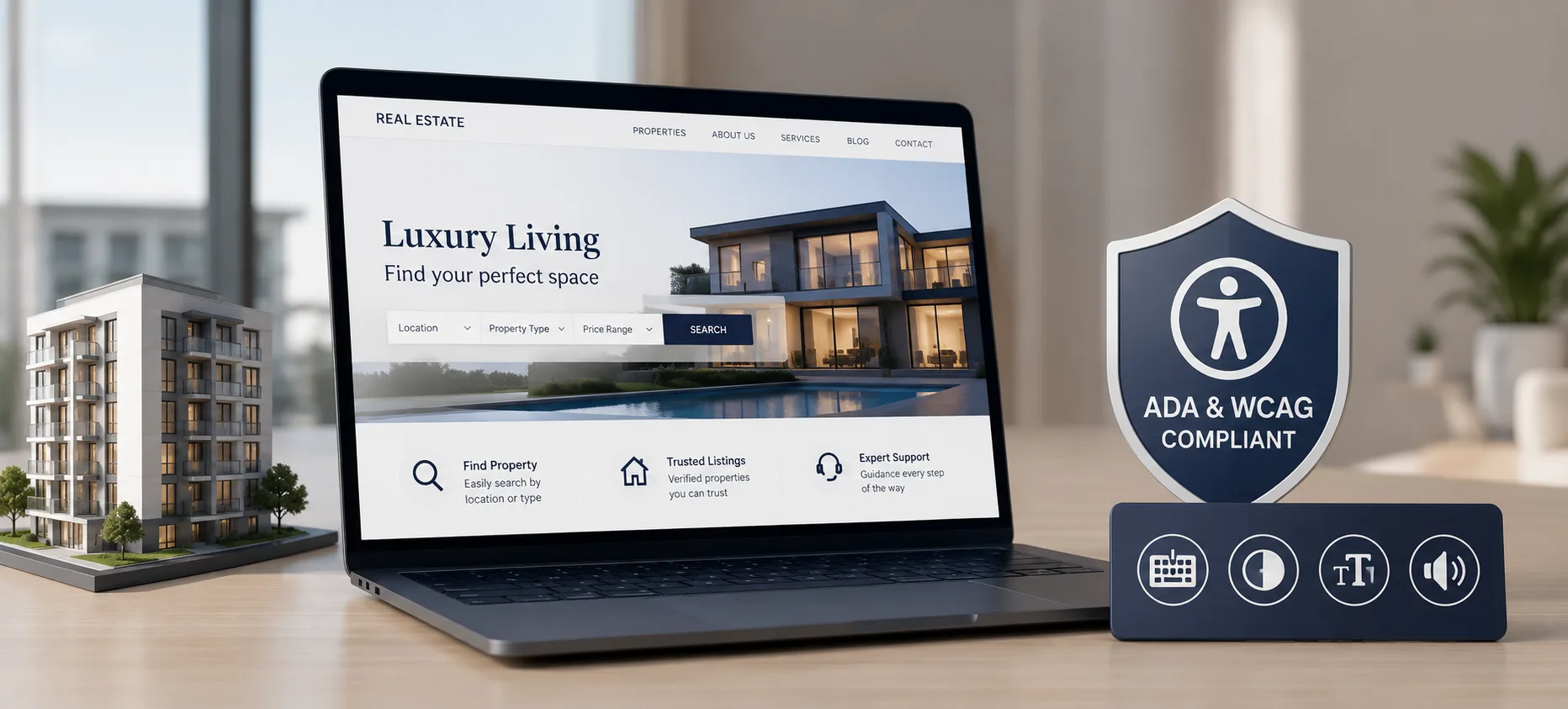 Real Estate
ADA & WCAG Accessibility Compliance for Real Estate Websites: What Operators Must Fix Before They Get Sued
This blog breaks down ADA and WCAG accessibility compliance for real estate websites, focused on what actually creates legal exposure. It explains why WCAG 2.1 Level AA has become the practical legal standard even without a formal Title III regulation for private businesses. It walks through the six accessibility failures responsible for 96% of all detected errors across the web, using real listing-page examples. It also warns against relying on accessibility overlay widgets, citing the FTC's 2025 action against accessiBe over deceptive compliance claims. The piece closes with a step-by-step audit process, an in-house versus compliance-partner comparison, and a 10-question FAQ section.
August 20, 2026
Ready to book a 30-minute strategy call?
We'll map the right digital moves for your real estate business, no pitch deck, no commitment.