

Atul Kumar Yadav
Founder, Noseberry Digitals
What Are the Trends in Real Estate Technology in 2026
Published June 30, 2026|14 min read
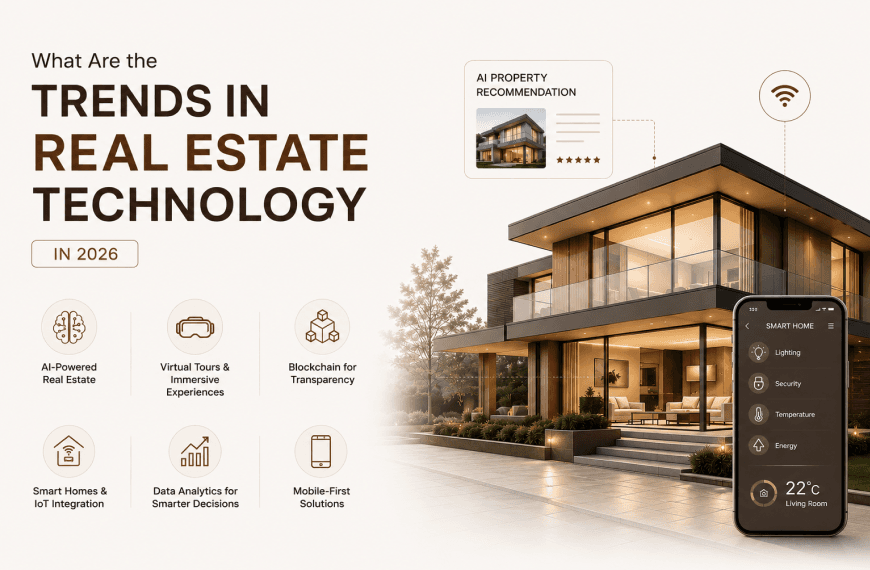
Real estate technology isn't evolving gradually anymore, it's accelerating fast, and most property businesses are already behind. This guide breaks down the trends actually moving the needle in 2026: agentic AI, predictive seller analytics, digital twins, drone data collection, and AI-enhanced CRMs. You'll see real adoption numbers, documented sales impact, and a clear framework for deciding which trend to act on first. Instead of a generic trend list, this post connects each innovation to a specific business outcome. If you want to know what's actually worth your attention this year, start here.
The trends in real estate technology for 2026 center on AI-powered lead scoring, predictive analytics, digital twins, drone-based data collection, and agentic CRM systems that automate the entire sales pipeline. These aren't experimental tools anymore. They're becoming the baseline that separates competitive property businesses from the ones falling behind.
Here's why this matters right now. Real estate technology trends used to move slowly: a new CRM here, a website redesign there, maybe a virtual tour platform every few years. That pace is gone. In my decade working with property operators across multiple markets at Noseberry Digitals, I've watched the gap between early adopters and late adopters widen faster in the last 18 months than in the previous five years combined. This guide breaks down exactly which trends in real estate technology matter, why they matter, and what to actually do about them.
What Is Driving Real Estate Technology Trends in 2026?
Real estate technology trends in 2026 are being driven by three forces: AI maturing from experimental to operational, buyer expectations shifting toward instant digital experiences, and the sheer cost of manual processes becoming impossible to justify. Together, these forces are pushing every part of the property industry toward automation.
The AI shift is the biggest one. Artificial intelligence in real estate has moved past chatbots and gimmicky features. It's now doing comparative market analysis, predicting which homeowners are likely to sell, and running entire marketing campaigns with minimal human input. That's a fundamentally different category of tool than what existed even two years ago.
Buyer expectations have shifted just as fast. Today's buyers expect instant responses, digital-first property exploration, and personalized recommendations before they ever speak to a human agent. A property business that can't deliver that experience loses the lead before the conversation even starts.
And the cost argument is straightforward. According to a 2025 analysis from Inoxoft, only 32% of real estate firms currently use CRM software, meaning the majority are still running their pipeline through spreadsheets and inboxes. The businesses making that switch now are capturing market share from the ones who have not.
Trend 1: Agentic AI Is Replacing Manual Workflows
Agentic AI is the most significant trend in real estate technology heading into 2026 because it doesn't just assist with a task, it completes the task end to end without ongoing human input. An agentic AI system can receive a maintenance request, prioritize it by urgency, dispatch the right vendor, and follow up on completion, all without a property manager touching it.
This is a meaningful jump from earlier AI tools, which mostly answered questions or drafted content. Agentic systems take action. In sales and marketing specifically, agentic AI can monitor live market data continuously and adjust pricing recommendations automatically, something that used to require a full day of manual analysis.
One case documented by Inoxoft in 2026 found that a property business replacing manual pricing analysis with a continuously monitoring AI agent saw a 25% increase in both sales volume and profit margin within 6 months. That's not a marginal efficiency gain. That's a structural change to how the business operates.
Agentic AI is expected to reach mainstream adoption in real estate between 2026 and 2027, according to Inoxoft's technology trend analysis. Property businesses that start experimenting now will have a real head start once adoption becomes standard.
Why Are AI-Enhanced CRMs Becoming the Default in Real Estate Technology Trends?
AI-enhanced CRMs are becoming the default because they don't just store contact data anymore, they actively score leads, predict conversion likelihood, and trigger personalized follow-up without manual configuration for every scenario. A CRM with AI baked in turns a static database into a system that gets smarter the longer you use it.
The adoption numbers back this up. AI-enhanced CRMs are projected to be used by nearly 89% of top agents in 2026, according to Ascendix Technologies. The stated goal of agentic CRMs is to boost conversion rates by 67% while reducing the administrative workload that eats into an agent's selling time.
Arthur Ambartsumyan, tech director at Ascendix Technologies, frames the time savings clearly: "Using CRM AI agents can save up to 12-16 hours per week." For a single agent, that's nearly two full working days returned to actual selling activity instead of data entry and manual follow-up.
This is exactly the kind of system we configure for clients building out a real estate CRM. The technology only delivers results when the underlying data structure is clean and the automation rules are mapped to your actual sales process, not a generic template.
Trend 2: Predictive Analytics Is Changing Who Agents Talk to First
Predictive analytics in real estate technology uses machine learning to analyze patterns in public records, ownership duration, equity positions, and behavioral signals to identify which homeowners are most likely to sell in the near future. This flips prospecting from reactive to proactive.
Instead of waiting for a seller to list and then competing with every other agent for the listing, predictive analytics tools surface likely sellers before they've made the decision public. Agents using these prospect lists can reach out earlier, build a relationship before the property hits the market, and often win the listing without a competitive pitch process.
The same underlying technology is reshaping pricing too. AI-powered comparative market analysis tools now process thousands of data points, including recent sales, active listings, market velocity, and neighborhood-level factors, to generate pricing recommendations faster and often more accurately than manual comps.
For sales and marketing teams, this trend connects directly to lead generation strategy. If you want to understand how predictive tools and AI fit into your broader marketing stack, our post on AI in real estate applications covers the practical side of implementation.
Trend 3: Digital Twins Are Reshaping Pre-Sale Marketing
A digital twin is a live, continuously updated 3D model of a physical building that tracks real-time data points like occupancy, energy usage, and maintenance status, because it lets property managers and buyers interact with an accurate digital version of the asset before, during, and after construction.
This matters most for off-plan sales. Buyers can now explore a finished apartment in photorealistic 3D long before construction is complete. That reduces the uncertainty that typically stalls off-plan deals and increases buyer commitment earlier in the sales cycle.
Modern digital twin structures integrate more than 8,000 real-time data points according to current industry benchmarks, and around 70% of smart buildings are expected to use digital twins by 2025-2026. For investors, a building with a live digital model and a documented performance history becomes a more defensible asset at exit, since data replaces assumptions with evidence.
This is one of the clearer examples of a real estate technology trend that benefits both sides of the transaction. Developers sell faster. Buyers commit with more confidence. Asset managers operate the building more efficiently after handover.
Trend 4: Drone Technology and Visual Data Collection Keep Growing
Drones have moved from a nice-to-have marketing extra to one of the most widely adopted tools in the industry. Drone photography and video are now used by 52% of realtors, according to NAR's 2025 Realtors Technology Survey, making it the highest-adoption emerging PropTech category tracked in the report.
What's driving that adoption isn't just better listing photos. Drones now feed data directly into mapping and GIS tools, support site progress monitoring for developments under construction, and provide land survey data that used to require a separate, expensive site visit.
For marketing specifically, aerial footage gives buyers spatial context that ground-level photography simply can't. A buyer can see a property's relationship to nearby amenities, road access, and neighboring developments in a single shot. That context shortens the buyer's research phase and speeds up decision-making.
Trend 5: Marketing Automation and AI Content Tools Are Standard, Not Optional
Marketing automation has crossed from "advanced tactic" to "baseline expectation" in 2026. Generative AI tools now produce listing descriptions, social posts, and email campaigns in a fraction of the time manual content creation used to take, and the quality gap has closed significantly.
The data on automation impact is striking. According to a study by the Annuitas Group, companies using marketing automation tools increased lead engagement and improved sales by 451%, while lead quantity increased by 80%. Few technology investments in any industry produce numbers like that.
Here's what this looks like in practice for a property business:
A new listing triggers an automated multi-channel campaign across email, social, and paid ads.
AI generates the listing description and ad copy variations automatically.
Behavioral email sequences nurture leads based on what they've clicked, viewed, or downloaded.
Automated review requests fire after every closed deal or completed site visit.
Weekly reporting dashboards pull performance data without anyone manually building a spreadsheet.
This is the kind of system we build into every client's digital marketing stack, because the trend isn't really about having more tools. It's about removing every manual step that slows a lead down on its way to becoming a closed deal.
Real Estate Technology Trends Compared: Adoption Rate and Sales Impact
Here's a side-by-side look at where each major trend stands on adoption and what kind of measurable impact it's producing in 2026:
Technology Trend | Current Adoption Rate | Measurable Sales Impact |
|---|---|---|
eSignature tools | 79% of realtors (NAR 2025) | Faster transaction close times |
Social media marketing | 75% of realtors (NAR 2025) | Higher engagement, brand visibility |
Drone photography/video | 52% of realtors (NAR 2025) | Better listing engagement, faster decisions |
CRM software | 32% of real estate firms (Inoxoft) | Reduced lead leakage, faster follow-up |
AI-enhanced CRMs | Projected 89% of top agents by 2026 (Ascendix) | 67% conversion rate lift |
Digital twins | 70% of smart buildings by 2025-2026 | Faster off-plan sales, asset valuation gains |
Agentic AI systems | Mainstream by 2026-2027 (projected) | 25% lift in sales volume and margin (case study) |
Marketing automation | Growing rapidly, no firm % yet | 451% increase in qualified leads (Annuitas Group) |
The clear pattern: tools with higher adoption rates tend to be the ones that are easiest to implement (eSignatures, social media), while the technologies with the biggest sales impact (AI CRMs, marketing automation) still have meaningful room to grow before most of the market catches up.
How Should a Property Business Decide Which Technology Trends to Adopt First?
A property business should adopt real estate technology trends in the order that solves its biggest current bottleneck, not in the order that feels most impressive. The right starting point depends entirely on where leads are currently getting lost.
Start by auditing your funnel honestly. Some practical questions to work through:
Are leads sitting unanswered for hours because there's no instant response system?
Is your team spending time on manual content creation that AI could handle in minutes?
Are you missing sellers who haven't listed yet because you have no predictive prospecting tool?
Is your reporting so thin that you can't tell which marketing channel actually closes deals?
Whichever question stings the most points to your next investment. From auditing 200+ property business websites and marketing stacks, the most common bottleneck we see isn't a lack of technology. It's technology that was bought but never properly integrated into the actual sales process.
If your foundation isn't solid yet, start with a real estate website that can actually support these technologies (fast load times, CRM integration, mobile-first design) before layering on AI tools that won't have anywhere good to send the leads they generate.
- The biggest trends in real estate technology for 2026 are agentic AI, AI-enhanced CRMs, predictive analytics, digital twins, and mature marketing automation.
- Agentic AI completes entire tasks independently and is expected to reach mainstream adoption in real estate between 2026 and 2027.
- AI-enhanced CRMs are projected to be used by 89% of top agents in 2026, with conversion rate gains of up to 67%.
- Only 32% of real estate firms currently use CRM software, leaving most of the market still running on spreadsheets and manual follow-up.
- Predictive analytics tools now identify likely sellers before they list, flipping prospecting from reactive to proactive.
- Digital twins are projected to power 70% of smart buildings by 2025-2026, reshaping off-plan sales and asset management.
- Drone photography and video are used by 52% of realtors, the highest adoption rate of any emerging PropTech category.
- Marketing automation tools have driven a documented 451% increase in lead engagement and sales, according to Annuitas Group research.
- The right trend to adopt first depends on your funnel's biggest bottleneck, not which technology feels most impressive.
- None of these trends are expected to replace real estate agents; they're consistently framed as tools that free up time for higher-value client work.
Why trust Noseberry
Our content is written by practicing real-estate and PropTech professionals, fact-checked by a dedicated editorial team, and reviewed against the latest industry data before publication.
- 10+ years of industry expertise
- All facts independently verified
- No sponsored rankings in guides
- Updated when the industry changes
Have Any Questions?
What are the trends in real estate technology for 2026?
The biggest trends in real estate technology for 2026 are agentic AI systems that complete tasks without manual input, AI-enhanced CRMs projected to reach 89% adoption among top agents, predictive analytics for identifying likely sellers, digital twins for pre-sale marketing, and marketing automation tools delivering measurable lead and revenue gains. Together, these trends are shifting the industry from manual, reactive processes toward automated, predictive systems.
What is the biggest trend in real estate technology right now?
The biggest trend in real estate technology right now is agentic AI, systems that don't just answer questions but complete entire tasks independently, like monitoring market data and adjusting pricing recommendations automatically. One documented case showed a 25% increase in sales volume and profit margin within 6 months of deploying this kind of system, signaling a meaningful shift from assistive AI to autonomous AI in property operations.
How is AI changing real estate technology trends?
AI is changing real estate technology trends by moving from experimental chatbots to operational systems that handle lead scoring, market analysis, content creation, and pricing recommendations. AI-enhanced CRMs are projected to be used by 89% of top agents in 2026 and can boost conversion rates by up to 67%. AI is no longer a feature added to existing tools; it's becoming the core engine that drives them.
What is the difference between PropTech and real estate technology trends?
PropTech is the broader umbrella term for any technology built specifically for the property industry, including listing platforms, smart building sensors, and blockchain transaction tools. Real estate technology trends refer to the specific innovations gaining traction within PropTech at a given time, like agentic AI or digital twins in 2026. PropTech is the category; trends are the moving parts inside it that change year to year.
How do digital twins fit into current real estate technology trends?
Digital twins fit into current real estate technology trends as live, continuously updated 3D models of buildings that track real-time performance data and let buyers explore finished spaces before construction completes. Around 70% of smart buildings are expected to use digital twins by 2025-2026. They reduce buyer uncertainty in off-plan sales and give asset managers better operational data after handover.
Should small real estate agencies follow these technology trends or wait?
Small real estate agencies should adopt the foundational trends now, particularly CRM software and AI-enhanced automation, rather than waiting. Only 32% of real estate firms currently use CRM software, which means agencies that adopt early gain a real advantage over the 68% still relying on manual processes. Waiting for trends to fully mature usually means waiting until the competitive advantage has already disappeared.
Why isn't my real estate technology adoption producing measurable results?
Real estate technology adoption often fails to produce results because tools are purchased in isolation rather than integrated into an actual sales workflow. A CRM that doesn't receive leads automatically from your website, or an AI tool used without a clear process attached to it, won't move your numbers. Audit your funnel end to end and confirm every tool hands data off to the next step automatically before assuming the technology itself is the problem.
What real estate technology trend has the highest adoption rate today?
eSignature technology has the highest current adoption rate among real estate technology trends, used by 79% of realtors according to NAR's 2025 Realtors Technology Survey. Social media marketing follows closely at 75% adoption, and drone photography and video sit at 52%, making it the highest-adoption emerging PropTech category specifically.
How much does it cost to adopt the latest real estate technology trends?
Costs for adopting real estate technology trends vary widely depending on scope. Basic CRM and automation tools can start under $100 per month, while AI-enhanced platforms, predictive analytics tools, or digital twin systems for larger developments can run into the thousands per month. Most property businesses should start with foundational tools (CRM, automation, a strong website) before investing in higher-cost emerging technology like digital twins or custom AI systems.
Will real estate technology trends eventually replace real estate agents?
No, current real estate technology trends are not expected to replace real estate agents. While AI tools automate tasks like lead scoring, content creation, and pricing analysis, the negotiation, relationship building, and judgment that agents bring to a transaction remain difficult to automate. Industry analysis consistently frames these technologies as complements that free up agent time for higher-value client interactions, not replacements for the agents themselves.
Related insights
 Real Estate
What should a PMS do for small-scale property managers?
The ideal PMS for a small-scale property manager (typically 10 to 500 units) should do ten things well: capture every rent payment automatically, log every maintenance ticket with photo evidence and vendor dispatch, hold every tenant lease and document in one searchable place, generate owner and investor statements in one click, run automated rent reminders and late-fee escalation, screen tenants with credit and eviction history, sync with the operator's accounting stack (QuickBooks, Xero), work on mobile so field checks and unit walks happen on a phone, integrate with a website for listing marketing and online applications, and produce broker-visible dashboards that let the manager see occupancy, delinquency, and cash flow at a glance. AppFolio Property Manager Core, Buildium, DoorLoop, Rentec Direct, and Hemlane are the platforms most adopted at this scale in 2026, at $1.40 to $4 per unit per month. This post covers what the ideal PMS should do, which platforms actually deliver it, and how to pick without overpaying.
August 22, 2026 Real Estate
Which AI tools work best for real estate developers in 2026?
The best AI tools for real estate developers in 2026 fall into eight categories that map to the developer lifecycle: land sourcing and site selection (Cherre, Reonomy, HouseCanary, LandGate), feasibility and financial modelling (Northspyre, TestFit, custom Excel plus GPT), design and architectural planning (Autodesk Forma, Higharc, Cove.tool, Snaptrude), construction management and progress tracking (Procore AI, Autodesk Construction Cloud, Buildots, Doxel, OpenSpace), pre-launch marketing and renders (Restb.ai, MidJourney, Adobe Firefly), off-plan sales CRM (Salesforce, HubSpot, Follow Up Boss, Rechat), ESG and net-zero analytics (Measurabl, Enertiv, Aquicore), and handover to operations (BIM AI, tenant portal AI). Used well, they cut construction cost 10 to 20 percent, compress design cycles 30 to 50 percent, and lift off-plan sales conversion 20 to 40 percent. Used badly, they burn subscription budget and produce plans that do not build. This post walks through each category, which tools actually work, and how to sequence adoption.
August 22, 2026 Real Estate
ADA & WCAG Accessibility Compliance for Real Estate Websites: What Operators Must Fix Before They Get Sued
This blog breaks down ADA and WCAG accessibility compliance for real estate websites, focused on what actually creates legal exposure. It explains why WCAG 2.1 Level AA has become the practical legal standard even without a formal Title III regulation for private businesses. It walks through the six accessibility failures responsible for 96% of all detected errors across the web, using real listing-page examples. It also warns against relying on accessibility overlay widgets, citing the FTC's 2025 action against accessiBe over deceptive compliance claims. The piece closes with a step-by-step audit process, an in-house versus compliance-partner comparison, and a 10-question FAQ section.
August 20, 2026
Ready to book a 30-minute strategy call?
We'll map the right digital moves for your real estate business, no pitch deck, no commitment.