

Mayank Pokharna
Real estate & PropTech specialist
Real Estate Performance Marketing: The 2026 Playbook
Published May 28, 2026|12 min read
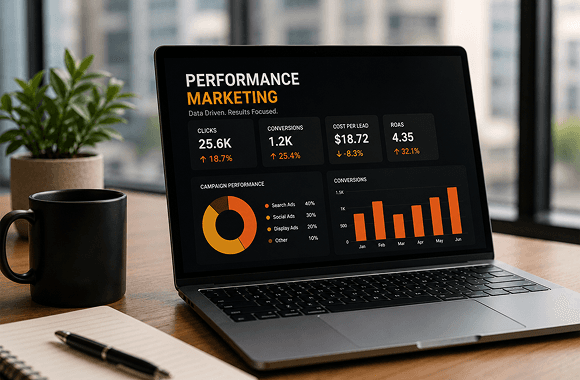
Real estate performance marketing is the discipline of running paid acquisition channels, Google Ads, Meta Ads, YouTube, LinkedIn, and programmatic, against measurable cost per lead and cost per acquisition targets specific to property buyers, tenants, and investors. In 2026, the strongest operators run blended cost per lead between USD 18 and USD 65, depending on asset class, attribute every closed deal back to the first touch source through their CRM, and reinvest budget weekly into the channels actually producing pipeline. Done well, real estate performance marketing recovers 2 to 4 times the ad spend in attributed gross revenue within the first 90 days.
What is real estate performance marketing?
Real estate performance marketing is the practice of acquiring buyers, tenants, and investors through paid digital channels where every dollar is tracked back to a measurable business outcome. Unlike brand marketing, which builds long-term recognition without a direct attribution path, performance marketing is judged on cost per lead, cost per qualified site visit, cost per signed deposit, and ultimately cost per closed deal.
The discipline sits at the intersection of media buying, creative production, landing page conversion, CRM workflow, and attribution. A real estate performance marketing programme that ignores any one of those four layers usually wastes 30 to 50 percent of its budget. The operators who run all four wells move the budget weekly into the channels showing the cleanest unit economics and away from channels that look busy but produce nothing.
Why performance marketing matters in 2026
Three shifts have made performance marketing the default growth motion for real estate operators this cycle.
Buyer behaviour has moved fully online. According to the National Association of Realtors 2024 Profile of Home Buyers and Sellers, 96 percent of home buyers now start their search on the internet, and 51 percent find their eventual home through an online listing. The same shift has happened in coliving, build-to-rent, and student housing, where direct booking now exceeds 60 percent of inventory for the strongest operators.
AI search is changing how buyers discover operators. ChatGPT, Perplexity, Claude, and Google AI Overviews now answer category queries that used to land on operator websites. Operators that combine performance marketing with structured SEO and AEO capture the buyers AI search refers to, while operators relying on either layer alone fall behind. The category is moving fast, and the playbook needs both.
Capital costs are up, and marketing has to compound. With interest rates higher than the 2018 to 2022 window, the cost of unsold inventory is significantly higher for residential developers, and the cost of unfilled rooms is higher for coliving and BTR operators. The marketing budget has to convert into bookings and deposits faster, not just impressions.
The 7-step framework for setting up real estate performance marketing
This is the framework we run across performance marketing engagements at Noseberry Digitals. It works for residential developers, coliving operators, brokerages, REITs, and PropTech founders alike, with channel mix and creative shifting by category.
Step 1: Define the unit economics first
Before a single ad goes live, every operator should know four numbers cold. Average gross margin per closed unit. Average sales cycle in days. Average historical cost per lead. Average lead-to-deposit conversion rate. These four numbers set the upper bound on what every channel can spend per lead before the campaign turns unprofitable. Skipping this step is the single most common reason real estate performance marketing programmes fail in the first quarter.
Step 2, instrument the funnel end-to-end.
Every campaign needs to be tracked from impression through to closed deal. That means GA4 events on the website, CRM deal stages mapped to the funnel, server-side conversion tracking pushing data back to Meta and Google, and a weekly reconciliation between marketing source data and closed pipeline. Without this instrumentation, the team optimises against vanity metrics rather than revenue.
Step 3: Set the per-channel target cost per lead
Not every channel produces leads of the same quality. A high-intent Google search lead for "3 bhk apartment whitefield bangalore" converts at a different rate than a Meta lookalike audience lead. Target cost per lead must reflect the historical conversion rate of leads from that specific channel. Without per-channel targets, the team chases the lowest cost per lead, which is often the lowest quality lead, too.
Step: build a creative that does the qualification work.
Performance creative in real estate is the lever most underused by operators. A scroll stopping 15 second vertical video of the actual unit, paired with three honest details on price, location, and possession date, qualifies the audience before the click. Generic stock imagery with "luxury living" copy lets every tyre kicker into the funnel and burns sales team capacity on unqualified follow-ups. Pair this work with your branding and website development team so the brand stays consistent across surfaces.
Step 5: route every lead into a single CRM with a 5-minute SLA.
Once the lead clicks, response speed determines whether the budget converts. InsideSales research shows lead conversion drops 80 percent past the 10-minute response window. Every channel must route into a single CRM with an automated first response and a human follow-up SLA of 5 minutes during business hours. The CRM implementation work is part of the performance marketing operation, not a separate project.
Step 6: Attribute every closed deal back to the source
Weekly attribution reconciliation against first touch and last touch source is the discipline that separates the operators recovering 3 times their ad spend from the operators wondering where the budget went. Build the reconciliation into the CRM, surface it to the leadership team weekly, and adjust channel budgets on the same cadence.
Step 7, compound, do not chase
Real estate performance marketing is a compounding game, not a viral one. The channels that produce the best unit economics in week 4 are typically still the best in week 24. Resist the temptation to chase the new channel, the new creative format, or the new platform every month. Compound budget into what works, refresh creative regularly, and run structured tests in 5 percent budget pockets rather than reallocating the whole programme on a hunch.
Channel-by-channel breakdown with 2026 benchmarks
Benchmarks below are drawn from Noseberry Digitals' aggregate dataset across 60+ real estate operator engagements and cross-referenced against WordStream's 2024 Google Ads benchmarks and Meta's industry benchmark report. Numbers vary by geography, asset class, and creative quality. Treat them as orientation points rather than absolutes.
Google Search
The highest intent channel for residential and brokerage operators. Buyers searching "2 bhk for sale gurgaon sector 67" are days away from a site visit, not months. Expected cost per click sits at USD 0.80 to USD 4.20 across most Indian, UAE, and Southeast Asian markets. Cost per qualified lead lands between USD 18 and USD 55. Conversion rate to booked site visit lands between 11 and 18 percent for operators with a strong landing page and a 55-minute response SLA.
Meta Ads (Facebook and Instagram)
The volume channel. Best for top of funnel discovery, retargeting site visitors, and reactivating cold CRM lists. Cost per click averages USD 0.35 to USD 1.40. Cost per lead averages USD 9 to USD 32, but lead quality is lower than Google Search by a factor of 2 to 3, so cost per qualified site visit lands at USD 45 to USD 110.
YouTube and connected TV
Underused by most operators in 2026. The best channel for residential project launches, with strong attribution lift on first touch when measured properly. Cost per thousand views runs USD 6 to USD 18, with 60 to 90 second project films producing the strongest pipeline contribution when paired with retargeting on Meta and Google.
The right channel for PropTech founders, REITs, and investment platform marketers targeting accredited investors and enterprise buyers. Cost per click is high at USD 6 to USD 14, and cost per qualified lead lands at USD 120 to USD 380. Worth the spend when the deal size justifies it.
Programmatic and OOH digital
Useful for residential project launches in metro markets and for branded residences, hospitality, and luxury developers. Programmatic display runs for USD 2 to USD 7 per thousand impressions. Best treated as a brand amplifier on top of the performance channels rather than a primary acquisition surface.
Brand marketing vs performance marketing
This is the question every real estate marketing leader gets asked at least once a quarter. The honest answer is operators need both, in the right ratio.
Brand marketing builds the recall and trust that lowers the cost per lead on every other channel. A buyer who has heard of your brand from a YouTube ad, a Forbes article, or a podcast episode is 30 to 50 percent more likely to click through and convert when they later see your performance ad.
Performance marketing generates the measurable pipeline that pays this month's mortgage, payroll, and construction costs. It is judged on cost per lead and revenue attribution rather than awareness.
For most residential developers, the right split in 2026 is roughly 75 percent performance marketing and 25 percent brand marketing, with the brand spend concentrated around project launches and seasonal campaigns. For PropTech founders raising rounds, the split shifts towards 60 percent performance and 40 percent brand and PR, because brand credibility moves the investor needle as much as the customer needle.
Common mistakes that burn real estate marketing budget
Bidding on the cheapest possible lead. Every operator optimising for the lowest cost per lead ends up with a low-quality lead funnel that swamps the sales team. Optimise for cost per qualified site visit or cost per booked appointment, not raw lead volume.
Routing leads into a shared inbox. If a lead lands anywhere other than your CRM, it leaks within 24 hours. Every channel must route into the same CRM with the same automated response.
Stopping a campaign in week two because it "is not working". Real estate sales cycles are 30 to 180 days. A performance marketing campaign needs at least one full sales cycle to be judged honestly. Two weeks of data is noise.
Running ads on your homepage. Every campaign needs a dedicated landing page with a single conversion goal. Sending traffic to your homepage cuts conversion rate by 50 to 70 percent. Our website development team builds dedicated landing pages alongside the performance campaign.
Ignoring creative refresh. Creative fatigue sets in at 4 to 6 weeks on Meta and 8 to 12 weeks on Google. Refreshing the same creative every quarter is the difference between a campaign that compounds and one that decays.
Real example, a residential developer in Bangalore
A residential developer launching a 480-unit gated community in north Bangalore came to us, spending USD 22,000 a month on Meta Ads and producing 1,400 leads, of which only 9 became signed deposits across a 90-day window. Cost per signed deposit was USD 7,333.
After a 6-week setup engagement with our performance marketing, CRM implementation, and website development teams running in parallel, the same USD 22,000 monthly budget produced 720 leads over the next 90 days, but 64 of them converted to signed deposits. Cost per signed deposit dropped to USD 1,032.
The lift came from four moves. Switching from broad Meta interest targeting to a tighter mix of Meta retargeting plus Google Search for high intent queries. Building three dedicated landing pages per campaign with single conversion goals. Routing every lead into HubSpot with an automated WhatsApp first response within 90 seconds. Reconciling closed deposits back to the first touch source weekly and reallocating the budget every Monday morning.
Tools and stack
The performance marketing stack we recommend in 2026 stays platform neutral and depends on team size.
Ad platforms: Google Ads, Meta Ads Manager, LinkedIn Campaign Manager, YouTube via Google Ads, programmatic through StackAdapt or DV360.
Analytics: GA4 with server-side tagging, PostHog for product analytics on PropTech sites, Mixpanel for funnel breakdowns.
CRM and lead routing: Salesforce, HubSpot, Follow Up Boss, or Zoho, depending on team size. Configured through our CRM implementation practice.
Landing pages: Built on Next.js or Webflow through our website development team for performance and SEO control, or Unbounce for marketing teams running heavy AB testing.
Attribution: A blend of platform attribution, GA4 attribution, and CRM source reconciliation. Tools like Triple Whale, Northbeam, or Rockerbox are worth considering for operators spending over USD 50,000 a month.
Creative production: Figma for static creative, Adobe Premiere or CapCut for video, Canva for marketing team self-serve, paired with our design and branding team for brand consistency across surfaces.
How do we measure return on investment for real estate performance marketing?
The cleanest metric is attributed gross revenue divided by total marketing spend, reconciled monthly through the CRM. Strong operators target 3 to 5 times return inside the first 90 days, with the multiple climbing to 6 to 10 times by month 12 as the brand layer compounds.
External authoritative sources
National Association of Realtors, Profile of Home Buyers and Sellers
WordStream Google Ads industry benchmarks
Meta Business industry insights
Ready to run real estate performance marketing that compounds?
Share your current pipeline, your channel mix, and your target cost per acquisition. A 30-minute audit covering creative, channel mix, attribution, and CRM routing comes back within 5 business days. No commitment, no generic packages, just a clear view of where the budget is leaking and what to do about it.
Why trust Noseberry
Our content is written by practicing real-estate and PropTech professionals, fact-checked by a dedicated editorial team, and reviewed against the latest industry data before publication.
- 10+ years of industry expertise
- All facts independently verified
- No sponsored rankings in guides
- Updated when the industry changes
Frequently asked questions
What is the average cost per lead for real estate performance marketing in 2026?
Across the operators we audit, the blended cost per lead ranges from USD 18 to USD 65, depending on asset class and geography. Residential developers in metro India typically see USD 22 to USD 38, coliving operators see USD 14 to USD 32, and PropTech founders targeting enterprise buyers see USD 120 to USD 380.
How much should a real estate developer spend on performance marketing?
A working rule of thumb is 0.6 to 1.4 percent of project gross sales value spent on performance marketing across the entire sales window. For a USD 50 million project, that translates to USD 300,000 to USD 700,000 across roughly 18 months. Bigger luxury developments at the higher end, faster-moving affordable projects at the lower end.
Which is better for real estate, Google Ads or Meta Ads?
Both, in different roles. Google Search captures high-intent buyers who already know what they want. Meta captures lower intent buyers who can be educated and retargeted into the pipeline. The strongest operators run both with separate cost per lead targets, not one against the other.
How long does it take for real estate performance marketing to deliver results?
Pipeline contribution typically appears within 14 to 21 days. Full attribution clarity takes one complete sales cycle, which for residential is 60 to 120 days and for coliving is 21 to 45 days. Judging a campaign earlier than that is judging noise.
What is the difference between performance marketing and digital marketing?
Digital marketing is the broader category covering SEO, content, social media, email, paid ads, and influencer work. Performance marketing is the subset focused exclusively on paid acquisition channels with measurable cost per outcome targets. Performance marketing is judged on cost per lead and cost per acquisition, while digital marketing as a whole includes brand and content layers that play a longer game.
Can performance marketing replace a sales team?
No. Performance marketing fills the pipeline. The sales team converts the pipeline. Operators who try to replace one with the other either burn marketing budget on unqualified leads or starve a strong sales team of pipeline. The two operate together.
How do we measure return on investment for real estate performance marketing?
The cleanest metric is attributed gross revenue divided by total marketing spend, reconciled monthly through the CRM. Strong operators target 3 to 5 times return inside the first 90 days, with the multiple climbing to 6 to 10 times by month 12 as the brand layer compounds.
Related insights
 Real Estate
App Store Optimization (ASO) for Real Estate and PropTech Apps
App Store Optimization for real estate and proptech apps isn't a launch-week checklist. It's an ongoing habit. It's built on precise keyword mapping, screenshots that show real use cases, a review timing plan, and metadata that stays honest as the app grows. Teams that treat their listing as a living asset, tested every quarter, tend to out-rank competitors with bigger budgets and bigger dev teams.
September 4, 2026 Real Estate
Influencer and Creator Marketing for Real Estate Brands: Beyond the Listing Video
This blog breaks down influencer marketing and creator marketing for real estate brands as two distinct strategies, not one interchangeable tactic. It explains the difference between paying for an influencer's existing audience versus paying a creator for original content your brand can reuse. It covers six content formats that outperform a basic listing walkthrough, from neighborhood guides to buyer testimonial clips. It compares running these partnerships in-house against hiring a specialized agency, with real cost and speed benchmarks. It closes with FTC disclosure and Fair Housing compliance rules every real estate brand needs before its next sponsored post.
September 2, 2026 Real Estate
Real Estate Digital Agency in USA: How Noseberry Digitals Helps Developers & PropTech Companies Grow
This blog explains what makes Noseberry Digitals a real estate digital agency in USA built for developers and proptech companies. It covers why generalist agencies struggle with real estate-specific needs like MLS integrations and multi-market brand consistency. It walks through the agency's full-stack services, from branding and websites to CRM, AI, and a 60-day proptech MVP program. It highlights named, documented case studies with real client results, something the piece notes is rare among proptech marketing agencies. It closes with a practical checklist for choosing a real estate digital agency and clears up whether Noseberry Digitals is itself a proptech company.
August 27, 2026
Ready to book a 30-minute strategy call?
We'll map the right digital moves for your real estate business, no pitch deck, no commitment.