

Mayank Pokharna
COO, Noseberry Digitals & Industry Expert
Smart Home and IoT Integration for Property Operators: Cost, ROI, and What to Build First
Published August 24, 2026|12 min read
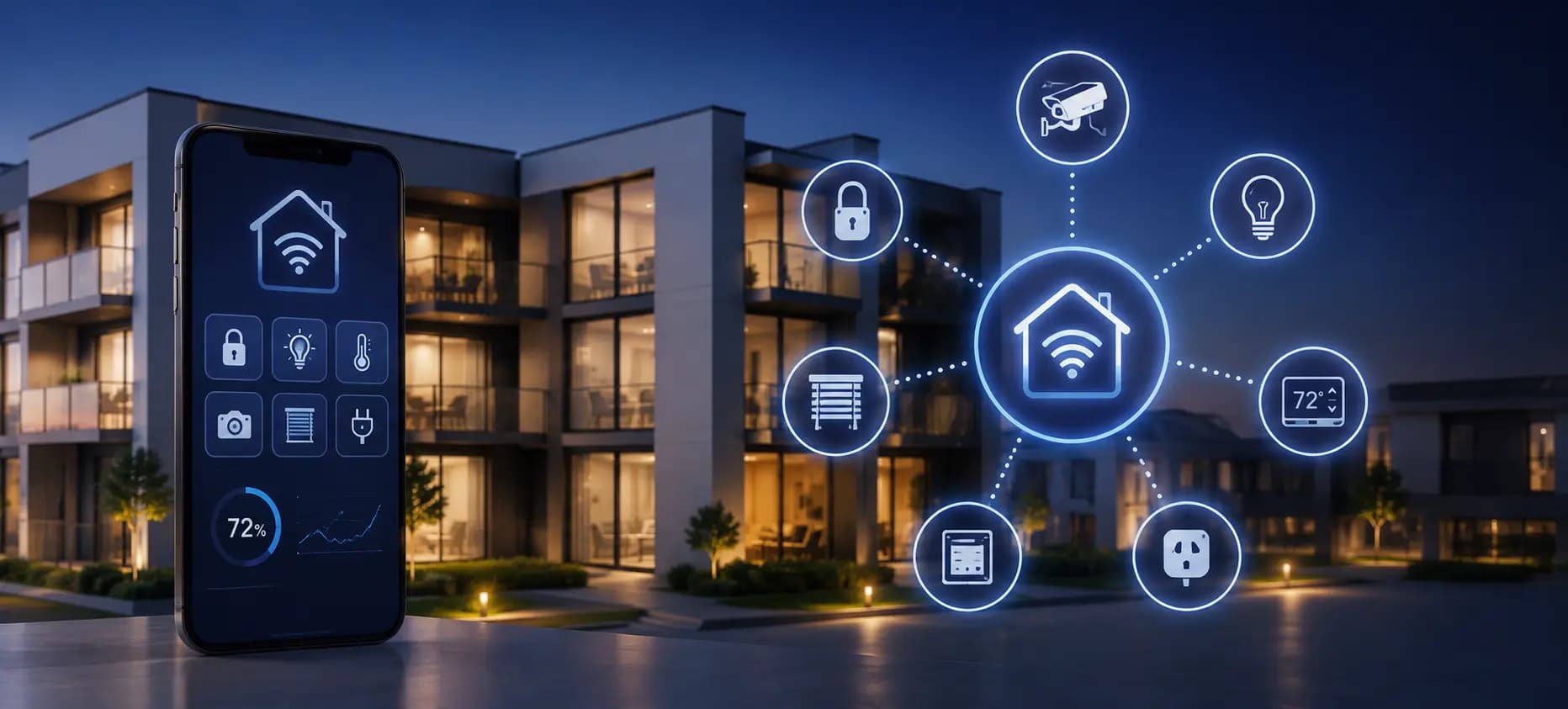
This blog breaks down smart home and IoT integration for property operators, covering real costs, real ROI, and exactly what to build first. It walks through actual pricing by portfolio size, from new construction to full enterprise retrofits. It explains where the ROI really comes from, including energy savings data from a major retrofit case study and renter demand statistics. It lays out a staged build order, starting with access control and climate sensors before predictive maintenance, security, and tenant apps. It closes with a data privacy and security checklist, a DIY versus integration partner comparison, and a 10-question FAQ section.
Here's the short answer. IoT integration for property operators typically costs $5,000 to $20,000 per unit for new construction. A mid-size existing building runs $50,000 to $200,000. Either way, it usually pays back within two to five years through energy savings and lower vacancy. Start with access control and climate sensors, not flashy tenant apps. Those two categories pay for themselves fastest, and they set up everything you build next.
That order matters more than most operators realize. I've watched proptech teams sink budget into a slick resident app before they've even fixed their HVAC scheduling. The ROI never catches up. IoT integration in real estate isn't one project. It's a stack, and the stack only works if you build the boring, high-payback layers first. A multifamily portfolio we worked with cut its energy spend noticeably within a year. It didn't touch anything tenant-facing. It just added smart thermostats and leak sensors first. This guide breaks down real costs, real ROI, and the build order most guides on this topic skip entirely.
What Is IoT Integration for Property Operators?
IoT integration for property operators means connecting devices like sensors, locks, and thermostats to one shared platform. That platform collects and acts on their data. It turns scattered hardware into a system an operator can actually manage. Without integration, smart devices are just disconnected gadgets that create more work, not less.
The word "integration" is doing real work here. A smart lock alone is just a convenience feature. Connect that same lock to your property management software, access logs, and maintenance tickets. Now it's an operational tool. That connection is what separates real IoT integration from a pile of consumer gadgets bought off a shelf.
Why Smart Home and IoT Integration Matters for Property Operators Now
This kind of integration matters now for two reasons. Tenant expectations have shifted, and the technology has gotten cheap enough to justify the cost. Renters increasingly expect it. Operators who skip it end up competing on price alone, in a market where price is the hardest lever to pull.
What Renters and Tenants Actually Expect
Roughly 65% of renters say smart home features make an apartment more appealing. About 54% now expect smart locks, thermostats, and security cameras as standard, according to Rently's 2025 Smart Apartment Trends Report. That's not a luxury expectation anymore. It's closer to table stakes in competitive markets.
What It Means for Lease Renewals and Retention
The retention numbers are even more compelling. Seventy-seven percent of renters said they'd consider a longer lease if smart security and energy-saving devices were in place. Fifty-seven percent said they'd be more likely to renew for the same reason. Eighty percent said they'd accept higher rent if smart technology guaranteed lower utility bills. That's a direct line from smart home and IoT integration to fewer vacancies and steadier cash flow.
What Does IoT Integration Cost for a Property Portfolio?
IoT integration costs scale with portfolio size and building age. New construction runs cheapest per unit. Retrofitting older buildings costs more, because of legacy wiring and outdated infrastructure. Budget accordingly before you commit to a rollout timeline.
Portfolio Type | Typical Cost | Best Fit |
New construction, per unit | $5,000 to $20,000 | Developers building smart features in from day one |
Small existing building (under 5,000 sq ft) | $15,000 to $50,000 | Boutique operators testing a pilot rollout |
Mid-size building (20,000 to 100,000 sq ft) | $50,000 to $200,000 | Multifamily and mixed-use operators scaling across a property |
Large portfolio or enterprise rollout | $200,000 and up | Institutional owners standardizing across many assets |
Our smart home and building technology team sees the same pattern across almost every client. A phased rollout, tested on one building first, keeps these numbers from ballooning. It also tells you what actually works for your tenants before you scale.
The Real ROI of Smart Home and IoT Integration
The real ROI here comes mostly from energy savings, not the sticker price of the devices. Buildings using connected sensors and automated HVAC controls typically cut energy consumption by 20% to 30%. Payback usually lands between two and five years, depending on the building type and savings achieved.
One well-documented case makes the scale clear. The Empire State Building's retrofit cut energy consumption by 38%. That generated roughly $4.4 million in annual savings, based on figures reported by Sparxit's 2026 IoT in real estate analysis. Smaller portfolios won't see numbers that large, but the underlying mechanics hold. HVAC alone represents 40% to 51% of a typical office building's utility costs. Shaving even a fifth off that number moves the needle on net operating income fast. Our machine learning use cases in real estate guide covers this in more depth. Predictive models can squeeze even more savings out of that same HVAC data.
There's a resale angle too. Homes and units equipped with smart technology tend to sell 3% to 5% above comparable properties without it. They also typically spend less time on the market. That premium compounds with the energy savings and retention gains above, which is exactly why IoT integration in real estate keeps outranking cosmetic renovations on most capital improvement lists.
What Should Property Operators Build First?
Property operators should build access control and climate sensors first. Energy monitoring comes next, then predictive maintenance, and tenant-facing amenities last. This order follows payback speed, not excitement. The flashiest features are usually the ones that pay back slowest.
Start With the Fast-Payback Basics
Smart locks and access control. These cut down on rekeying costs and speed up turnover between tenants. They also create a clean audit trail for who entered a unit and when.
Smart thermostats and climate sensors. These are the fastest route to the 20% to 30% energy savings mentioned above. Most tenants notice the comfort improvement immediately.
Water leak and moisture sensors. A single early leak alert can prevent a repair bill that dwarfs the sensor's entire cost.
Layer In Predictive Maintenance and Security Next
Energy submetering. Once basic controls are live, submetering shows you which units or systems actually drive costs. No more guessing from one building-wide bill.
Predictive maintenance sensors on HVAC and major equipment. Catching a failing compressor before it fails outright avoids emergency repair costs and tenant complaints.
Security cameras and building automation systems. These carry more upfront cost and more data governance responsibility. They belong after the basics are proven out.
Tenant-facing apps and smart amenities. Resident apps and voice-controlled amenities are genuinely valuable, but they're the reward layer, not the foundation.
Our AI and automation services often plug in around step five. Predictive maintenance only works once you have enough clean sensor data to actually predict anything.
Should You Build Your Own IoT Stack or Use an Integration Partner?
Build your own stack if you have in-house technical staff and a small, single-property pilot to test. Use an integration partner once you're rolling out across multiple properties. The same goes once you need devices from different vendors to work together reliably. Most institutional operators land on the second option once they pass a handful of buildings.
Approach | Typical Cost | Speed | Best For |
In-house build | Staff time plus device costs | Slow to start, hard to scale | Single-property pilots with existing technical staff |
Integration partner | $50,000 to $200,000+ per project | Faster rollout, ongoing support included | Multifamily and institutional portfolios scaling across properties |
Hybrid model | Partner-built platform, internal facilities team runs it | Moderate | Operators who want vendor expertise but in-house daily control |
Our custom software and integrations team specifically handles the part most DIY rollouts get stuck on. Locks, thermostats, and sensors from different vendors rarely talk to one platform on their own.
Data Privacy and Security Risks Every Property Operator Should Know
Connected devices collect a lot of tenant data. That data carries real legal and reputational risk if it's mishandled. Property operators need a plan for this before the first sensor goes live, not after a breach forces the issue.
Access logs and camera footage count as sensitive tenant data in most states. Store and limit access to them carefully.
Default device passwords are a common entry point for attackers. Every device needs a unique, managed credential.
Vendor contracts should specify who owns the data your sensors collect, especially if you ever switch platforms.
Firmware updates on locks and cameras need a real schedule. Outdated firmware is a known attack vector.
Tenant-facing apps should disclose exactly what's being collected. That's consistent with NIST's IoT cybersecurity guidance for connected consumer devices.
Our case studies show operators who build this governance in from the start. They avoid the costly retrofits that come from bolting security on later. The same lesson applies to proptech startups building a device fleet from scratch. A governance plan is far cheaper to design early than to fix after the fact.
Conclusion
Smart home and IoT integration for property operators pays off when the build order matches the payback curve, not the marketing brochure. Here's the one sentence to remember: start with access control and climate sensors, then add predictive maintenance and security once those basics prove out. Save tenant-facing amenities for last.
Start with a single pilot building if you haven't already. Price out smart thermostats and leak sensors for that one property this month. Map out which vendor's locks and sensors actually integrate with your existing property management software before you buy anything else. If you want a clearer picture of where your portfolio stands, our proptech readiness check is a fast way to find out.
Whatever you build first, build it with the next layer in mind. Treat IoT integration as a staged system, not a one-time purchase. That's what separates the operators seeing lower vacancy and lower energy bills a year from now.
- IoT integration for property operators means connecting devices to one shared platform, not buying isolated gadgets.
- New construction smart packages cost $5,000 to $20,000 per unit; retrofits run $50,000 to $200,000 or more.
- Energy savings of 20% to 30% drive most of the ROI, with payback in two to five years.
- The Empire State Building retrofit cut energy use by 38%, saving about $4.4 million a year.
- 65% of renters find smart features more appealing, and many will pay more rent or renew longer for them.
- Build access control and climate sensors first, then energy monitoring, then predictive maintenance and security.
- Tenant-facing apps and smart amenities should come last, once the operational basics are proven.
- Use an integration partner once scaling past one property or mixing multiple device vendors.
- Data governance and device security need a plan before rollout, not after a breach.
- Smart-equipped properties tend to sell 3% to 5% above comparable units without the technology.
Why trust Noseberry
Our content is written by practicing real-estate and PropTech professionals, fact-checked by a dedicated editorial team, and reviewed against the latest industry data before publication.
- 10+ years of industry expertise
- All facts independently verified
- No sponsored rankings in guides
- Updated when the industry changes
Have any questions?
What is IoT integration in real estate?
IoT integration in real estate means connecting smart devices like locks, thermostats, and sensors to one shared platform. A property operator can monitor and control everything from that platform. It turns individual gadgets into one coordinated system. Without integration, smart devices work in isolation and create more manual work, not less.
What is the role of IoT integration for property operators?
The role of IoT integration for property operators is to cut energy costs, reduce maintenance surprises, and meet rising tenant expectations. It supports retention and net operating income directly, not just tenant convenience. Operators who skip it end up competing on price alone.
How much does smart home and IoT integration cost?
Costs range from $5,000 to $20,000 per unit for new construction. A full mid-size building retrofit can run $200,000 or more. Older buildings cost more due to legacy wiring and outdated infrastructure. Most operators start with a single pilot building before committing to a full rollout.
What should property operators build first with IoT integration?
Property operators should build access control and climate sensors first, since these have the fastest payback and lowest cost. Energy submetering and predictive maintenance come next, followed by security systems. Tenant-facing apps and smart amenities should come last, once the basics are proven out.
What is the ROI of smart home and IoT integration?
It typically pays back within two to five years, driven mostly by energy savings of 20% to 30%. Properties with smart features also tend to sell for 3% to 5% more than comparable units without them. Retention gains from tenant satisfaction add further value that's harder to measure directly.
Should I build my own IoT stack or hire an integration partner?
Build your own stack only if you have in-house technical staff and a single property to pilot. Hire an integration partner once you're scaling across multiple properties, or mixing devices from different vendors. Most institutional operators eventually move to a partner once a DIY pilot proves the concept.
Do renters actually want smart home features?
Yes. About 65% of renters say smart home features make an apartment more appealing. Roughly 54% now expect smart locks and thermostats as standard. Many also say they'd accept higher rent or a longer lease in exchange for smart security and energy-saving devices.
Is IoT integration worth it for a small property portfolio?
Yes, especially starting with low-cost, fast-payback devices like smart thermostats and leak sensors. A small portfolio can pilot these on one building before scaling further. The energy savings and reduced maintenance costs often justify the investment even at a modest scale.
What are the biggest risks with smart home and IoT integration?
The biggest risks are data privacy gaps, weak device security, and vendor lock-in on data ownership. Default device passwords and outdated firmware are common entry points for attackers. A clear data governance plan before rollout prevents most of these problems.
How long does it take to see results from IoT integration in real estate?
Energy savings from smart thermostats and sensors often show up within the first billing cycle after installation. Full payback on a larger retrofit typically takes two to five years, depending on the building and savings achieved. Retention and resale value gains tend to show up over a longer horizon, closer to one lease cycle or more.
Related insights
 Real Estate
What should a PMS do for small-scale property managers?
The ideal PMS for a small-scale property manager (typically 10 to 500 units) should do ten things well: capture every rent payment automatically, log every maintenance ticket with photo evidence and vendor dispatch, hold every tenant lease and document in one searchable place, generate owner and investor statements in one click, run automated rent reminders and late-fee escalation, screen tenants with credit and eviction history, sync with the operator's accounting stack (QuickBooks, Xero), work on mobile so field checks and unit walks happen on a phone, integrate with a website for listing marketing and online applications, and produce broker-visible dashboards that let the manager see occupancy, delinquency, and cash flow at a glance. AppFolio Property Manager Core, Buildium, DoorLoop, Rentec Direct, and Hemlane are the platforms most adopted at this scale in 2026, at $1.40 to $4 per unit per month. This post covers what the ideal PMS should do, which platforms actually deliver it, and how to pick without overpaying.
August 22, 2026 Real Estate
Which AI tools work best for real estate developers in 2026?
The best AI tools for real estate developers in 2026 fall into eight categories that map to the developer lifecycle: land sourcing and site selection (Cherre, Reonomy, HouseCanary, LandGate), feasibility and financial modelling (Northspyre, TestFit, custom Excel plus GPT), design and architectural planning (Autodesk Forma, Higharc, Cove.tool, Snaptrude), construction management and progress tracking (Procore AI, Autodesk Construction Cloud, Buildots, Doxel, OpenSpace), pre-launch marketing and renders (Restb.ai, MidJourney, Adobe Firefly), off-plan sales CRM (Salesforce, HubSpot, Follow Up Boss, Rechat), ESG and net-zero analytics (Measurabl, Enertiv, Aquicore), and handover to operations (BIM AI, tenant portal AI). Used well, they cut construction cost 10 to 20 percent, compress design cycles 30 to 50 percent, and lift off-plan sales conversion 20 to 40 percent. Used badly, they burn subscription budget and produce plans that do not build. This post walks through each category, which tools actually work, and how to sequence adoption.
August 22, 2026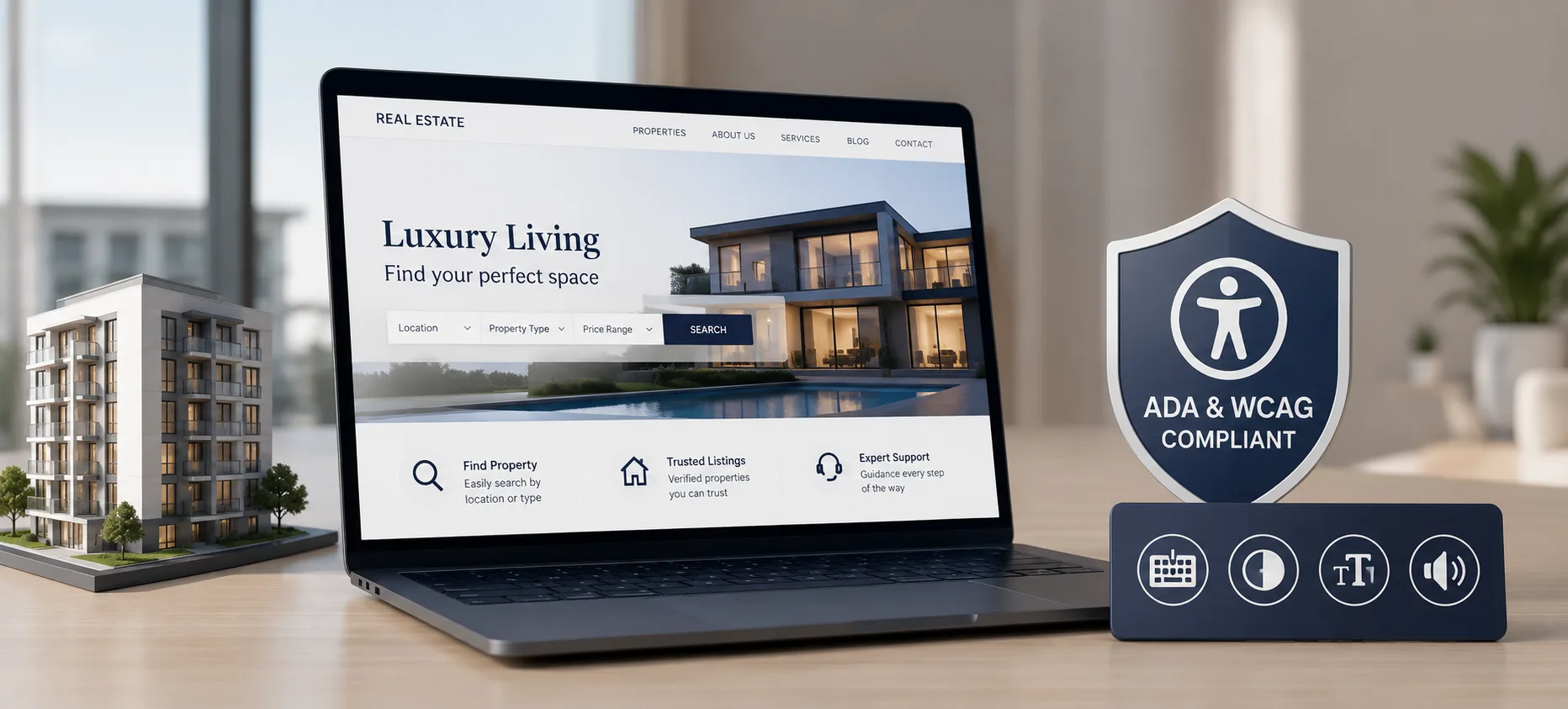 Real Estate
ADA & WCAG Accessibility Compliance for Real Estate Websites: What Operators Must Fix Before They Get Sued
This blog breaks down ADA and WCAG accessibility compliance for real estate websites, focused on what actually creates legal exposure. It explains why WCAG 2.1 Level AA has become the practical legal standard even without a formal Title III regulation for private businesses. It walks through the six accessibility failures responsible for 96% of all detected errors across the web, using real listing-page examples. It also warns against relying on accessibility overlay widgets, citing the FTC's 2025 action against accessiBe over deceptive compliance claims. The piece closes with a step-by-step audit process, an in-house versus compliance-partner comparison, and a 10-question FAQ section.
August 20, 2026
Ready to book a 30-minute strategy call?
We'll map the right digital moves for your real estate business, no pitch deck, no commitment.