

Anmol Sharma
SEO Expert
Real Estate Lead Generation Strategies That Actually Work in 2026
Published June 5, 2026|14 min read
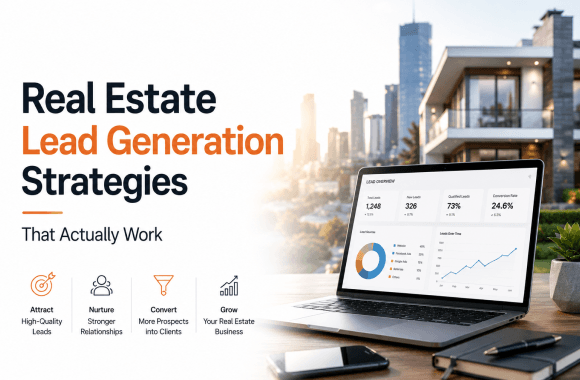
The single most important shift in real estate lead generation strategies between 2020 and 2026 is this: the operators winning the pipeline battle aren't the ones with the biggest ad budgets. They're the ones with the most connected systems.
The most effective real estate lead generation strategies in 2026 combine high-intent paid search, organic SEO, answer engine visibility, and CRM-driven nurture into a single, attribution-tracked funnel. Operators who run all four together consistently report 3x to 5x more qualified pipeline than those running any single channel in isolation.
If you've been burning budget on Meta ads, crossing your fingers that referrals keep coming, and wondering why your cost per acquisition keeps climbing, this playbook is for you. After working with 100+ real estate operators across 14 countries, I've seen exactly which approaches fill pipelines and which ones fill spreadsheets with impressive-looking vanity metrics. The difference usually comes down to three things: channel selection, CRM integration, and attribution discipline. Let's get into it.
What Are the Most Effective Real Estate Lead Generation Strategies in 2026?
The most effective real estate lead generation strategies in 2026 are those that capture demand at multiple stages of the buyer journey simultaneously. Relying on a single channel is a structural weakness, not a strategy.
Here's the short answer if you need it: paid search captures buyers who are already looking; SEO and AEO build organic authority that compounds over time; social media builds trust and remarketing audiences; and CRM automation converts cold leads into warm conversations without manual effort. Each layer feeds the next.
According to the National Association of Realtors' 2025 Profile of Home Buyers and Sellers, 97% of buyers used the internet in their home search at some point. That statistic alone tells you where the battle for leads is fought. But what's changed in 2026 is where on the internet those searches happen. A growing share now starts inside AI tools like ChatGPT, Perplexity, and Google AI Overviews, not just on the classic Google SERP. Operators who haven't adjusted their visibility strategy for this shift are already leaving leads on the table.
Why Most Real Estate Lead Campaigns Fail Before They Start
Most campaigns fail because they skip the diagnostic step entirely.
I've audited hundreds of real estate marketing setups. The pattern is almost always the same: budget goes into ads before anyone has confirmed where the conversion breaks down. Leads come in, enter a spreadsheet or a generic CRM, and then nothing happens for 72 hours. By then, the prospect has already spoken to three competitors who called within 5 minutes.
Research from MIT and Harvard published in the Harvard Business Review found that contacting a web lead within 5 minutes makes you 100 times more likely to qualify that lead than waiting 30 minutes. That's not a small edge. That's a structural advantage. And it's entirely a process problem, not a spend problem.
The fix is boring but effective: close the loop between your ad platform, your website, and your CRM before you scale any channel. Everything else in this playbook assumes you've done that. If you haven't, the CRM implementation guide for real estate operators is a good place to start.
How Does Paid Search Drive Real Estate Leads in 2026?
Paid search is still the fastest way to generate high-intent real estate leads because it intercepts buyers at the exact moment they're ready to act.
Google Ads and Meta Ads remain the two dominant paid channels, but how you structure them has changed significantly. In 2026, Google's Performance Max campaigns use AI to match your listings and landing pages to the most conversion-likely users across Search, Display, YouTube, and Gmail simultaneously. If you're not on PMax, you're likely paying more for less reach.
The operators getting the best results from paid search in 2026 typically do three things differently:
They run dedicated landing pages for every campaign, not the homepage. Conversion rates on single-purpose landing pages consistently run 3x to 5x higher than sending traffic to a general website.
They track offline conversions, not just form fills. By feeding signed lease data back into Google through CRM integration, the algorithm optimises for actual revenue events rather than cheap form submissions that never convert.
They layer retargeting aggressively. Across dozens of real estate campaigns I've run, the average prospect researches for 6 to 8 weeks before making contact. Retargeting keeps you in front of them throughout that window for a fraction of the cost of cold acquisition.
For a deep-dive on setting up conversion tracking properly, our Google Ads conversion tracking guide for real estate covers the exact GA4 and CRM integration stack you'll need.
The SEO and AEO Advantage: How to Generate Organic Leads at Scale
SEO is a long-term investment that compounds because every piece of optimised content you publish works for you 24 hours a day without incremental spend.
But in 2026, SEO alone isn't enough. Answer Engine Optimisation (AEO) is the practice of structuring your content so that AI tools like ChatGPT, Perplexity, Claude, and Google AI Overviews cite your brand when answering real estate questions. It's the difference between appearing on Page 1 of Google and being named as the authoritative answer inside the AI. Both matter. Neither replaces the other.
What Makes Real Estate Content Rank and Get Cited?
Real estate content ranks and gets cited when it answers specific, high-intent questions with clear, declarative facts that AI systems can confidently extract and attribute. Vague brand content doesn't get cited. Specific, evidence-rich editorial content does.
The operators seeing the strongest AEO traction in 2026 publish 3 to 6 SEO and AEO-optimised pieces per month, organise content around 4 to 6 pillar topics, and tie every content investment back to CRM-tracked pipeline. The real estate content marketing strategy guide covers the production framework in detail.
From a technical side, the foundations that move the needle most are: Core Web Vitals scores in the green range, properly structured schema markup (FAQPage, Article, RealEstateAgent, LocalBusiness), and a consistent internal linking architecture that passes equity to your highest-converting pages. Our real estate SEO and AEO operator guide lays out the full technical checklist.
Social Media and Video: Which Platforms Actually Generate Leads?
The honest answer is: Instagram, YouTube, and LinkedIn, and only if you're willing to be consistent.
Social media is not a short-term lead generation channel. It's a trust-building engine. Buyers who've watched 12 of your YouTube walkthroughs before they call don't need convincing. They already trust you. That's why conversion rates from social-originated leads are typically higher than from cold paid search, even though volume is lower.
The numbers bear this out. According to the Sprout Social Index 2025, real estate brands that post consistently (5 or more times per week across two or three platforms) see 2.3x higher follower growth and measurably more inbound direct messages than irregular posters. More practically: agents who commit to a YouTube channel of 2 to 4 videos per month typically see their first organic lead inquiries within 90 to 120 days, and those leads convert at double the rate of paid traffic.
Short-form video on Instagram Reels and TikTok has its place for brand awareness and top-of-funnel reach. But for actual lead generation, long-form YouTube content and LinkedIn thought leadership for commercial and PropTech segments consistently outperform. Our social media marketing guide for real estate agents covers platform-specific playbooks in full.
How Does CRM Automation Turn Real Estate Leads Into Clients?
CRM automation turns real estate leads into clients by making sure no lead goes cold, regardless of how busy your team is. It is the operational backbone of any serious lead generation programme.
When I look at operators who double their close rate without increasing their ad spend, it's almost always because they fixed their lead response and nurture infrastructure. The tactics vary, but the pattern is consistent: faster first response, more touchpoints across the 6 to 8 week research window, and automatic re-engagement of leads that went quiet.
What Should a Real Estate CRM Nurture Sequence Include?
A well-designed real estate CRM nurture sequence includes an immediate automated response (within 5 minutes), a personalised follow-up call prompt for your team within the same hour, a 7 to 14 day email drip sequence with relevant content, and periodic re-engagement triggers for leads that haven't converted after 30 and 60 days.
The specific CRM tools that work best depend on your operation size and complexity. The best CRM guide for coliving and real estate operators in 2026 walks through when to use HubSpot, Salesforce, Zoho, or a fully custom build.Multi-Channel vs. Single-Channel: What the Data Says
Here's a quick breakdown of how the major real estate lead generation channels compare on the metrics that matter:
Channel | Avg. Cost Per Lead | Time to First Lead | Lead Quality (1-10) | Scalability |
|---|---|---|---|---|
Google Search Ads | $45-$120 | 1-3 days | 8 | High |
Meta Ads (Facebook/Instagram) | $20-$60 | 1-7 days | 5-6 | High |
SEO + Content | $10-$25 (blended) | 3-6 months | 7-8 | Very High |
AEO / AI Citations | $0 (content cost only) | 4-8 months | 9 | Medium-High |
Email Nurture (existing leads) | $5-$15 | Ongoing | 8 | High |
Social Media / YouTube | $15-$40 | 60-120 days | 7-9 | Medium |
Referral / CRM Re-engagement | $5-$20 | Variable | 9-10 | Low-Medium |
The case for multi-channel is simple: each channel covers the weaknesses of the others. Paid search is fast but expensive and stops the moment you cut the budget. SEO is cheap at scale but slow to start. Social builds trust but takes time to convert. Together, they create a funnel that's both fast and compounding.
The operators consistently generating the most pipeline in 2026 don't ask "which channel should we be on?" They ask "how do we make all our channels reinforce each other?" That's the shift from tactics to strategy.
What Does a Real Estate Marketing Agency Actually Do to Generate Leads?
A real estate marketing agency builds and manages the full-funnel infrastructure that most operators don't have the time, tools, or team to run in-house. This includes paid media management, SEO and AEO programs, content production, CRM setup, and attribution dashboards.
The critical word there is "infrastructure." Agencies that just run ads are vendors. The ones that actually move your pipeline number are partners who care about your cost per acquisition, your lead-to-close ratio, and the technical plumbing that connects all your channels to your CRM. Working with a specialist real estate marketing agency rather than a generalist shop matters because real estate has longer sales cycles, higher transaction values, and more complex attribution challenges than almost any other industry.
When Should You Hire a Real Estate Marketing Agency?
You should hire a real estate marketing agency when the cost of managing your lead generation in-house (including your team's time, the tools, and the missed optimisations) exceeds what an external team would charge for better results. For most growing operators, that crossover happens somewhere between 5 and 20 properties or $500K and $2M in annual marketing spend.
In my experience working with operators across this growth stage, the three biggest gains from agency engagement are speed (campaigns go live in weeks, not months), specialisation (the team has run this campaign type before), and accountability (you get dashboards that connect spend to pipeline, not just impressions).
Email Marketing and Lead Re-Engagement: The Underused Strategy
Email marketing for real estate generates some of the highest ROI of any digital channel, but most operators either ignore it or treat it as a broadcast newsletter nobody reads.
Effective real estate email isn't about monthly newsletters. It's about automated, behaviour-triggered sequences that deliver the right content to the right lead at the right point in their decision journey. A buyer who downloaded your neighbourhood guide gets a different sequence than a buyer who attended a viewing. That level of segmentation is what turns a 5% email open rate into a 28-35% open rate, which is exactly the range our clients hit on well-structured sequences.
The content that performs best in real estate email nurture includes: market update summaries with a specific number (not vague commentary), property match alerts based on stated preferences, social proof content (case studies, video testimonials), and re-engagement prompts that offer genuine value ("We just listed 3 properties matching your criteria. Want a private preview?").
For operators looking to build this out, our digital marketing services page covers the CRM and email automation setup in detail.
Conclusion
The single most important shift in real estate lead generation strategies between 2020 and 2026 is this: the operators winning the pipeline battle aren't the ones with the biggest ad budgets. They're the ones with the most connected systems.
Paid search fills the top of the funnel fast. SEO and AEO build the compounding organic foundation that reduces your cost per lead over time. Social media and video create the trust that makes leads close faster and cheaper once they arrive. CRM automation makes sure none of those leads fall through the cracks. Email nurture re-activates the ones that went cold. And attribution tracking tells you what's working so you can do more of it.
None of these channels is optional if you're serious about building a predictable acquisition engine. The question is which ones to prioritise first given your current stage, budget, and team capacity.
If you're a real estate operator, developer, brokerage, or PropTech company that wants an honest audit of where your current lead generation is breaking down and a realistic roadmap for fixing it, that's exactly what our team does. We've run this for 100+ operators across 14 countries. We know what works at every scale.
The next step is simple: book a free strategy call with Noseberry Digitals. No slides, no sales pitch. Just an honest look at your pipeline and a prioritised action plan. Most clients who take that first call have a clear roadmap within 48 hours. You'll leave the call knowing exactly what to do next, whether you work with us or not.
If you're not ready for a call yet, start by taking the PropTech Readiness Index to benchmark your current operations, marketing, and technology across 12 factors in 5 minutes.
- 97% of real estate buyers use the internet during their property search, making digital lead generation non-negotiable for operators in 2026.
- The most effective real estate lead generation strategies combine paid search (fast), SEO and AEO (compounding), social (trust), CRM (nurture), and email (re-engagement) into one connected funnel.
- Contacting a lead within 5 minutes makes you 100 times more likely to qualify them than waiting 30 minutes. Speed of response is a structural competitive advantage.
- AEO (Answer Engine Optimisation) is the new frontier of organic lead generation, putting your brand inside AI answers on ChatGPT, Perplexity, and Google AI Overviews.
- Dedicated landing pages for paid campaigns convert 3x to 5x higher than sending traffic to a homepage or general listing page.
- Offline conversion tracking (feeding CRM deal data back to Google) is the single most impactful paid media optimisation most operators haven't implemented.
- Multi-channel attribution tracking allows operators to reallocate 20 to 30% of budget from underperforming channels within the first quarter of measurement.
- Specialist real estate marketing agencies outperform generalists because they understand long sales cycles, multi-touch attribution, and the specific content formats that work for property buyers, tenants, and investors.
Why trust Noseberry
Our content is written by practicing real-estate and PropTech professionals, fact-checked by a dedicated editorial team, and reviewed against the latest industry data before publication.
- 10+ years of industry expertise
- All facts independently verified
- No sponsored rankings in guides
- Updated when the industry changes
Have Any Questions?
What are real estate lead generation strategies and why do they matter?
Real estate lead generation strategies are the structured methods operators use to attract, capture, and convert prospective buyers, tenants, or investors into active pipeline. They matter because without a predictable lead source, revenue becomes unpredictable. Operators with documented, multi-channel lead generation strategies consistently outperform competitors on pipeline volume, cost per acquisition, and annual revenue growth.
What is the best real estate lead generation strategy in 2026?
The best single strategy depends on your timeline and budget, but the most effective overall approach in 2026 combines high-intent paid search for immediate leads with SEO and AEO for compounding organic traffic. Operators running both together typically reduce their blended cost per qualified lead by 30 to 50% within 6 to 12 months, compared to running paid media alone without any organic foundation.
How do real estate lead generation strategies differ between residential and commercial?
Residential lead generation focuses on volume and speed, using paid search, social media, and portal listings to capture buyers and renters early in a high-frequency search process. Commercial real estate lead generation is more relationship-driven, relying on LinkedIn thought leadership, targeted email outreach, content marketing, and PR to build authority and reach decision-makers over longer deal cycles that can span months or years.
How do I generate real estate leads without spending a lot on ads?
Generating leads without heavy ad spend requires investing in content that ranks organically. Publish SEO and AEO-optimised blog posts targeting specific buyer questions, optimise your Google Business Profile for local search, build a consistent social presence on YouTube and LinkedIn, and actively request reviews from past clients. Organic channels take 3 to 6 months to build momentum, but the cost per lead drops to a fraction of paid acquisition once they mature.
How does AEO help with real estate lead generation?
AEO (Answer Engine Optimisation) helps real estate lead generation by ensuring your brand gets cited when buyers ask questions inside ChatGPT, Perplexity, Google AI Overviews, or similar tools. Buyers who see your brand named as the authoritative answer by an AI tool arrive with higher trust and shorter decision timelines. As a growing share of property searches start in AI tools rather than traditional search, AEO is becoming a primary source of high-quality inbound leads.
What should I look for in a real estate marketing agency for lead generation?
Look for an agency that tracks pipeline and revenue, not just impressions and clicks. A specialist real estate marketing agency should understand long sales cycles, multi-touch attribution, and how paid media, SEO, and CRM work together. Ask to see cost per qualified lead data across previous client engagements. Ask how they attribute closed deals back to their marketing channels. Any agency that can't answer those questions clearly is optimising for the wrong outcomes.
Why are my real estate leads not converting into clients?
Real estate leads fail to convert most often because of slow response times, poor lead qualification, or gaps in the nurture sequence. Research shows that leads contacted within 5 minutes are dramatically more likely to convert than those contacted after 30 minutes. If your response time is the issue, CRM automation fixes it. If your leads are low quality, the problem is upstream in your targeting or messaging, and the fix is in your campaign structure, not your follow-up process.
Should I use a CRM for real estate lead generation, or is a spreadsheet enough?
A spreadsheet is enough when you have fewer than 10 active leads per month. Beyond that, a CRM is essential because it automates follow-up, segments leads by stage and behaviour, triggers re-engagement sequences automatically, and gives you attribution data that a spreadsheet can never provide. Operators who switch from spreadsheets to a properly configured CRM typically see lead-to-consultation conversion rates improve by 25 to 40% within the first 90 days.
What real estate lead generation strategies work best for new developments or launches?
For new development launches, the most effective combination is a dedicated landing page with a clear value hook, Google Search Ads targeting high-intent keywords, Meta Ads retargeting visitors who didn't convert, an early-access email sequence for registrations, and PR coverage to generate credibility and organic mentions. Starting this programme 6 to 12 weeks before launch, rather than on launch day, consistently produces stronger pre-sales pipelines.
How do I measure the ROI of my real estate lead generation strategies?
Measure ROI by tracking cost per qualified lead, cost per consultation booked, lead-to-close rate, and average transaction value per lead source. Connect your ad platforms, CRM, and website analytics into a single attribution dashboard. Every closed deal should trace back to its first-touch and last-touch marketing source. Operators who implement this attribution infrastructure typically reallocate 20 to 30% of their budget away from underperforming channels within the first quarter of tracking, improving overall ROI without increasing total spend.
Related insights
 Real Estate
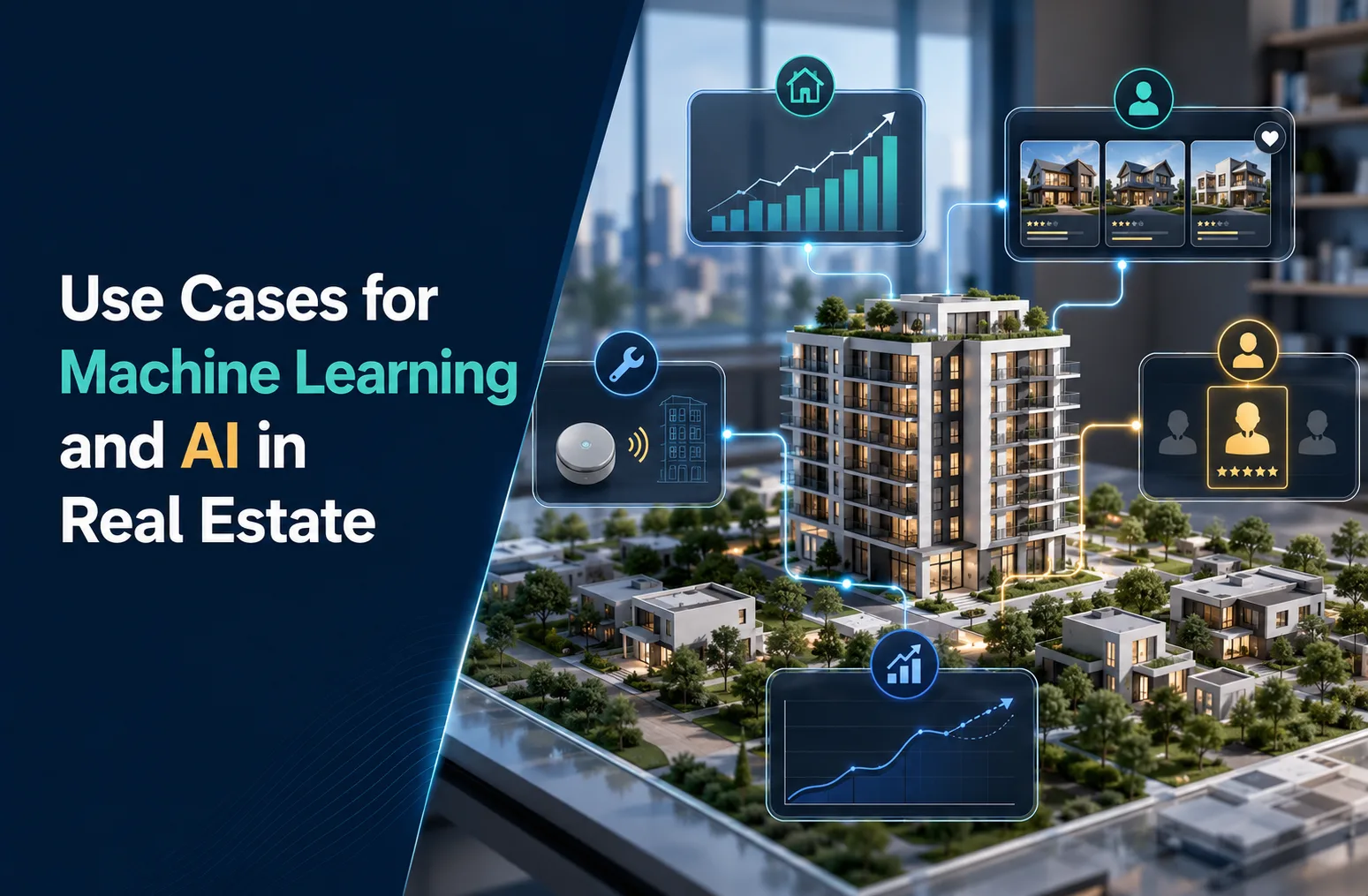
What are use cases for machine learning and AI in real estate?
Machine learning and AI in real estate have ten proven use cases in 2026: automated valuation models (AVMs), lead scoring and prioritisation, generative listing content, image and virtual-tour enhancement, predictive maintenance for property management, tenant and buyer screening (with fair-housing caveats), demand forecasting, chatbots and conversational agents, document and contract review, and portfolio-level investment analytics. Together they cover the full stack from marketing to leasing to operations to capital markets. Not every use case delivers equal ROI. AVMs, lead scoring, generative listings, and predictive maintenance produce the fastest returns; screening and forecasting carry more risk and need more oversight. This post walks through what each use case does, what it is worth, and where the returns are already showing up.
July 28, 2026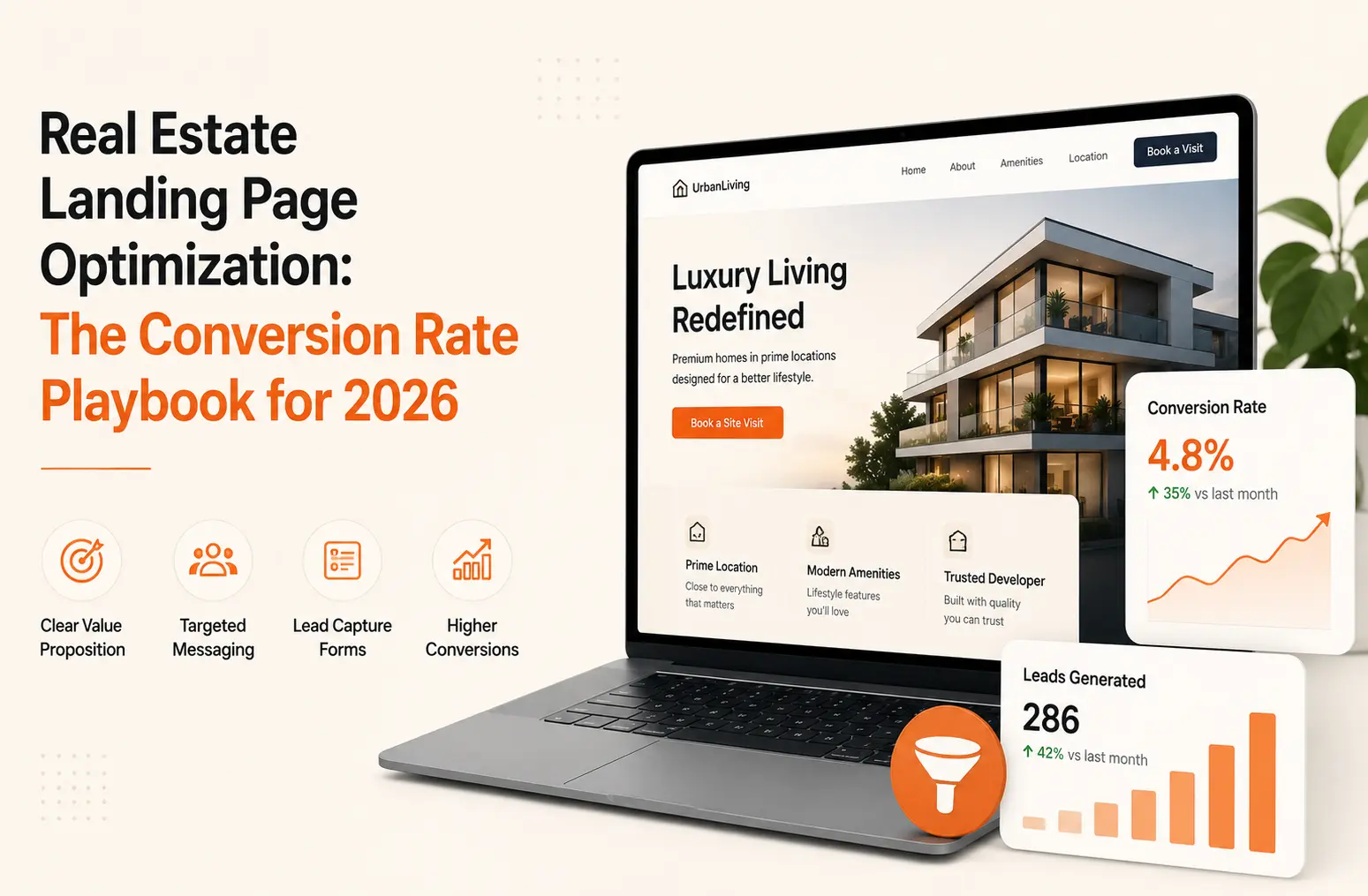 Real Estate
Real Estate Landing Page Optimization: The Conversion Rate Playbook for 2026
Most real estate landing pages convert at 2.7% while the top 25% convert at 11.45% or higher, and the gap has nothing to do with budget or design talent. This playbook breaks down exactly how to close that gap in 2026 through the nine structural elements every high-converting property landing page shares, a 15-point CRO audit you can run today, and a traffic source-specific optimization strategy that treats Google Search visitors, Meta cold audiences, and email traffic as the completely different conversion challenges they are. You'll also get the post-click architecture blueprint that connects your landing page to your CRM, automated response, and lead scoring system so conversions become pipeline, not just form fills sitting in a spreadsheet. Every section is built around measurable outcomes with specific benchmarks you can test against. If you're spending money driving traffic to a landing page that isn't hitting 5% or above, this is the playbook that fixes it.
July 28, 2026 Real Estate
Where is AI making a surprising impact on real estate support services?
AI is quietly reshaping the back-office of real estate, not just the front-office. The most surprising impact in 2026 is in support services that most operators still treat as manual: transaction coordination, escrow and title, property-management admin, compliance document review, vendor coordination, tenant communications, and bookkeeping. These functions absorb 30 to 40 percent of an operator's staff hours, and AI tools built for them now cut that load by 40 to 70 percent per workflow. Unlike front-office AI (listing generation, pricing, agent-side content) where the risk and disclosure burden is heavy, back-office AI has clearer economics, lower client-trust exposure, and faster payback. This is where operators are quietly capturing most of their real AI value in 2026, while everyone else is still debating whether ChatGPT should write listing descriptions.
July 28, 2026
Ready to book a 30-minute strategy call?
We'll map the right digital moves for your real estate business, no pitch deck, no commitment.