

Mayank Pokharna
Real estate & PropTech specialist
Best CRM for coliving operators 2026: buyer's guide
Published June 5, 2026|12 min read
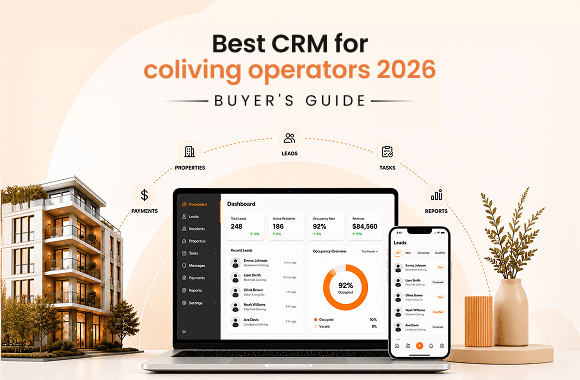
A CRM for coliving operators is a sales, tenant, and operations platform that tracks every room enquiry, qualifies leads, manages the booking funnel, and runs the full tenant lifecycle from waitlist through to move-out across multiple properties and markets. In 2026, the four CRMs worth seriously evaluating are HubSpot, Salesforce, Zoho, and a custom-built CRM, with the right choice driven by property count, geographic footprint, integration complexity, and the level of workflow customisation the operation needs. Operators running fewer than 10 properties typically run best on HubSpot or Zoho. Operators running 20+ properties across 3+ countries usually graduate to Salesforce or a custom build through our CRM implementation service.
What is a CRM for coliving operators?
A CRM for coliving operators is the central system of record for every prospect, tenant, and resident interaction across a coliving portfolio. Unlike a traditional real estate CRM built around long-cycle residential sales, a coliving CRM is structured around the specific operating model of coliving: room-by-room inventory rather than apartment-by-apartment, 1 to 12 month tenancies rather than indefinite leases, dynamic pricing rather than fixed annual rents, and a community management layer that does not exist in standard rental software.
The CRM has to do four jobs at once: capture and qualify enquiries across multiple inbound channels (website, WhatsApp, Instagram, listing portals, channel partners), route the booking journey through to a signed deposit, manage the tenant relationship for the duration of the stay, and reconcile every closed deposit back to its first-touch marketing source so the operator knows which channels are actually producing pipeline.
The companion piece on how to reduce lead leakage in real estate covers the discipline that turns raw CRM functionality into measurable pipeline recovery.
Why do coliving operators need a specialised CRM?
Three structural realities make a coliving-tuned CRM materially different from a generic real estate CRM.
The unit of inventory is the room, not the property. A 40-room coliving property is 40 individually rentable units with different pricing tiers, different lease end dates, different community fit considerations, and different turnover dynamics. A CRM that treats the property as a single inventory unit cannot manage coliving inventory properly. According to Coliving Insights research, 78 percent of coliving operators running on generic real estate CRMs report inventory tracking as their top operational pain point.
Pricing is dynamic. A coliving room is not priced annually like a residential lease. Pricing changes by length of stay, by community fit, by season, by occupancy, and by promotion. The CRM must hold this complexity natively, or operators end up duplicating data into spreadsheets and breaking attribution.
The tenant lifecycle continues after move-in. A residential brokerage CRM ends its job at the closing. A coliving CRM continues through tenant onboarding, community events, lease renewal, upsells (private bathroom upgrades, parking, additional services), and move-out coordination. Operators tracking this lifecycle properly see 38 percent higher lease renewal rates than operators running on transactional-only CRMs (JLL coliving market research, 2024).
For a deeper view of the coliving operating model, our coliving industry hub covers the broader stack.
What features should a coliving CRM include in 2026?
Twelve features separate a working coliving CRM from a generic real estate CRM forced to fit. If the CRM under evaluation does not have these natively or via supported integration, the operator will end up patching them later.
1. Room-level inventory tracking. Each room is a distinct CRM object with attributes for property, floor, size, amenities, current tenant, lease end date, and pricing tier.
2. Multi-property, multi-currency, multi-language. Native support for operating across countries without forcing every market into a single template.
3. Multi-channel enquiry capture. Website forms, WhatsApp Business API, Meta Lead Ads, Instagram DM, listing portal feeds, and missed-call SMS all route into the same CRM record with full source attribution.
4. AI-driven lead qualification. Automated first response within 60 seconds, qualifying budget, length of stay, move-in date, and community preference before the human team is involved.
5. Booking flow automation. Calendar integration for property tours, deposit handling through Stripe or Razorpay, lease document generation, and digital signature integration.
6. Tenant lifecycle stages. Stages covering enquiry, qualified, tour booked, tour attended, application submitted, deposit paid, moved in, in residence, renewal due, and moved out. Each stage triggers different automation.
7. Community management layer. Tracking community events, resident NPS scores, complaints, and upsell opportunities across the stay.
8. Channel partner portal. Broker and channel partner referrals are tracked separately with their own attribution and commission workflow.
9. CRM-to-PMS integration. Live sync with the property management system, handling rent collection, maintenance, and inventory. Hostfully, Cloudbeds, Mews, AppFolio, Buildium, and custom PMS platforms all need supported integration paths.
10. Marketing source attribution. Every closed deposit is traceable back to the first-touch source (Google, Meta, organic, channel partner, referral). The discipline that makes this work is covered in how to reduce lead leakage in real estate.
11. Reporting layer. Occupancy by property, conversion by channel, average cost per booked tenant, average tenant lifetime value, and revenue per available room (RevPAR) all surfaced in the CRM, not buried in a separate BI tool.
12. Mobile-first agent experience. Coliving sales agents close deals on the property during tours. The CRM mobile app has to support deposit collection, document signing, and lease creation from a phone.
How does coliving CRM differ from traditional residential CRM?
The differences are structural, not cosmetic.
Dimension | Traditional residential CRM | Coliving CRM |
|---|---|---|
Inventory unit | Property (1 unit) | Room (multiple units per property) |
Sales cycle | 60 to 180 days | 21 to 45 days |
Pricing model | Fixed annual rent | Dynamic by length of stay and demand |
Tenant relationship after move-in | Minimal | Ongoing community management |
Upsell opportunity | Rare | Continuous (room upgrades, services) |
Renewal as a workflow | Annual lease cycle | Rolling requires active management |
Community as a feature | Not relevant | Central to retention |
Multi-currency requirement | Rare | Common for cross-country operators |
Channel partner depth | Brokerage agents | Brokers, listing portals, influencers, corporate partners |
A coliving operator running on a traditional residential CRM ends up forcing this complexity into a system that was not built to hold it. The result is duplicate spreadsheets, broken attribution, and reporting that nobody trusts.
Which CRM is best for coliving operators in 2026?
Four CRMs are worth evaluating. The right choice is driven by property count, geographic footprint, and integration complexity. We are vendor-neutral on this question, and we have implemented all four across operator engagements.
HubSpot for coliving operators
Best for: Operators running 1 to 10 properties in 1 or 2 countries who need fast implementation and predictable per-seat pricing.
Strengths:
Fast implementation (4 to 6 weeks for a coliving setup)
Native WhatsApp Business API integration
Strong inbound marketing workflow,s including email and ad attribution
Per-seat pricing that scales linearly with team size
Wide partner ecosystem for integrations
Trade-offs:
Multi-currency and multi-language support requires the Enterprise tier and custom configuration
Less flexible than Salesforce for highly customised operating models
Integration with non-standard PMS platforms requires middleware
Annual cost: USD 8,000 to USD 40,000 in HubSpot license fees plus USD 18,000 to USD 45,000 implementation through our HubSpot real estate CRM service.
Salesforce for coliving operators
Best for: Operators running 20+ properties across 3+ countries, or operators with complex multi-stakeholder workflows (institutional investors, multiple brand lines, large channel partner networks).
Strengths:
The deepest customisation depth of any commercial CRM
Native multi-currency, multi-language, and multi-region data residency
The strongest partner ecosystem for enterprise integrations
Best-in-class reporting and dashboarding
AppExchange marketplace covers most niche PropTech tooling
Trade-offs:
Highest license cost
Implementation runs 10 to 16 weeks
Requires ongoing admin capacity (in-house or outsourced)
Over-engineered for operators below 15 properties
Annual cost: USD 24,000 to USD 200,000 in Salesforce license fees plus USD 45,000 to USD 180,000 implementation through our Salesforce real estate CRM service.
Zoho for coliving operators
Best for: Operators with strong cost discipline, existing Zoho One subscriptions, or those operating primarily in India, the UAE, and Southeast Asia, where Zoho support is strongest.
Strengths:
Roughly 40 percent of the equivalent HubSpot or Salesforce annual cost
Zoho One bundles 40+ apps under one subscription, useful for operators wanting CRM, helpdesk, books, social, and analytics under one license
Strong workflow automation in Zoho CRM Plus
Native Indian Rupee, AED, Singapore Dollar handling
Trade-offs:
Smaller partner ecosystem than HubSpot or Salesforce
Custom integrations sometimes require more engineering than HubSpot equivalents
The reporting layer is less polished than Salesforce
Annual cost: USD 5,000 to USD 22,000 in Zoho license fees plus USD 14,000 to USD 38,000 implementation through our Zoho real estate CRM service.
Custom CRM built for coliving operators.
Best for: Operators running 25+ properties, generating USD 5 million+ ARR, or operating workflows that off-the-shelf CRMs cannot accommodate without significant custom engineering on top.
Strengths:
Built exactly around the operator's workflow, not the other way around
No per-seat fees that scale with team growth
Full data ownership and no vendor lock-in
Native integration with whatever PMS, payment, and identity stack the operator already runs
Compounding asset value over a 5 to 10 year horizon
Trade-offs:
Highest upfront engineering cost
Requires committed product ownership inside the operator team
Implementation runs 16 to 28 weeks for the MVP
Annual cost: Zero license fees post-build. Implementation typically costs USD 80,000 to USD 280,000, depending on the scope, through our custom real estate CRM development service.
How much does a coliving CRM cost in 2026?
Three cost buckets to plan for in the first 12 months of a coliving CRM engagement.
Bucket 1, license fees. HubSpot USD 8K to USD 40K, Salesforce USD 24K to USD 200K, Zoho USD 5K to USD 22K, custom build USD 0.
Bucket 2, implementation. HubSpot USD 18K to USD 45K, Salesforce USD 45K to USD 180K, Zoho USD 14K to USD 38K, custom build USD 80K to USD 280K.
Bucket 3, ongoing support. 10 to 20 percent of the implementation cost annually for admin, configuration changes, and feature additions.
Across 100+ operator engagements, the total cost of CRM ownership over 3 years averages roughly equivalent across HubSpot, Salesforce, and Zoho (license fees plus implementation plus support). Custom builds break even in year 3 to 4 against off-the-shelf alternatives, with a significant cost advantage from year 4 onward.
How long does it take to implement a coliving CRM?
Implementation timelines depend on CRM choice and operator complexity.
HubSpot: 4 to 6 weeks for a single-country operator with under 10 properties. 8 to 10 weeks for multi-country.
Zoho: 6 to 10 weeks for a single-country operator. 10 to 14 weeks for multi-country.
Salesforce: 10 to 16 weeks for a multi-country, multi-currency setup. Single-country simpler builds run 8 to 12 weeks.
Custom build: 16 to 28 weeks for the MVP, with rolling additions over the following 12 months.
Across all CRM choices, the implementation phases follow the same five steps: discovery and requirements, data migration, workflow configuration, integration build, and team training. The companion piece on how to automate property enquiries covers the operational discipline that needs to wrap around the CRM at launch.
What are the most common coliving CRM mistakes?
Picking the CRM before defining the operating workflow. The operator buys HubSpot because a peer uses HubSpot, then forces the operation into the HubSpot defaults. The right sequence is to map the operating workflow first, then pick the CRM that fits it.
Skipping data migration discipline. Old leads, duplicate records, and inconsistent data fields get migrated wholesale into the new CRM and pollute the system from day one. Every migration needs an audit and a cleanup pass. Our data migration service handles this layer.
Optimising for cost per seat instead of total cost of ownership. A USD 25 per seat CRM that requires three middleware tools and constant manual intervention ends up costing more than a USD 75 per seat CRM that includes native automation.
Forgetting CRM-to-PMS integration at scoping. Operators implement the CRM first, then realise the PMS does not have a supported integration path. Always scope the integration layer before signing the CRM contract.
No source attribution from day one. Without UTM tagging, lead source capture on every form, and weekly attribution reconciliation, the CRM tracks activity but cannot prove which marketing channels produce closed deposits.
Over-customising HubSpot or Zoho beyond their natural ceiling. When customisation requests start hitting platform limitations, the right move is to migrate to Salesforce or commission a custom build, not to keep layering middleware. The build vs buy decision framework is one of the topics we cover in custom real estate CRM development.
Real example, a 14-country coliving operator
A coliving operator running 38 properties across 14 countries came to us with three separate CRMs (a Salesforce instance for North America, a HubSpot instance for Europe, and a Zoho instance for South East Asia), no unified data layer, and an inability to report consolidated occupancy or pipeline at the group level. The cost of running three CRMs was USD 240,000 per year in license fees plus USD 380,000 per year in admin and middleware.
After a 22-week consolidation engagement, the operator migrated to a single Salesforce Enterprise instance with custom configuration for room-level inventory, dynamic pricing, and community management, plus integration with their underlying Hostfully PMS. License cost stabilised at USD 165,000 per year. Admin and middleware costs dropped to USD 110,000 per year. Group-level reporting became live for the first time.
Within 6 months of consolidation, attributable inbound bookings increased 31 percent because the marketing team could finally see which channels produced bookings across all 14 countries, and reallocate budget accordingly.
Ready to pick the right CRM for your coliving operation?
Share your property count, geographic footprint, and current tech stack. A 30-minute audit covering CRM fit, integration path, implementation timeline, and total cost of ownership comes back within 5 business days. No commitment, no slides, just a clear map of the right CRM for your operation and the cost to ship it.
Book a free coliving CRM audit · Explore our CRM implementation service · Try the free CRM readiness assessment
- The coliving sales cycle, 21 to 45 days from enquiry to deposit, is shorter than the residential cycle and longer than the hotel cycle. The CRM that fits this rhythm is not the same one that fits residential brokerage or hotel revenue management.
- HubSpot wins for operators under 10 properties because of fast implementation, native WhatsApp and email automation, and predictable per-seat pricing. Most engagements ship in 4 to 6 weeks.
- Salesforce wins for operators over 20 properties or 3+ countries because of multi-currency, multi-language, and the partner integration ecosystem. Implementation runs 10 to 16 weeks.
- Zoho wins for operators with strong cost discipline and existing Zoho One subscriptions. Implementation runs 6 to 10 weeks at roughly 40 percent of the equivalent HubSpot or Salesforce build cost.
- Custom CRM builds become economically rational past USD 5 million ARR and 25+ properties, where the cost of forcing the operation into off-the-shelf workflows exceeds the cost of a bespoke build.
Why trust Noseberry
Our content is written by practicing real-estate and PropTech professionals, fact-checked by a dedicated editorial team, and reviewed against the latest industry data before publication.
- 10+ years of industry expertise
- All facts independently verified
- No sponsored rankings in guides
- Updated when the industry changes
Frequently Asked Question
What is the best CRM for a small coliving operator with 3 to 5 properties?
HubSpot or Zoho. HubSpot if marketing automation is the priority. Zoho if cost discipline is the priority. Both can be implemented in 4 to 6 weeks.
Can a coliving operator use a generic real estate CRM?
Technically, yes, in practice, no. Generic real estate CRMs do not handle room-level inventory, dynamic pricing, or community management natively. Operators end up forcing the operation into a tool that was not built for it, leaking data into spreadsheets, and breaking attribution.
Should a coliving operator build a custom CRM?
Past USD 5 million ARR and 25+ properties, a custom build often becomes the right call. Below that scale, off-the-shelf CRMs typically deliver better unit economics.
How do I migrate from one CRM to another without losing data?
Through a structured data migration with audit, cleanup, mapping, and validation phases. Across the migrations we have shipped, the average data loss is zero when the migration is run properly. Our data migration service covers this in detail.
What is the right CRM for a coliving operator expanding from 1 country to 5 countries?
At the expansion point, evaluate Salesforce against a custom build. HubSpot Enterprise also supports multi-currency, but begins to creak past 8 to 10 countries. The choice depends on whether the operator wants speed (Salesforce) or workflow control (custom).
How does the CRM connect to my coliving website and booking platform?
Through native integrations or middleware. Most modern CRMs support webhooks and API connectivity into Hostfully, Cloudbeds, Mews, and major coliving booking platforms. The integration layer is part of our CRM implementation service.
What are the AI capabilities to look for in a coliving CRM in 2026?
AI lead scoring, automated first-response chatbots, semantic search across tenant history, automated content generation for community engagement, and predictive churn modeling for tenant renewal. These layers are increasingly native in HubSpot and Salesforce, and can be built into Zoho or custom CRMs through our real estate AI solutions practice.
Related insights
 Real Estate
What are use cases for machine learning and AI in real estate?
Machine learning and AI in real estate have ten proven use cases in 2026: automated valuation models (AVMs), lead scoring and prioritisation, generative listing content, image and virtual-tour enhancement, predictive maintenance for property management, tenant and buyer screening (with fair-housing caveats), demand forecasting, chatbots and conversational agents, document and contract review, and portfolio-level investment analytics. Together they cover the full stack from marketing to leasing to operations to capital markets. Not every use case delivers equal ROI. AVMs, lead scoring, generative listings, and predictive maintenance produce the fastest returns; screening and forecasting carry more risk and need more oversight. This post walks through what each use case does, what it is worth, and where the returns are already showing up.
July 28, 2026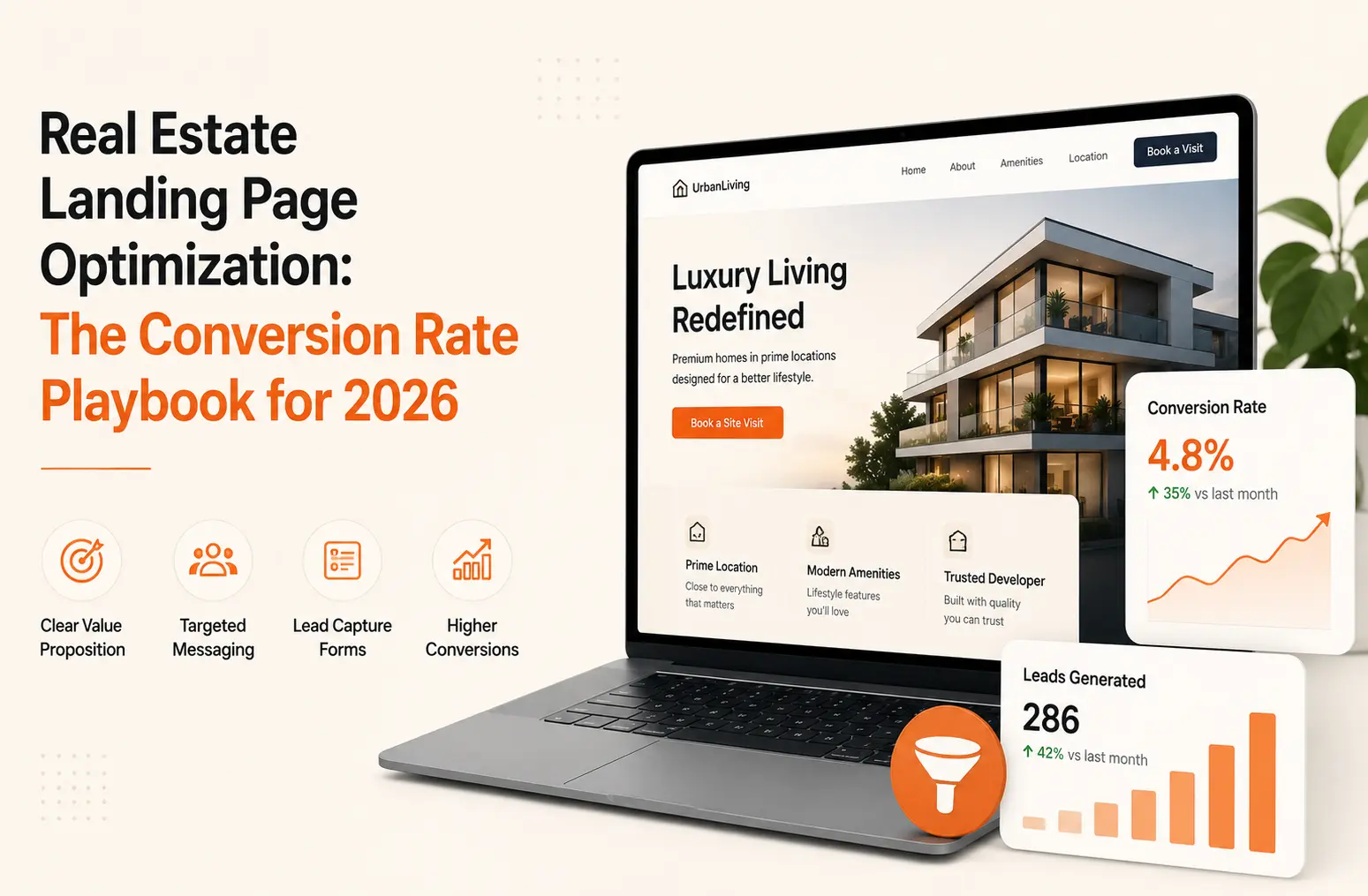 Real Estate
Real Estate Landing Page Optimization: The Conversion Rate Playbook for 2026
Most real estate landing pages convert at 2.7% while the top 25% convert at 11.45% or higher, and the gap has nothing to do with budget or design talent. This playbook breaks down exactly how to close that gap in 2026 through the nine structural elements every high-converting property landing page shares, a 15-point CRO audit you can run today, and a traffic source-specific optimization strategy that treats Google Search visitors, Meta cold audiences, and email traffic as the completely different conversion challenges they are. You'll also get the post-click architecture blueprint that connects your landing page to your CRM, automated response, and lead scoring system so conversions become pipeline, not just form fills sitting in a spreadsheet. Every section is built around measurable outcomes with specific benchmarks you can test against. If you're spending money driving traffic to a landing page that isn't hitting 5% or above, this is the playbook that fixes it.
July 28, 2026 Real Estate
Where is AI making a surprising impact on real estate support services?
AI is quietly reshaping the back-office of real estate, not just the front-office. The most surprising impact in 2026 is in support services that most operators still treat as manual: transaction coordination, escrow and title, property-management admin, compliance document review, vendor coordination, tenant communications, and bookkeeping. These functions absorb 30 to 40 percent of an operator's staff hours, and AI tools built for them now cut that load by 40 to 70 percent per workflow. Unlike front-office AI (listing generation, pricing, agent-side content) where the risk and disclosure burden is heavy, back-office AI has clearer economics, lower client-trust exposure, and faster payback. This is where operators are quietly capturing most of their real AI value in 2026, while everyone else is still debating whether ChatGPT should write listing descriptions.
July 28, 2026
Ready to book a 30-minute strategy call?
We'll map the right digital moves for your real estate business, no pitch deck, no commitment.