

Anmol Sharma
SEO Expert
Commercial Real Estate Technology Trends 2026: The Complete Guide to AI, PropTech & Smart Buildings
Published June 9, 2026|14 min read
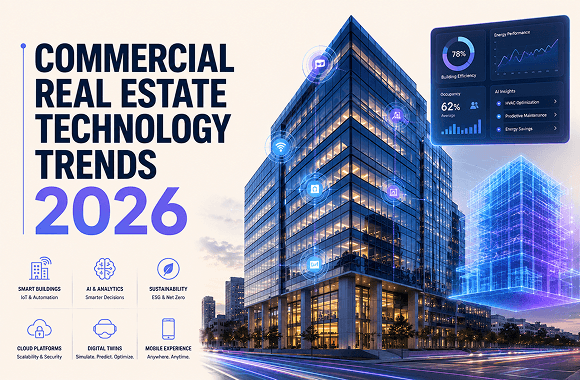
This guide covers the six most important commercial real estate technology trends shaping 2026: AI and agentic automation, smart building IoT, digital twins, tenant experience platforms, blockchain tokenization, and predictive analytics. It includes real data points from JLL, PwC, and CBRE, a CRE vs. residential PropTech comparison table, a 10-question FAQ section optimized for AI search, and a practical technology adoption roadmap for operators at every stage of maturity. Whether you manage a single commercial asset or a multi-market portfolio, this post gives you the framework to build a 2026 technology strategy with confidence.
The biggest commercial real estate technology trends in 2026 are AI-driven property operations, smart building IoT infrastructure, digital twin deployment, agentic lease management, and blockchain-enabled transactions. Together, these five forces are changing how commercial assets are owned, operated, leased, and valued. If you manage, develop, or invest in commercial property and haven't built a technology roadmap yet, you're already behind the operators who have.
Commercial real estate has always been slow to change. But in the past 36 months, the pace of commercial real estate innovation has accelerated faster than any prior decade. Global PropTech investment hit $16.7 billion in 2025, according to the Race Forum PropTech report, and the overwhelming majority of that capital flowed into commercial-focused tools: building intelligence platforms, AI underwriting systems, and tenant experience apps. This guide breaks down what's actually moving, what's hype, and what CRE operators should prioritize in 2026.
What Are the Biggest Commercial Real Estate Technology Trends in 2026?
The six categories dominating commercial real estate technology in 2026 are: artificial intelligence and automation, smart building IoT, digital twins, PropTech platforms for tenant experience, blockchain-based transactions, and predictive data analytics. Each category is mature enough to deliver measurable ROI, not just pilot-stage experiments.
Here's a breakdown of where the industry sits right now.
AI and Automation: From Chatbots to Full Agentic Workflows
In my decade working with real estate operators, nothing has shifted the efficiency conversation more dramatically than the move from simple AI chatbots to full agentic workflows. A year ago, clients were asking about chatbots for tenant FAQs. Today, they're asking about AI agents that qualify commercial tenants, abstract lease clauses, flag covenant breaches, and push alerts to asset managers, all without a human in the loop.
AI is now embedded across the CRE value chain. On the acquisition side, AI underwriting tools ingest financials, comparable sales, rent rolls, and macro data to produce deal screens in minutes rather than days. On the operations side, AI-powered property management platforms handle maintenance triage, vendor dispatch, and predictive fault detection before a tenant even notices a problem. On the leasing side, AI lease abstraction tools like Kira and Leverton extract critical dates, obligations, and rent escalation clauses from hundreds of pages of documents in seconds.
According to JLL's 2026 Technology Industry Trends report, 74% of commercial real estate firms now use at least one AI tool in their core operations, up from 39% in 2023. That's a near-doubling in three years.
The operators pulling the most value from AI aren't using off-the-shelf SaaS. They're working with teams that build custom AI systems for real estate workflows, trained on their own data, connected to their stack, and owned outright. That distinction matters: a general-purpose AI tool can handle generic queries. A domain-trained agent knows the difference between a gross lease and a triple-net, handles CAM reconciliation queries, and integrates with your existing property management software.
Smart Buildings and IoT: The Infrastructure Layer Everyone Is Finally Taking Seriously
Smart building technology is commercial real estate innovation in its most physical form. IoT sensors embedded in HVAC systems, lighting rigs, elevators, and access control panels generate continuous data streams that, when properly analyzed, cut operating costs and improve tenant retention.
The numbers are compelling. IoT-enabled building management systems reduce energy consumption by 10-15%, according to research cited by VanEd's 2026 real estate tech report. Advanced security and access-control systems boost asset value by up to 12% and enable a 15-20% rental premium. For a 200,000 sq ft Class A office building, that premium represents millions in additional annual NOI.
What's changed in 2026 is the integration layer. Earlier smart building deployments ran on siloed platforms. An HVAC vendor had its own dashboard. The access control system had another. The lighting automation had a third. Today, unified building operating systems like Willow, HqO, and Siemens Building X consolidate all sensor data into a single pane of glass, accessible on mobile, connected to the asset management platform, and fed into AI analytics engines.
The smart home and IoT integration capability that once applied only to residential builds is now the foundation of every high-performing commercial asset. Tenants expect it. Institutional investors price it in. If your building doesn't have at least a basic IoT layer, you're competing with one hand behind your back.
How Are Digital Twins Changing Commercial Property Management?
Digital twins are changing commercial property management by creating a real-time virtual replica of a physical building that synchronizes with live sensor data, enabling owners and operators to simulate scenarios, predict failures, and optimize performance without touching the physical asset. A well-deployed digital twin pays for itself through reduced maintenance costs and energy savings, typically within 18-24 months of go-live.
A digital twin is a continuously updated virtual model of a physical asset, connected to real-world data via IoT sensors, BIM models, and facility management systems. It's not a static 3D render. It moves with the building: temperature fluctuations, occupancy patterns, equipment wear, energy draw. When something drifts outside normal parameters, the twin flags it before it becomes a failure.
In commercial real estate, digital twins are being deployed at three levels. The component level tracks individual systems (HVAC units, elevators, fire suppression). The floor level models space utilization, air quality, and occupancy. The portfolio level aggregates data across multiple buildings, enabling operators to benchmark performance, allocate capex efficiently, and report on ESG metrics with actual data rather than estimates.
PwC's Emerging Trends in Real Estate 2026 report notes that digital twin adoption in commercial real estate grew 58% year-on-year between 2024 and 2025, driven by institutional pressure on ESG reporting and the falling cost of IoT sensor deployment.
When I've worked with commercial operators on digital twin strategy, the first question is always: where does the data live? The answer matters because a twin is only as good as its data pipeline. Buildings running on legacy BMS (building management systems) often need a middleware integration layer before a twin can consume live data reliably.
PropTech Platforms for Tenant Experience: What CRE Operators Need to Know
Tenant experience technology is no longer a "nice to have" for Class A office buildings. It's a lease renewal lever. Commercial tenants evaluating renewals now weigh the building's tech stack almost as heavily as the physical space itself. Operators who can demonstrate energy efficiency, responsive maintenance, and a frictionless digital-first tenant journey retain tenants at meaningfully higher rates.
The leading tenant experience platforms in 2026 include HqO, Equiem, Comfy, and building-specific apps built on custom app development frameworks. These platforms handle:
Mobile access control and visitor management
Maintenance request submission and tracking
Amenity booking (meeting rooms, wellness spaces, parking)
ESG dashboards for tenants reporting on their own sustainability metrics
Community features, events, and communication threads
The competitive gap in this space is not feature parity. Every major platform has roughly the same feature set now. The differentiator is integration depth: how well the tenant app talks to the building's BMS, access control system, parking management platform, and the operator's CRM. Operators who connect all these layers see tenant satisfaction scores rise substantially, and that translates directly into renewal rates.
According to a 2025 CBRE Tenant Experience Survey, buildings with high-quality tenant experience apps see lease renewal rates 22% higher than comparable buildings without them.
Blockchain and Tokenization: Is Commercial Real Estate Ready?
Blockchain and tokenization are ready for specific commercial real estate use cases in 2026, particularly large-scale transaction settlement, fractional ownership of institutional assets, and digital title management. They are not yet ready to replace the full transaction stack for most CRE operators, but the infrastructure is maturing fast.
Here's the honest picture. Smart contracts are being actively used by large commercial REITs and institutional investors to reduce settlement times and cut intermediary costs. Leveraging blockchain for large-scale commercial transactions can reduce transaction fees by up to 70%, according to VanEd's 2026 CRE tech analysis, largely by eliminating escrow agents, title insurers, and manual verification steps.
Tokenization of commercial real estate is the more transformative (and more nascent) use case. It converts fractional ownership of a building into digital tokens tradeable on compliant securities platforms. A $50M office tower becomes 50,000 tokens, each representing $1,000 of ownership, tradeable like a stock. This dramatically lowers the minimum ticket size for institutional-grade CRE investment and improves asset liquidity.
Platforms like RealT, Tokeny, and Harbor are making tokenized CRE investment operationally feasible. The regulatory picture is clearer in the US, EU, and Singapore than in most other markets, which is where early adoption is concentrated.
For most mid-market CRE operators, blockchain isn't yet the first technology investment to make. But understanding the direction is important because the operators who will benefit most from tokenization are those who get their data, documentation, and legal structures clean now.
Predictive Analytics and AI-Driven Investment Intelligence
Predictive analytics is not a new concept in commercial real estate. What's new in 2026 is the quality of the inputs and the accessibility of the tools. Five years ago, meaningful predictive modeling required a data science team and months of work. Today, CRE-specific analytics platforms ingest satellite imagery, foot traffic data, planning application data, rent roll histories, and macro-economic indicators to produce investment forecasts that a regional operator can actually use.
The clearest use cases for predictive analytics in 2026 commercial real estate are:
Vacancy forecasting by asset class and submarket, enabling proactive leasing campaigns before a building runs into trouble.
Capex prioritization based on predictive equipment failure modeling, directing maintenance budgets to the highest-risk assets first.
Acquisition screening, where AI scores incoming deal opportunities against portfolio strategy before a human analyst touches the file.
Rent optimization, modeling the effect of rental adjustments on occupancy probability and NOI.
ESG reporting automation, pulling live energy and emissions data into regulatory reporting frameworks like GRESB and TCFD.
As James Scott, Head of Real Estate Research at MIT's Real Estate Innovation Lab, has noted: "The CRE firms generating alpha in 2026 are those treating data as a balance-sheet asset, not just an operational byproduct." That framing has stuck with me. Data infrastructure is not an IT project. It's a competitive moat.
This connects directly to the real estate lead generation strategies that commercial operators use. When your analytics platform tells you which tenants in your submarket are six months from lease expiration, your leasing team knows exactly who to call. That's predictive analytics turning into direct revenue.
How Does Commercial Real Estate Technology Differ From Residential PropTech?
Commercial real estate technology differs from residential PropTech in its scale, complexity, and primary use cases. Residential PropTech focuses on transaction facilitation, consumer experience, and individual property management. Commercial technology focuses on asset-level performance optimization, institutional reporting, multi-tenant operational complexity, and investment-grade data infrastructure.
Dimension | Residential PropTech | Commercial Real Estate Technology |
|---|---|---|
Primary user | Individual buyer or tenant | Asset manager, REIT, operator, investor |
Data scale | One unit | Hundreds to thousands of units per asset |
AI use case | Valuation, virtual tours | Lease abstraction, NOI forecasting, ESG |
IoT focus | Smart home convenience | Building operations, energy, security |
Blockchain use | Title transfer | Tokenization, institutional settlement |
Integration depth | Listing platforms, CRMs | BMS, ERP, capital markets platforms |
Regulatory complexity | Local compliance | Multi-jurisdiction, GRESB, TCFD, SEC |
This distinction matters when you're choosing technology partners. A team that has built 30 residential property portals and calls itself a PropTech agency is not the same as a team that has shipped commercial real estate software for operators running multi-asset portfolios across multiple markets. Ask the specific question before you sign an engagement.
What Does the Future of Commercial Real Estate Technology Look Like Beyond 2026?
The future of commercial real estate technology beyond 2026 will be defined by autonomous building systems, agentic AI operating the full property management stack, spatial computing replacing traditional building inspections, and the convergence of physical and digital asset ownership through tokenization at scale.
Here are the five directions shaping the next five years.
Autonomous buildings. By 2028-2030, the most advanced commercial buildings will self-regulate occupancy, energy, climate, and security without human intervention for routine operations. The building operating system becomes as sophisticated as an aircraft's autopilot: human override capability always present, but rarely needed.
Full-stack agentic AI. Today's AI handles individual tasks. Tomorrow's AI orchestrates entire workflows: a lease expiry triggers an AI agent that generates renewal proposals, benchmarks against market comps, routes to the asset manager for approval, and sends the signed document to the tenant. No human touches the process until the approval stage.
Spatial computing for property. Apple Vision Pro and its successors are beginning to appear in CRE due diligence workflows. Within three years, building inspections, portfolio reviews, and tenant walkthroughs will happen in spatial computing environments, dramatically reducing site visit costs for investors and lenders.
Climate risk integration. ESG is moving from voluntary to mandatory. Climate risk scoring will be embedded in every underwriting model, every loan covenant, and every institutional reporting framework. The CRE firms investing in data infrastructure now will have a significant compliance advantage.
Convergence of digital and physical ownership. As tokenization matures, the line between owning shares in a REIT and owning tokenized fractions of a specific building will blur. This will change liquidity, secondary market dynamics, and the investor base for commercial real estate profoundly.
If you want to understand how to position your CRE business for these shifts, the real estate SEO and AEO guide for 2026 is worth reading alongside this post: digital visibility is increasingly how tenants, investors, and partners find and evaluate CRE operators before they ever pick up the phone.
Conclusion
Commercial real estate technology in 2026 is not a future story. It's a present reality that's already separating well-capitalized, operationally intelligent operators from those running on instinct and spreadsheets. The firms winning in this environment have done three things: they've built a connected data layer across their portfolio, they've deployed AI where it replaces genuine manual labor (not just adds a chatbot), and they've treated their building infrastructure as a technology platform rather than a fixed physical asset.
The six technology categories covered in this guide, including AI and agentic automation, smart building IoT, digital twins, tenant experience platforms, blockchain-enabled transactions, and predictive analytics, are not independent trends. They're layers of the same integrated system. A digital twin is only as useful as the IoT sensors feeding it. Predictive analytics is only as sharp as the data your building management system captures. AI lease management only works if your document infrastructure is clean.
The practical next step depends on where you are. If you're early-stage with no formal technology stack, start with the data layer: get your IoT sensors deployed, your BMS connected, and your property data into a structured format. If you're mid-stage with disconnected tools, the priority is integration, connecting your CRM, building platform, and analytics layer into a unified system. If you're advanced and running connected systems, the next conversation is AI: where can an agent replace a manual workflow and generate measurable ROI?
At Noseberry Digitals, we've worked with 100+ real estate operators across 14 countries building exactly these systems, from custom property management software to agentic AI for real estate operations to the SEO and AEO infrastructure that makes sure investors and tenants can find you. If you want to talk through where your technology roadmap should start, book a strategy call with our team. No slides, no pitch. Just an honest conversation about what's worth building in 2026.
- Global PropTech investment reached $16.7 billion in 2025, with commercial-focused tools capturing the largest share of funding.
- 74% of commercial real estate firms now use at least one AI tool in core operations (JLL, 2026), nearly double the 39% figure from 2023.
- Smart building IoT systems reduce energy consumption by 10-15% and enable a 15-20% rental premium over non-connected buildings.
- Digital twin adoption in commercial real estate grew 58% year-on-year between 2024 and 2025, driven by ESG reporting mandates.
- Buildings with tenant experience apps see lease renewal rates 22% higher than comparable buildings without them (CBRE, 2025).
- Blockchain tokenization can reduce commercial transaction fees by up to 70% by removing traditional intermediaries from the settlement process.
- Commercial real estate technology differs from residential PropTech in scale, regulatory complexity, and its focus on asset-level performance rather than consumer experience.
- The operators winning in 2026 have built a connected data layer, deployed AI on genuine manual workflows, and treat their building as a technology platform.
- Full-stack agentic AI, autonomous buildings, and climate risk scoring will define the CRE technology landscape from 2026 through 2030.
- Starting with IoT infrastructure before deploying AI is the right sequencing for most mid-market CRE operators who haven't yet built a formal tech stack.
Why trust Noseberry
Our content is written by practicing real-estate and PropTech professionals, fact-checked by a dedicated editorial team, and reviewed against the latest industry data before publication.
- 10+ years of industry expertise
- All facts independently verified
- No sponsored rankings in guides
- Updated when the industry changes
Have Any Questions?
What are the top commercial real estate technology trends in 2026?
The top commercial real estate technology trends in 2026 are AI-driven property operations and lease management, smart building IoT systems, digital twin deployment, tenant experience platforms, blockchain-based transactions and tokenization, and predictive analytics for investment intelligence. Each of these is delivering measurable ROI for commercial operators today, not just in pilot stages. Global PropTech investment reached $16.7 billion in 2025, with commercial-focused tools receiving the largest share.
What is PropTech and how does it apply to commercial real estate?
PropTech is the application of technology to improve how properties are designed, transacted, managed, and invested in. In commercial real estate specifically, PropTech covers building intelligence platforms, AI lease abstraction tools, tenant experience apps, investor portals, and automated NOI reporting systems. Commercial PropTech differs from residential PropTech in its focus on asset-level performance, institutional reporting requirements, and multi-tenant operational complexity at scale.
How is AI being used in commercial real estate right now?
AI is currently used in commercial real estate for lease abstraction, deal underwriting, tenant qualification, maintenance triage, predictive fault detection, rent optimization, ESG reporting, and agentic workflows that execute multi-step operational tasks without human involvement. According to JLL's 2026 Technology Industry Trends report, 74% of commercial real estate firms now use at least one AI tool in core operations. The most impactful deployments use custom-trained AI, not generic tools.
What is a digital twin in commercial real estate?
A digital twin in commercial real estate is a continuously updated virtual model of a physical building that synchronizes with live sensor data from IoT devices, BMS systems, and facility management platforms. It allows operators to monitor building performance in real time, simulate capex scenarios, predict equipment failures before they occur, and produce accurate ESG reports. Digital twin adoption in commercial real estate grew 58% year-on-year between 2024 and 2025, driven by ESG reporting mandates.
Should I invest in smart building technology for my commercial property?
Yes, if your asset is in a competitive market for Class A or B tenants. IoT-enabled building management systems reduce energy consumption by 10-15%, boost asset value by up to 12%, and enable a 15-20% rental premium over comparable non-smart buildings. Buildings with high-quality tenant experience apps see lease renewal rates 22% higher than comparable buildings without them (CBRE, 2025). The ROI case for smart building investment is strong across office, industrial, and mixed-use asset classes.
How does commercial real estate technology compare to residential PropTech?
Commercial real estate technology focuses on asset performance optimization, institutional reporting, multi-tenant operational management, and investment-grade data infrastructure. Residential PropTech centers on transaction facilitation and individual consumer experience. The tools, data volumes, regulatory requirements, and integration complexity differ substantially. A platform built for residential agents will not meet the operational needs of a commercial asset manager running a multi-million-square-foot portfolio.
What is blockchain tokenization in commercial real estate?
Blockchain tokenization in commercial real estate converts fractional ownership of a physical building into digital tokens that can be traded on compliant securities platforms. A $50 million office building becomes 50,000 tokens, each representing $1,000 of ownership, dramatically reducing the minimum investment threshold for institutional-grade CRE assets. Tokenization improves liquidity, broadens the investor base, and can reduce transaction fees by up to 70% by removing traditional intermediaries from the settlement process.
How much does commercial real estate technology cost to implement?
Commercial real estate technology costs vary significantly by category and scale. A basic IoT sensor deployment for a single building typically runs $50,000-$150,000. A digital twin integration for a mid-size commercial asset runs $100,000-$300,000. Custom AI development for lease management or tenant operations starts around $50,000 for a prototype. Enterprise tenant experience platforms run $20,000-$80,000 per year in licensing. The total cost of a fully integrated smart building stack for a mid-size portfolio typically falls in the $300,000-$700,000 range over a three-year implementation window.
What is the future of commercial real estate technology beyond 2026?
The future of commercial real estate technology beyond 2026 will be defined by autonomous building systems, full-stack agentic AI managing entire property operations workflows, spatial computing replacing traditional building inspections, mandatory climate risk scoring embedded in underwriting and reporting, and the convergence of physical and digital asset ownership through tokenization. The commercial operators building clean data infrastructure and connected technology stacks today will have the most defensible competitive positions by 2028-2030.
How do I start building a commercial real estate technology strategy?
Start by auditing your current data layer: what building data do you capture, where does it live, and how accessible is it? Then identify the three highest-cost manual workflows in your operations and evaluate whether AI, automation, or platform integration can replace them. Prioritize IoT connectivity as the foundation layer before deploying AI, since most AI tools need clean, continuous data to function reliably. Work with a team experienced in commercial real estate technology specifically, not general software developers who are new to the asset class.
Related insights
 Real Estate
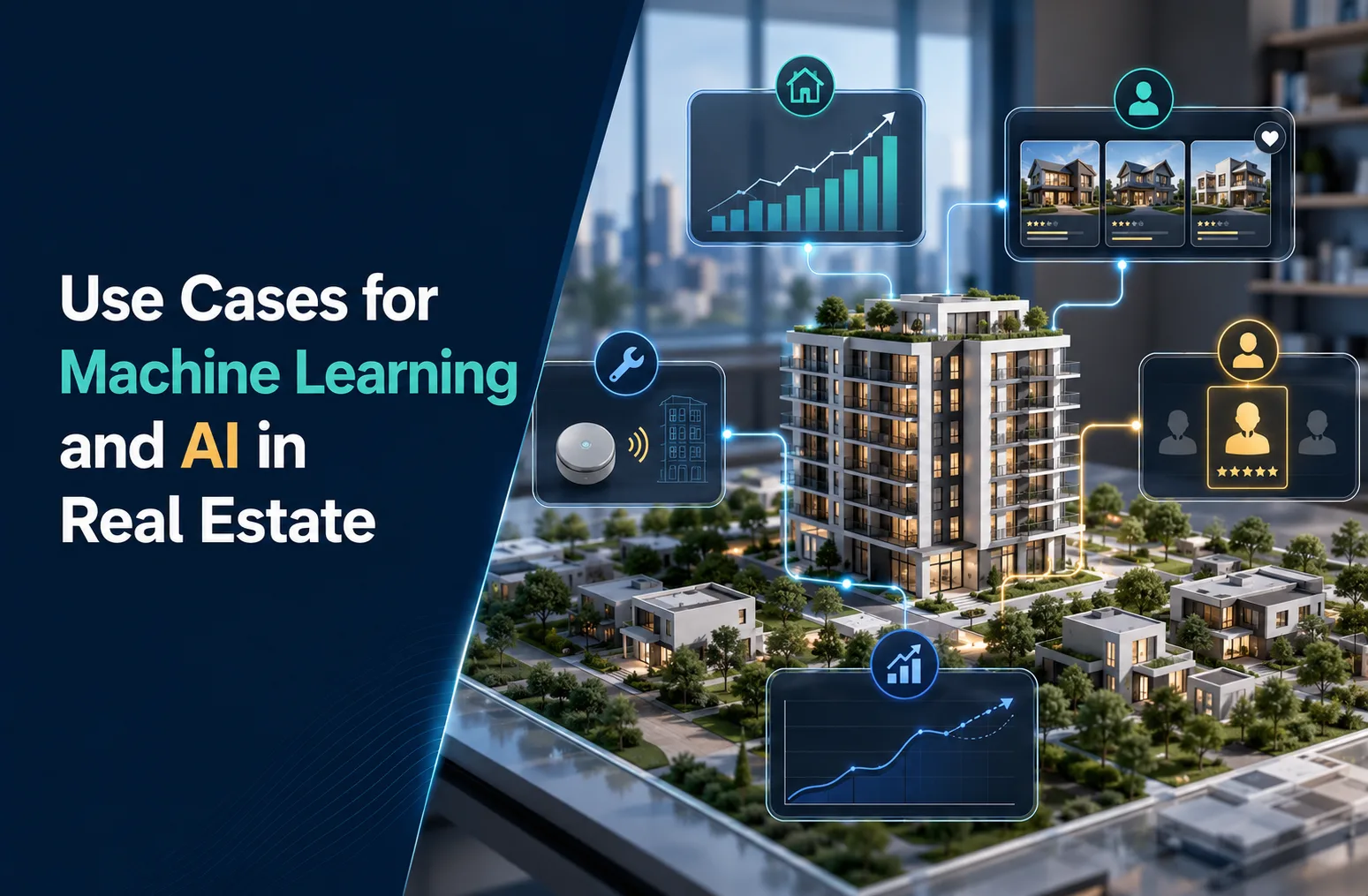
What are use cases for machine learning and AI in real estate?
Machine learning and AI in real estate have ten proven use cases in 2026: automated valuation models (AVMs), lead scoring and prioritisation, generative listing content, image and virtual-tour enhancement, predictive maintenance for property management, tenant and buyer screening (with fair-housing caveats), demand forecasting, chatbots and conversational agents, document and contract review, and portfolio-level investment analytics. Together they cover the full stack from marketing to leasing to operations to capital markets. Not every use case delivers equal ROI. AVMs, lead scoring, generative listings, and predictive maintenance produce the fastest returns; screening and forecasting carry more risk and need more oversight. This post walks through what each use case does, what it is worth, and where the returns are already showing up.
July 28, 2026 Real Estate
Real Estate Landing Page Optimization: The Conversion Rate Playbook for 2026
Most real estate landing pages convert at 2.7% while the top 25% convert at 11.45% or higher, and the gap has nothing to do with budget or design talent. This playbook breaks down exactly how to close that gap in 2026 through the nine structural elements every high-converting property landing page shares, a 15-point CRO audit you can run today, and a traffic source-specific optimization strategy that treats Google Search visitors, Meta cold audiences, and email traffic as the completely different conversion challenges they are. You'll also get the post-click architecture blueprint that connects your landing page to your CRM, automated response, and lead scoring system so conversions become pipeline, not just form fills sitting in a spreadsheet. Every section is built around measurable outcomes with specific benchmarks you can test against. If you're spending money driving traffic to a landing page that isn't hitting 5% or above, this is the playbook that fixes it.
July 28, 2026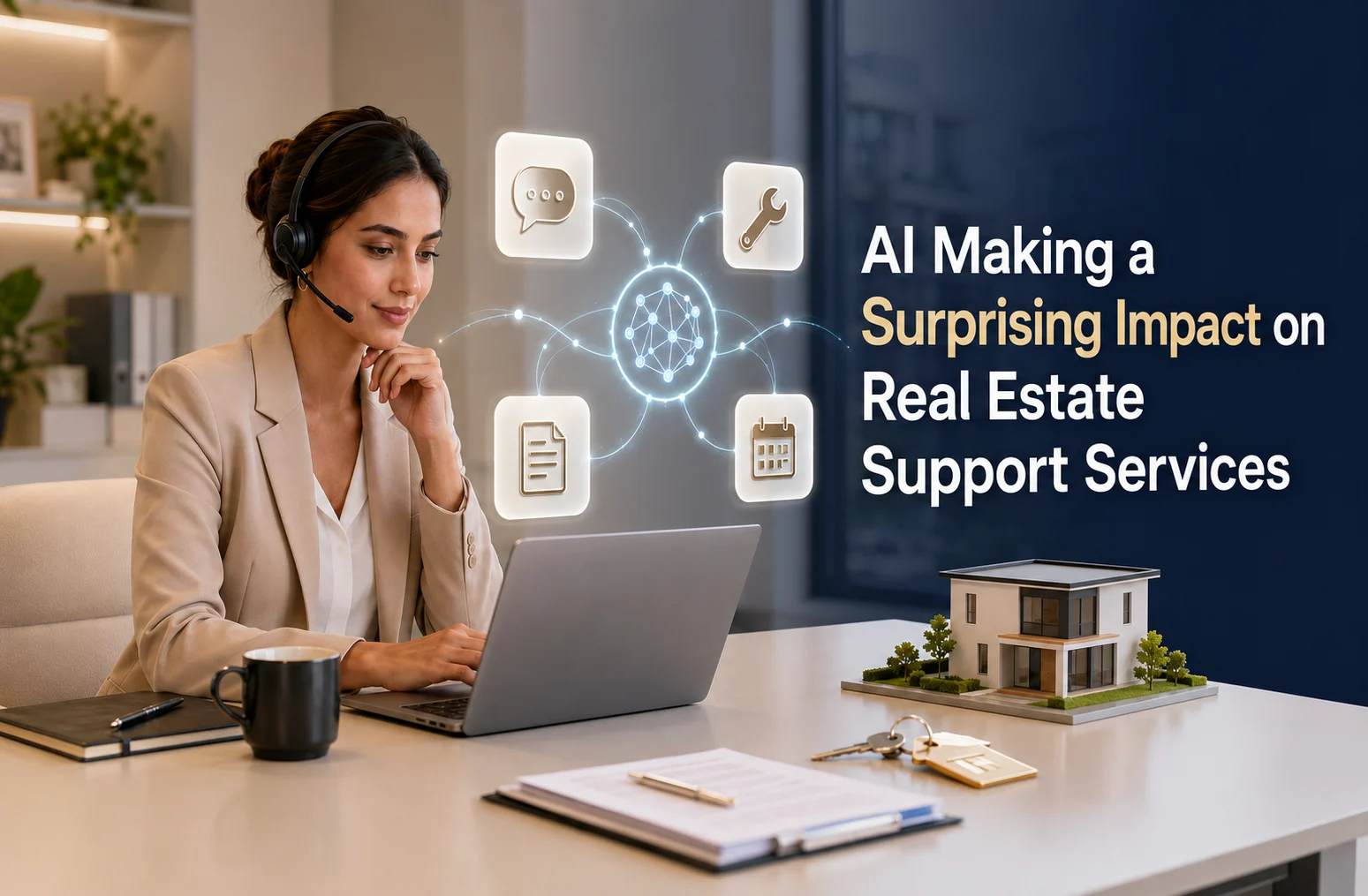 Real Estate
Where is AI making a surprising impact on real estate support services?
AI is quietly reshaping the back-office of real estate, not just the front-office. The most surprising impact in 2026 is in support services that most operators still treat as manual: transaction coordination, escrow and title, property-management admin, compliance document review, vendor coordination, tenant communications, and bookkeeping. These functions absorb 30 to 40 percent of an operator's staff hours, and AI tools built for them now cut that load by 40 to 70 percent per workflow. Unlike front-office AI (listing generation, pricing, agent-side content) where the risk and disclosure burden is heavy, back-office AI has clearer economics, lower client-trust exposure, and faster payback. This is where operators are quietly capturing most of their real AI value in 2026, while everyone else is still debating whether ChatGPT should write listing descriptions.
July 28, 2026
Ready to book a 30-minute strategy call?
We'll map the right digital moves for your real estate business, no pitch deck, no commitment.