

Atul Kumar
Real estate & PropTech specialist
Best Student Housing Software in 2026: A Buyer's Guide for PBSA and BTR Operators
Published June 12, 2026|11 min read
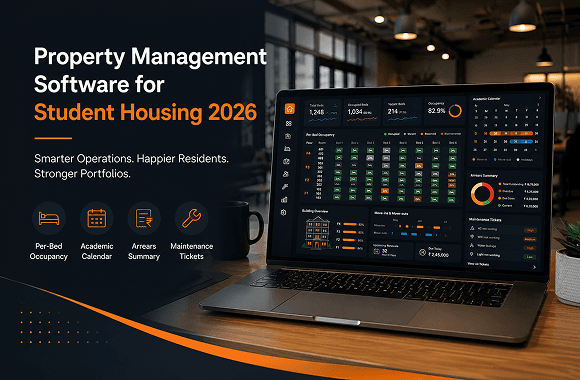
This buyer's guide is written specifically for PBSA and BTR operators who need student housing software that actually matches how student accommodation works, not a generic list of PM tools repackaged for SEO. It covers what separates student housing management software from standard residential tools, breaks down the top platforms honestly (including where they fail at scale), explains when off-the-shelf stops working and custom wins, provides a full cost breakdown across pricing models.
The best student housing software in 2026 depends entirely on your operating model. Purpose-built student accommodation (PBSA) and build-to-rent operators with complex portfolios, per-bed billing, and multi-jurisdiction compliance need fundamentally different tools than a landlord managing a handful of student lets off a spreadsheet.
This guide cuts through the noise. You'll find a clear breakdown of what student housing software actually does, which tools fit which operator profile, and the point at which off-the-shelf platforms stop working and a custom property management system becomes the smarter investment. We've worked with student housing operators across 14 countries, and the pattern of what breaks as portfolios scale is remarkably consistent.
What Is Student Housing Software and Who Actually Needs It?
Student housing software is a category of property management technology that handles the specific operational demands of student accommodation: academic-year lease cycles, bulk intake periods, per-bed (rather than per-unit) billing, guarantor management, occupancy tracking tied to term dates, and compliance with institutional or local housing regulations.
It's different from standard residential property management software because the tenancy rhythm is completely different. Students move in and out in cohorts, not as individual households. Lease lengths align with academic calendars. A single flat may have five separate tenants, five separate guarantors, and five separate rent accounts. General-purpose tools were not built for this.
Who needs dedicated student housing property management software?
PBSA operators managing purpose-built student blocks with 100 or more beds
BTR landlords with a significant student tenant mix in university cities
University accommodation offices managing on-campus and affiliated stock
Property managers running HMO portfolios near campuses at scale
PropTech platforms building student-facing booking and management products
If you're managing fewer than 10 student units informally, a standard residential PM tool works fine. Once you're above that threshold and operating with any complexity, purpose-built software starts paying for itself.
What Are the Core Features Every Student Housing Management System Needs?
Strong student housing management software must handle five functional areas that generic tools consistently get wrong.
1. Per-bed billing and academic-cycle leasing The system needs to generate individual payment schedules per bed, not per property. Rent instalments should align with term dates and student loan disbursement windows, typically three times per year in the UK or semester-based in the US. Any tool that only bills per unit will create manual reconciliation work at scale.
2. Guarantor and parental consent management Most student tenancies require a guarantor. The software needs a guarantor portal, automated chasing workflows, e-signature integration, and guarantor liability tracking tied to each individual tenancy. Without this, your team is managing it over email, which breaks above 50 beds.
3. Bulk intake and move-out workflows A PBSA block may turn over 200 residents in a single week in September. The system must support bulk application processing, room assignment logic (including roommate matching if relevant), automated welcome sequences, and coordinated move-out inspections. Tools that handle one tenancy at a time become a bottleneck at intake.
4. Maintenance and compliance tracking Student residents raise maintenance tickets at higher rates than general residential tenants. The system needs a mobile-friendly tenant portal, automated contractor dispatch, SLA tracking, and compliance logs for HMO licenses, fire safety checks, and HHSRS assessments in regulated markets.
5. Occupancy analytics tied to academic calendar Standard occupancy reporting doesn't account for term-time versus vacation occupancy, summer subletting, or block-booking patterns. Student housing operators need analytics that map directly to the academic year, with forecasting tools that help plan re-marketing well before the summer intake cycle begins.
The Top Student Housing Software Options in 2026
Here's an honest look at the tools most commonly evaluated by operators, with their real strengths and the situations where they fall short.
Software | Best For | Per-Bed Billing | Guarantor Portal | Bulk Intake | Custom Workflows | Starting Price |
|---|---|---|---|---|---|---|
Entrata | Large PBSA operators (500+ beds) | Yes | Yes | Yes | Limited | Custom quote |
StarRez | University accommodation offices | Yes | Yes | Yes | Moderate | Custom quote |
Buildium | Small to mid portfolios under 200 beds | Partial | No | No | Limited | ~$55/month |
Yardi Voyager | Institutional operators, US/UK focus | Yes | Yes | Yes | High | Custom quote |
Kinetic | PBSA and student-specific operators | Yes | Yes | Yes | Moderate | Custom quote |
DoorLoop | General residential with student mix | No | No | No | Limited | ~$69/month |
JumboTiger (Custom PMS) | Complex PBSA/BTR operators, multi-market | Yes | Yes | Yes | Full | Scoped build |
Entrata
Entrata is one of the more comprehensive enterprise platforms for student housing. It handles per-bed billing, academic-cycle lease terms, and has a functional guarantor management module. The platform works well for operators running 500 or more beds with a stable operating model. The downside is inflexibility: Entrata's workflows are fixed, and customising them requires working through their professional services team at additional cost. If your operating model is non-standard or you're expanding into new markets with different regulatory requirements, you'll hit the walls of the platform faster than you'd expect.
StarRez
StarRez is purpose-built for university housing offices rather than private PBSA operators. It handles room assignment, roommate matching, and on-campus housing administration very well. The academic integrations (including SIS system connectivity for student verification) are strong. It's less suited to private operators who need commercial-grade accounting, CRM integration, and investor reporting alongside the housing management layer.
Buildium
Buildium is a solid choice for operators managing small-to-mid student portfolios, roughly 20-200 beds, where the operating model is relatively simple. It handles lease management, rent collection, maintenance, and basic reporting cleanly. It doesn't support per-bed billing natively, has no guarantor portal, and can't manage bulk intake workflows. Operators tend to outgrow it when they cross around 150-200 beds or expand to a second market.
Yardi Voyager
Yardi is the institutional-grade option. It supports virtually every requirement a large PBSA or BTR operator would have, including per-bed billing, multi-currency, multi-entity accounting, and complex compliance tracking. The challenge is implementation: a full Yardi Voyager deployment typically runs 6-18 months and costs significantly more than most mid-market operators want to spend. It's also a shared platform, which means you're configuring their system rather than owning a system built around yours.
Kinetic
Kinetic is one of the more operator-friendly specialist platforms in this space. It was designed specifically for student housing and has genuine per-bed billing, bulk intake tools, and PBSA-relevant workflows. Users report that the platform is more configurable than Entrata without the implementation complexity of Yardi. The main limitation is that it's less well-known outside the UK and Australia, so support infrastructure varies by market.
DoorLoop
DoorLoop is a strong general property management platform. It's not designed for student housing in any meaningful sense. There's no per-bed billing, no guarantor portal, and no bulk intake workflow. It appears on many "best student housing software" lists because it's a well-funded brand that invests heavily in SEO content. For a landlord managing five student HMOs, it's functional. For any operator running real PBSA volume, it's not a student housing tool.
Custom PMS (JumboTiger / Noseberry Builds)
Operators running 200 or more beds across multiple properties, managing multi-currency or multi-jurisdiction portfolios, or running a non-standard operating model (co-living, hybrid PBSA, BTR with a student tenant mix) consistently find that off-the-shelf tools require too many workarounds. A custom property management system built around your exact workflows owns the problem rather than adapting to a product designed for someone else's. Our custom real estate software development service builds PMS platforms with full source code transfer, no per-seat tax, and a modular architecture you can extend as your portfolio grows.
When Does Off-the-Shelf Student Housing Software Stop Working?
This is the question most guides avoid, and it's the most useful one for operators at the scaling stage.
Off-the-shelf student housing software stops working when your operating model creates edge cases the platform wasn't designed for. In practice, that happens at one or more of the following thresholds.
Portfolio complexity above 200 beds across multiple buildings. Most platforms handle one property well. Multi-property, multi-entity reporting with consolidated dashboards, split owner accounting, and cross-property maintenance triage is where generic tools fragment. You end up running three or four tools in parallel and doing reconciliation manually.
Multi-jurisdiction compliance requirements. If you're operating in more than one country, or even in multiple regulatory zones within the UK or US (HMO licensing requirements vary by local authority), you need a system that can hold different compliance rulesets per property without contaminating reporting across the portfolio.
Investor reporting requirements. Institutional investors and lenders expect NOI by asset, arrears by cohort, and occupancy against budget. Standard PM tools weren't built to produce investor-grade outputs. Operators who raise institutional capital inevitably need to either build a parallel reporting layer or migrate to a custom-built system.
CRM-integrated leasing funnels. As of 2026, the operators filling beds fastest are running integrated CRM and PMS workflows: enquiries captured in CRM, qualified and nurtured automatically, then handed to the PMS at application stage. No off-the-shelf student housing tool natively integrates with Salesforce, HubSpot, or Zoho at the workflow level. This is a gap that costs operators 10-15% of their potential pipeline. Our CRM implementation service connects leasing pipelines directly to property management workflows across both SaaS and custom stacks.
According to a 2024 JLL report on PBSA investment trends, the global purpose-built student accommodation market reached approximately $17 billion in transaction volume, with institutional investors increasingly demanding operational technology as a condition of underwriting. That's not a stat about software features. It's a signal that technology infrastructure has become a direct component of asset valuation.
How Do You Choose the Right Student Housing Software for Your Portfolio?
The right choice comes down to four variables: portfolio size, operating model complexity, geographic footprint, and whether you need the system to serve investors as well as operators.
Work through these questions before shortlisting tools.
How many individual beds do you manage, and across how many properties?
Do you need per-bed billing or per-unit billing?
Do you manage guarantors, and is that process currently manual?
Are you operating in more than one country or regulatory zone?
Do you have institutional investors or lenders who require structured reporting?
Is your leasing process connected to a CRM, or do enquiries land in an inbox?
Do you expect your portfolio to double in the next 24 months?
If your answers to questions 3 through 7 are mostly "yes," you're already at the point where a custom build is worth evaluating alongside the off-the-shelf options. The economics often surprise operators. A purpose-built system replacing five disconnected tools typically costs less on a monthly basis than the combined subscriptions, and it generates no per-seat charges as headcount grows.
As Richard Lees, Head of Student Accommodation Technology at one of the UK's largest PBSA operators, noted in a 2025 PropTech Summit session: "The moment we moved off a generic platform and onto a system built for our operating model, our team's time on manual reconciliation dropped by around 60 percent. The tool was finally solving our problem, not theirs."
What Does Student Housing Software Typically Cost in 2026?
Pricing varies significantly by software category. Here's a realistic breakdown.
Entry-level general PM tools (Buildium, DoorLoop, Innago): $0-$150 per month for small portfolios, but typically charge transaction fees on rent payments (1.5-3%) that compound quickly at scale. A 100-bed portfolio paying $600 per month per bed means $60,000 in monthly rent volume. At 2% per transaction, that's $1,200 per month in payment processing fees alone, before the subscription.
Mid-market specialist tools (Kinetic, Entrata for smaller deployments): Typically custom-quoted, but operators commonly report all-in costs of $2,000-$8,000 per month for portfolios in the 200-1,000 bed range, including onboarding and support.
Enterprise platforms (Yardi Voyager, full Entrata deployments): Implementation costs commonly run $50,000-$250,000 or more, with ongoing per-seat or per-unit fees. Built for operators who can absorb that investment against large portfolios.
Custom PMS build: A modular custom build through a partner like Noseberry Digitals is scoped as a fixed-fee project rather than a subscription. Operators typically replace 4-8 tools, eliminate per-seat fees, and own the system outright. The build timeline is typically 12-20 weeks to a production-ready platform.
According to Savills' 2025 Global Student Housing Report, occupancy rates across the top 30 global student housing markets averaged 97.3%, with operators increasingly citing technology as the primary operational differentiator rather than location or amenity spec. That's a direct signal that software investment at this point in the market cycle translates into competitive advantage, not just cost management.
For a full cost breakdown of custom PMS options, see our guide: How Much Does a Custom PMS Cost in 2026.
How Does Student Housing Software Connect to Your CRM and Leasing Pipeline?
This is the integration question that most student housing software guides ignore entirely, and it's the one that matters most for operators who want to reduce void periods.
Student housing management software handles what happens after a tenancy begins. CRM handles what happens before: enquiry capture, lead qualification, follow-up sequences, viewing scheduling, application conversion, and pipeline reporting. The gap between these two systems is where most operators lose 10-20% of their potential bookings.
The operators filling beds fastest in 2026 have connected these two layers. An enquiry comes in from a listing portal, it's captured in HubSpot or Salesforce, it moves through a qualification workflow automatically, and at the point of application it hands off to the PMS with the tenant record already populated. No manual data entry. No dropped follow-ups. No enquiries sitting unanswered while the team is processing an intake cohort.
Building that connection on top of an off-the-shelf PM tool typically requires custom API work and ongoing maintenance as either system updates. Building it into a custom PMS from the start means the integration is native, not bolted on. For operators evaluating their current tech stack, our PropTech readiness assessment scores your current setup across 12 operational and technology factors in under five minutes.
For a deeper look at how CRM connects to the broader leasing stack, read our guide: Best CRM for Coliving Operators 2026.
What Are the Biggest Mistakes Operators Make When Choosing Student Housing Software?
In working with student housing operators across the UK, UAE, India, and the US, the same selection mistakes appear repeatedly.
Choosing based on pricing alone. The cheapest tool is almost never the right tool above 50 beds. Transaction fees, per-seat charges, and manual overhead costs typically exceed the subscription savings within 12-18 months.
Not testing bulk intake workflows before committing. The tool that handles day-to-day operations fine can completely fail during a September intake of 300 students. Demand a live demo of bulk application processing before signing any contract.
Ignoring guarantor management. This is the most consistently underbuilt feature in generic PM tools. If your team is chasing guarantors by email, you're losing weeks of staff time per intake cycle that a proper workflow would reclaim.
Buying a system for your current portfolio, not your 24-month portfolio. Migration is expensive and disruptive. Buy one level above where you are today, or build a system that scales with you.
Assuming CRM integration "can be figured out later." It can't, not cleanly. The time to build the CRM-to-PMS connection is at implementation, not after 18 months of live data have accumulated in an incompatible format. Our commercial real estate technology overview covers how the best operators are thinking about integrated technology stacks across the 2026 cycle.
Conclusion
The student housing software market in 2026 is more crowded than ever, but the right choice for any given operator is more specific than most guides suggest.
For small landlords and emerging operators under 150 beds with a simple operating model, tools like Buildium, Kinetic, or Innago offer a workable starting point at relatively low cost. For institutional PBSA operators managing large, complex portfolios across multiple markets, Yardi Voyager or a full Entrata deployment provides the depth the operation needs, at a correspondingly high implementation cost.
The gap in the market sits in the middle: growing operators managing 200-2,000 beds, running non-standard models (co-living, hybrid BTR, multi-jurisdiction PBSA), or building toward institutional capital who need a system that fits their operating model precisely, integrates cleanly with their CRM, generates investor-grade reporting, and doesn't charge per-seat fees that scale linearly with portfolio growth.
That's exactly where a purpose-built custom PMS changes the economics. In our experience working with operators across 14 countries, the shift from a fragmented off-the-shelf stack to a custom system typically delivers 40-75% reduction in manual administrative time, eliminates 4-8 separate vendor subscriptions, and produces reporting infrastructure that directly supports fundraising and institutional partnerships.
The best student housing software is the one built around how your operation actually works, not the one with the largest marketing budget or the longest feature list.
If you're evaluating software for a student housing portfolio and want a frank assessment of whether off-the-shelf or custom is the better route for your specific situation, book a strategy call with the Noseberry Digitals team. We'll scope the problem honestly and tell you clearly which direction makes sense, including when the answer is to stay on your current platform.
- Student housing software is distinct from general residential PM tools because it must handle per-bed billing, academic-cycle lease terms, and guarantor management natively.
- Tools like DoorLoop and Buildium appear on most lists for SEO reasons, not because they actually support PBSA operating requirements.
- The five non-negotiable features are: per-bed billing, guarantor portal, bulk intake workflows, mobile maintenance portal, and academic-calendar analytics.
- Off-the-shelf platforms work well under 150-200 beds with simple, single-market operations.
- A custom PMS becomes the stronger economic choice for operators above 200 beds, managing multiple markets, or building toward institutional capital.
- CRM-to-PMS integration is the most overlooked requirement in student housing tech stacks, and fixing it after implementation is significantly more costly than building it in from day one.
- Enterprise platforms like Yardi Voyager offer depth but commonly require 6-18 month implementations and six-figure upfront costs.
- Pricing models (transaction fees vs. subscriptions vs. custom builds) need to be evaluated against actual portfolio revenue volume, not headline monthly costs.
- The global PBSA transaction market hit ~$17B in 2024 (JLL), making technology infrastructure a direct component of asset valuation.
- The best student housing software is the one built around your specific operating model, not the one with the biggest marketing presence.
Why trust Noseberry
Our content is written by practicing real-estate and PropTech professionals, fact-checked by a dedicated editorial team, and reviewed against the latest industry data before publication.
- 10+ years of industry expertise
- All facts independently verified
- No sponsored rankings in guides
- Updated when the industry changes
Have Any Questions?
What is student housing software?
Student housing software is a category of property management technology specifically built for the operational demands of student accommodation. Unlike standard residential property management tools, it handles per-bed (not per-unit) billing, academic-year lease cycles, cohort-based move-in and move-out workflows, guarantor management, and occupancy analytics tied to term dates. It is used by PBSA operators, BTR landlords, university accommodation offices, and HMO portfolio managers. The core distinction is that student tenants move in and out in cohorts aligned to academic calendars — a rhythm that generic residential tools were not designed to support.
What is the difference between student housing software and regular residential property management software?
The fundamental difference lies in how tenancies are structured. Standard residential property management software bills per unit and manages tenancies as individual households on rolling or annual leases. Student housing property management software must bill per bed, manage multiple separate tenants and guarantors within a single flat, align lease terms and payment instalments with academic calendars, and process hundreds of move-ins and move-outs within a single intake week. Tools like DoorLoop or standard Buildium configurations handle general residential well, but they lack guarantor portals, per-bed billing, and bulk intake workflows that PBSA operators require at any meaningful scale.
What are the core features of student housing property management software?
There are five non-negotiable features that every student housing management system needs:
Per-bed billing — individual payment schedules aligned to term dates and student loan disbursement windows, not billed per unit.
Guarantor portal — a dedicated workflow for guarantor onboarding, e-signature collection, automated chasing, and liability tracking tied to each individual tenancy.
Bulk intake and move-out tools — the ability to process hundreds of applications, room assignments, and coordinated check-ins within a single intake period.
Mobile-friendly maintenance portal — student residents raise maintenance requests at higher rates than general tenants; the system needs tenant-facing ticketing, contractor dispatch, SLA tracking, and compliance logging.
Academic-calendar occupancy analytics — reporting that maps term-time versus vacation occupancy, forecasting that supports re-marketing before intake cycles begin, and cohort-level arrears tracking.
Any tool that is missing more than one of these features will create significant manual overhead at scale.
Which is the best student housing software in 2026?
The best student housing software depends entirely on your portfolio size and operating model. For large institutional PBSA operators (500+ beds), Entrata and Yardi Voyager offer the deepest functionality, though both carry high implementation costs and limited flexibility. StarRez is the strongest option for university accommodation offices managing on-campus housing. Kinetic is the most operator-friendly specialist platform for mid-market PBSA operators, particularly in the UK and Australia. Buildium works for smaller portfolios under 150 beds with simple operations. For operators above 200 beds running multi-market or non-standard models, a custom-built PMS often outperforms all off-the-shelf options delivering full workflow ownership, no per-seat fees, and investor-grade reporting without the constraints of a shared platform.
How much does student housing property management software cost in 2026?
Student housing software pricing varies significantly by tier:
Entry-level general PM tools (Buildium, Innago, DoorLoop): $0–$150/month subscription, but typically add payment processing fees of 1.5–3% per transaction. On a 100-bed portfolio collecting $60,000/month in rent, a 2% transaction fee adds $1,200/month before your subscription cost.
Mid-market specialist platforms (Kinetic, mid-tier Entrata): Custom-quoted, but operators commonly report all-in costs of $2,000–$8,000/month for 200–1,000-bed portfolios including onboarding and support.
Enterprise platforms (Yardi Voyager, full Entrata deployments): Implementation alone typically costs $50,000–$250,000+, with ongoing per-seat or per-unit charges suited to large institutional operators.
Custom-built PMS: Scoped as a fixed-fee project rather than a recurring subscription. Operators typically replace 4–8 separate tools, eliminate per-seat fees, and own the system outright — with builds typically completing in 12–20 weeks.
The lowest headline price is rarely the lowest total cost once transaction fees and manual reconciliation time are factored in.
When does off-the-shelf student housing software stop working and a custom PMS become necessary?
Off-the-shelf student housing software typically stops being sufficient at one or more of the following thresholds: managing more than 200 beds across multiple buildings; operating in more than one country or regulatory zone with different compliance rulesets; needing investor-grade reporting (NOI by asset, arrears by cohort, occupancy against budget) that standard PM tools cannot produce natively; or requiring a CRM-integrated leasing funnel where enquiries flow automatically from capture through qualification into the PMS at application. When a portfolio requires four or more tools running in parallel with manual reconciliation between them, the economics of a purpose-built custom system typically become stronger than continuing to adapt to tools designed for someone else's operating model.
Can student housing property management software integrate with a CRM like HubSpot or Salesforce?
Very few off-the-shelf student housing platforms natively integrate with CRM systems at the workflow level. The gap between CRM (which handles enquiry capture, lead qualification, follow-up sequences, and viewing scheduling) and the PMS (which handles everything after a tenancy begins) is where most operators lose 10–20% of their potential bookings. Operators filling beds most efficiently in 2026 have built connected pipelines where an enquiry is captured in HubSpot or Salesforce, moves through automated qualification, and hands off to the PMS with the tenant record pre-populated - no manual data entry, no dropped follow-ups. Building this connection natively into a custom PMS is significantly cleaner than bolting it onto an off-the-shelf platform through API workarounds that require ongoing maintenance as either system updates.
How does student housing software handle guarantor management?
Guarantor management is one of the most consistently underbuilt features in generic property management tools. Purpose-built student housing property management software should provide a dedicated guarantor portal where guarantors can review their obligations, complete identity verification, and sign agreements digitally. The system should automate chasing workflows (email and SMS reminders at configurable intervals), track guarantor liability tied to each individual tenancy rather than the overall property, and log all guarantor interactions for compliance purposes.
Is student housing property management software worth it for HMO landlords with small portfolios?
For landlords managing fewer than 10–15 student units with a simple operating model, standard residential property management tools like Buildium or even spreadsheet-based systems are adequate. The specialist features of student housing software - per-bed billing, bulk intake workflows, guarantor portals - only generate return on investment once your portfolio reaches sufficient scale and complexity to justify the setup cost. The inflection point for most operators is around 20–50 beds: above that threshold, the manual overhead of managing guarantors, per-bed arrears, and cohort move-ins on generic tools typically costs more in staff time than the software investment would. HMO landlords scaling toward 50–150 beds across multiple properties are usually at the point where a purpose-built student housing tool starts paying for itself.
What are the most common mistakes operators make when selecting student housing property management software?
There are five mistakes that recur across student housing operators at every scale:
Choosing on price alone — the cheapest tool is almost never the right tool above 50 beds. Transaction fees and manual reconciliation costs typically exceed subscription savings within 12–18 months.
Not testing bulk intake before signing — a tool that handles daily operations smoothly can fail entirely under the load of a 300-student September intake. Always demand a live demo of bulk application processing.
Underestimating guarantor management complexity — this is the most commonly overlooked feature. If your team is chasing guarantors by email, you're losing weeks of capacity per intake cycle.
Buying for your current portfolio size, not your 24-month portfolio — software migration is disruptive and expensive; it's almost always cheaper to buy one level ahead of where you are today.
Treating CRM integration as a "later" problem — connecting your leasing funnel to your PMS after 18 months of live data in incompatible formats is far more expensive than building that integration from day one.
Related insights
 Real Estate
What are use cases for machine learning and AI in real estate?
Machine learning and AI in real estate have ten proven use cases in 2026: automated valuation models (AVMs), lead scoring and prioritisation, generative listing content, image and virtual-tour enhancement, predictive maintenance for property management, tenant and buyer screening (with fair-housing caveats), demand forecasting, chatbots and conversational agents, document and contract review, and portfolio-level investment analytics. Together they cover the full stack from marketing to leasing to operations to capital markets. Not every use case delivers equal ROI. AVMs, lead scoring, generative listings, and predictive maintenance produce the fastest returns; screening and forecasting carry more risk and need more oversight. This post walks through what each use case does, what it is worth, and where the returns are already showing up.
July 28, 2026 Real Estate
Real Estate Landing Page Optimization: The Conversion Rate Playbook for 2026
Most real estate landing pages convert at 2.7% while the top 25% convert at 11.45% or higher, and the gap has nothing to do with budget or design talent. This playbook breaks down exactly how to close that gap in 2026 through the nine structural elements every high-converting property landing page shares, a 15-point CRO audit you can run today, and a traffic source-specific optimization strategy that treats Google Search visitors, Meta cold audiences, and email traffic as the completely different conversion challenges they are. You'll also get the post-click architecture blueprint that connects your landing page to your CRM, automated response, and lead scoring system so conversions become pipeline, not just form fills sitting in a spreadsheet. Every section is built around measurable outcomes with specific benchmarks you can test against. If you're spending money driving traffic to a landing page that isn't hitting 5% or above, this is the playbook that fixes it.
July 28, 2026 Real Estate
Where is AI making a surprising impact on real estate support services?
AI is quietly reshaping the back-office of real estate, not just the front-office. The most surprising impact in 2026 is in support services that most operators still treat as manual: transaction coordination, escrow and title, property-management admin, compliance document review, vendor coordination, tenant communications, and bookkeeping. These functions absorb 30 to 40 percent of an operator's staff hours, and AI tools built for them now cut that load by 40 to 70 percent per workflow. Unlike front-office AI (listing generation, pricing, agent-side content) where the risk and disclosure burden is heavy, back-office AI has clearer economics, lower client-trust exposure, and faster payback. This is where operators are quietly capturing most of their real AI value in 2026, while everyone else is still debating whether ChatGPT should write listing descriptions.
July 28, 2026
Ready to book a 30-minute strategy call?
We'll map the right digital moves for your real estate business, no pitch deck, no commitment.