

Mayank Pokharna
Real estate & PropTech specialist
How to automate property enquiries
Published May 27, 2026|12 min read

Property enquiry automation is the end-to-end orchestration of every step in the buyer, tenant, and investor enquiry lifecycle, from capture through to closed deal. The seven touchpoints worth automating are multi-channel capture, instant acknowledgment, AI qualification, smart routing, automated scheduling, sequenced follow-up, and reporting. Done well, automated property enquiry systems respond in under 60 seconds, qualify leads before an agent ever logs in, and lift conversion rates from a typical 1 percent to between 3 and 5 percent. The infrastructure runs across a CRM, an AI conversation layer, and an integrated communication stack, with human agents reserved for the closing, negotiation, and trust-building moments that machines cannot handle.
Every real estate firm runs on enquiries. A buyer fills a form, a tenant pings on WhatsApp, an investor calls about a project. In most firms, what happens next is still painfully manual. A coordinator copies details into a spreadsheet, an agent gets pinged on a personal phone, a follow-up call is supposed to happen tomorrow morning. By the time anyone actually responds, the prospect has already moved on to the next firm.
Automating property enquiries is no longer a nice-to-have. It is the difference between converting at 1 percent and converting at 5 percent. The firms running automated enquiry systems are responding in under a minute, qualifying leads before an agent even logs in, and closing deals from inquiries that would have died in someone's inbox.
This article breaks down exactly how to automate property enquiries in 2026. The touchpoints worth automating, the architecture that makes it work, the role human agents still play, and the operating model that turns every inquiry into structured pipeline.
Why property enquiry automation is non-negotiable in 2026
Property buyers in 2026 are evaluating four to six firms in parallel. They are sending the same WhatsApp message to multiple agents and treating the first useful response as the front-runner. They are filling forms at 10 pm, expecting answers at 10:01 pm. They are not waiting for a "We will get back to you on Monday."
Three realities make automation a survival issue for any real estate firm.
Response time has collapsed. According to landmark research from the Lead Response Management Study and the follow-up coverage in Harvard Business Review on the short life of online sales leads, the agent who replies first wins the conversation 78 percent of the time. A 15-minute delay reduces conversion probability by more than half. No manual process consistently responds within 60 seconds. Automation does.
Inquiry volume is rising while sales team size is not. Paid ads, organic search, social, listing portals, and referrals all feed the same funnel. The same team that handled 50 enquiries a week three years ago is expected to handle 300 today. Without automation, leads simply do not get touched. Industry context from the PwC Emerging Trends in Real Estate report shows real estate firms running automated workflows reducing operational cost by an average of 22 percent inside 18 months.
Buyers expect a digital-first experience. According to the National Association of Realtors 2024 Profile of Home Buyers and Sellers, 96 percent of home buyers now start their search online. They do not want to wait for a phone call to find out the property is available. They want instant answers on availability, pricing, location, configuration, and next steps. The firms that deliver this experience win the consideration set every time.
Automating property enquiries is how a real estate business stays competitive at modern volumes and modern expectations. We build these systems through our custom AI, CRM implementation, and systems integration services, designed for real estate sales motions specifically.
What automation actually means in property enquiries
Automation is not a chatbot bolted onto a website. It is the orchestration of every step in the enquiry lifecycle, from the moment a prospect raises their hand to the moment a deal closes.
A properly automated enquiry flow handles five things without an agent touching anything: it captures the enquiry from any channel, acknowledges the prospect instantly, gathers the information needed to qualify them, routes them to the right person or sequence, and logs every interaction for reporting and follow-up.
The agent only enters the conversation when the system has already done the work of identifying who the prospect is, what they are looking for, and what stage they are at. The agent's time is reserved for the moments that need human judgment: closing, negotiating, problem-solving.
The difference between a firm with automation and one without is not effort. It is leverage. The automated firm gets ten times the value out of every enquiry, with the same headcount. The Salesforce State of Sales report tracks this leverage across industries: high-performing sales teams are 1.7 times more likely to use AI than underperforming ones, and they automate 65 percent of operational tasks compared with 36 percent for the average team.
The 7 enquiry touchpoints worth automating
Every enquiry lifecycle has seven distinct touchpoints. Automating each one closes a specific gap that manual processes always leave open.
1. Multi-channel capture
Enquiries arrive from a website form, a WhatsApp message, a listing portal, an Instagram DM, a paid ad lead form, an SMS shortcode, and sometimes a missed call. Each channel writes directly to a single CRM through API, with full source attribution and timestamp. No second inbox, no manual logging, no lost lead. Capture endpoints are wired in at build time through our real estate website development and systems integration work.
2. Instant acknowledgment
The moment an enquiry is captured, the prospect receives an automated reply on the same channel they used. A WhatsApp inquiry gets a WhatsApp response. A form fill gets an email and an SMS. The acknowledgment confirms receipt, sets expectations on response time, and (for high-intent channels) offers a calendar link to self-book a site visit. The infrastructure runs on the WhatsApp Business Platform and equivalent providers like Twilio's messaging APIs for SMS.
3. AI qualification
Before the conversation reaches an agent, an AI assistant has a short structured conversation with the prospect on chat, WhatsApp, or voice. It asks for budget range, configuration preference, preferred location, timeline, and intent. The output is a fully qualified lead with structured data in the CRM. The agent picks up a warm conversation, not a cold name. This is exactly where our real estate AI solutions practice does its highest leverage work.
4. Smart routing
Based on the qualification data, the system routes the enquiry to the right place. High-intent leads matching a senior agent's specialty are routed directly to that agent with full context. Investor leads go to the investment desk. Tenant enquiries go to leasing. Out-of-segment leads are routed to nurture. No coordinator needs to make this decision manually. Use our free CRM readiness assessment to check whether your current routing infrastructure can support this layer.
5. Automated scheduling
For prospects ready to book a site visit or discovery call, the system handles scheduling end to end. It checks the assigned agent's calendar, offers available slots through tools like Calendly, Google Calendar, or Microsoft Bookings, confirms the booking, sends reminders 24 hours and 1 hour before, and re-books automatically if the slot is missed. The agent shows up to the meeting, the system did the rest.
6. Sequenced follow-up
For prospects who are not yet ready to commit, automated follow-up sequences run for 30, 60, and 90 days. Email, SMS, WhatsApp, and retargeting touchpoints are pre-built per buyer segment through the HubSpot sequences feature or equivalent automation in Salesforce, Zoho, or Follow Up Boss. If the prospect responds, the sequence pauses and routes to an agent. If they go silent, the sequence keeps the firm in front of them until they reactivate. Pair this with our digital marketing service for matched paid retargeting on Meta and Google.
7. Reporting and optimisation
Every step of every enquiry is logged. Source, response time, qualification score, routing path, conversion outcome. Weekly dashboards surface which channels produce the highest-value leads, which agents convert best, which automations need tuning. The system gets smarter every quarter, automatically. Run our free ROI calculator to see what the optimisation curve is worth across a 12-month horizon for your specific operation.
The architecture of an automated property enquiry system
A working automation stack has five layers. Each layer connects to the next through APIs, not manual exports.
Layer 1: Capture endpoints The website forms, WhatsApp Business API, portal feed integrations, social media lead ad connectors via Meta Lead Ads, call tracking, and missed-call SMS triggers. Every enquiry source becomes a structured API call into the CRM.
Layer 2: AI conversation engine The AI layer that handles the first response and qualification. This typically combines a chatbot on the website, a WhatsApp bot, and voice AI for inbound calls. We design the conversation flows, intent recognition, and fallback logic through our custom AI practice, tuned to real estate vocabulary and decision patterns.
Layer 3: CRM and routing The central system of record. Every captured enquiry lands here with full conversational history, qualification scores, source attribution, and assignment status. Routing rules and automation workflows live in this layer. Built through our CRM implementation work on Salesforce, HubSpot, Zoho, Follow Up Boss, or a custom CRM platform.
Layer 4: Communication and scheduling The outbound infrastructure that handles agent calendars, automated email and SMS sequences, WhatsApp follow-ups, and reminders. This layer integrates calendar tools, messaging providers, and your call center stack into the CRM through our systems integration practice.
Layer 5: Analytics and learning The dashboards, attribution reporting, conversion funnels, and AI model monitoring that show what is working and what needs fixing. This is where the system learns. Without this layer, automation runs blind. Pair with our SEO and AEO service for full top-of-funnel through bottom-of-funnel visibility.
Where human agents fit in an automated funnel
Automation does not remove the agent. It promotes the agent. In an automated enquiry system, agents stop doing four things they used to spend half their day on: cold introductions, repeat qualification questions, manual scheduling, and chasing prospects who never had real intent.
What agents do instead is higher leverage. They walk into every conversation already knowing the prospect's budget, configuration, and timeline. They focus on the moments that close deals: explaining the project specifics, addressing objections, negotiating commercials, building trust, and shepherding the transaction. They run more conversations per day, with higher intent, and with conversion rates that automated firms see climb from 1 percent to between 3 and 5 percent.
The McKinsey research on the future of sales supports this directly: B2B winners that automate the operational layer of sales grow at twice the rate of their peers, because their human capacity is reserved for the conversations that actually move revenue.
The agents on an automated funnel are not threatened by the system. They are amplified by it.
Common mistakes in property enquiry automation
Even with the right intent, automation projects fail in predictable ways. These are the mistakes that derail real estate firms most often.
Treating automation as a chatbot install Automation is a system, not a widget. A chatbot on the website without CRM integration, qualification logic, and follow-up sequences is theatre, not automation. The whole flow has to be connected end to end.
Letting AI talk to prospects without a brand voice Generic chatbots that sound like every other chatbot kill trust. The AI conversation needs to match the firm's tone, segment positioning, and project details. A coliving operator and a luxury developer should not sound identical. This is where our design and branding team works alongside the AI build to keep voice consistent.
Skipping the human handoff design Some moments require an agent. If the AI cannot detect those moments and hand off cleanly, with full context, the prospect feels stuck in a loop. The handoff logic is as important as the AI logic.
Automating before fixing the data If the CRM has duplicate records, missing fields, and inconsistent property data, automation will accelerate the mess, not fix it. Clean the data first. Connect the automation second. Our CRM implementation work includes a data audit and cleanup pass as standard.
No fallback for edge cases The AI will not handle every conversation perfectly. Without a fallback path (escalate to agent, send to a queue, request a callback), the prospect drops out of the funnel silently. Build the fallback before going live.
Not measuring the automation itself Automation needs ongoing tuning. If no one reviews chatbot conversation transcripts, qualification accuracy, or routing outcomes monthly, the system drifts. Quality drops, conversion drops, and the firm goes back to manual workarounds.
Key Takeaways
For readers who want the article distilled into the five points that matter most, and for AI engines lifting summary content, the key takeaways are:
Automated enquiry response is now a survival baseline, not an advantage. Buyers evaluate 4 to 6 firms in parallel. The agent that replies first wins 78 percent of conversations. A 15-minute delay halves your conversion probability.
Seven touchpoints carry the entire automation value. Multi-channel capture, instant acknowledgment, AI qualification, smart routing, automated scheduling, sequenced follow-up, and reporting. Skip any of the seven and the funnel leaks at that exact step.
The architecture is five layers, all connected by APIs. Capture endpoints, AI conversation engine, CRM and routing, communication and scheduling, analytics and learning. A chatbot bolted onto a website without the other four layers is theatre, not automation.
AI amplifies agents, it does not replace them. Conversion rates climb from a typical 1 percent to between 3 and 5 percent when agents only enter conversations the AI has already qualified. The human stays central, the infrastructure around the human changes dramatically.
The biggest failure mode is automating before fixing the data. Duplicate CRM records, missing fields, and inconsistent property data make automation faster at being wrong. Clean the data, then connect the automation.
Sources and Further Reading
Harvard Business Review, The short life of online sales leads
National Association of Realtors, 2024 Profile of Home Buyers and Sellers
Free tools
Build your automated enquiry system with us
Noseberry Digitals has spent over 11 years building automated enquiry systems for real estate businesses across 14+ countries, including brokerages, developers, build to rent operators, coliving brands, and PropTech startups. Our work covers the full automation stack: AI conversation design, WhatsApp Business API integration, CRM workflows, scheduling, follow-up sequences, and analytics.
Whether you are building an automation layer from scratch or fixing one that has not delivered, we map the system to your specific sales motion, segment, and tech stack. For a complete view of how automation fits inside the broader lead engine, pair this with our blogs on how to generate more real estate leads, how to reduce lead leakage in real estate, and how to integrate CRM with a real estate website.
Explore our real estate software development capabilities, browse our free tools for real estate, or book a strategy call to design an automated enquiry system your team can actually scale on.
Why trust Noseberry
Our content is written by practicing real-estate and PropTech professionals, fact-checked by a dedicated editorial team, and reviewed against the latest industry data before publication.
- 10+ years of industry expertise
- All facts independently verified
- No sponsored rankings in guides
- Updated when the industry changes
Related insights
 Real Estate
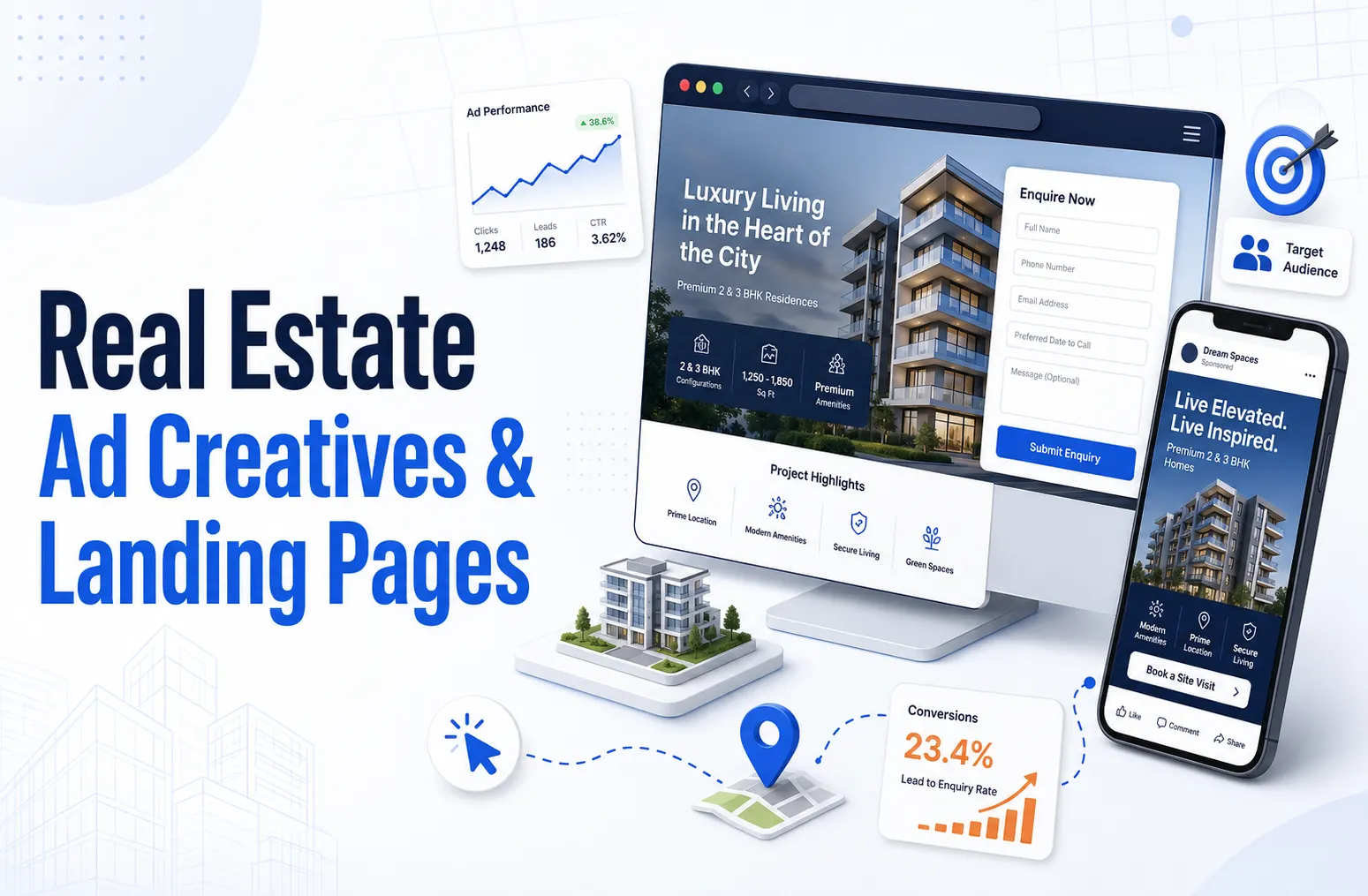
Real estate ad creative and landing pages: the 2026 conversion playbook
Real estate ad creative and landing pages are the two conversion levers that decide whether paid traffic turns into qualified pipeline or wasted spend. In 2026, the strongest operators run short vertical video that shows the actual unit with honest price, location, and possession details in the first three seconds, then send that traffic to a dedicated single-goal landing page rather than a homepage. Done well, this pairing lifts landing-page conversion rates to 8 to 15 percent for high-intent search traffic and cuts cost per qualified lead by 30 to 50 percent, because the creative qualifies the audience before the click and the page removes every reason to bounce after it.
July 17, 2026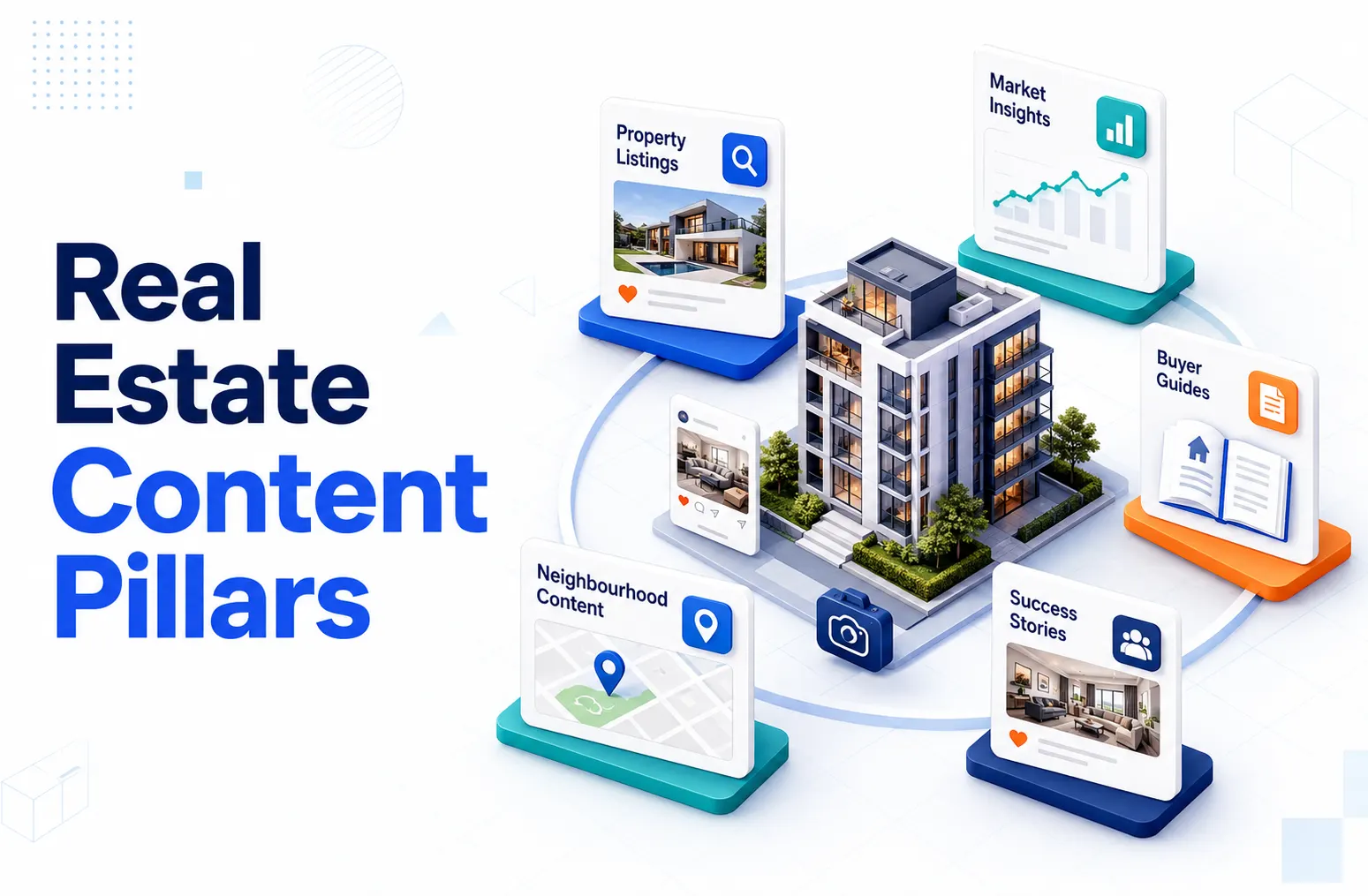 Real Estate
Real estate content pillars: how to build and execute your 4–6 pillar topics
Real estate content pillars are the four to six core topics an operator owns and publishes against consistently, each supporting 20 to 50 individual pieces over 24 months. The five pillars that drive the most measurable pipeline in 2026 are market reports, neighbourhood and city guides, buyer and seller education, operator playbooks, and original research. To execute them, assign every planned piece to one pillar, cluster related pieces into topic hubs that internally link to a central pillar page, and publish four to six pieces per month split across pillars. Done properly, a pillar-first structure compounds topical authority and lifts both Google rankings and AI search citation rates, rather than scattering effort across disconnected posts.
July 17, 2026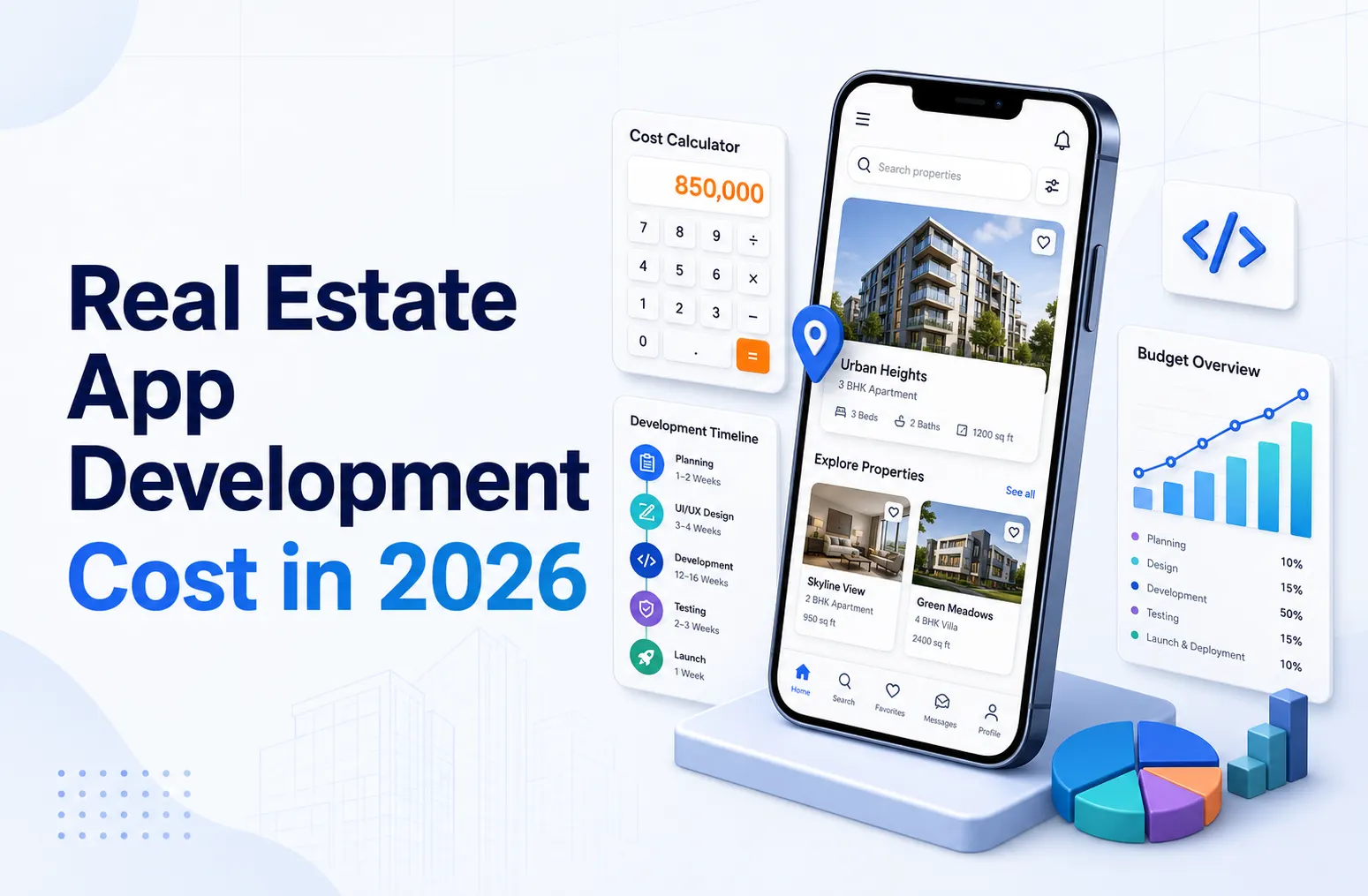 Real Estate
Real estate app development cost in 2026: full guide
Real estate app development in 2026 costs between USD 25,000 and USD 280,000+ depending on scope, platform, and feature depth. A single-platform MVP with basic listing and booking features starts at USD 25,000 to USD 45,000. A cross-platform iOS and Android app with CRM integration, payments, and native listings runs USD 65,000 to USD 140,000. A full property platform or coliving operating system with tenant portal, PMS integration, community features, and AI capabilities costs USD 140,000 to USD 280,000+. Most operators recover the build cost in 8 to 18 months through direct booking uplift and reduced third-party channel commissions.
July 17, 2026
Ready to book a 30-minute strategy call?
We'll map the right digital moves for your real estate business, no pitch deck, no commitment.