

Honey Saxena
Digital Marketing Expert
Real estate ad creative and landing pages: the 2026 conversion playbook
Published July 17, 2026|9 min read
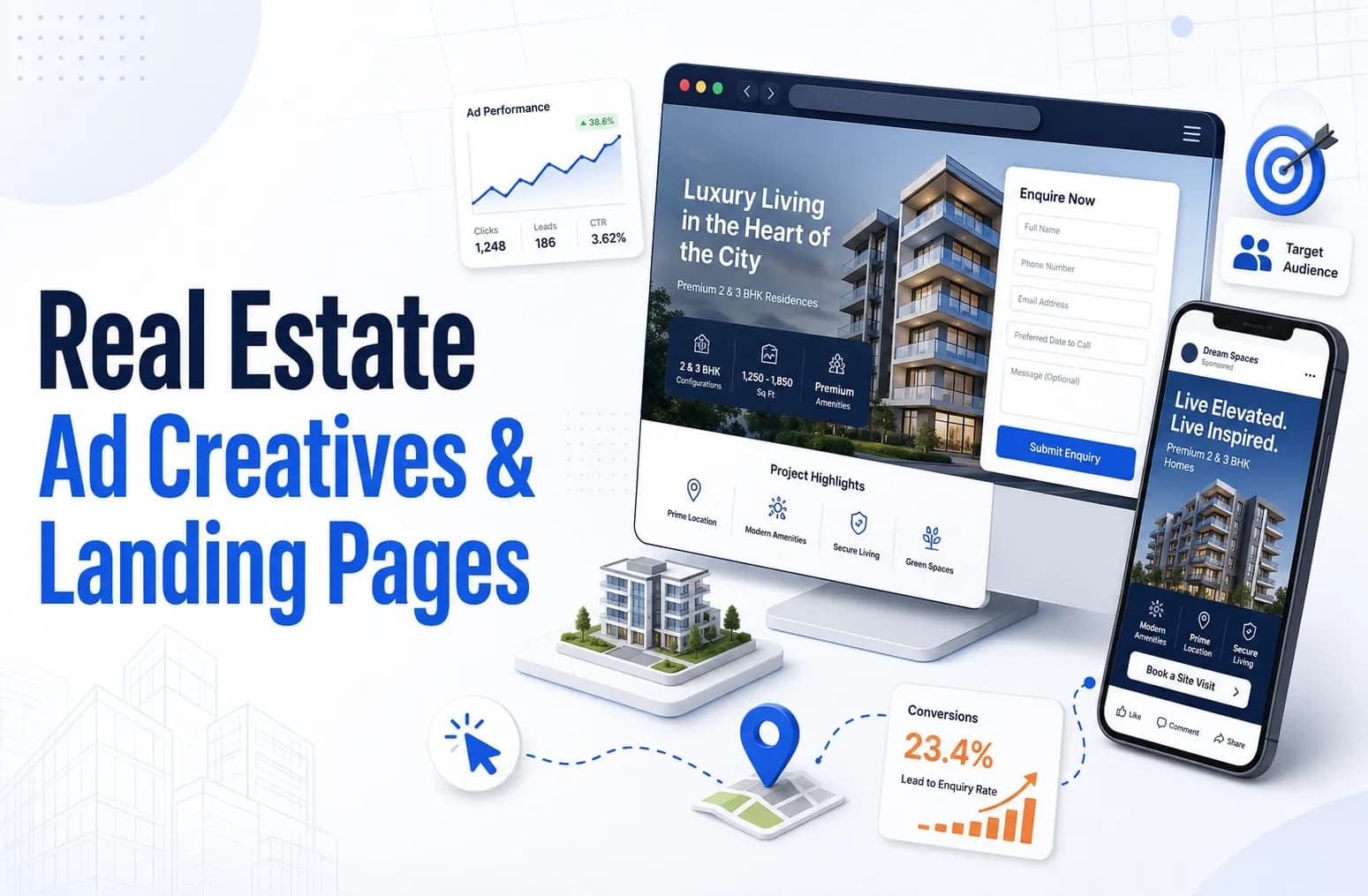
Real estate ad creative and landing pages are the two conversion levers that decide whether paid traffic turns into qualified pipeline or wasted spend. In 2026, the strongest operators run short vertical video that shows the actual unit with honest price, location, and possession details in the first three seconds, then send that traffic to a dedicated single-goal landing page rather than a homepage. Done well, this pairing lifts landing-page conversion rates to 8 to 15 percent for high-intent search traffic and cuts cost per qualified lead by 30 to 50 percent, because the creative qualifies the audience before the click and the page removes every reason to bounce after it.
Why do creative and landing pages affect your cost per lead?
In the performance marketing playbook, we covered channels, benchmarks, and the seven-step setup. But two levers inside that framework do most of the heavy lifting on cost per lead, and both were only touched on briefly: the creative that earns the click and the landing page that converts it. This piece goes deep on both.
The economics are simple. Media buying sets how many people see your ad, but creative sets how many of the right people click, and the landing page sets how many of those convert. A campaign with average targeting but excellent creative and pages will beat a campaign with perfect targeting and weak creative every time. According to WordStream's benchmark data, the gap between the median and top-quartile landing page conversion rate is often 3 to 5 times, which means the page alone can move cost per lead more than any bid adjustment.
For real estate specifically, this matters more than in most categories because the purchase is high-consideration and the sales team's time is expensive. Creative that lets unqualified tyre-kickers into the funnel doesn't just waste ad spend; it burns sales capacity on follow-ups that never convert.
What makes a real estate ad creative convert in 2026?
The best-performing real estate creative in 2026 does the qualification work before the click. Four principles drive this.
Show the actual asset, not stock imagery. A scroll-stopping 15-second vertical video of the real unit, walkthrough, or view outperforms polished stock footage and "luxury living" copy. Authenticity signals honesty, and honesty pre-qualifies. Generic aspirational creative attracts everyone, which means it attracts mostly the wrong people.
Put the qualifying details in the first three seconds. Price band, location, and possession or availability date belong at the front of the creative, not buried. A buyer who sees the price and self-selects out never becomes a wasted lead. A buyer who sees it and leans in is far closer to a booked visit.
Match the creative format to the channel's intent. Short vertical video for Meta and Reels, 60-to-90-second project films for YouTube where the buyer is in discovery mode, and clean, benefit-led static or responsive search creative for Google where the buyer already knows what they want.
Refresh before fatigue sets in. Creative fatigue hits Meta at four to six weeks and Google at eight to twelve. A refresh cadence built into the calendar is the difference between a campaign that compounds and one that quietly decays. Keep brand consistency across every creative surface by aligning with your design and branding team.
What does a high-converting real estate landing page look like?
A landing page is not a homepage. A homepage serves ten audiences and offers twenty paths; a landing page serves one audience and offers one action. Sending paid traffic to a homepage cuts conversion by 50 to 70 percent, which is why a dedicated page per campaign is non-negotiable.
A high-converting real estate landing page follows a consistent structure. The hero section repeats the ad's promise word-for-word so the visitor knows they're in the right place, and it states price, location, and possession immediately. The body carries proof: real photos, a short walkthrough video, floor plans, and honest specifics rather than adjectives. Trust signals such as RERA or regulatory registration, developer track record, and genuine reviews reduce hesitation. A single, repeated call to action, usually to book a site visit or request a callback, appears above the fold and again after the proof. Every field on the form that isn't essential is removed, because each extra field measurably lowers completion.
The one-page, one-goal discipline is what makes the whole performance programme convert. Building these pages on a fast, SEO-controlled stack is a job for your website development team, working in parallel with the campaign rather than after it.
How should creative and landing pages match the funnel stage?
Creative and pages should mirror where the buyer is in the journey, not treat every click the same. Cold discovery traffic from Meta or YouTube meets brand-and-project creative and a landing page that educates before it asks, since these visitors need context before commitment. High-intent Google Search traffic meets specific, offer-led creative and a page that gets to the booking action quickly, because these buyers are days from a site visit, not months. Retargeting traffic meets urgency-and-proof creative, testimonials, limited availability, next-step nudges, and a page that removes the last friction, since these visitors already know you.
The mistake is running one creative and one page against all three stages. A funnel-matched setup consistently outperforms a one-size-fits-all campaign on cost per qualified site visit.
How do you test creative and landing pages without burning the budget?
The disciplined approach is structured testing in small budget pockets rather than wholesale changes on a hunch. Reserve roughly five percent of the budget for tests, change one variable at a time, hook, format, headline, or call to action, and let each test run against enough conversions to be meaningful rather than calling it after two days of noise.
Because real estate sales cycles run 30 to 180 days, judge creative and pages on cost per qualified site visit or cost per booked appointment, not raw lead volume or same-week signals. A page that produces cheap leads that never book is worse than one that produces fewer, higher-intent leads. This is the same optimise-for-qualified-outcomes principle that the main playbook applies at the channel level.
How do creative and landing pages fit the wider performance stack?
Creative and pages are the conversion layer, but they only compound when the rest of the stack is wired in. Every landing page needs GA4 events and server-side conversion tracking so the team can see which creative and page combinations actually produce pipeline. Every form must route into a single CRM with a fast first-response SLA, because even a perfect page leaks if the lead lands in a shared inbox; the mechanics of that routing sit inside the performance marketing playbook and your CRM implementation. And every closed deal should reconcile back to the creative and page that produced it, so budget flows toward the combinations that win.
In short, creative earns the click, the page converts it, and the CRM and attribution layers prove which combinations to scale. Miss any layer, and the other work leaks at that stage.
- Creative and landing pages move cost per lead more than bid or budget changes. A top-quartile page can convert 3 to 5 times better than a median one.
- The best real estate creative shows the actual asset and puts price, location, and possession in the first three seconds, qualifying the audience before the click.
- A landing page is not a homepage. One audience, one goal, one repeated call to action, and every non-essential form field removed.
- Match creative and pages to the funnel stage: educate cold traffic, convert high-intent search traffic fast, and use proof plus urgency for retargeting.
- Test in 5 percent budget pockets, one variable at a time, and judge on cost per qualified site visit, not raw lead volume.
- Creative and pages only compound when GA4, server-side tracking, CRM routing, and attribution are wired in from the start.
Why trust Noseberry
Our content is written by practicing real-estate and PropTech professionals, fact-checked by a dedicated editorial team, and reviewed against the latest industry data before publication.
- 10+ years of industry expertise
- All facts independently verified
- No sponsored rankings in guides
- Updated when the industry changes
Frequently Asked Question
What is the best ad format for real estate in 2026?
Short vertical video showing the actual unit is the top performer on Meta and Reels, while 60-to-90-second project films work best on YouTube for discovery. On Google Search, clean benefit-led responsive search ads win because the buyer already knows what they want. Match the format to the channel's intent rather than reusing one asset everywhere.
Why shouldn't I send ad traffic to my homepage?
A homepage serves many audiences and offers many paths, which dilutes the single action you want a paid visitor to take. Sending campaign traffic to a homepage typically cuts conversion by 50 to 70 percent. Every campaign needs a dedicated landing page with one audience and one conversion goal.
How many form fields should a real estate landing page have?
As few as possible. Each non-essential field measurably lowers completion, so start with name, phone, and one qualifying field, and add more only if the sales team genuinely needs them upfront. Extra qualification can happen in the follow-up call rather than on the form.
How often should I refresh my ad creative?
Creative fatigue sets in around four to six weeks on Meta and eight to twelve weeks on Google. Build a refresh cadence into your calendar before performance decays, rather than waiting for cost per lead to climb. Refreshing on schedule is what keeps a campaign compounding.
What landing page conversion rate is good for real estate?
For high-intent Google Search traffic with a strong dedicated page, 8 to 15 percent is a healthy range. Cold Meta or YouTube traffic converts lower because the visitor is earlier in the journey, so judge each page against the intent of its traffic rather than a single universal number.
Related insights
 Real Estate
Real Estate Digital Agency in USA: How Noseberry Digitals Helps Developers & PropTech Companies Grow
This blog explains what makes Noseberry Digitals a real estate digital agency in USA built for developers and proptech companies. It covers why generalist agencies struggle with real estate-specific needs like MLS integrations and multi-market brand consistency. It walks through the agency's full-stack services, from branding and websites to CRM, AI, and a 60-day proptech MVP program. It highlights named, documented case studies with real client results, something the piece notes is rare among proptech marketing agencies. It closes with a practical checklist for choosing a real estate digital agency and clears up whether Noseberry Digitals is itself a proptech company.
August 27, 2026 Real Estate
PR Strategy for PropTech Startups: Earning Press and Investor Attention Before You Raise
This blog lays out a pre-raise PR playbook for proptech founders built around timing, not volume, of press coverage. It explains why research shows more media mentions can actually backfire past a certain threshold, and why narrative quality beats raw mention count with investors. It covers how investors actually use press coverage during due diligence, and what they're typically searching for before a first call. It walks through a practical three-to-six-month PR timeline, plus which trade outlets matter most for real estate versus general tech press. It closes with a DIY versus agency comparison, common PR mistakes that sink fundraising, and a 10-question FAQ section.
August 26, 2026 Real Estate
Smart Home and IoT Integration for Property Operators: Cost, ROI, and What to Build First
This blog breaks down smart home and IoT integration for property operators, covering real costs, real ROI, and exactly what to build first. It walks through actual pricing by portfolio size, from new construction to full enterprise retrofits. It explains where the ROI really comes from, including energy savings data from a major retrofit case study and renter demand statistics. It lays out a staged build order, starting with access control and climate sensors before predictive maintenance, security, and tenant apps. It closes with a data privacy and security checklist, a DIY versus integration partner comparison, and a 10-question FAQ section.
August 24, 2026
Ready to book a 30-minute strategy call?
We'll map the right digital moves for your real estate business, no pitch deck, no commitment.