

Honey Saxena
Digital Marketing Expert
Real estate app development cost in 2026: full guide
Published July 17, 2026|11 min read
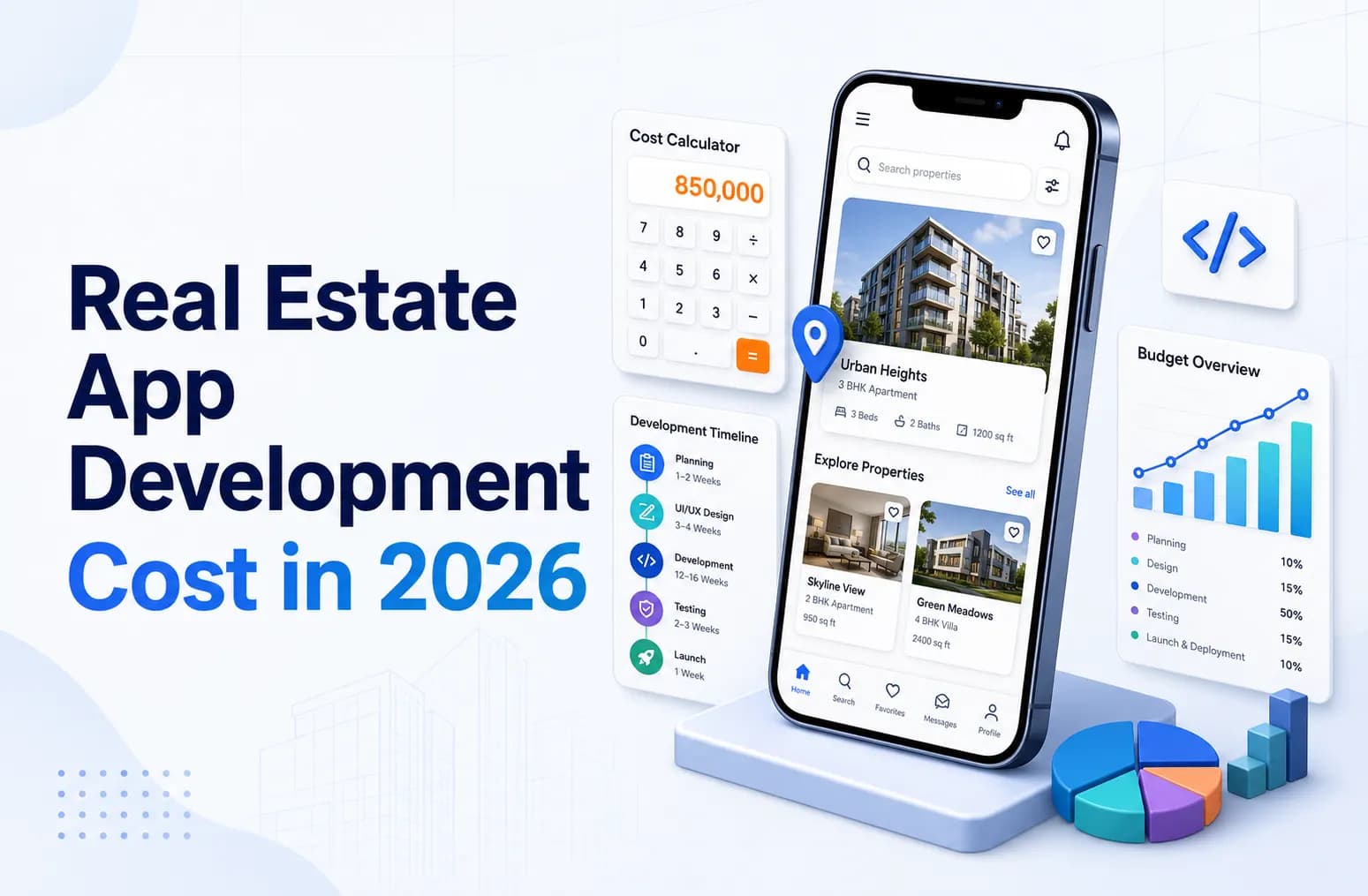
Real estate app development in 2026 costs between USD 25,000 and USD 280,000+ depending on scope, platform, and feature depth. A single-platform MVP with basic listing and booking features starts at USD 25,000 to USD 45,000. A cross-platform iOS and Android app with CRM integration, payments, and native listings runs USD 65,000 to USD 140,000. A full property platform or coliving operating system with tenant portal, PMS integration, community features, and AI capabilities costs USD 140,000 to USD 280,000+. Most operators recover the build cost in 8 to 18 months through direct booking uplift and reduced third-party channel commissions.
Real estate app development in 2026 falls into three cost bands.
Band 1, MVP builds. USD 25,000 to USD 45,000. A single-platform (either iOS or Android, not both) app with core listing browse, basic search, contact form, and 1 to 2 integrations. Timeline: 8 to 14 weeks. This is where solo agents, small brokerages, and pre-seed PropTech founders start.
Band 2, cross-platform production apps. USD 65,000 to USD 140,000. Both iOS and Android built on React Native or Flutter, with CRM integration, payment processing, push notifications, in-app messaging, native listing search, and analytics. Timeline: 14 to 22 weeks. Fits most residential brokerages, coliving operators running 20 to 100 units, and Series A PropTech founders.
Band 3, full platforms and operating systems. USD 140,000 to USD 280,000+. Multi-role apps (tenant plus operator plus broker), full PMS integration, community features, KYC and document signing, AI capabilities (lead scoring, chatbot, valuation), multi-currency and multi-language. Timeline: 22 to 36 weeks. Built for multi-country coliving operators, PropTech scale-ups, REITs, and large brokerages.
The Statista 2025 mobile app development market report shows the median mobile app development cost across all industries sits at USD 92,000. Real estate apps track slightly above this median because of the integration depth (MLS, IDX, RETS, PMS, payments) that most other categories do not require.
What factors influence real estate app development cost?
Six factors drive the final number more than anything else.
1. Platform coverage. iOS only, Android only, or both. Both platforms adds roughly 40 to 60 percent to a single-platform build if built natively, or roughly 25 to 40 percent if built cross-platform on React Native or Flutter.
2. Feature scope. A listing browse app is not the same as a full booking and tenant portal platform. Each additional feature category (search filters, saved listings, in-app chat, push notifications, payments, KYC, document signing) adds USD 3,000 to USD 15,000 to the build.
3. Integrations. MLS, IDX, RETS, PMS, CRM, payment gateways, and identity providers all add engineering time. According to Clutch's 2025 app development pricing research, integration work accounts for 25 to 40 percent of total app build cost in categories that carry industry-specific data sources like real estate.
4. Design depth. A production-grade design system with custom illustrations, motion, and accessibility work adds USD 8,000 to USD 25,000 versus a functional but templated design.
5. Team location. Development teams in India, Eastern Europe, and Southeast Asia typically bill 40 to 60 percent lower than teams in the United States, United Kingdom, or Western Europe for equivalent engineering quality.
6. Ownership model. Fully custom builds with source code ownership are more expensive upfront than white-label platforms, but produce compounding value over 5 years. White-label real estate apps typically start at USD 8,000 to USD 15,000 but charge monthly licensing forever.
How does iOS vs Android vs React Native affect real estate app cost?
Three platform paths, three different cost structures.
Native iOS only (Swift, SwiftUI). USD 30,000 to USD 65,000 for a production MVP. Best for markets where iOS holds significant market share (United States, United Kingdom, United Arab Emirates, Singapore). Delivers the highest visual polish and the best performance for animation-heavy interfaces. Our real estate iOS development service covers the full delivery.
Native Android only (Kotlin, Jetpack Compose). USD 28,000 to USD 60,000 for a production MVP. Best for markets where Android dominates (India, Latin America, most of Asia and Africa). Delivers the widest device reach at slightly lower cost than iOS.
Cross-platform React Native or Flutter. USD 45,000 to USD 110,000 for both iOS and Android on one codebase. Roughly 35 to 50 percent cheaper than building both natively. Suits most real estate operators who need broad platform reach without paying twice for the same features. Full delivery through our real estate React Native development service.
Native both platforms. USD 60,000 to USD 140,000. Best only when the app depends heavily on platform-specific hardware features (AR, complex camera work, native mapping performance). For most real estate use cases, the cost is not justified against React Native.
What features drive real estate app development cost?
Grouped by cost contribution.
Foundation (included in every build)
Authentication and user accounts
Property listing browse and search
Property detail pages
Contact form and lead capture
Basic push notifications
Analytics integration
Cost contribution: USD 15,000 to USD 30,000 (baseline for any real estate app).
High-cost features
Booking and payment flow (Stripe, Razorpay, PayU, Cashfree). USD 8,000 to USD 20,000.
In-app messaging and chat. USD 6,000 to USD 15,000.
Video calls or virtual tours (property walkthroughs, live viewing). USD 10,000 to USD 25,000.
MLS, IDX, or RETS integration. USD 8,000 to USD 22,000 depending on feed complexity.
CRM integration (HubSpot, Salesforce, Zoho, custom). USD 5,000 to USD 15,000.
KYC and document verification. USD 6,000 to USD 18,000.
AI features (lead scoring, chatbot, valuation). USD 12,000 to USD 40,000. Delivered through our real estate AI solutions.
Medium-cost features
Saved listings and favourites: USD 2,000 to USD 5,000
Advanced filters and map search: USD 5,000 to USD 12,000
Multi-language support: USD 4,000 to USD 10,000
Multi-currency support: USD 3,000 to USD 8,000
Community features (events, forum): USD 8,000 to USD 20,000
Maintenance request routing: USD 4,000 to USD 10,000
The Data.ai 2025 State of Mobile report shows that real estate apps with 5 or more integrated features drive 3 to 4 times higher user retention than apps with only 1 to 2 features. The upfront cost of the additional features usually pays back inside the first year through improved engagement.
How much does a coliving or BTR app cost?
Coliving and build-to-rent apps sit in a specific cost band because of the operator-plus-resident dual audience requirement.
Coliving MVP (resident-only, single property). USD 35,000 to USD 55,000. Room booking, deposit payment, community events, maintenance requests, tenant portal.
Coliving production app (multi-property, resident plus operator dashboard). USD 75,000 to USD 130,000. Adds inventory management, dynamic pricing, PMS integration (Hostfully, Cloudbeds, Mews), and multi-currency support.
Coliving operating system (multi-country, resident plus operator plus broker, full AI stack). USD 150,000 to USD 240,000. Adds multi-language, KYC, document signing, AI lead scoring, community moderation, and analytics.
Delivered through our tenant experience app development service and paired with our coliving website development service so the tenant journey stays unified across web and mobile.
How much does a property management app cost?
Property management apps vary by role coverage.
Tenant-only app. USD 30,000 to USD 60,000. Rent payment, maintenance requests, document access, community notices.
Owner or landlord app. USD 40,000 to USD 75,000. Portfolio overview, financial dashboards, tenant approvals, maintenance approvals.
Full property management platform (tenant plus owner plus field team). USD 85,000 to USD 180,000. Adds field team routing, work order management, vendor management, accounting integration.
Enterprise PMS (multi-portfolio, multi-jurisdiction). USD 180,000 to USD 320,000+. Adds compliance layer, multi-entity accounting, portfolio analytics, and enterprise SSO.
Full delivery through our property management app development service. Pairs with our property management software development service when the operator also needs a web dashboard.
What are the hidden costs of real estate app development?
Six cost categories that operators consistently underestimate.
1. App Store and Play Store fees. USD 99 per year for Apple Developer, USD 25 one-time for Google Play. Small but easy to miss during budgeting.
2. Third-party API and SaaS costs. Mapping (Mapbox, Google Maps), messaging (Twilio, SendGrid), payments (Stripe processing fees), analytics (Mixpanel, Amplitude). Typically USD 200 to USD 2,000 per month depending on volume.
3. Maintenance and updates. Annual maintenance runs 15 to 25 percent of the initial build cost. iOS and Android platform updates force refactoring every 12 to 18 months. New OS versions can break existing functionality if not addressed.
4. Content moderation. Community features require moderation. Either team time (2 to 5 hours per week per property) or third-party moderation services (USD 500 to USD 3,000 per month).
5. Compliance and legal. GDPR, DPDP (India), CCPA compliance work. USD 3,000 to USD 12,000 one-time plus USD 500 to USD 2,000 per year for ongoing legal review as regulations evolve.
6. Marketing to drive downloads. An app built but never marketed sits at 50 to 200 downloads in year one. Meaningful adoption requires USD 5,000 to USD 30,000 per month in app install ads, ASO (App Store Optimization), and PR. Our digital marketing service handles this layer.
How do you reduce real estate app development costs?
Six ways to bring the build cost down without sacrificing quality.
1. Ship a real MVP first. Cut every feature that is not essential to the first release. A tight MVP at USD 30,000 that ships in 12 weeks produces more learning than a USD 90,000 platform that ships in 30 weeks.
2. Choose React Native over dual native builds. Save 35 to 50 percent on cross-platform delivery with no material loss in performance for real estate use cases.
3. Use open-source libraries where they are strong. Avoid rebuilding features (image upload, video playback, authentication, PDF viewer) that are solved by well-maintained open-source packages.
4. Reuse existing brand and design systems. If your website already has a defined design system, extend it into the app rather than starting the design work from scratch.
5. Phase integrations. Ship the app without PMS integration in phase 1. Add PMS in phase 2 once user adoption justifies the investment.
6. Work with a specialist real estate team. A generalist agency spends 30 to 50 percent of the build time learning real estate context. A specialist real estate app development team starts on day one with the domain knowledge already in place.
Ready to scope your real estate app build?
Share your target audience, platform preference, and feature list. A fixed-fee proposal comes back within 5 business days covering deliverables, timeline, and investment. No commitment, no generic packages, just a scope shaped around your operation and growth stage.
Book a free app scoping call · Explore our app development service · Try the free ROI calculator
- Real estate app development cost in 2026 depends on three levers: platform (iOS, Android, or cross-platform), feature scope (MVP vs platform), and integrations (PMS, CRM, payments, AI).
- A single-platform MVP starts at USD 25,000 to USD 45,000. A cross-platform production app runs USD 65,000 to USD 140,000. A full operating platform runs USD 140,000 to USD 280,000+.
- React Native and Flutter cut cross-platform build cost by 35 to 50 percent versus native iOS and Android built separately.
- Post-launch maintenance runs 15 to 25 percent of the build cost annually. Budget for it upfront.
- 89 percent of real estate operators who ship a branded app recover the build cost within 18 months, according to internal Noseberry data across 40+ real estate app engagements.
Why trust Noseberry
Our content is written by practicing real-estate and PropTech professionals, fact-checked by a dedicated editorial team, and reviewed against the latest industry data before publication.
- 10+ years of industry expertise
- All facts independently verified
- No sponsored rankings in guides
- Updated when the industry changes
Related insights
 Real Estate
Real Estate Digital Agency in USA: How Noseberry Digitals Helps Developers & PropTech Companies Grow
This blog explains what makes Noseberry Digitals a real estate digital agency in USA built for developers and proptech companies. It covers why generalist agencies struggle with real estate-specific needs like MLS integrations and multi-market brand consistency. It walks through the agency's full-stack services, from branding and websites to CRM, AI, and a 60-day proptech MVP program. It highlights named, documented case studies with real client results, something the piece notes is rare among proptech marketing agencies. It closes with a practical checklist for choosing a real estate digital agency and clears up whether Noseberry Digitals is itself a proptech company.
August 27, 2026 Real Estate
PR Strategy for PropTech Startups: Earning Press and Investor Attention Before You Raise
This blog lays out a pre-raise PR playbook for proptech founders built around timing, not volume, of press coverage. It explains why research shows more media mentions can actually backfire past a certain threshold, and why narrative quality beats raw mention count with investors. It covers how investors actually use press coverage during due diligence, and what they're typically searching for before a first call. It walks through a practical three-to-six-month PR timeline, plus which trade outlets matter most for real estate versus general tech press. It closes with a DIY versus agency comparison, common PR mistakes that sink fundraising, and a 10-question FAQ section.
August 26, 2026 Real Estate
Smart Home and IoT Integration for Property Operators: Cost, ROI, and What to Build First
This blog breaks down smart home and IoT integration for property operators, covering real costs, real ROI, and exactly what to build first. It walks through actual pricing by portfolio size, from new construction to full enterprise retrofits. It explains where the ROI really comes from, including energy savings data from a major retrofit case study and renter demand statistics. It lays out a staged build order, starting with access control and climate sensors before predictive maintenance, security, and tenant apps. It closes with a data privacy and security checklist, a DIY versus integration partner comparison, and a 10-question FAQ section.
August 24, 2026
Ready to book a 30-minute strategy call?
We'll map the right digital moves for your real estate business, no pitch deck, no commitment.