
REIT and institutional owners
REITs win on transparent reporting, portfolio returns and LP trust. Every pillar below is a lever we work with fund and REIT teams to move.
Framework: the 12 Pillars of real estate
What we do for REITs and institutional owners
Noseberry Digitals builds the digital operating layer REITs and institutional real estate owners need to run portfolios, report to LPs, and raise capital, portfolio dashboards, asset performance analytics, investor portals, quarterly reporting automation, ESG data capture, and integrations to Yardi, MRI, and ARGUS.
Portfolio and asset dashboards
Live NOI, occupancy, valuation, and yield across every asset, fund, and region, filterable and drill-down ready.
Institutional LP reporting
Automated quarterly packages aligned to INREV and ILPA templates. Close-to-report inside 15 to 30 days.
Investor portal and deal room
SOC 2-ready LP portals with KYC, capital calls, distributions, K-1 statements, and audit-grade document access.
ESG capture and GRESB submission
Continuous energy, water, and emissions data flowing into a submission-ready dataset, not a year-end scramble.
Yardi, MRI, ARGUS integration
Bidirectional data flows so property, valuation, and accounting systems feed one source of truth.
Every pillar below is a lever we work with REIT and institutional owner teams to move, so the fund raises cleanly and retains its LPs across cycles.
The 12 Pillars, applied to REIT and institutional owners
Every pillar plays out differently here. This page walks how each one applies, what good looks like, and where we solve it.
Business Models
The operator's problem
REITs earn distributed returns from portfolios of assets. Every empty unit or lost tenant compounds across the fund, and reporting to LPs and public markets is the whole game.
What good looks like
Quarterly distributions land on schedule, NAV per unit compounds through the cycle, and the fund's return profile hits the LPA target range at year 5 without capital calls out of sequence.
How Noseberry solves it
We model portfolio economics, stress-test scenarios and document the operating strategy.
- Portfolio-level economic model
- Distribution and yield sensitivities
- Cycle stress-test scenarios
- Operating strategy document
Concept & Product Design
The operator's problem
The REIT's product to LPs and public markets is transparency and predictability. Weak reporting or opaque metrics quietly costs valuation.
What good looks like
LPs read the quarterly package once, sign the capital call within 48 hours, and the IR inbox stays at zero unanswered questions between formal reporting cycles.
How Noseberry solves it
We shape the reporting narrative and the investor-facing product.
- Investor-report information architecture
- KPI framework and definitions
- Reporting cadence and channel design
- Positioning brief
Customer Experience
The operator's problem
Your customers are your LPs, unit-holders and regulators. Their experience of the fund runs across quarterly reports, LP calls and portal access.
What good looks like
Existing LPs commit 60 to 100% of Fund II inside the first close, refer 2 to 3 peer institutions each, and the re-up rate across successive raises stays above 85%.
How Noseberry solves it
We map the LP journey and build the touchpoints that carry it.
- LP-journey map with engagement targets
- Investor portal for reporting and documents
- LP communication programme
- Advocacy and re-up motion
Fundraising & Investment
The operator's problem
REITs are fundraising machines. Every capital raise requires disclosure, diligence and materials tuned for institutional audiences.
What good looks like
The fund closes the target raise inside the planned 9 to 18 month window, the LP question log stays under 30 items per raise, and the data room activity report shows every LP downloaded the full deck.
How Noseberry solves it
We build the deck, IM, model, data room and investor prep.
- Institutional pitch deck
- Information memorandum and quarterly reports
- Financial model with portfolio scenarios
- Data room and diligence support
Design & Architecture
The operator's problem
Investor-facing brand carries. Institutional LPs will not commit to a fund whose website and materials feel inconsistent or dated.
What good looks like
The LP-facing brand, the quarterly package layout, and the investor portal UI read as one product, credible enough to sit next to institutional peer materials without apology.
How Noseberry solves it
We produce brand, investor-report design and portal experience.
- Fund brand identity system
- Investor-report and quarterly-update design
- Portal and portal UX
- Marketing collateral for LP audiences
Marketing Strategies
The operator's problem
REIT marketing is investor relations. Awareness, credibility and channel building among institutional LPs is a slow multi-year game.
What good looks like
The LP pipeline holds 40 to 60 qualified institutional conversations at any time, 15 to 20 first meetings per quarter, and the first-close date in the LPA is the date the fund actually hits.
How Noseberry solves it
We run investor-relations content, channel building and campaigns.
- IR content programme (research, insights, quarterly)
- Institutional channel building
- Events and roundtable programme
- Reporting on LP pipeline
Operations & Property Management
The operator's problem
Portfolio operations sit across property managers, asset managers, custodians and administrators. Weak coordination costs NOI and reporting quality.
What good looks like
Every property reports operating data in the same taxonomy, occupancy and NOI roll up to portfolio level in real time, and quarterly close time is measured in days, not weeks.
How Noseberry solves it
We build the operations layer across systems and reporting.
- Asset-management platform integration
- Property-manager and administrator data flows
- Reporting workflow and cadence
- Ops reporting
Apps & Technology
The operator's problem
REIT tech stacks fail when property data, valuation, distributions and reporting live in separate systems.
What good looks like
Property-level operating data from Yardi and MRI flows into the portfolio dashboard, the valuation model, and the LP report automatically, with no CSV exports and no manual reconciliation.
How Noseberry solves it
We design and build the platform that connects the layers.
- Investor portal for LPs and unit-holders
- Portfolio dashboard and analytics
- Data pipeline from property-level systems
- Integrations with administrators and custodians
HR & Training
The operator's problem
IR, portfolio and finance teams have to work from the same numbers and tell the same story. Weak internal enablement shows up as reporting drift.
What good looks like
IR, portfolio, and finance teams produce the same NAV, the same NOI walk, and the same LP narrative from one source of truth, without a reconciliation call before every quarterly close.
How Noseberry solves it
We build the enablement layer across teams.
- IR and reporting playbook
- Brand and communications guide
- Digital tools for portfolio and reporting
- Onboarding and training
Sales & Lead Generation
The operator's problem
REIT sales are LP relationships. Nurturing over years, transparent through cycles and responsive when LPs ask questions.
What good looks like
60 to 80% of first meetings convert to a second meeting, 25 to 35% of second meetings convert to a commitment, and the LP-to-commitment cycle averages under 6 months.
How Noseberry solves it
We build the CRM, LP pipeline and communications engine.
- LP CRM configuration
- Pipeline tracking and cadence
- LP communication automation
- Re-up and expansion tracking
Market Research & Trends
The operator's problem
Portfolio and allocation decisions rest on real property, competitor and macro data. Guessing costs the whole fund.
What good looks like
Every hold-vs-sell recommendation cites named submarket comparables, forward cap-rate assumptions with source, and a documented view of tenant demand for the next 24 months.
How Noseberry solves it
We provide research from actual market and portfolio data.
- Portfolio and property research
- Competitor fund analysis
- Macro and cycle research
- Allocation decision documents
Compliance & Legal
The operator's problem
REITs sit under securities regulation, real-estate law, tax rules and investor-reporting standards. Compliance failures can pause capital raises or trigger fines.
What good looks like
SFDR classification, GRESB submission, SEC filings, and jurisdictional real estate rules are handled by workflow rather than by scramble, and no LP audit finds a material gap for two consecutive years.
How Noseberry solves it
We build compliance into every platform.
- Securities and disclosure compliance
- Data protection and audit trail
- KYC and AML for LPs
- ESG and tax reporting
Signals it is time to talk to us
If you recognise two or more of these in your current or upcoming plan, the pillars framework will move the needle faster than another point solution.
- 01
Quarterly reporting is a monthly scramble across disconnected systems.
- 02
LPs are asking for data your current stack cannot produce cleanly.
- 03
The investor portal feels dated compared to what LPs see from other funds.
- 04
You are preparing for the next raise and the materials need work.
- 05
Portfolio-level analytics live in a spreadsheet, not a dashboard.
- 06
You are expanding into a new asset class or geography and need the tech to keep up.
Why operators trust us
Real people, real projects, real clients
A decade of shaping one industry. Every case study we publish is a real operator we have shipped for.

Atul Kumar Yadav
Founder & CEO
Founded Noseberry Digitals in 2019 and continues to lead the company as CEO. Sets vision and growth strategy across brand, software, marketing and AI for real estate and PropTech operators.

Related guides
Long-form reading tied to the pillars above. Every guide goes deeper on what works, what breaks, and what to build against.
- REIT Technology & Investor PortalsWhat LPs and public-market investors want from a REIT's tech and reporting.
- REIT DashboardsWhat a REIT dashboard has to show its board, its LPs and its investment committee.
- Real Estate Branding & DesignHow brand and design carry the sale before the product is touched.
- Custom Real Estate CRM DevelopmentWhen off-the-shelf CRM stops working and a custom build starts paying back.
- PropTech Platform ArchitectureHow to design a property platform that scales from ten customers to a thousand.
- Real Estate Digital TransformationThe pillar guide to modernising a property business, from model to platform to launch.
From the blog
Shorter takes on what we are seeing across engagements. Field notes, playbooks and observations from live projects.
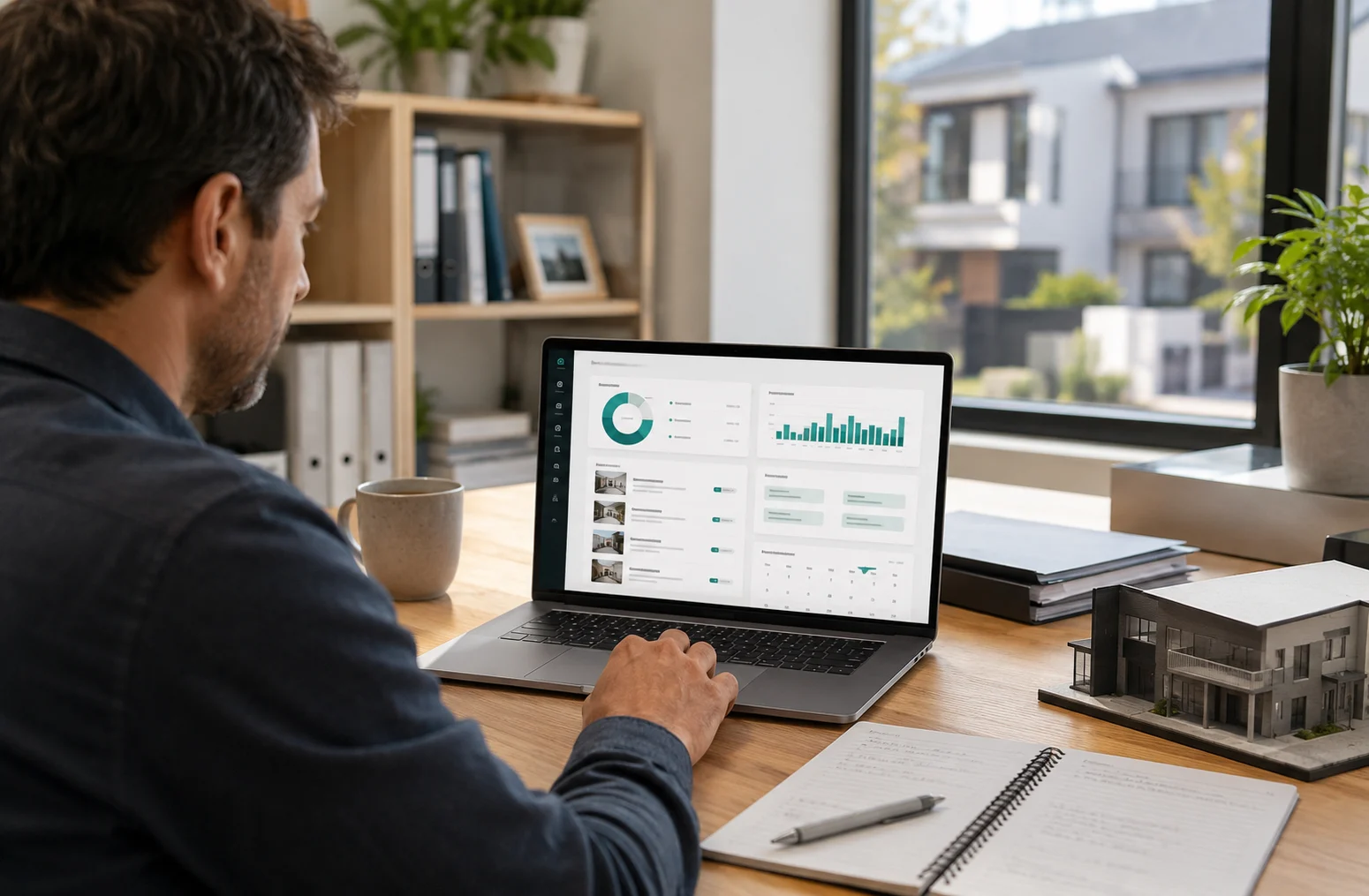
What should a PMS do for small-scale property managers?
The ideal PMS for a small-scale property manager (typically 10 to 500 units) should do ten things well: capture every rent payment automatically, log every maintenance ticket with photo evidence and vendor dispatch, hold every tenant lease and document in one searchable place, generate owner and investor statements in one click, run automated rent reminders and late-fee escalation, screen tenants with credit and eviction history, sync with the operator's accounting stack (QuickBooks, Xero), work on mobile so field checks and unit walks happen on a phone, integrate with a website for listing marketing and online applications, and produce broker-visible dashboards that let the manager see occupancy, delinquency, and cash flow at a glance. AppFolio Property Manager Core, Buildium, DoorLoop, Rentec Direct, and Hemlane are the platforms most adopted at this scale in 2026, at $1.40 to $4 per unit per month. This post covers what the ideal PMS should do, which platforms actually deliver it, and how to pick without overpaying.

Which AI tools work best for real estate developers in 2026?
The best AI tools for real estate developers in 2026 fall into eight categories that map to the developer lifecycle: land sourcing and site selection (Cherre, Reonomy, HouseCanary, LandGate), feasibility and financial modelling (Northspyre, TestFit, custom Excel plus GPT), design and architectural planning (Autodesk Forma, Higharc, Cove.tool, Snaptrude), construction management and progress tracking (Procore AI, Autodesk Construction Cloud, Buildots, Doxel, OpenSpace), pre-launch marketing and renders (Restb.ai, MidJourney, Adobe Firefly), off-plan sales CRM (Salesforce, HubSpot, Follow Up Boss, Rechat), ESG and net-zero analytics (Measurabl, Enertiv, Aquicore), and handover to operations (BIM AI, tenant portal AI). Used well, they cut construction cost 10 to 20 percent, compress design cycles 30 to 50 percent, and lift off-plan sales conversion 20 to 40 percent. Used badly, they burn subscription budget and produce plans that do not build. This post walks through each category, which tools actually work, and how to sequence adoption.
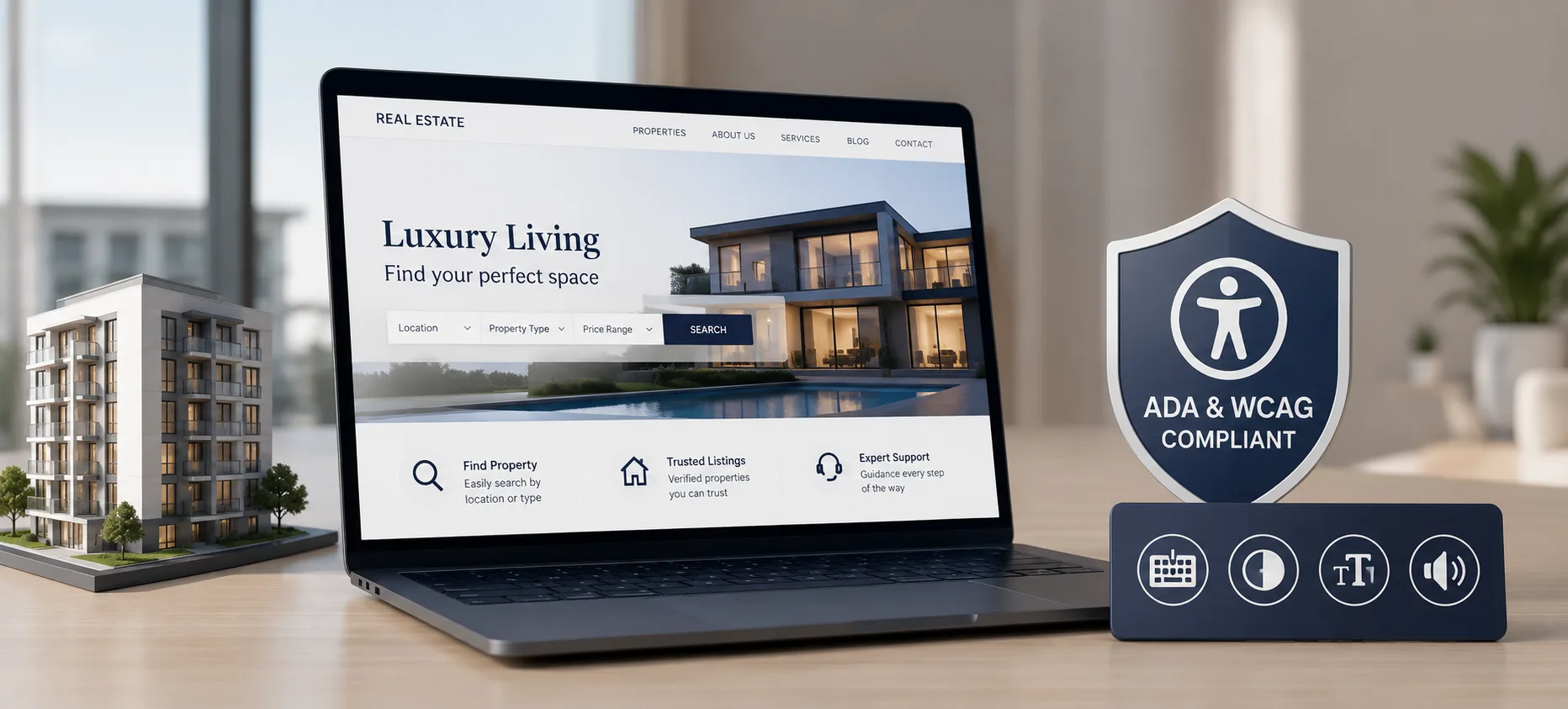
ADA & WCAG Accessibility Compliance for Real Estate Websites: What Operators Must Fix Before They Get Sued
This blog breaks down ADA and WCAG accessibility compliance for real estate websites, focused on what actually creates legal exposure. It explains why WCAG 2.1 Level AA has become the practical legal standard even without a formal Title III regulation for private businesses. It walks through the six accessibility failures responsible for 96% of all detected errors across the web, using real listing-page examples. It also warns against relying on accessibility overlay widgets, citing the FTC's 2025 action against accessiBe over deceptive compliance claims. The piece closes with a step-by-step audit process, an in-house versus compliance-partner comparison, and a 10-question FAQ section.
Frequently asked questions
What does a digital agency do for REITs?
We help REITs and institutional owners raise cleanly and retain LPs, across brand, investor portal, portfolio dashboards, reporting workflow and compliant data.
Do you build investor portals?
Yes. Investor portals for reporting, documents, capital calls and distributions, with the data pipeline from portfolio companies.
Can you build portfolio dashboards?
Yes. Operator-performance dashboards aggregating data from across the portfolio, with drill-down for GPs and summary views for LPs.
Do you help with quarterly reporting?
Yes. Reporting workflow, document generation, information architecture and the underlying data pipeline.
What size of REIT or institutional owner do you work with?
From single-fund private REITs through multi-fund institutional owners running across markets and asset classes.
The full REIT and institutional plan
Reporting, LP trust and portfolio returns are won across all 12 pillars. Tell us where you are and we will map the pillars that most affect your next raise.
REIT and institutional owners · 12-pillar plan · Reply within 24 hours