
Commercial, office and industrial
Commercial landlords win on occupancy, WAULT and renewal rate. Every pillar below is a lever we work with landlords to move.
Framework: the 12 Pillars of real estate
What we do for commercial office, industrial, and logistics owners
Noseberry Digitals builds the CRE owner digital operating layer commercial office, industrial, and logistics owners need to run buildings and portfolios, tenant portals, leasing platforms, portfolio dashboards, OPEX transparency, and integrations with Yardi, MRI, and building management systems.
Tenant portal and service requests
Work orders, HVAC, security, and visitor management running through one portal so tenants get answered, not routed.
Leasing platform
Deal pipeline, LOI, e-sign, and tenant onboarding in one workflow, so leasing velocity is measurable end to end.
Portfolio dashboards
NOI, occupancy, WALT, and tenant concentration by asset and portfolio, filterable and drill-down ready.
OPEX transparency and CAM reconciliation
Tenant-billable expense flows tracked line by line, so recoveries land clean and disputes drop.
Yardi, MRI, and BMS integration
Accounting, lease admin, and building systems feeding one operating stack for every asset.
Every pillar below is a lever we work with commercial and industrial owner teams to move, so occupancy holds, WALT lengthens, and net operating income compounds.
The 12 Pillars, applied to commercial, office and industrial
Every pillar plays out differently here. This page walks how each one applies, what good looks like, and where we solve it.
Business Models
The operator's problem
Commercial landlords earn rent on space leased to businesses. Occupancy is the game, and every empty floor or warehouse bay is compounding lost income.
What good looks like
Occupancy stabilises above 92% across the portfolio, WALT holds above 6 years on office and above 8 years on industrial, and tenant retention on lease expiry clears 75% without material concession creep.
How Noseberry solves it
We model portfolio and property economics and stress-test lease-up.
- Per-property economics and sensitivities
- Occupancy and WAULT scenarios
- Rent-review and renewal modelling
- Operating strategy document
Concept & Product Design
The operator's problem
Businesses choose space based on flexibility, spec, location and terms. Rigid product loses to flex operators; over-flexible loses to rate.
What good looks like
Floor plate, spec, and amenity brief match the tenant segment named in the leasing plan, rent per square foot lands within 5% of the underwritten rate, and deal cycle from LOI to signed lease runs inside 60 days.
How Noseberry solves it
We validate positioning against real tenant demand and shape the leasing product.
- Tenant persona research
- Amenity and spec pressure-test
- Flex and term option design
- Positioning brief
Customer Experience
The operator's problem
Tenants live with you for years. Every service request, communication and renewal conversation shapes whether they stay.
What good looks like
Tenant satisfaction survey scores stay above 4.2 out of 5, every service ticket closes inside the SLA window, and no lease renewal is negotiated inside the last 90 days of expiry because retention conversations start 12 months out.
How Noseberry solves it
We map the tenant journey and build the touchpoints that carry it.
- Tenant-journey map with retention targets
- Leasing website and enquiry flow
- Tenant app for services and requests
- Renewal engagement programme
Fundraising & Investment
The operator's problem
Commercial real estate is capital-heavy. Lenders and equity want to see occupancy history, WAULT and clear operational competence.
What good looks like
The refinancing closes 12 to 18 months ahead of loan maturity, the IC pack cites named comparables for every occupancy and NOI assumption, and no lender flags a material issue during diligence on the debt renewal.
How Noseberry solves it
We build the deck, IM, model and data room.
- Investor deck for commercial audiences
- IM with tenant and lease assumptions
- Financial model with NOI and yield scenarios
- Data room and diligence
Design & Architecture
The operator's problem
Design signals class of asset. Grade A tenants pay for Grade A design; the wrong finish costs both rent and prospective demand.
What good looks like
Common areas, unit fit-out, and building envelope carry one design language across the portfolio, ESG score progresses one band per two-year cycle, and OPEX per square foot stays within 5% of the asset-class benchmark.
How Noseberry solves it
We produce brand, interior visualisation and tenant-facing collateral.
- Property and portfolio brand identity
- Interior visualisation and 3D
- Tenant-facing brochures and floorplans
- Signage and wayfinding
Marketing Strategies
The operator's problem
Commercial marketing is B2B leasing. Brokers, tenant reps, corporate real estate teams and direct enquiries all feed the pipeline.
What good looks like
The building stabilises above 92% occupancy inside 12 to 18 months of handover, direct-tenant enquiries make up 30 to 40% of pipeline volume alongside brokered deals, and CAM recovery clears 90% from year one.
How Noseberry solves it
We run brand, leasing website and B2B demand generation.
- Property brand and leasing website
- Broker and tenant-rep engagement
- LinkedIn and B2B search campaigns
- Reporting on lease pipeline
Operations & Property Management
The operator's problem
Facilities management, tenant support, service delivery, maintenance and lease events all happen every day. Weak operations show up in tenant satisfaction and renewals.
What good looks like
Every service request closes inside the SLA window, capex-on-plan clears 90% across the annual programme, and no tenant renewal negotiation slips into the last 90 days of a lease term without a mitigation flagged in asset review.
How Noseberry solves it
We build the operations stack across FM systems, tenant app and reporting.
- FM and PMS integration
- Tenant app for services and requests
- Maintenance workflow with SLA tracking
- Ops reporting
Apps & Technology
The operator's problem
Commercial stacks have to hold together across landlords, property managers, tenants and building services. Fragmentation costs NOI.
What good looks like
Lease administration, building operations, and financial reporting run on one connected system, occupancy, WALT, and NOI roll up to portfolio level in real time, and monthly close runs inside 5 business days.
How Noseberry solves it
We design and build the stack for commercial operations.
- Leasing platform for the portfolio
- Tenant app across iOS and Android
- FM, security and building-systems integrations
- Analytics on NOI and tenant lifecycle
HR & Training
The operator's problem
Building managers, FM teams and leasing agents represent the asset. Weak enablement costs retention and rent achieved.
What good looks like
Leasing, property management, and asset teams work from the same tenant playbook and the same KPI set, and tenant satisfaction scores stay within a 5% variance across every building in the portfolio.
How Noseberry solves it
We build the enablement package.
- Building manager playbook
- Brand and tenant-comms guide
- Digital tools for FM and leasing
- Onboarding and training
Sales & Lead Generation
The operator's problem
B2B leasing cycles are longer and more relationship-driven. Slow response costs pipeline; over-automation kills trust.
What good looks like
Enquiries are answered inside 4 business hours, site tour is booked within one week, LOI signed within 3 to 4 weeks, and the CRM flags any deal that stalls beyond 10 days without a documented next step.
How Noseberry solves it
We build the lead engine and CRM for commercial cycles.
- CRM for commercial pipeline
- Broker and tenant-rep tracking
- Tour and LOI workflows
- Stalled-deal alerts and revival
Market Research & Trends
The operator's problem
Site, mix and rent decisions rest on real occupier demand data. Guessing costs occupancy for the whole life of the asset.
What good looks like
Every acquisition, rent, and capex recommendation cites named submarket comparables, forward cap-rate assumptions with source, and a documented view of tenant demand across the next 8 quarters of the leasing plan.
How Noseberry solves it
We provide research on occupier demand, competitor supply and rent evidence.
- Catchment demand analysis
- Competitor supply and rent benchmarks
- Occupier behaviour research
- Site and rent decision document
Compliance & Legal
The operator's problem
Commercial real estate sits under landlord-tenant law, licensing, safety, ESG reporting and data protection, all shifting by market.
What good looks like
Building certifications, ESG disclosures, and lease filings land on their statutory calendars, refinancing runway holds at 12 months minimum on every loan, and no portfolio audit surfaces a material lapse for two consecutive years.
How Noseberry solves it
We build compliance into every platform.
- Data protection compliance
- Consent capture and audit trail
- Lease and licence documentation
- ESG and safety reporting integrations
Signals it is time to talk to us
If you recognise two or more of these in your current or upcoming plan, the pillars framework will move the needle faster than another point solution.
- 01
Occupancy has drifted and tenants are renegotiating rather than renewing at target rent.
- 02
Broker enquiries are strong but tours-to-LOI conversion has weakened.
- 03
You are considering adding flex product but do not have the operations to run it.
- 04
Your tenant experience is 100% email and phone, and tenants notice.
- 05
Investor reporting is a monthly scramble across disconnected systems.
- 06
You are opening a new building or entering a new market.
Why operators trust us
Real people, real projects, real clients
A decade of shaping one industry. Every case study we publish is a real operator we have shipped for.

Atul Kumar Yadav
Founder & CEO
Founded Noseberry Digitals in 2019 and continues to lead the company as CEO. Sets vision and growth strategy across brand, software, marketing and AI for real estate and PropTech operators.

Related guides
Long-form reading tied to the pillars above. Every guide goes deeper on what works, what breaks, and what to build against.
- Real Estate Branding & DesignHow brand and design carry the sale before the product is touched.
- Real Estate Website DevelopmentWhat separates a converting site from a brochure page.
- Real Estate App DevelopmentWhere a buyer portal or resident app earns its keep across the property lifecycle.
- Custom Real Estate CRM DevelopmentWhen off-the-shelf CRM stops working and a custom build starts paying back.
- Real Estate Digital Marketing & Lead GenerationHow launch and ongoing campaigns are structured across property channels.
- Property Management SoftwareThe operational software backbone of a property management or operator business.
From the blog
Shorter takes on what we are seeing across engagements. Field notes, playbooks and observations from live projects.
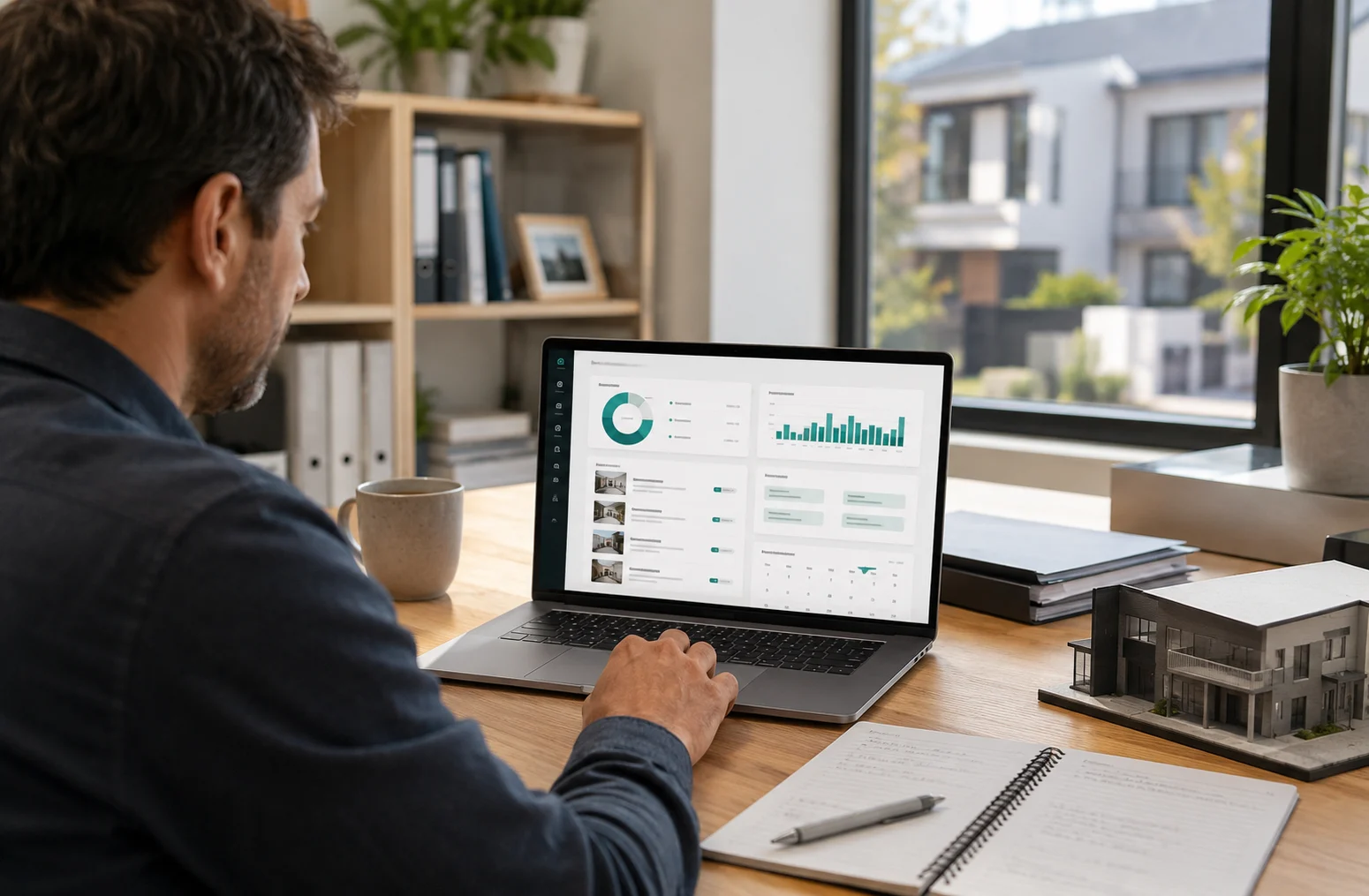
What should a PMS do for small-scale property managers?
The ideal PMS for a small-scale property manager (typically 10 to 500 units) should do ten things well: capture every rent payment automatically, log every maintenance ticket with photo evidence and vendor dispatch, hold every tenant lease and document in one searchable place, generate owner and investor statements in one click, run automated rent reminders and late-fee escalation, screen tenants with credit and eviction history, sync with the operator's accounting stack (QuickBooks, Xero), work on mobile so field checks and unit walks happen on a phone, integrate with a website for listing marketing and online applications, and produce broker-visible dashboards that let the manager see occupancy, delinquency, and cash flow at a glance. AppFolio Property Manager Core, Buildium, DoorLoop, Rentec Direct, and Hemlane are the platforms most adopted at this scale in 2026, at $1.40 to $4 per unit per month. This post covers what the ideal PMS should do, which platforms actually deliver it, and how to pick without overpaying.

Which AI tools work best for real estate developers in 2026?
The best AI tools for real estate developers in 2026 fall into eight categories that map to the developer lifecycle: land sourcing and site selection (Cherre, Reonomy, HouseCanary, LandGate), feasibility and financial modelling (Northspyre, TestFit, custom Excel plus GPT), design and architectural planning (Autodesk Forma, Higharc, Cove.tool, Snaptrude), construction management and progress tracking (Procore AI, Autodesk Construction Cloud, Buildots, Doxel, OpenSpace), pre-launch marketing and renders (Restb.ai, MidJourney, Adobe Firefly), off-plan sales CRM (Salesforce, HubSpot, Follow Up Boss, Rechat), ESG and net-zero analytics (Measurabl, Enertiv, Aquicore), and handover to operations (BIM AI, tenant portal AI). Used well, they cut construction cost 10 to 20 percent, compress design cycles 30 to 50 percent, and lift off-plan sales conversion 20 to 40 percent. Used badly, they burn subscription budget and produce plans that do not build. This post walks through each category, which tools actually work, and how to sequence adoption.
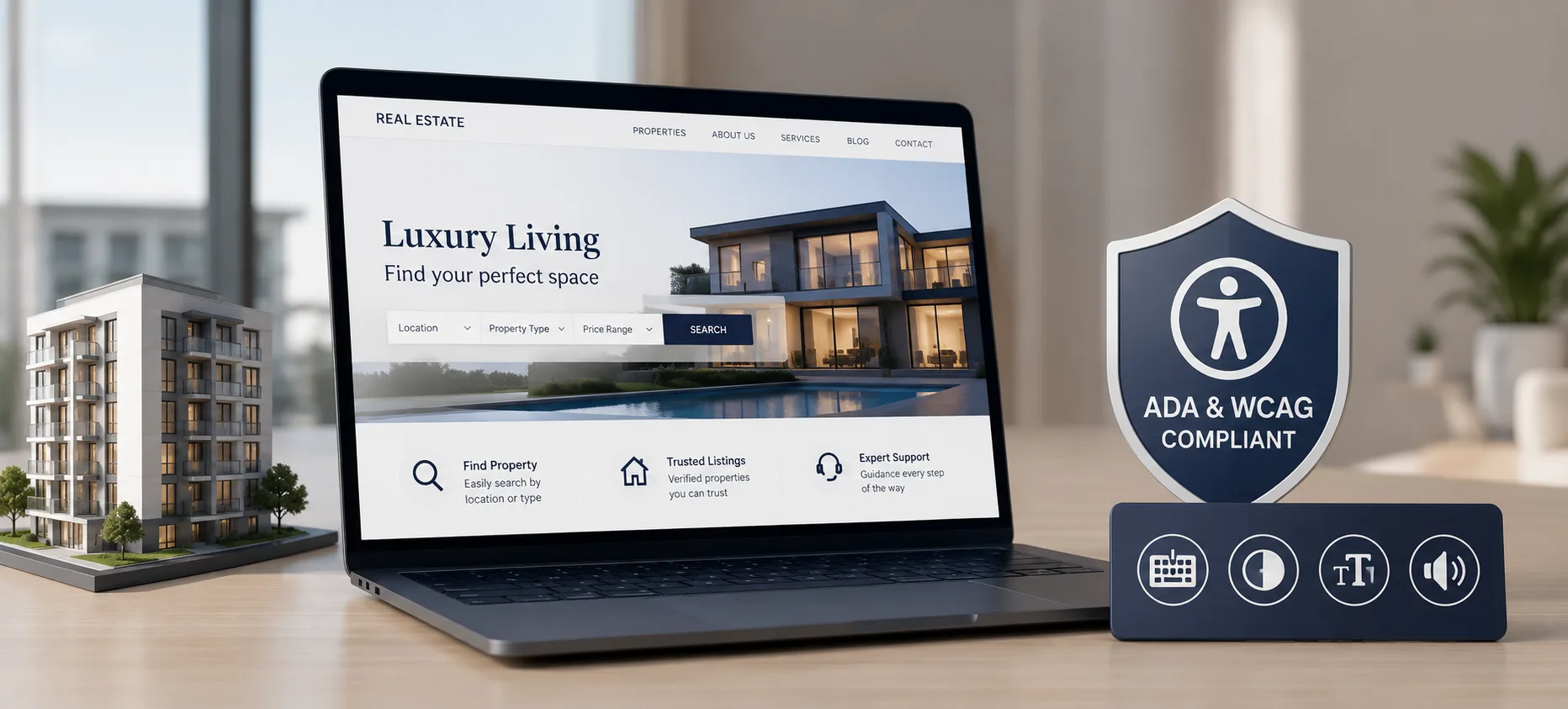
ADA & WCAG Accessibility Compliance for Real Estate Websites: What Operators Must Fix Before They Get Sued
This blog breaks down ADA and WCAG accessibility compliance for real estate websites, focused on what actually creates legal exposure. It explains why WCAG 2.1 Level AA has become the practical legal standard even without a formal Title III regulation for private businesses. It walks through the six accessibility failures responsible for 96% of all detected errors across the web, using real listing-page examples. It also warns against relying on accessibility overlay widgets, citing the FTC's 2025 action against accessiBe over deceptive compliance claims. The piece closes with a step-by-step audit process, an in-house versus compliance-partner comparison, and a 10-question FAQ section.
Frequently asked questions
What does a digital agency do for commercial landlords?
We help landlords lease up faster and retain longer, across brand, leasing website, tenant app, CRM, FM integration and compliant data.
Do you build tenant apps for commercial?
Yes. Tenant apps for services, requests, access and building information, branded to the property or portfolio, on iOS and Android.
How do you work with broker and tenant-rep channels?
We build CRM configurations that track broker and tenant-rep pipelines separately, with communication automation and pipeline reporting.
Can you help with flex-office launch?
Yes. Flex-office platforms, booking flows, membership CRM and operations stack for landlords adding flex product.
What size of landlord do you work with?
From single-asset landlords through multi-property portfolios and REIT-adjacent commercial owners.
The full commercial landlord plan
Occupancy and retention are won across all 12 pillars. Tell us where you are and we will map the pillars that most affect your NOI.
Commercial, office and industrial · 12-pillar plan · Reply within 24 hours