

Honey Saxena
Digital Marketing Expert
WhatsApp Lead Generation for Real Estate: The 2026 Automation Playbook
Published July 15, 2026|14 min read
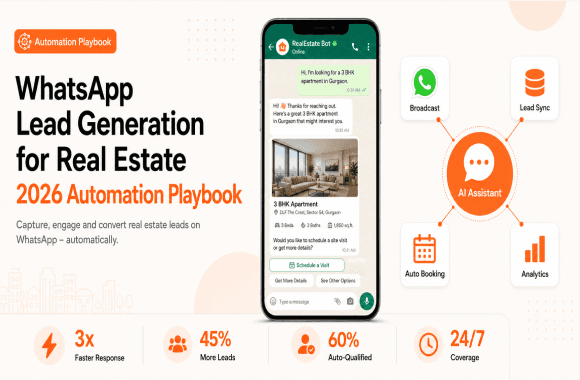
WhatsApp for real estate lead generation is not a trend to watch. It's a channel producing measurable, documented results in markets where property buyers have already shifted their communication preferences away from email and phone calls. The businesses building automation on this channel now are accumulating a competitive advantage that will be significantly harder to close in 18 months.
WhatsApp for real estate lead generation works because it meets buyers where they already are, on the most personal, highest-open-rate communication channel available, and automation turns that channel into a 24/7 lead qualification and nurture engine that runs without your team manually responding to every message. With over 3 billion active users globally and open rates above 95%, WhatsApp isn't a supplementary channel for property businesses anymore. In most markets across the Middle East, South Asia, Southeast Asia, and beyond, it's the primary one.
Here's the problem most property teams still have in 2026. They use WhatsApp personally, but they run it manually. One agent's personal number handles hundreds of inquiries. Nothing is tracked. Nothing feeds the CRM. Brochures get sent by hand. Site visit confirmations happen in scattered group chats. When a lead goes cold for 30 days, nobody notices and nobody follows up. The result is a high-volume, low-conversion pipeline built on one of the world's best channels, used at about 10% of its capacity.
This playbook changes that. At Noseberry Digitals, we've configured WhatsApp automation stacks for property operators across multiple markets, from solo agents to developers managing thousands of units. What follows is the full automation architecture, the specific workflows, the compliance rules you can't ignore, and the CRM integration that makes the whole system compound in value over time.
Why WhatsApp Dominates Real Estate Lead Generation in 2026
WhatsApp dominates real estate lead generation in 2026 because it combines three things no other channel offers simultaneously: near-universal adoption in high-growth property markets, open rates that dwarf email and SMS, and a conversational format that mirrors how buyers actually want to communicate when making major financial decisions.
Consider the numbers. WhatsApp messages see open rates of 95-98%, compared to 20-25% for email, according to Statista's 2025 messaging benchmark report. Response rates on WhatsApp average above 45%, versus under 6% for cold email outreach. And in markets like the UAE, India, Southeast Asia, and across Europe, WhatsApp is not just widely used but culturally expected for business communication.
For real estate specifically, the channel advantages are direct. A buyer shortlisting three properties at 10pm on a Tuesday doesn't want to fill out a web form and wait until tomorrow. They want to ask a quick question and get an immediate answer. WhatsApp automation delivers that answer in under 60 seconds, qualifies the lead through a conversational flow, and passes a structured summary to your CRM before your agent even wakes up.
According to Go4whatsup's 2025-2026 benchmark data from approximately 40 real estate developers and brokerages, a lead contacted through WhatsApp in under 5 minutes closes at 9 times the rate of a lead contacted after an hour. That single metric justifies the entire investment in WhatsApp automation for real estate.
The channel also carries a trust signal that other channels don't. Buyers in high-stakes property transactions feel the weight of the decision. Receiving a WhatsApp message from a verified business number with a green tick feels personal and legitimate. That combination of instant response and perceived personal attention converts at a significantly higher rate than a follow-up email from a generic info@ address.
What Is WhatsApp Business API and Do You Need It?
WhatsApp Business API is the enterprise-grade version of WhatsApp that allows businesses to send automated, templated messages at scale, integrate with CRM systems, and manage conversations through team inboxes, because the standard WhatsApp Business app limits you to manual responses and blocks the integrations that make automation possible.
There are two versions of WhatsApp for business:
WhatsApp Business App (free): Designed for individual agents or very small teams handling fewer than 50 messages per day. You get basic automation (away messages, quick replies, greeting messages), a business profile, and catalog features. You cannot connect it to a CRM, run broadcast campaigns at scale, or manage multiple agents in a shared inbox. This is fine as a starting point but creates a ceiling quickly.
WhatsApp Business API (paid, via approved platform): Designed for property teams, brokerages, and developers running significant inquiry volume. It supports: automated multi-step conversation flows, CRM integration with full message history sync, team inbox management with lead routing, broadcast campaigns to opted-in contacts, message template management for outbound campaigns, and green tick verification for brand trust. The API doesn't connect directly to your phone. It connects to a Business Solution Provider (BSP) platform (like WATI, Interakt, Twilio, or a custom build), which provides the interface your team uses.
For any real estate operation managing more than 3-5 agents, running paid campaigns, or handling over 50 daily inquiries, the WhatsApp Business API is not optional. It's the foundation that makes every other workflow in this playbook possible.
The monthly cost of API access via a BSP typically runs $50-$300 per month depending on message volume and platform features, plus Meta's own per-message charges for template messages (usually $0.01-$0.08 per conversation depending on country). For a business where a single closed deal is worth thousands in revenue, this is one of the cheapest infrastructure investments available.
How Does WhatsApp Automation Work for Real Estate Lead Generation?
WhatsApp automation for real estate lead generation works by connecting your lead capture points (ads, website, portals, QR codes) to a conversation flow that qualifies the lead, delivers requested materials, scores their intent, and either books a site visit or passes them to an agent, all without any manual intervention.
The automation runs on trigger-action logic. A trigger fires (new lead clicks a Click-to-WhatsApp ad), an action executes (welcome message sends instantly), the lead responds, the next action fires based on their response. The system branches like a decision tree, personalizing the conversation based on what each lead tells it.
Here's how each entry point connects:
Entry Point 1: Click-to-WhatsApp Ads
Click-to-WhatsApp (CTWA) ads are Meta ads (Facebook or Instagram) where the call-to-action button opens a WhatsApp chat instead of a landing page form. The lead doesn't type their phone number. Meta passes their WhatsApp number directly when they click, dramatically reducing friction.
CTWA ads are currently the highest-performing paid acquisition format for WhatsApp real estate lead generation in markets where Meta advertising is strong. Go4whatsup's benchmark data shows that targeting CTWA ads by city, locality, and property type (rather than broad "property investment" audiences) cuts junk leads by approximately 50% while maintaining volume. Buyers who complete a three-question qualification flow in the first message are 5-10 times more likely to attend a site visit than those who don't.
The moment a lead clicks your CTWA ad and opens WhatsApp, your automation fires within seconds. The response time advantage is enormous: no form to fill, no confirmation email to check, no waiting for office hours. The conversation starts immediately.
Entry Point 2: Website WhatsApp Widget
A floating WhatsApp icon on your real estate website gives visitors a one-tap route into your automated flow. Unlike a web form that requires a name, email, phone number, and a submission, the WhatsApp widget starts a conversation. That lower friction typically converts 2-3x more visitors than a standard form.
Configure the widget so that clicking it opens a pre-filled message in WhatsApp (for example: "Hi, I'm interested in [Property Name]"). This pre-fill ensures your automation can identify the lead's entry point immediately and route them into the right conversation flow.
Connect your website widget to your real estate CRM through the API so every WhatsApp conversation started from the website creates a new lead record automatically, with source, timestamp, and initial intent tagged from the first message.
Entry Point 3: Property Portal Inquiry Integration
In markets like the UAE, India, and Southeast Asia, a significant portion of real estate leads arrive through property portals (Bayut, Property Finder, 99acres, MagicBricks, Housing.com). Many of these portals now support direct WhatsApp inquiry routing. Leads who click "Contact Agent" on a listing can be redirected to a WhatsApp conversation rather than a contact form.
Even where direct portal-to-WhatsApp routing isn't available, configure your portal inquiry email notifications to trigger a Zapier or Make automation that immediately sends a WhatsApp message to the new lead's phone number. This closes the response time gap between a portal inquiry arriving in your inbox and a human agent seeing it.
Entry Point 4: QR Codes on Physical Materials
Print QR codes on property boards, brochure covers, show apartment signage, and open house materials that link directly to your WhatsApp automation flow. A buyer standing outside a property at the weekend who scans a QR code enters your qualification flow immediately, at the moment of highest interest.
This is one of the most underused entry points in real estate WhatsApp automation. It captures high-intent, location-specific leads who are literally standing in front of your product.
The 7-Step WhatsApp Automation Flow for Real Estate Agents
The most effective WhatsApp automation flow for real estate lead generation runs seven steps from first contact to site visit booking, and takes the average engaged lead from inquiry to scheduled appointment in under 10 minutes of conversation.
Here is the complete flow architecture:
Step 1: Instant welcome and project confirmation (trigger: new lead enters) The first message fires within 30-60 seconds of the lead entering the system. It confirms which property or project they've shown interest in, greets them by first name (pulled from Meta ad data or their WhatsApp profile), and sets expectations: "Hi [Name], thanks for your interest in [Project/Area]. I'm going to ask you three quick questions so I can send you exactly what's relevant. Is that okay?" This opener is important. Asking permission before launching into questions increases response rates significantly. It also establishes a conversational tone that feels personal, not automated.
Step 2: Budget qualification "What's your approximate budget range for this purchase?" Provide 3-4 button options (WhatsApp's Quick Reply feature) so the lead doesn't have to type a free-text answer. Options reduce friction and produce clean data that flows into your CRM as a structured field.
Step 3: Property type and configuration "Are you looking for a 1BHK, 2BHK, 3BHK, or something else?" (adjust to your market's unit nomenclature). Again, use Quick Reply buttons.
Step 4: Purchase intent and timeline "What's your timeline? Looking to move within 3 months, 3-6 months, or further out?" This single question separates hot leads from long-nurture leads. An agent should handle a "within 3 months" response immediately. A "further out" response enters a long-term drip sequence.
Step 5: Automated asset delivery Based on the answers collected, the automation delivers the relevant brochure (as a PDF), a floor plan image, and a short video or virtual tour link for the most relevant unit configuration. The delivery is personalized: "Based on what you've shared, I think you'd like [Unit Type] at [Project]. Here's the floor plan and pricing sheet." This personalization, even when automated, converts dramatically better than sending the same brochure to every lead regardless of their answers.
Step 6: Site visit booking prompt "Would you like to book a site visit? I can arrange one this week at a time that suits you." Follow with Quick Reply options for preferred days and times, or a link to a calendar booking tool.
Step 7: Agent handoff with full context summary When a lead completes the flow and books a visit, or when their score passes a threshold indicating high intent, the automation sends a structured summary to the assigned agent: lead name, contact number, budget range, property interest, timeline, and what materials they've already received. The agent starts the first human conversation with complete context.
The average qualified lead who completes all seven steps takes 8-12 minutes to move from first contact to site visit booked. Without automation, the same journey requires an agent to manually send messages, wait for responses, send brochures, and negotiate a time slot. It takes hours, if it happens at all.
Our post on real estate marketing automation workflows shows how this WhatsApp flow connects to the broader automation stack, including email nurture, CRM lead scoring, and post-visit follow-up sequences.
WhatsApp Lead Scoring: How to Identify Your Hottest Prospects Automatically
WhatsApp lead scoring is the practice of assigning point values to specific lead behaviors inside a WhatsApp conversation, so your automation can automatically flag high-intent prospects for immediate agent attention without anyone manually reading through every chat.
This is one of the most powerful and least-used features in WhatsApp automation for real estate. Most teams set up a qualification flow and then treat all leads who complete it equally. Lead scoring lets you rank completions by how they answered, not just whether they answered.
A basic real estate WhatsApp lead scoring model works like this:
Timeline "within 3 months": 30 points
Timeline "3-6 months": 15 points
Timeline "over 6 months": 5 points
Budget within your project's target range: 25 points
Budget significantly above your target range: 35 points
Requested a specific floor plan (shows active shortlisting): 20 points
Clicked the virtual tour link: 15 points
Replied to a follow-up message after 24+ hours of silence: 10 points
Replied within 5 minutes of receiving the brochure: 20 points
When a lead accumulates 60+ points, the automation fires an immediate agent notification: "Hot lead alert. [Name] has budget [X], timeline [Y], and has viewed the virtual tour. Follow up now."
When a lead scores below 30, they enter a long-term nurture sequence rather than agent queue. This ensures your agents spend their calling time on the highest-probability prospects.
Integrate your WhatsApp lead scores directly with your real estate CRM so the score lives on the lead record and updates dynamically as the conversation develops. Every new WhatsApp touchpoint can adjust the score upward or downward based on engagement signals.
Traditional WhatsApp Outreach vs. Automated WhatsApp for Real Estate
Here's a direct comparison of what manual WhatsApp management produces versus what a properly configured automation stack delivers:
Metric | Manual WhatsApp | Automated WhatsApp for Real Estate |
Lead response time | 2-8 hours (business hours only) | Under 60 seconds (24/7) |
Leads handled simultaneously | Limited to 1 agent's capacity | Unlimited concurrent conversations |
Qualification consistency | Depends on individual agent | 100% consistent, every lead |
Brochure delivery speed | Manual, often delayed | Instant, automated on entry |
Lead data entry to CRM | Manual, often incomplete | Automatic, structured, tagged |
After-hours lead capture | Zero | Full qualification flow runs |
Site visit booking rate | Low (agent availability required) | Higher (calendar link in flow) |
Long-term nurture | Ad hoc, rarely maintained | Systematic, 60-90 day sequences |
Compliance risk | High (untracked personal numbers) | Low (API with audit trail) |
Team scalability | Requires headcount addition | Scales with volume, not headcount |
The data from the market validates this gap. A 2026 benchmark from Emblix Solutions across their Dubai real estate clients showed a CTWA campaign producing 9 closed properties from 5,000 targeted ad impressions at an average deal value of AED 1.8 million, with total campaign spend including ads, automation, and agency at approximately AED 22,000. That's a return on marketing spend of 736x. While that's a top-performing campaign, it illustrates the ceiling that automated WhatsApp systems can reach when the entire stack is properly integrated.
How to Connect WhatsApp Automation to Your Real Estate CRM
WhatsApp automation only reaches its full potential when every conversation, qualification answer, lead score, and booked appointment flows automatically into your CRM, because a WhatsApp thread that isn't captured in a central system is just a conversation, not a lead.
The integration works through your WhatsApp Business API platform (WATI, Interakt, or similar). Most BSP platforms support native CRM connectors for HubSpot, Zoho, Salesforce, and Pipedrive, as well as webhook connections for any other system.
Here's what the integration should capture automatically:
New lead creation in the CRM on first WhatsApp contact, with source tagged (CTWA ad, website widget, portal inquiry, QR code)
All qualification answers (budget, property type, timeline) written to structured CRM fields, not just a notes section
Lead score updated in real time as the WhatsApp conversation develops
Conversation transcript linked to the lead record so any agent can read the full history before calling
Site visit bookings creating a CRM task automatically assigned to the relevant agent
Nurture message delivery logs showing which messages were sent, opened, and replied to
When this integration is configured, a WhatsApp inquiry at 11pm on a Friday creates a fully structured CRM lead with all qualification data, a lead score, and a follow-up task assigned to an agent, by 11:01pm on Friday. No human involvement until the agent picks up the task during business hours.
This is the level of infrastructure we configure as part of the real estate CRM and automation work we do at Noseberry Digitals. The WhatsApp stack and the CRM are one integrated system, not two separate tools running in parallel.
For teams also running email and paid acquisition alongside WhatsApp, our post on AI in real estate applications covers how AI scoring across multiple channels combines into a single lead readiness view in your CRM.
WhatsApp Compliance Rules Every Real Estate Business Must Follow
WhatsApp automation for real estate generates results only as long as your account stays active. Getting blocked or banned resets everything. Here are the compliance rules that protect your account and your pipeline:
The non-negotiable rules:
Always use the WhatsApp Business API for volume messaging. Using the standard WhatsApp app for bulk outreach violates Meta's terms of service and results in number bans. The API is the only compliant way to automate at scale.
Never message contacts who haven't opted in. Every contact on your broadcast list must have explicitly consented to receive WhatsApp messages from your business. Opt-in can happen via a web form checkbox, a CTWA ad click (Meta passes consent), or a verbal confirmation recorded in your CRM.
Use only pre-approved message templates for outbound messages. Messages sent outside a 24-hour active conversation window must use Meta-approved templates. These cannot contain language promising investment returns, guaranteed appreciation, or anything Meta categorizes as misleading financial claims.
Keep your message quality rating high. Meta tracks how many recipients block or report your messages. A low quality rating throttles your sending ability. High quality rating is maintained by sending relevant, expected, opted-in messages. Segmenting your broadcasts by property type and location interest, rather than blasting your entire database, is the single most effective way to keep quality ratings strong.
Build an opt-out mechanism into every sequence. Every automated sequence should include a simple way for the lead to stop receiving messages ("Reply STOP to unsubscribe"). Providing this option reduces blocks and protects your quality rating.
Verify your business. Apply for Meta's green tick verification for your WhatsApp business account. A verified badge increases open rates and response rates. It signals to buyers that they're communicating with a legitimate business, which matters significantly in high-value property transactions.
For teams operating across multiple countries, check Meta's market-specific restrictions as template policies and messaging categories can vary by country. RERA compliance in the UAE, for example, requires specific disclosure language in all property marketing communications, including WhatsApp.
What Tools Power WhatsApp Automation for Real Estate in 2026?
You don't need to build WhatsApp automation from scratch. The BSP ecosystem provides platforms specifically designed for this use case. Here's how the main options compare:
WATI: One of the most widely used BSP platforms for real estate in India, Southeast Asia, and the Middle East. Strong CRM integration, shared team inbox, broadcast campaign management, and chatbot builder. Pricing from approximately $49/month.
Interakt: Popular in India and South Asia. Good for broadcast campaigns, contact management, and integrations with e-commerce and real estate CRMs. Pricing from approximately $15/month.
Twilio: Developer-friendly API with maximum flexibility for custom builds. Higher technical setup requirement but offers the most customization. Suitable for teams with a developer resource. Pricing based on message volume.
360dialog: Official Meta BSP with direct API access. Often used as the API layer by other platforms or by teams building custom integrations. Competitive pricing on message costs.
HubSpot + WhatsApp integration: For teams already using HubSpot as their CRM, the native WhatsApp Business integration allows conversations to live directly inside HubSpot contact records. Simplifies the stack but limits some advanced automation features.
The right choice depends on your team size, technical resources, and whether you're building on an existing CRM or starting fresh. If you're unsure where to start, our AI services for real estate work includes WhatsApp automation stack design and configuration.
How to Measure WhatsApp Lead Generation Performance
The metrics that tell you whether your WhatsApp for real estate lead generation is actually working are not the same as email or social media metrics. Here are the five KPIs that matter:
1. Response rate: What percentage of leads who receive your first automated message reply within 24 hours? A well-configured first message targeting an opted-in, relevant audience should achieve above 40%.
2. Qualification completion rate: What percentage of leads who enter the 7-step flow complete all qualification questions? Above 60% is the benchmark for a well-designed flow. Below 40% usually means the first message isn't compelling enough or the flow has too many steps.
3. Lead-to-site-visit conversion rate: Of all qualified WhatsApp leads, what percentage book and attend a site visit? This is the metric that matters most for revenue. Track it separately for CTWA leads, website widget leads, and portal integration leads to identify which entry point produces the highest-intent prospects.
4. Cost per qualified WhatsApp lead: Divide total WhatsApp automation cost (BSP platform, Meta API fees, ad spend if applicable) by the number of leads who completed qualification. Compare this to your cost per lead from email campaigns and paid search to evaluate channel efficiency.
5. WhatsApp-to-CRM data quality rate: What percentage of WhatsApp leads arrive in your CRM with all structured fields (budget, property type, timeline, lead score) populated? This measures your integration health. Below 80% means your automation-to-CRM handoff has gaps.
For teams running paid campaigns alongside WhatsApp, set up Meta's Conversion API (CAPI) tracking so your ad platform's bidding algorithm can optimize toward qualified WhatsApp lead completions, not just ad clicks. Go4whatsup benchmark data shows that CAPI tracking typically reduces cost per qualified lead by 25-40% within four weeks of setup.
Connect your WhatsApp performance data into your broader reporting dashboard alongside SEO, Google Ads, and email metrics. Our post on real estate performance marketing covers how to build attribution that traces every closed deal back to its first-touch source, whether that touch was a WhatsApp message, an organic search, or a paid ad click.
Conclusion
WhatsApp for real estate lead generation is not a trend to watch. It's a channel producing measurable, documented results in markets where property buyers have already shifted their communication preferences away from email and phone calls. The businesses building automation on this channel now are accumulating a competitive advantage that will be significantly harder to close in 18 months.
The key takeaway from this entire playbook: WhatsApp automation works best not as a standalone tool but as the fastest-moving part of an integrated sales system. The automation captures and qualifies. The CRM stores and scores. The nurture sequences keep leads warm. The agent closes. Each layer depends on the one before it functioning properly.
Here is where to start. This week, set up a WhatsApp Business API account with a BSP that integrates with your existing CRM. Build the seven-step qualification flow with Quick Reply buttons. Run a small CTWA campaign targeting one specific property or area in your market. Measure the qualification completion rate and the lead-to-site-visit conversion rate after 30 days.
You don't need to automate everything at once. You need to prove the unit economics on a small test before scaling. A $500 test campaign on CTWA ads flowing into a properly configured automation, tracked through to booked appointments, tells you everything you need to know about whether this channel deserves a larger share of your marketing budget.
If you want help designing and configuring the full WhatsApp automation stack, the team at Noseberry Digitals has built these systems across multiple real estate markets. We design the flow architecture, configure the CRM integration, build the lead scoring logic, and set up the reporting that connects WhatsApp performance to closed deals.
Book a free strategy call atnoseberrydigitals.com and we'll map your current WhatsApp setup against what it could be doing for your pipeline.
- WhatsApp messages achieve 95-98% open rates versus 20-25% for email, making it the highest-engagement communication channel available for real estate lead generation.
- A lead contacted via WhatsApp within 5 minutes of inquiry is 9 times more likely to close than one contacted after an hour (Go4whatsup benchmark, 2025-2026).
- The WhatsApp Business API is non-negotiable for any property operation managing more than 50 daily inquiries or more than 3 agents; the standard Business App blocks all CRM integration and automation at scale.
- Click-to-WhatsApp ads reduce lead capture friction by passing the buyer's WhatsApp number automatically on click, eliminating form fills and increasing conversion rates significantly.
- The 7-step qualification flow (welcome, budget, property type, timeline, asset delivery, site visit prompt, agent handoff) moves an engaged lead from inquiry to booked appointment in under 12 minutes.
- WhatsApp lead scoring assigns point values to buyer behaviors (timeline urgency, budget match, virtual tour view, quick reply speed) so automation can flag hot prospects for immediate agent action.
- CRM integration must capture all qualification answers as structured fields, not just conversation transcripts, so agents have complete context before making the first human call.
- Meta Conversion API (CAPI) tracking on CTWA campaigns typically reduces cost per qualified lead by 25-40% within four weeks by training the ad algorithm on qualified completions rather than ad clicks.
- Compliance is non-negotiable: always use pre-approved message templates for outbound campaigns, only message opted-in contacts, and maintain a high message quality rating to avoid account bans.
- WhatsApp automation never replaces agents; it qualifies and scores leads automatically so agents spend 100% of their calling time on high-intent, pre-warmed prospects with full context already loaded.
Why trust Noseberry
Our content is written by practicing real-estate and PropTech professionals, fact-checked by a dedicated editorial team, and reviewed against the latest industry data before publication.
- 10+ years of industry expertise
- All facts independently verified
- No sponsored rankings in guides
- Updated when the industry changes
Have any questions?
What is WhatsApp for real estate lead generation?
WhatsApp for real estate lead generation is the practice of using WhatsApp Business API, automated conversation flows, and CRM-integrated lead management to capture, qualify, and nurture property buyers and investors through the world's highest-open-rate messaging platform. It works because WhatsApp messages achieve 95-98% open rates compared to 20-25% for email, and because property buyers in most high-growth markets already prefer WhatsApp for business communication before making major financial decisions.
How does WhatsApp automation help real estate agents get more leads?
WhatsApp automation helps real estate agents get more leads by running qualification flows 24/7 without agent involvement, so every inquiry, including those arriving at midnight or over the weekend, receives an instant response that captures buyer interest before a competitor does. A lead contacted via automated WhatsApp within 5 minutes of inquiry is 9 times more likely to close than one contacted after an hour. Automation ensures sub-60-second response every time, regardless of how busy your team is.
What is the WhatsApp Business API and why do real estate agents need it?
The WhatsApp Business API is the enterprise version of WhatsApp that enables businesses to send automated messages at scale, integrate with CRM systems, manage team inboxes, and run broadcast campaigns to opted-in contacts. Real estate agents need it because the standard WhatsApp Business app blocks all CRM integration, limits automation to basic away messages, and cannot handle the volume of concurrent conversations that a serious property marketing operation generates. BSP platforms like WATI and Interakt provide access to the API for $49-$300 per month.
How do Click-to-WhatsApp ads work for real estate lead generation?
Click-to-WhatsApp ads are Meta (Facebook or Instagram) ads where the call-to-action button opens a WhatsApp conversation instead of a landing page form. Meta passes the lead's WhatsApp number automatically on click, so the lead doesn't type any details. When they open the chat, your automation fires within seconds. Targeting these ads by city, locality, and property configuration rather than broad categories cuts junk leads by approximately 50% according to real estate benchmark data from Go4whatsup.
How do I avoid getting my WhatsApp Business account banned?
Avoid WhatsApp Business account bans by always using the official WhatsApp Business API for volume messaging, only messaging contacts who have explicitly opted in to receive messages from your business, using pre-approved message templates for all outbound campaigns, maintaining a high message quality rating by sending relevant segmented messages rather than broad blasts, and including an opt-out option in every automated sequence. Accounts are banned when too many recipients block or report messages as spam, which happens when irrelevant messages reach non-opted-in contacts.
What is the best WhatsApp automation tool for real estate agents in 2026?
The best WhatsApp automation tool for real estate agents in 2026 depends on your market and tech stack. WATI is widely used across India, Southeast Asia, and the UAE with strong CRM integrations and a real estate-friendly chatbot builder starting at $49/month. Interakt is strong for Indian operators at a lower price point. Teams already using HubSpot can use the native WhatsApp integration. Developers or teams with technical resources benefit from Twilio's API flexibility. The best tool is the one that integrates cleanly with your existing CRM without requiring manual data entry between the two systems.
How do I connect WhatsApp automation to my real estate CRM?
Connect WhatsApp automation to your real estate CRM by choosing a BSP platform (WATI, Interakt, or 360dialog) that offers a native connector or webhook integration for your CRM. Configure the integration so that every new WhatsApp lead creates a CRM record automatically with source, qualification answers, and lead score populated as structured fields. Every conversation transcript should link to the lead record so agents have full context before calling. This setup ensures no WhatsApp lead exists only in a chat thread. All data lives in your CRM from the first message.
How should I structure a WhatsApp message sequence for real estate nurturing?
Structure a real estate WhatsApp nurture sequence as follows: instant qualification flow on day zero, market insight message on day two, social proof testimonial on day five, soft site visit prompt on day ten, market update on day twenty-one, re-engagement check on day thirty-five, new inventory or incentive message on day fifty, and a long-term monthly update sequence from day sixty onward for unconverted leads. All outbound messages after the initial 24-hour conversation window must use Meta-approved templates and target only opted-in contacts.
Can WhatsApp automation replace real estate agents in the sales process?
No, WhatsApp automation does not replace real estate agents. It handles the qualification, information delivery, lead scoring, and nurture tasks that currently eat agents' time so that agents can focus entirely on human conversations with high-intent, pre-qualified prospects. Industry benchmarks consistently show that real estate trust is built in human conversation, not automation. The best WhatsApp automation stacks are designed to hand off to a human agent at exactly the right moment, with a full context summary, so the first human conversation starts warm rather than cold.
How do I measure whether WhatsApp lead generation is working for my real estate business?
Measure WhatsApp lead generation performance using five KPIs: response rate to your first automated message (target above 40%), qualification flow completion rate (target above 60%), lead-to-site-visit conversion rate (your most important revenue metric), cost per qualified WhatsApp lead compared to other channels, and WhatsApp-to-CRM data quality rate (what percentage of leads arrive in your CRM with all structured fields populated, target above 80%). Connect Meta's Conversion API tracking to your ad campaigns so your bidding algorithm optimizes toward qualified lead completions, typically reducing cost per lead by 25-40% within four weeks.
Related insights
 Real Estate
Real Estate Digital Agency in USA: How Noseberry Digitals Helps Developers & PropTech Companies Grow
This blog explains what makes Noseberry Digitals a real estate digital agency in USA built for developers and proptech companies. It covers why generalist agencies struggle with real estate-specific needs like MLS integrations and multi-market brand consistency. It walks through the agency's full-stack services, from branding and websites to CRM, AI, and a 60-day proptech MVP program. It highlights named, documented case studies with real client results, something the piece notes is rare among proptech marketing agencies. It closes with a practical checklist for choosing a real estate digital agency and clears up whether Noseberry Digitals is itself a proptech company.
August 27, 2026 Real Estate
PR Strategy for PropTech Startups: Earning Press and Investor Attention Before You Raise
This blog lays out a pre-raise PR playbook for proptech founders built around timing, not volume, of press coverage. It explains why research shows more media mentions can actually backfire past a certain threshold, and why narrative quality beats raw mention count with investors. It covers how investors actually use press coverage during due diligence, and what they're typically searching for before a first call. It walks through a practical three-to-six-month PR timeline, plus which trade outlets matter most for real estate versus general tech press. It closes with a DIY versus agency comparison, common PR mistakes that sink fundraising, and a 10-question FAQ section.
August 26, 2026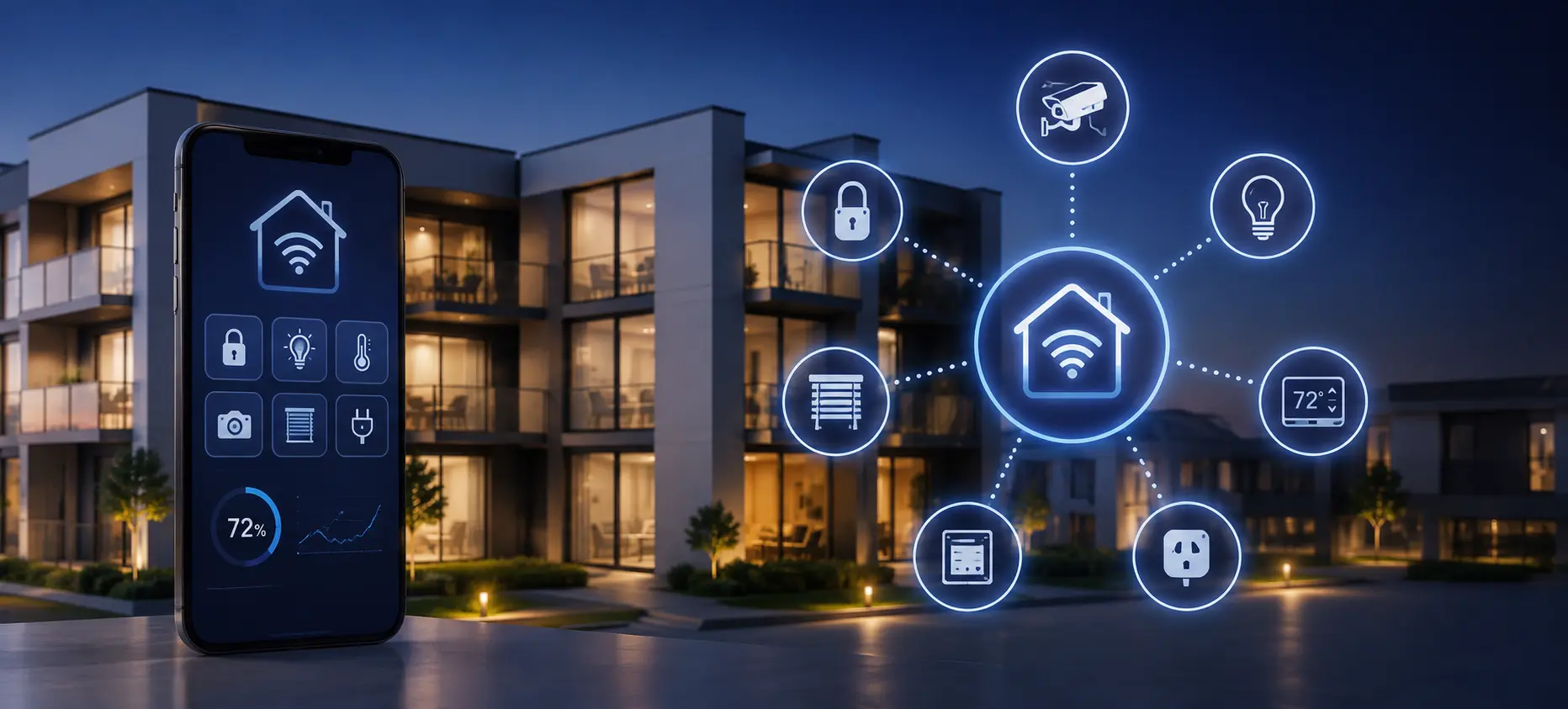 Real Estate
Smart Home and IoT Integration for Property Operators: Cost, ROI, and What to Build First
This blog breaks down smart home and IoT integration for property operators, covering real costs, real ROI, and exactly what to build first. It walks through actual pricing by portfolio size, from new construction to full enterprise retrofits. It explains where the ROI really comes from, including energy savings data from a major retrofit case study and renter demand statistics. It lays out a staged build order, starting with access control and climate sensors before predictive maintenance, security, and tenant apps. It closes with a data privacy and security checklist, a DIY versus integration partner comparison, and a 10-question FAQ section.
August 24, 2026
Ready to book a 30-minute strategy call?
We'll map the right digital moves for your real estate business, no pitch deck, no commitment.