

Mayank Pokharna
COO, Noseberry Digitals & Industry Expert
How Much Does a Real Estate Website Cost in 2026 (Pricing Guide)
Published July 9, 2026|12 min read
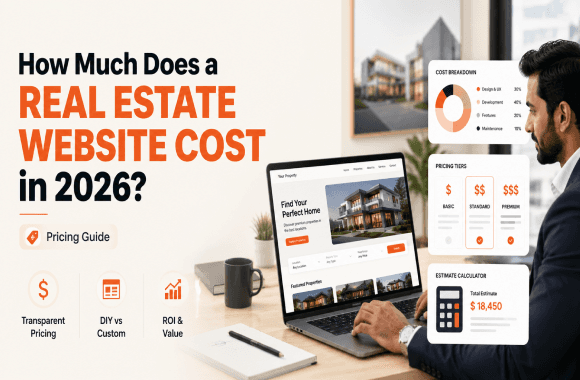
Most real estate website pricing guides stop at the build quote and leave out the recurring fees that quietly double your investment over 12 months. This guide breaks down the true real estate website cost in 2026 from every angle: initial build tiers by business type, IDX integration pricing, monthly running costs, a 3-year total cost of ownership model, and the features that actually generate leads versus the upsells that don't. You'll also get a clear framework for calculating ROI based on your average deal value, so the budget decision is grounded in numbers, not guesswork. Whether you're a solo agent spending $5,000 or a brokerage planning a $50,000 platform investment, this guide gives you the information to spend it right. Read it before you approve any proposal.
A real estate website cost in 2026 ranges from $200 for a basic template to over $60,000 for a fully custom brokerage platform. Most independent agents and small teams should expect to spend between $4,000 and $15,000 for an initial build, plus $150-$500 per month in ongoing hosting, maintenance, and IDX feed costs. The right budget depends entirely on what the website needs to do for your business.
Here's what most pricing guides miss. They list the build tiers but skip the more important question: how much should you be willing to spend, given what a single closed deal is worth to your business? If your average commission is $8,000, a $6,000 website that produces two additional deals per year returns $10,000 net in year one alone. If your average deal value is $50,000, the ROI math shifts further still. Real estate website cost is not just a line item. It's an investment decision that should be benchmarked against deal value, not just compared to the lowest available quote.
In my decade working with property businesses across 14+ countries at Noseberry Digitals, I've seen a $500 template site outperform a $20,000 custom build because the expensive one had no CRM integration, and I've seen a $12,000 investment generate over $200,000 in pipeline within 90 days because the conversion architecture was right. The cost matters less than what the site is built to do.
What Does a Real Estate Website Actually Cost in 2026?
Real estate website cost in 2026 covers three distinct investment layers: the initial build cost, the recurring monthly costs, and the optional add-on costs for features that improve lead generation and conversion. Most agents only budget for the first layer and get surprised by the second.
Here's a complete breakdown of every cost component:
Initial Build Cost by Tier
Website Type | Build Cost (2026) | Best For |
|---|---|---|
Template / DIY (Wix, Squarespace) | $200-$1,000 | Solo agents needing a fast digital presence |
SaaS platform (Placester, Real Geeks, kvCORE) | $0-$2,000 setup + monthly fee | Agents wanting all-in-one tools with less control |
Semi-custom (WordPress + IDX) | $2,000-$8,000 | Solo agents and small teams wanting brand control |
Professional custom build | $8,000-$25,000 | Growing teams and established brokerages |
Enterprise / brokerage platform | $25,000-$60,000+ | Large brokerages, multi-city operators, developers |
According to Scopebit's analysis of 600 real estate web projects in 2026, the median build cost for a solo agent site with IDX is $5,500, and the median for a team site with custom branding is $13,000. Those numbers are a useful sanity check when you receive quotes.
Recurring Monthly Costs
This is where most agents get surprised. Beyond the build, a real estate website carries ongoing costs that add up significantly over 12 months:
Hosting: $5-$100 per month depending on server type. Shared hosting is cheap but slow. A VPS or dedicated hosting runs $20-$100/month and is worth it for sites handling real listing traffic.
IDX feed: $50-$300 per month. This is the live MLS data feed that lets visitors search active properties on your site. Without it, your site is a brochure. More on IDX costs below.
Domain name: $10-$50 per year. A one-time annual cost, but worth budgeting.
SSL certificate: Usually included in hosting, but occasionally separate at $50-$200 per year.
CRM integration: $50-$500 per month depending on the platform. This is what turns a website visitor into a tracked, nurtured lead.
Website maintenance: $150-$500 per month for plugin updates, security patches, content updates, and technical monitoring.
SEO retainer (optional but high-ROI): $800-$5,000 per month depending on scope and market competitiveness.
Add it up honestly. A well-equipped real estate website with IDX, CRM integration, hosting, and basic maintenance typically costs $500-$1,200 per month in ongoing fees, on top of the initial build. A budget for Year 1 should include both.
What Does IDX Integration Cost, and Do You Actually Need It?
IDX integration costs between $50 and $300 per month for a standard feed, plus a one-time setup cost of $500-$8,000 depending on whether you need an embedded iframe solution or a fully branded, SEO-optimized IDX build on your own domain.
IDX (Internet Data Exchange) is the technology that pulls live MLS listings into your website, because it allows buyers to search available properties directly on your site rather than bouncing to a third-party portal. Without IDX, every buyer who wants to search properties leaves your site and likely ends up on Zillow, Rightmove, or a local portal. With IDX, the search happens on your domain, where you control the branding, the lead capture forms, and the follow-up experience.
There are three main IDX integration types, at very different price points:
Iframe embed ($30-$200/month, no setup fee): The cheapest option. Listings appear in a frame on your site, but they don't live on your domain. Google doesn't index individual listing pages. You get functionality, not SEO value.
Branded IDX on your domain ($2,000-$8,000 build + $100-$300/month): Listings live on your own domain with custom search filters and branded URLs. Each listing page is indexable by Google, which builds your organic visibility over time. This is the right choice for most serious agents.
Direct MLS data feed ($5,000-$25,000 build + $200-$800/month): Full control over how listing data is rendered, multi-MLS support, and the ability to build custom search experiences. Necessary for large brokerages or developers listing their own inventory.
For most independent agents, Option 2 is the right investment. The SEO value of having hundreds of indexed listing pages on your domain compounds over time and eventually reduces your cost per lead from organic search. Our guide on real estate SEO and lead generation explains exactly how that organic pipeline builds.
How Much Does It Cost to Build a Real Estate Website by Business Type?
The right real estate website budget scales with the complexity of what you're selling, the size of your team, and what role the website plays in your lead generation strategy. Here's a realistic breakdown by business type:
Solo Real Estate Agent
Budget range: $3,000-$8,000 build + $300-$600/month ongoing
A solo agent needs a site that communicates credibility, showcases their listings, captures leads, and connects to a CRM. Speed matters more than complexity. A clean WordPress site with a well-integrated IDX feed and a clear call-to-action structure delivers everything a solo agent needs.
The most common mistake solo agents make is overspending on visual design and underinvesting in conversion architecture. A stunning site that loads slowly, has no lead capture form, and fires nothing when a visitor submits an inquiry is a very expensive business card.
Real Estate Team (2-10 agents)
Budget range: $8,000-$20,000 build + $500-$1,000/month ongoing
A team site needs individual agent profiles, shared listing inventory, team branding, and a CRM that routes leads to the right agent automatically. The IDX setup typically needs to support multiple agents' listings and filter by agent. Lead routing and CRM integration become critical, not optional, at this size.
Real Estate Brokerage
Budget range: $20,000-$60,000+ build + $1,000-$3,000/month ongoing
A brokerage site functions as a talent recruitment tool as much as a lead generation tool. It needs to showcase agent rosters, display a large inventory, support property search at scale, and usually integrate with a back-office system. Custom development is often necessary at this level because off-the-shelf platforms hit their ceiling quickly.
Property Developer
Budget range: $15,000-$100,000+ per project microsite or $20,000-$80,000 for a portfolio site
Developers often build separate project microsites for each new development, alongside a main corporate portfolio site. Project microsites typically feature 3D walkthroughs, drone video embeds, a payment plan calculator, and an inquiry form that feeds directly into a CRM. The conversion architecture on these sites is especially critical because a single conversion can be worth hundreds of thousands in revenue.
When we build real estate websites for developers at Noseberry Digitals, the CRM integration is always configured before the design brief is approved. A website that doesn't connect directly to a live real estate CRM is essentially asking your team to manually process every inquiry, which creates the exact response-time gaps that cost you sales.
What Features Drive Real Estate Website Cost Up (and Which Are Worth It)?
Not every feature that increases cost increases leads. Some are genuine multipliers for your pipeline. Some are upsells that look good in a proposal but generate no measurable return. Here's how to tell the difference:
Features worth the investment:
CRM-connected lead forms: Every form submission should fire a CRM entry and an automated 60-second response. This single feature can triple your lead-to-site-visit conversion rate. Without it, your SEO and paid traffic investment produces half the leads it should.
Mobile-first design: Mobile devices account for over 60% of global web traffic according to Statcounter GlobalStats 2026. A site that isn't fast and clean on mobile loses the majority of its visitors before they see a listing.
Schema markup: Schema tells Google and AI answer engines what your page is, who owns it, and what it covers. Pages with schema markup have a significantly higher chance of appearing in featured snippets, knowledge panels, and AI-generated answers.
Neighborhood landing pages: These hyper-local pages rank for area-specific searches that national portals rarely target well. Each page builds your local authority incrementally. A site with 20 well-written neighborhood pages competes effectively with much larger competitors in local search.
Core Web Vitals compliance: Google uses page load speed and visual stability as ranking factors. A site that fails Core Web Vitals is penalized in search rankings regardless of how good the content is.
Features that often don't earn their cost:
Complex animated homepage headers: Look impressive, slow the page down, and contribute nothing to lead conversion.
Mortgage calculator widgets (if not connected to a lender CTA): Generates engagement but rarely produces a lead if there's no clear next step attached.
Social media feed embeds: Pulls visitors off your site and onto a platform you don't control.
Premium "luxury" design templates at significant cost uplift: Design influences brand perception but doesn't directly determine lead volume. A fast, clear, and credible site converts better than a beautiful slow one.
As Rand Fishkin (founder of SparkToro and Moz) observed about digital marketing generally: "The websites that win aren't always the prettiest. They're the ones that load fast, answer questions clearly, and make it easy to take the next step."
How Do Real Estate Website Platforms Compare on Cost and Features?
Here's a side-by-side comparison of the most commonly used real estate website platforms in 2026:
Platform | Starting Monthly Cost | IDX Included | CRM Included | SEO Control | Best For |
|---|---|---|---|---|---|
Placester | $59/month | Yes (NAR pricing) | Basic | Limited | Budget-conscious solo agents |
Real Geeks | $299/month | Yes | Yes | Moderate | Solo agents and small teams |
kvCORE | $499+/month | Yes | Yes (advanced) | Moderate | Teams and brokerages |
AgentFire | $149/month | Add-on | No | Strong | Agents focused on local SEO |
Sierra Interactive | $500+/month | Yes | Yes | Very strong | SEO-first teams |
WordPress (custom) | $100-$300/month ongoing | Add-on (IDX provider) | Add-on (CRM) | Full control | Agents wanting full ownership |
Custom build (agency) | $500-$3,000/month ongoing | Integrated | Integrated | Full control | Brokerages and developers |
The pattern is clear. More control costs more monthly. Less control is cheaper short-term but limits what you can do with the site over time. Closed SaaS platforms also carry a portability risk: if you decide to switch providers, you may need to rebuild from scratch because you don't own the underlying code.
When evaluating platforms, ask one question before signing anything: if I want to leave this platform in 18 months, what do I keep? The answer tells you whether you're renting a website or building an asset.
What Is the True Total Cost of a Real Estate Website Over 3 Years?
The true total real estate website cost is almost always significantly higher than the upfront build quote because of recurring monthly fees, content investment, and periodic redesigns. Here's a realistic 3-year cost model for a professional agent site:
3-Year Total Cost of Ownership for a Mid-Range Real Estate Website:
Initial build (professional custom WordPress + IDX setup): $8,000-$12,000
Hosting (36 months at $50/month): $1,800
IDX feed (36 months at $150/month): $5,400
CRM integration (36 months at $100/month): $3,600
Maintenance and updates (36 months at $200/month): $7,200
Domain and SSL (3 years): $150-$300
Basic SEO content (12 blog posts/year at $150 each, 3 years): $5,400
3-Year total: approximately $31,500-$35,500
That's around $880-$990 per month averaged over three years. If you're generating 3-5 additional transactions per year from the website at an average commission of $5,000-$15,000 each, the ROI is strong. If the site produces nothing, that's a significant budget to recover.
This is why treating a real estate website as a one-time purchase misses the point. It's an operational infrastructure investment with ongoing running costs, just like rent or staffing. Budget accordingly from the start.
Our real estate performance marketing post covers how to set up attribution so every lead from your website is tracked back to a closed deal, giving you the actual data to evaluate that ROI properly.
How Should You Choose Who Builds Your Real Estate Website?
Choosing who builds your real estate website is as important as choosing what features to include, because the quality of the build determines whether the investment produces leads or just a presence.
There are three main options: a specialist real estate web agency, a general web design freelancer or agency, and a DIY platform. Each has a different cost profile and risk profile:
Specialist real estate agency: Typically the highest cost, but brings ready-made IDX relationships, CRM integration experience, and a portfolio of sites actually generating leads. This is the right choice for teams and developers where the website is a primary sales channel.
General web agency or freelancer: Usually lower cost but requires more briefing from your side on real estate-specific requirements. IDX integration, schema markup for property listings, and CRM connection are often not in the developer's default scope. If you go this route, specify every technical requirement in writing before work begins.
DIY SaaS platform: Lowest upfront cost, fastest to launch, but you rent rather than own. You're limited to the platform's feature set and can't export your site if you leave.
The real question isn't "who is cheapest?" It's "who has done this before for businesses at my stage, in my market, and can show me what the results were?" Ask for case studies. Ask to speak to current clients. Ask specifically what their standard for "done" looks like in terms of CRM connection, lead capture, and page speed.
At Noseberry Digitals, we build real estate websites as the front end of a complete digital marketing system. The website design brief doesn't get approved until the CRM workflow, lead capture architecture, and SEO strategy are mapped out first. That sequence matters because a website built in isolation from the marketing stack it feeds will almost always underperform.
If you're also planning to run paid acquisition alongside your organic presence, our Google Ads guide for real estate lead generation explains how to configure landing pages and tracking so every click is measured against a closed deal, not just a form fill.
What Hidden Costs Do Most Real Estate Website Quotes Leave Out?
Most real estate website quotes present the build cost and monthly hosting fee, then stop. The costs that typically appear after you sign are:
CRM setup and migration: Moving your existing contacts into a new CRM and configuring automation workflows is often quoted separately, or not at all. Budget $500-$3,000 for a professional CRM setup.
Content creation: A new website needs copy for every page, plus photography and video. Professional real estate photography runs $300-$800 per session. Copywriting per page runs $100-$400 depending on length and complexity.
SEO setup: Title tags, meta descriptions, schema markup, and Google Search Console configuration are often not included in a standard web build quote. Ask specifically whether on-page SEO is in scope.
Training: Some platforms require significant training to use confidently. Budget 2-5 hours of paid training time, or factor in the weeks of reduced productivity while your team learns the system.
Redesign frequency: A real estate website has a practical lifespan of 3-4 years before it needs a significant refresh to meet current design and performance standards. Budget for this in your long-term planning.
Our AI and automation services for real estate can reduce some of these ongoing content costs significantly. AI tools now generate listing descriptions, blog post outlines, and email copy drafts at a fraction of the cost of manual creation, reducing the gap between a bare-bones site and a content-rich one.
To see how other property businesses have structured their website and marketing investments, our case studies include breakdowns of what we built, what it cost, and what it produced.
Conclusion
Real estate website cost in 2026 isn't a single number. It's a range that starts at a couple of hundred dollars for a basic template and stretches to six figures for a fully custom enterprise platform, with the most practical range for most independent agents and small teams sitting between $4,000 and $15,000 for the initial build, plus $500-$1,000 per month in ongoing costs.
The most important insight from this entire guide is this: the cost of a real estate website matters far less than what the website is built to do. A $3,000 site that captures leads instantly, connects to your CRM, loads in under 2 seconds on mobile, and sits on an SEO-optimized foundation will outperform a $20,000 site that has none of those things. Budget for outcomes, not aesthetics.
Before you approve a single proposal, run through this checklist. Does the build include CRM integration? Does the IDX solution put listing pages on your domain for SEO value? Is mobile performance a priority in the brief? Are conversion elements (lead capture forms, chat, call-to-action buttons) specified in the scope? Is ongoing maintenance included or quoted separately?
If you can answer yes to all of those, the price you pay is almost certainly justified. If the proposal doesn't mention any of them, you're likely being quoted for a website that will look good in a screenshot but produce little in your pipeline.
The team at Noseberry Digitals builds real estate websites as the front end of a complete marketing and sales system. We've done it across 14+ countries for operators at every scale. If you want an honest assessment of what your current or planned website should cost and what it should be generating, book a free strategy call at noseberrydigitals.com. We'll tell you exactly where the money is well spent and where it isn't.
- Real estate website cost in 2026 ranges from $200 for a basic template to $60,000+ for a fully custom brokerage build; most agents should budget $4,000-$15,000 for a professional site.
- The median solo agent site with IDX costs $5,500 to build, according to Scopebit's analysis of 600 real estate web projects in 2026.
- Ongoing monthly costs (IDX feed, hosting, CRM, maintenance) add $500-$1,200 per month, making 3-year total cost of ownership $31,000-$35,000 for a mid-range professional site.
- IDX integration adds $50-$300/month in feed fees plus $500-$8,000 in setup; branded IDX on your own domain is worth the cost premium for long-term SEO value.
- Features that genuinely increase leads: CRM-connected forms, mobile-first design, schema markup, neighborhood landing pages, and Core Web Vitals compliance.
- Over 60% of global web traffic comes from mobile devices (Statcounter 2026), making mobile performance a non-negotiable specification, not an optional upgrade.
- Platform sites are cheaper short-term but create dependency and ownership risk; custom builds are more expensive but produce an asset you control.
- The true ROI calculation for a real estate website is annual revenue from incremental deals divided by total cost of ownership, not just the upfront build quote.
- Hidden costs that most quotes omit include CRM setup ($500-$3,000), content creation, SEO configuration, and the periodic redesign budget every 3-4 years.
- The most important question to ask any developer before signing: "If I leave this platform, what do I keep?" The answer reveals whether you're building an asset or renting one.
Why trust Noseberry
Our content is written by practicing real-estate and PropTech professionals, fact-checked by a dedicated editorial team, and reviewed against the latest industry data before publication.
- 10+ years of industry expertise
- All facts independently verified
- No sponsored rankings in guides
- Updated when the industry changes
Have Any Questions?
How much does a real estate website cost in 2026?
A real estate website cost in 2026 ranges from $200 for a basic template to $60,000 or more for a fully custom brokerage platform. Most independent agents should budget $4,000-$12,000 for a professional build with IDX integration, plus $300-$600 per month in ongoing hosting, IDX feed, and maintenance fees. According to Scopebit's 2026 analysis of 600 real estate projects, the median solo agent site with IDX costs $5,500 to build.
What is IDX and how does it affect real estate website cost?
IDX (Internet Data Exchange) is the technology that displays live MLS property listings on your website, because it keeps buyers searching on your domain instead of bouncing to third-party portals. It directly affects real estate website cost by adding $50-$300 per month in feed fees and $500-$8,000 in setup costs depending on whether you use a basic iframe embed or a fully branded, SEO-optimized IDX build on your own domain. Most serious agents should choose the branded IDX option for the long-term SEO value.
What is the cheapest way to build a real estate website?
The cheapest way to build a real estate website is to use a SaaS platform like Placester, which starts at $59 per month with no significant upfront cost and includes basic IDX. DIY template builders like Wix or Squarespace can produce a site for under $200, but they typically don't support IDX integration, offer limited SEO control, and look generic. The cheapest option is rarely the best investment if your website is meant to generate leads consistently.
How much does real estate website maintenance cost?
Real estate website maintenance costs between $150 and $500 per month for a professional site, covering plugin updates, security monitoring, content updates, technical performance checks, and IDX feed management. Sites with more complex features or higher traffic volumes can cost more. Skipping maintenance is a false economy: an unmaintained real estate website typically degrades in performance and security within 12-18 months, often requiring a costly rebuild.
Should I use a real estate website platform or build a custom site?
You should use a real estate website platform if you need a fast launch, have a tight budget, and don't require significant customization. You should build a custom site if you want full SEO control, plan to scale your team, need custom CRM integrations, or are running a brokerage or development business where the website is a primary sales channel. Most growing real estate teams eventually outgrow platforms and move to custom builds, so starting custom can avoid a costly migration later.
How long does it take to build a professional real estate website?
A professional real estate website takes 4-12 weeks to build from brief approval to launch, depending on complexity. Template-based platform sites can go live in days. Semi-custom WordPress builds with IDX typically take 4-6 weeks. Fully custom builds for teams or brokerages run 8-16 weeks and require active involvement from your team for content, photography, and feedback rounds. Rushing the build to save time almost always costs more in fixes after launch.
What features should a real estate website include in 2026?
A real estate website in 2026 should include mobile-first design, CRM-connected lead capture forms, IDX property search on your own domain, neighborhood landing pages for local SEO, schema markup for search and AI engine visibility, Google Analytics 4 and Search Console integration, Core Web Vitals compliance, a Google Business Profile connection, and an AI chatbot or live chat for after-hours lead capture. According to Statcounter GlobalStats 2026, mobile devices account for over 60% of global web traffic, making mobile performance a non-negotiable baseline requirement.
How do I calculate the ROI of a real estate website?
Calculate real estate website ROI by dividing the revenue from incremental leads generated by the site by the total cost of building and maintaining it over a given period. If a $10,000 website produces three additional transactions per year at an average commission of $6,000 each, it generates $18,000 annually on a total first-year cost of roughly $16,000 (build plus monthly fees), producing a positive return in year one. Track which leads came from organic search, direct traffic, and paid channels to attribute revenue accurately.
What is the difference between a real estate website and a property portal?
A real estate website is owned and controlled by an individual agent, team, or brokerage, built to generate leads for that specific business. A property portal (Zillow, Rightmove, Bayut) is a third-party aggregator that lists properties from many agents and charges for leads or visibility. The key difference is ownership: a real estate website builds long-term SEO authority and brand equity for its owner, while a portal creates dependency on a platform that controls the relationship between you and the buyer.
How much does it cost to redesign an existing real estate website?
Redesigning an existing real estate website costs $3,000-$15,000 depending on scope, with full rebuilds on new platforms sitting toward the higher end. If the existing site is on a platform you own (WordPress), a visual refresh with updated content and performance improvements can cost $2,000-$5,000. If you're migrating from one platform to another, budget for content migration, IDX reconfiguration, and an SEO migration audit (typically $500-$2,000) to ensure existing rankings transfer properly to the new domain structure.
Related insights
 Real Estate
What should a PMS do for small-scale property managers?
The ideal PMS for a small-scale property manager (typically 10 to 500 units) should do ten things well: capture every rent payment automatically, log every maintenance ticket with photo evidence and vendor dispatch, hold every tenant lease and document in one searchable place, generate owner and investor statements in one click, run automated rent reminders and late-fee escalation, screen tenants with credit and eviction history, sync with the operator's accounting stack (QuickBooks, Xero), work on mobile so field checks and unit walks happen on a phone, integrate with a website for listing marketing and online applications, and produce broker-visible dashboards that let the manager see occupancy, delinquency, and cash flow at a glance. AppFolio Property Manager Core, Buildium, DoorLoop, Rentec Direct, and Hemlane are the platforms most adopted at this scale in 2026, at $1.40 to $4 per unit per month. This post covers what the ideal PMS should do, which platforms actually deliver it, and how to pick without overpaying.
August 22, 2026 Real Estate
Which AI tools work best for real estate developers in 2026?
The best AI tools for real estate developers in 2026 fall into eight categories that map to the developer lifecycle: land sourcing and site selection (Cherre, Reonomy, HouseCanary, LandGate), feasibility and financial modelling (Northspyre, TestFit, custom Excel plus GPT), design and architectural planning (Autodesk Forma, Higharc, Cove.tool, Snaptrude), construction management and progress tracking (Procore AI, Autodesk Construction Cloud, Buildots, Doxel, OpenSpace), pre-launch marketing and renders (Restb.ai, MidJourney, Adobe Firefly), off-plan sales CRM (Salesforce, HubSpot, Follow Up Boss, Rechat), ESG and net-zero analytics (Measurabl, Enertiv, Aquicore), and handover to operations (BIM AI, tenant portal AI). Used well, they cut construction cost 10 to 20 percent, compress design cycles 30 to 50 percent, and lift off-plan sales conversion 20 to 40 percent. Used badly, they burn subscription budget and produce plans that do not build. This post walks through each category, which tools actually work, and how to sequence adoption.
August 22, 2026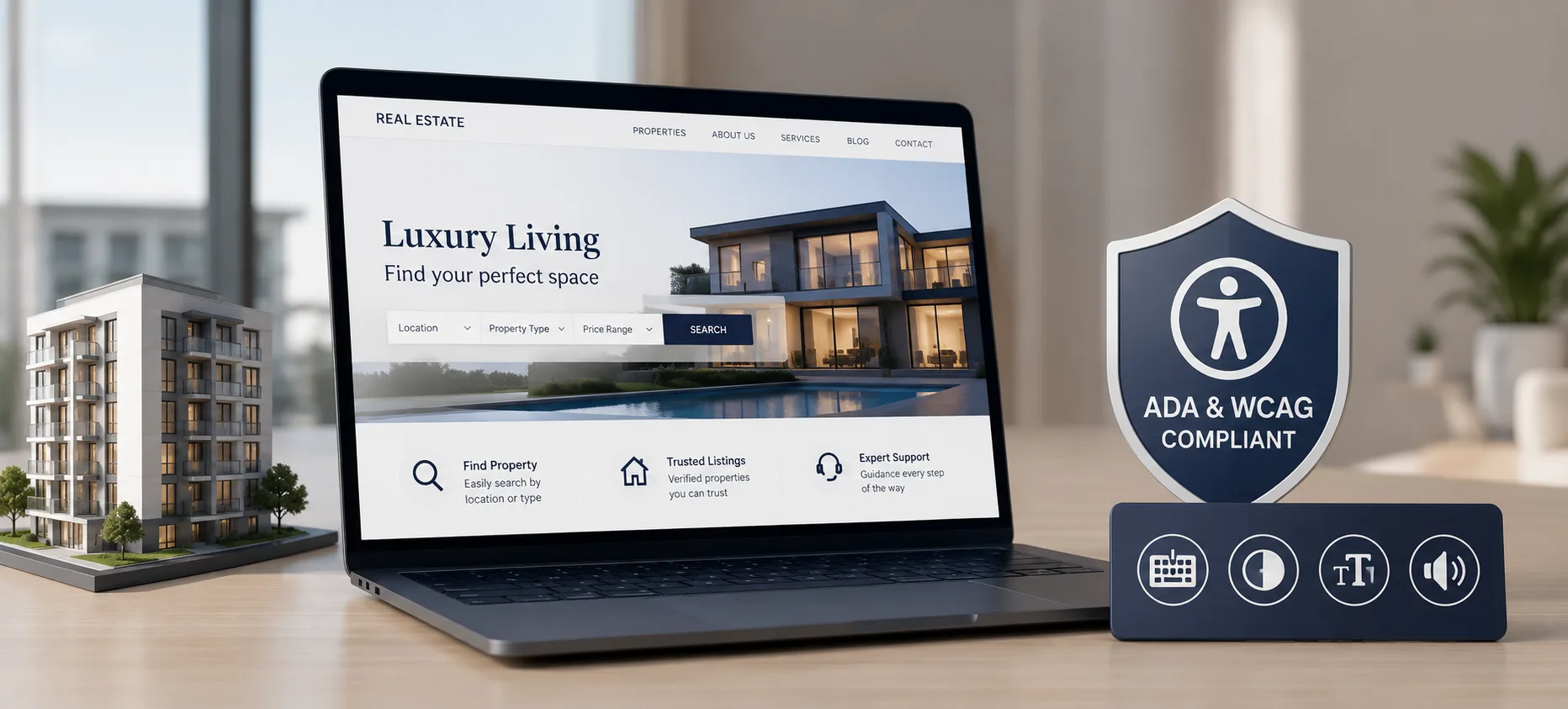 Real Estate
ADA & WCAG Accessibility Compliance for Real Estate Websites: What Operators Must Fix Before They Get Sued
This blog breaks down ADA and WCAG accessibility compliance for real estate websites, focused on what actually creates legal exposure. It explains why WCAG 2.1 Level AA has become the practical legal standard even without a formal Title III regulation for private businesses. It walks through the six accessibility failures responsible for 96% of all detected errors across the web, using real listing-page examples. It also warns against relying on accessibility overlay widgets, citing the FTC's 2025 action against accessiBe over deceptive compliance claims. The piece closes with a step-by-step audit process, an in-house versus compliance-partner comparison, and a 10-question FAQ section.
August 20, 2026
Ready to book a 30-minute strategy call?
We'll map the right digital moves for your real estate business, no pitch deck, no commitment.