

Mayank Pokharna
COO, Noseberry Digitals & Industry Expert
AI Chatbots for Real Estate: Benefits, Use Cases, and Cost (Full Guide)
Published July 14, 2026|14 min read
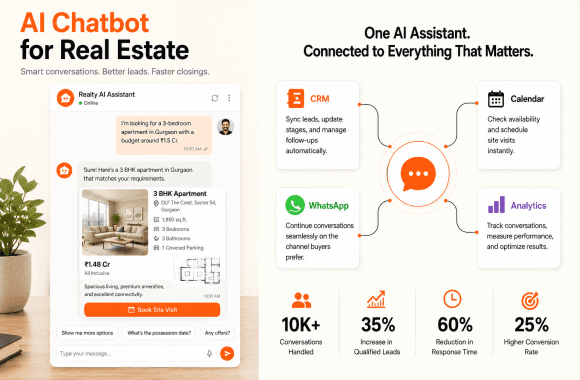
Most property businesses lose half their leads simply because no one was available to respond when the inquiry arrived. This guide breaks down exactly what AI chatbots for real estate do, covering the full picture from lead qualification and site visit booking to tenant management and post-sale nurturing. You'll get a detailed cost breakdown from $15-per-month prebuilt tools to $50,000 custom builds, a clear ROI calculation framework you can run against your own numbers, and a practical decision guide for choosing between prebuilt and custom deployment. Every use case is mapped to a real workflow, and every benefit is backed by data so you know what to actually expect from the investment. If you're considering deploying a chatbot for your property business, or auditing one that's already in place, this is the guide to start with.
AI chatbots for real estate are software systems that use artificial intelligence and natural language processing to hold conversations with buyers, sellers, tenants, and investors at any hour, qualify leads automatically, schedule viewings, and feed structured data directly into your CRM without a human agent involved. They work because 90% of consumers now expect instant responses from businesses, and property businesses that respond within one minute are 7 times more likely to convert a lead than those that respond later.
Here is the context that makes this matter in 2026. The average real estate inquiry arrives outside business hours. A buyer browsing listings at 9pm on a Tuesday is not going to wait until 9am the next morning to get an answer about floor plans or payment schedules. If your website doesn't respond, a competitor's will. AI chatbots close that gap entirely. They handle the first conversation, collect the information your agents need, qualify intent, and hand off warm leads with a full context summary before your team even starts their day.
At Noseberry Digitals, we've deployed chatbot systems for property operators across multiple markets. The consistent finding: a properly configured AI chatbot doesn't just save time. It changes the shape of your pipeline by capturing leads that would otherwise have gone cold overnight. This guide covers exactly what AI chatbots for real estate do, where they add the most value across the property lifecycle, what they cost, and how to choose between a prebuilt tool and a custom build.
What Is an AI Chatbot for Real Estate, and How Does It Work?
An AI chatbot for real estate is an intelligent virtual assistant that simulates human-like conversation to handle property inquiries, qualify leads, schedule site visits, and provide property information across channels including websites, WhatsApp, SMS, and social media, because it removes the dependency on human availability for every early-stage interaction.
Unlike a traditional rule-based chatbot that follows a fixed decision tree and falls apart the moment a user asks something unexpected, a modern AI-powered chatbot uses natural language processing (NLP) to understand intent, maintain conversation context across multiple messages, and respond in a way that feels natural. It can understand "I'm looking for a 3BHK near a good school in the northern part of the city" just as well as it understands a formal form submission.
Here is how the system works end to end in a property context:
A visitor lands on your website, WhatsApp channel, or listing page and sends a message
The AI processes the intent: is this a buyer, renter, investor, or existing client?
The chatbot asks qualifying questions: budget, location preference, timeline, financing status
Based on answers, it recommends relevant listings, sends a brochure, or books a site visit directly into your agent's calendar
All collected data pushes automatically to your CRM with the lead tagged by intent, property type, and qualification score
If the conversation requires a human (complex legal question, high-intent hot lead, complaint), the chatbot escalates with a full transcript so the agent has context before they say hello
That last step is the one most property businesses miss when they first implement a chatbot. The handoff to a human agent is as important as the automation itself. A chatbot that answers questions but doesn't escalate smartly is a support tool, not a sales tool. Connecting it properly to your real estate CRM transforms it into a round-the-clock sales qualifier.
What Role Does a Chatbot Play in Real Estate Sales?
The role of a chatbot in real estate is to act as the first line of engagement for every inbound inquiry, handling the top-of-funnel work that currently consumes a significant portion of every agent's day, so agents can focus their time on the conversations that actually require human judgment: negotiations, complex questions, relationship building, and deal closing.
Think of it this way. If a senior partner at a law firm was spending 40% of their day answering basic procedural questions that a paralegal could handle, you'd restructure the workflow immediately. That's exactly what's happening in most property businesses today. Agents are handling initial qualification, answering FAQ-level questions about floor plans and pricing, and chasing unresponsive leads when they should be focused on closing the deals already in their pipeline.
The role of chatbot in real estate breaks down across three distinct functions:
Sales function: Captures leads, qualifies intent, recommends listings, schedules viewings, and passes warm prospects to agents with full context. This is the primary revenue-generating role.
Service function: Answers common questions about properties, processes, fees, and documentation 24 hours a day, 7 days a week, in multiple languages. Reduces the volume of repetitive inbound calls and emails that interrupt agent focus time.
Operations function: For property managers and developers, chatbots handle tenant maintenance requests, rent payment queries, lease renewal reminders, and document requests without requiring a human team member to respond to each one individually.
According to a 2025 analysis by RTS Labs, AI chatbots can handle up to 80% of customer inquiries in top-tier real estate firms without human involvement. Gartner projects that by 2029, agentic AI will autonomously resolve 80% of common customer service issues, leading to a 30% reduction in operational costs. For property businesses managing high inquiry volumes, those are transformative numbers.
What Are the Key Benefits of AI Chatbots for Real Estate?
AI chatbots for real estate deliver six measurable benefits that directly impact revenue, agent productivity, and client experience. Here's each one with the specific mechanism behind it:
Benefit 1: Instant 24/7 Lead Response
A chatbot responds to every inquiry in under 3 seconds, regardless of the time of day or the volume of simultaneous conversations. This matters because businesses that respond within 1 minute are 7 times more likely to convert leads, according to a widely cited analysis by Harvard Business Review and InsideSales.com. Most property teams respond in hours. A chatbot responds in seconds, every time.
Benefit 2: Automatic Lead Qualification
Rather than putting every unqualified inquiry into an agent's calendar, a chatbot pre-screens leads by collecting budget range, timeline, property type preference, and financing status. Agents receive only the leads that meet a minimum qualification threshold, with the full qualification data already captured. This reduces the number of site visits that lead nowhere and increases the conversion rate of the visits that do happen.
Real estate teams using AI chatbots for lead qualification have seen up to a 40% increase in lead conversion rates, according to RTS Labs' 2025 analysis of property business deployments.
Benefit 3: Multilingual Engagement Without Additional Staff
Modern AI chatbots handle conversations in 50+ languages. For property businesses operating in multilingual markets (the UAE, Singapore, India, Malaysia, the UK with international buyer populations), this is a significant operational advantage. Serving buyers in their preferred language builds immediate trust and removes the friction that causes inquiry abandonment.
A property company with a multilingual chatbot doesn't need a multilingual support team. The chatbot handles Arabic, English, Hindi, Mandarin, and Russian inquiries simultaneously without additional headcount.
Benefit 4: Scalable Volume Handling
A human agent can handle one conversation at a time. An AI chatbot handles thousands simultaneously without degradation in response quality. During a project launch, a new listing release, or a peak market period when inquiry volume spikes 10x overnight, the chatbot absorbs the volume without requiring an emergency staffing response.
According to RTS Labs, AI chatbots improve query handling capacity by up to 80% compared to human-only teams. For a developer launching a 500-unit residential project, that capacity difference is the gap between capturing every inquiry and missing half of them during the launch window.
Benefit 5: CRM Data Quality and Completeness
Every conversation a chatbot handles produces structured data: name, contact details, budget, property preference, location, timeline, and behavioral signals. This data pushes automatically into your CRM in a consistent format, tagged and categorized. Human-processed inquiries produce inconsistent, incomplete data. Chatbot-processed inquiries produce clean, actionable records.
According to a 2025 survey, 74% of organizations using automated agents report improved data collection processes compared to manual lead handling. Cleaner CRM data means more effective segmentation, better personalization in follow-up sequences, and more accurate pipeline reporting.
Benefit 6: Post-Sale and Tenant Relationship Management
The role of chatbot in real estate doesn't end when a deal closes. For developers and property managers, chatbots handle the ongoing operational workload: tenant maintenance requests, lease renewal reminders, rent payment confirmations, and document requests. This dramatically reduces the administrative load on property management teams and improves tenant satisfaction through faster acknowledgment of every request.
10 Specific Use Cases of AI Chatbots in Real Estate
Here are ten concrete, deployment-ready use cases across the full property lifecycle:
New lead qualification on your website: The chatbot greets every new visitor, identifies their intent (buy, rent, invest), collects qualifying information, and routes hot leads to an agent's queue in real time.
WhatsApp and social media inquiry handling: Buyers increasingly contact property businesses via WhatsApp, Instagram DM, and Facebook Messenger. A chatbot deployed across these channels ensures every message gets an immediate, structured response regardless of channel.
Listing recommendations and property matching: Based on budget, location, and configuration preferences collected in conversation, the chatbot suggests matching listings from your inventory and sends brochures or floor plans on request.
Site visit and viewing scheduling: The chatbot connects directly to your agent's calendar and books confirmed appointments without email back-and-forth. Confirmation messages and reminders fire automatically.
Project launch inquiry management: When a new development launches and 500 inquiries arrive in 48 hours, the chatbot handles every initial conversation, qualifies all leads, and delivers a prioritized list to your sales team rather than an unmanaged inbox.
After-hours FAQ handling: Questions about pricing, payment plans, floor plans, school zones, and property specifications come in at all hours. The chatbot answers them instantly from a knowledge base you control, with accurate, consistent responses every time.
Seller and landlord lead capture: A chatbot on a property valuation tool or a "sell with us" landing page can qualify potential sellers and landlords, collect property details, and schedule a valuation call without involving a lister manually.
Tenant maintenance request processing: A chatbot for property management captures maintenance requests in a structured format (unit number, issue type, urgency, photo if relevant), creates a work order automatically, notifies the relevant contractor, and acknowledges the tenant within seconds.
Re-engagement of dormant leads: The chatbot proactively reaches out to leads that went quiet after a certain number of days, with a personalized message referencing their original property interest. This re-engagement often surfaces buyers who were simply not ready at first contact.
Post-sale relationship nurturing: After a deal closes, the chatbot maintains contact through check-in messages, market updates, property anniversary notifications, and referral asks, all triggered automatically from the CRM at the right time.
These use cases connect directly to the real estate marketing automation workflows that a well-built property marketing stack runs on. A chatbot is the front-end conversation layer. The automation system behind it handles what happens next.
How Much Does a Real Estate Chatbot Cost in 2026?
Real estate chatbot cost in 2026 ranges from $15 per month for a basic prebuilt tool to $50,000 or more for a fully custom-built, multi-channel AI deployment with deep CRM integration. The right budget depends on your inquiry volume, the number of channels you need to cover, how much customization your workflow requires, and whether you need the chatbot to integrate with a specific CRM or property management system.
Here's the full cost breakdown by deployment type:
Prebuilt SaaS Chatbot Platforms
Cost: $15-$500 per month
Platforms like ManyChat, Tidio, Landbot, and Drift offer prebuilt chatbot frameworks that you configure using visual builders. They're fast to deploy (often 1-3 days), require no coding, and handle the most common use cases: FAQ answering, basic lead capture, and appointment booking.
The limitations appear quickly in a property context. Prebuilt tools rarely support deep CRM integration out of the box, can't handle complex qualification workflows, and often struggle with the nuanced property questions buyers ask. They work well as a starting point for small agencies with low inquiry volumes.
Best for: Solo agents, small agencies, teams testing chatbot deployment for the first time.
Mid-Tier Chatbot Platforms with Real Estate Configuration
Cost: $200-$1,500 per month
Platforms like Yellow.ai, Intercom, or HubSpot's chatbot feature (part of the broader marketing hub) support more complex workflows, multi-channel deployment, and proper CRM integration. Configuring one of these for real estate typically takes 2-4 weeks and requires someone who understands both the platform and your sales process.
At this tier, you get behavioral routing (the chatbot behaves differently for a buyer vs. a returning client), calendar integration for direct booking, and proper CRM data sync. This is the tier where most growing property teams and mid-size agencies should operate.
Best for: Growing real estate teams, brokerages, and property developers with moderate inquiry volume.
Custom-Built AI Chatbot
Cost: $10,000-$50,000+ build + $500-$2,000/month maintenance
A custom-built chatbot is designed specifically for your property business: your inventory, your qualification criteria, your CRM, your brand voice, and your language requirements. It handles complex multi-turn conversations, integrates directly with your property management system or IDX feed, and escalates with full context to the right human agent or department.
Custom builds make sense when your workflow can't be handled by a prebuilt tool, when you need tight integration with a proprietary system, when inquiry volumes are high enough that a suboptimal chatbot creates meaningful revenue leakage, or when you need multilingual support across more than 2-3 languages with high accuracy.
The build cost is offset over time by the labor cost it replaces. If your team currently spends 20 agent hours per week on initial qualification conversations at a labor cost of $30/hour, that's $31,200 per year in qualification labor. A chatbot that handles 80% of those conversations pays for its build cost in under 18 months and continues paying for itself indefinitely.
Best for: Property developers, large brokerages, co-living operators, and international property businesses with complex multilingual workflows.
Real Estate Chatbot Cost Comparison Table
Deployment Type | Build Cost | Monthly Cost | Best For | Integration Depth |
|---|---|---|---|---|
Prebuilt SaaS (ManyChat, Tidio) | $0 | $15-$200 | Solo agents, basic FAQ | Limited |
Mid-tier platform (Yellow.ai, Intercom) | $0-$2,000 setup | $200-$1,500 | Teams, brokerages | Good |
HubSpot chatbot (within CRM stack) | Included in HubSpot | $200-$800 | HubSpot CRM users | Strong |
Custom-built AI chatbot | $10,000-$50,000+ | $500-$2,000 | Developers, large teams | Full custom |
Enterprise AI agent (multi-channel, multilingual) | $30,000-$100,000+ | $2,000+ | Enterprise, portfolio operators | Full custom |
How Do You Calculate the ROI of a Real Estate Chatbot?
ROI from a real estate chatbot comes from two sources: revenue gained from additional converted leads and cost saved from reduced manual handling. Both are measurable.
Revenue side: If your chatbot handles 200 additional after-hours inquiries per month that previously went unanswered, and your site-visit conversion rate is 15%, that's 30 additional site visits. If your site-visit-to-booking conversion rate is 10%, that's 3 additional bookings per month. At an average deal margin or commission of $5,000, that's $15,000 per month in additional revenue directly attributable to chatbot availability.
Cost side: If your chatbot handles 80% of inbound inquiries that previously required a human response, and each response took 15 minutes at a labor cost of $25/hour, handling 500 monthly inquiries manually costs $3,125 per month. The chatbot eliminates 400 of those interactions, saving $2,500 per month in direct labor cost.
Total monthly ROI from a $500/month chatbot: $15,000 + $2,500 - $500 = $17,000 net per month in a conservative scenario.
These numbers are conservative because they don't include the compounding value of cleaner CRM data, faster lead response improving conversion rates, and the operational freed-up time being reinvested in higher-value selling activities.
Our real estate performance marketing post covers how to track this ROI properly, connecting every chatbot interaction back to a closed deal through your CRM attribution setup.
How Does a Real Estate Chatbot Connect to Your Marketing Stack?
An AI chatbot for real estate only delivers its full value when it sits inside a connected marketing and sales stack, because a chatbot in isolation answers questions but doesn't build a pipeline. When connected properly, it becomes the intake mechanism for your entire lead generation system.
Here's how the connections should work:
Website and landing pages: The chatbot is the first interaction on your highest-traffic pages. It captures visitors who would otherwise leave without filling out a form. Embed it on your homepage, listing pages, and paid ad landing pages.
WhatsApp and social channels: Deploy the same underlying AI across WhatsApp Business, Instagram DM, and Facebook Messenger so every inquiry channel feeds the same CRM pipeline. Buyers who won't fill out a web form often will message on WhatsApp.
CRM integration: Every conversation ends with a structured data push to your CRM. The lead enters the pipeline tagged with source, qualification score, property interest, and contact details. Your automation sequences fire from there. This is the integration that turns a chatbot from a support tool into a sales system. Our digital marketing stack builds always include this connection as a non-negotiable.
Calendar and scheduling tools: Direct integration between the chatbot and your agents' calendars allows confirmed booking without human involvement. The lead picks a time, the chatbot confirms it, and both parties receive a reminder sequence automatically.
Analytics and reporting: Chatbot conversation data feeds your weekly reporting dashboard. Track containment rate (what percentage of conversations the bot resolves without escalation), qualification accuracy (what percentage of bot-qualified leads become site visits), and channel performance (which deployment, website vs. WhatsApp vs. social, produces the highest-quality leads).
When this stack is connected end to end, your AI services aren't just answering questions. They're running a 24-hour intake and qualification engine that makes every other part of your marketing investment more efficient.
What Makes a Real Estate Chatbot Actually Work in Practice?
Most real estate chatbot deployments underperform not because the technology is wrong but because three setup decisions are made poorly. Get these right and performance follows:
First: the handoff logic. Define precisely when and how the chatbot escalates to a human. If the confidence score of the AI's response falls below a threshold, if a user asks to speak to an agent, or if the conversation signals a high-intent buyer asking pricing and payment questions, the escalation should fire immediately with a full transcript forwarded to the right agent. A chatbot that doesn't escalate smartly is a dead end for your hottest leads.
Second: the knowledge base accuracy. The chatbot's answers are only as good as the property information it can access. If your listings change frequently, your knowledge base needs to update automatically, either through a live IDX feed integration or a structured data sync with your CRM. A chatbot that quotes incorrect pricing or references a property that's already sold destroys trust instantly.
Third: the CRM integration completeness. Every data point the chatbot collects should land in your CRM automatically, correctly formatted, and tagged consistently. If agents have to manually move chatbot conversation data into the CRM, the time savings disappear and the data quality benefits evaporate. The integration is not optional.
Building the real estate website and chatbot as a connected system from the start, rather than adding the chatbot as an afterthought, is the single most important structural decision in deployment. It determines whether the chatbot is a tool sitting on your site or a front door to your entire sales pipeline.
Conclusion
AI chatbots for real estate are no longer a forward-thinking experiment. They're an operational tool that a growing majority of competitive property businesses are using to capture after-hours leads, qualify inquiries at scale, serve multilingual buyer populations, and reduce the administrative load that keeps agents from doing their best work.
The central takeaway from this guide is this: an AI chatbot for real estate delivers its real value not from the conversations it has, but from what those conversations feed into. A chatbot that answers questions and stops there is a FAQ page with a friendly interface. A chatbot connected to your CRM, your calendar, your marketing automation, and your reporting dashboard is a 24-hour sales intake system that makes your entire pipeline faster, fuller, and more efficient.
Start with the use case that has the highest immediate impact. For most property businesses, that's after-hours lead capture on the website and WhatsApp. Configure the qualification questions, connect the CRM integration, define the escalation rules, and go live. Measure containment rate and lead-to-site-visit conversion rate from chatbot-qualified leads against manually handled leads. The data will tell you quickly whether the deployment is working and where to optimize next.
If you're evaluating chatbot options for your property business and want a recommendation based on your specific workflow, inquiry volume, and CRM setup, the team at Noseberry Digitals builds these systems for property operators across 14+ countries. We know where prebuilt tools perform well and where custom builds are worth the investment.
Book a free strategy call at noseberrydigitals.com and we'll map your chatbot deployment options against your actual pipeline needs in the first 30 minutes.
- AI chatbots for real estate handle lead qualification, property recommendations, site visit scheduling, and post-sale management 24/7 without human involvement.
- Businesses that respond within 1 minute are 7 times more likely to convert leads; a chatbot makes sub-3-second response the default for every inbound inquiry.
- Real estate teams using AI chatbots for lead qualification have seen up to 40% increases in lead conversion rates (RTS Labs 2025).
- AI chatbots can handle up to 80% of customer inquiries in top-tier real estate firms, and Gartner projects 80% autonomous resolution of common service issues by 2029.
- Chatbot costs range from $15/month (prebuilt SaaS) to $50,000+ (custom build), with most growing teams operating effectively at $200-$1,500/month on a properly configured mid-tier platform.
- The role of chatbot in real estate spans three functions: sales (lead capture and qualification), service (24/7 FAQ handling), and operations (tenant maintenance and property management).
- 28% of real estate businesses have already adopted live chat as their primary AI tool, making multi-channel chatbot deployment a current competitive baseline.
- Chatbot ROI comes from two measurable sources: additional revenue from after-hours lead capture and direct cost savings from reduced manual inquiry handling.
- The three decisions that determine whether a chatbot actually works: smart escalation logic, accurate and updated knowledge base, and complete CRM integration.
- Custom-built chatbots are worth the investment when inquiry volume is high, workflows are complex, or multilingual accuracy across multiple languages is a business requirement.
Why trust Noseberry
Our content is written by practicing real-estate and PropTech professionals, fact-checked by a dedicated editorial team, and reviewed against the latest industry data before publication.
- 10+ years of industry expertise
- All facts independently verified
- No sponsored rankings in guides
- Updated when the industry changes
Have Any Questions?
What is an AI chatbot for real estate?
An AI chatbot for real estate is an intelligent virtual assistant that uses natural language processing to hold conversations with property buyers, sellers, tenants, and investors across websites, WhatsApp, and social media channels. It qualifies leads, recommends listings, schedules site visits, and answers property questions 24 hours a day without human involvement. A well-configured real estate chatbot pushes all collected lead data directly to a CRM and escalates high-intent conversations to a human agent with full context.
What role does a chatbot play in real estate sales?
The role of a chatbot in real estate is to handle the top-of-funnel interactions that consume the majority of an agent's non-selling time: initial inquiry response, FAQ answering, lead qualification, and appointment scheduling. This frees agents to focus on negotiations, site visits, and relationship building. AI chatbots can handle up to 80% of customer inquiries in top-tier real estate firms according to RTS Labs, without reducing response quality or lead capture rates.
How much does a real estate chatbot cost in 2026?
Real estate chatbot cost in 2026 ranges from $15 per month for a basic prebuilt SaaS tool to $50,000 or more for a fully custom-built multi-channel AI deployment. Most growing property teams and mid-size agencies operate effectively on mid-tier platforms costing $200-$1,500 per month with proper CRM integration. Custom builds make sense when inquiry volume is high, workflows are complex, or multilingual accuracy across more than two or three languages is required.
What are the main benefits of AI chatbots for real estate agents?
The main benefits of AI chatbots for real estate agents are: 24/7 lead response (eliminating after-hours inquiry loss), automated lead qualification (delivering pre-screened prospects to agents), multilingual engagement without additional staff, high-volume handling during peak periods, clean CRM data collection from every conversation, and ongoing tenant and post-sale relationship management. Real estate teams using AI chatbots have seen up to 40% increases in lead conversion rates according to RTS Labs' 2025 analysis.
How do AI chatbots for real estate connect to a CRM?
AI chatbots connect to a real estate CRM through a direct API integration or a native connector on the chatbot platform. When a conversation ends or reaches a qualification threshold, the chatbot pushes structured data (name, contact, budget, property preference, intent score) to the CRM automatically, creating a contact record tagged with source and qualification details. This integration is what transforms a chatbot from a support tool into a sales qualification engine.
Can a real estate chatbot replace a human agent?
No. A real estate chatbot does not replace human agents; it handles the repetitive, time-consuming tasks that prevent agents from focusing on high-value work. Negotiations, complex buyer questions, relationship building, and deal closing all require human judgment, empathy, and expertise that AI cannot replicate in 2026. The well-configured chatbot handles the top-of-funnel workload and hands off to a human at exactly the moment human engagement creates the most value.
What is the difference between a rule-based chatbot and an AI chatbot for real estate?
A rule-based chatbot follows a fixed decision tree and can only respond to the specific inputs it was programmed to handle. An AI chatbot for real estate uses natural language processing to understand intent from any phrasing, maintain context across multiple messages, and handle novel questions it hasn't been explicitly programmed for. In real estate, where buyers ask highly specific and varied questions about properties, AI chatbots significantly outperform rule-based tools in both containment rate and lead satisfaction.
How long does it take to deploy a real estate chatbot?
A prebuilt SaaS chatbot for real estate can be deployed and live in 1-3 days once your knowledge base and qualification questions are defined. A mid-tier platform configured specifically for your workflow, CRM, and calendar integration takes 2-4 weeks. A custom-built AI chatbot with deep system integrations typically takes 8-16 weeks from briefing to launch. The configuration time is the most important investment: a poorly configured fast deployment will underperform a carefully configured slower one every time.
What channels should a real estate chatbot cover?
A real estate chatbot should cover your website (homepage, listing pages, and paid ad landing pages), WhatsApp Business, and any social channels where you receive significant inquiry volume (Facebook Messenger, Instagram DM). The chatbot's underlying AI should be the same across all channels, feeding the same CRM pipeline with consistent data formatting. 28% of real estate businesses have already adopted live chat as a primary AI tool, making multi-channel deployment the current competitive baseline.
Should a small real estate agency invest in an AI chatbot?
Yes, a small real estate agency should invest in an AI chatbot, starting with a prebuilt platform to minimize upfront cost. The after-hours lead capture benefit alone typically justifies the investment: a solo agent who captures two additional deals per year from after-hours chatbot responses at an average commission of $5,000-$10,000 generates 10x-20x their annual chatbot subscription cost. Start with the website and WhatsApp channels, configure basic qualification questions, connect your CRM, and scale from there.
Related insights
 Real Estate
Real Estate Digital Agency in USA: How Noseberry Digitals Helps Developers & PropTech Companies Grow
This blog explains what makes Noseberry Digitals a real estate digital agency in USA built for developers and proptech companies. It covers why generalist agencies struggle with real estate-specific needs like MLS integrations and multi-market brand consistency. It walks through the agency's full-stack services, from branding and websites to CRM, AI, and a 60-day proptech MVP program. It highlights named, documented case studies with real client results, something the piece notes is rare among proptech marketing agencies. It closes with a practical checklist for choosing a real estate digital agency and clears up whether Noseberry Digitals is itself a proptech company.
August 27, 2026 Real Estate
PR Strategy for PropTech Startups: Earning Press and Investor Attention Before You Raise
This blog lays out a pre-raise PR playbook for proptech founders built around timing, not volume, of press coverage. It explains why research shows more media mentions can actually backfire past a certain threshold, and why narrative quality beats raw mention count with investors. It covers how investors actually use press coverage during due diligence, and what they're typically searching for before a first call. It walks through a practical three-to-six-month PR timeline, plus which trade outlets matter most for real estate versus general tech press. It closes with a DIY versus agency comparison, common PR mistakes that sink fundraising, and a 10-question FAQ section.
August 26, 2026 Real Estate
Smart Home and IoT Integration for Property Operators: Cost, ROI, and What to Build First
This blog breaks down smart home and IoT integration for property operators, covering real costs, real ROI, and exactly what to build first. It walks through actual pricing by portfolio size, from new construction to full enterprise retrofits. It explains where the ROI really comes from, including energy savings data from a major retrofit case study and renter demand statistics. It lays out a staged build order, starting with access control and climate sensors before predictive maintenance, security, and tenant apps. It closes with a data privacy and security checklist, a DIY versus integration partner comparison, and a 10-question FAQ section.
August 24, 2026
Ready to book a 30-minute strategy call?
We'll map the right digital moves for your real estate business, no pitch deck, no commitment.