
Noseberry Digitals
What Is Real Estate ERP Software and Does Your Business Need It?
Published March 31, 2026|6 min read

Most real estate businesses start with a small stack of tools: a CRM for leads, an accounting package for invoices, a spreadsheet for property tracking. For a while, this works well enough. Then the portfolio grows. The team expands. The spreadsheets multiply. Data lives in five different systems that do not talk to each other. […]
Most real estate businesses start with a small stack of tools: a CRM for leads, an accounting package for invoices, a spreadsheet for property tracking. For a while, this works well enough. Then the portfolio grows. The team expands. The spreadsheets multiply. Data lives in five different systems that do not talk to each other. Finance is chasing the property team for figures. Reports take days to compile because the numbers have to be pulled from multiple sources manually. This is the problem that real estate ERP software is built to solve. This article explains what ERP means in a property context, what it actually does, and how to know whether your business is at the stage where it makes sense.
The Problem ERP Is Designed to Solve
ERP stands for Enterprise Resource Planning. In simple terms, it is a software platform that connects the different operational functions of a business into one integrated system so that data flows freely between departments without manual re-entry or duplication. In real estate, this problem is acute. Property businesses typically run operations across several distinct areas: leasing and tenancy management, sales pipeline and CRM, property maintenance and facilities, finance and billing, HR and payroll, compliance and documentation, and portfolio reporting. When each of these areas runs on a separate tool, the business is managing several disconnected data environments. Information that changes in one system does not automatically update in another. This creates inefficiency, errors, and delays at every point where departments need to share data.
What Real Estate ERP Software Actually Does
A real estate ERP system acts as a single operational backbone for the business. When a lease is signed in the tenancy module, the billing module generates the invoice schedule automatically. When a maintenance job is completed, the finance module records the contractor cost against the relevant property. When a new staff member joins, HR onboarding and system access are handled within the same platform. The data is consistent across the entire business because it lives in one place. Every department sees the same numbers. Reports are generated from a single source of truth rather than compiled by reconciling data from multiple systems. This is what ERP means in practice: not a feature set, but a connected architecture that removes the information gaps between departments.
Core Modules in a Property ERP System
A real estate ERP system is typically built around a set of core modules that cover the main operational functions of the business. Property and portfolio management handles the master record for each property: ownership details, legal documents, valuation history, lease records, and condition reports. Tenancy and lease management covers the full tenancy lifecycle from application and onboarding through to renewal, termination, and deposit management. Finance and billing automates rent collection, invoice generation, payment reconciliation, expense tracking, and financial reporting. Maintenance and facilities manages work orders, contractor assignments, scheduled maintenance programmes, and inspection records. CRM and sales pipeline tracks leads, viewings, offers, and deals across the sales and leasing teams. HR and payroll manages employee records, leave, performance, and payroll within the same platform. Reporting and business intelligence consolidates data from all modules into dashboards and reports that give leadership a real-time view of the whole business.
How ERP Differs From a Property Management System
This is a question that causes genuine confusion, and it is worth answering clearly. A property management system (PMS) is focused on the operational management of tenancies and properties. It handles leases, maintenance requests, inspections, and tenant communications. It is a purpose-built tool for the property side of the business. A real estate ERP system is broader. It includes property management functionality but extends it to cover the whole business: finance, HR, operations, compliance, and reporting. It is designed to run the entire organisation, not just the tenancy and maintenance workflows. For a small property management business, a PMS may be entirely sufficient. For a growing real estate company with multiple departments, finance complexity, and a large portfolio, ERP provides the integration across the whole business that a standalone PMS cannot.
Signs Your Business Has Outgrown Its Current Tools
There are consistent patterns that signal a business is ready to consider ERP: Your finance team spends significant time reconciling data from multiple systems at the end of each month. Leadership cannot get a reliable view of portfolio performance without waiting for manual reports. Different departments hold different versions of the same data. New staff members need to be set up across multiple disconnected tools. Compliance reporting requires pulling records from several places and assembling them manually. If several of these describe your current situation, ERP is worth evaluating seriously.
Custom ERP vs Off-the-Shelf: A Quick Overview
Off-the-shelf real estate ERP platforms exist and can work well for businesses whose workflows align closely with standard industry processes. They are faster to deploy and carry lower upfront cost. Custom ERP is built specifically around how your business operates. It connects the tools and data structures you already have, accommodates the workflows that make your business distinct, and scales as your portfolio and operations grow. The right choice depends on how closely your operations map to what generic platforms offer. Businesses with standard processes often do well with off-the-shelf. Businesses with complex ownership structures, non-standard lease types, or bespoke reporting requirements frequently find that generic platforms require enough customisation to make a purpose-built system more cost-effective over time. Our Real Estate ERP Software Development page covers how we approach building custom ERP systems for property businesses at different stages of growth.
Conclusion
Real estate ERP is not a tool for every business at every stage. It is a solution for a specific problem: a growing organisation whose departments have outpaced the disconnected tools holding them together. If your business is still at the stage where a CRM, an accounting package, and a property management system cover your needs without significant friction, you do not need ERP yet. But if your finance team is spending days on reconciliation, your leadership team is waiting on manual reports, and your data is living in multiple places that never fully agree with each other, the problem is not going to improve by adding another standalone tool. ERP solves the integration problem at its root. It replaces the patchwork with a single architecture where data flows between departments without manual effort, reports reflect reality in real time, and the business can scale without adding operational complexity at every step. The decision to implement ERP is not a small one. But for property businesses that have reached the point where disconnected systems are genuinely limiting growth, it is the right one.
Why trust Noseberry
Our content is written by practicing real-estate and PropTech professionals, fact-checked by a dedicated editorial team, and reviewed against the latest industry data before publication.
- 10+ years of industry expertise
- All facts independently verified
- No sponsored rankings in guides
- Updated when the industry changes
Related insights
 Real Estate
What Role Does SEO Play in Lead Generation for Real Estate Agents?
Most real estate agents either ignore SEO entirely or treat it as a branding exercise with no connection to their actual pipeline. This guide breaks down exactly what role SEO plays in lead generation for real estate agents, from the moment a buyer types a search query to the moment they book a call with you. You'll get the specific hacks that move map pack rankings, a clear comparison of SEO versus paid ads, and an explanation of AEO and GEO, the new lead sources that most agents haven't discovered yet. Every tactic is mapped to a sales outcome, not just a traffic metric. If you want an organic pipeline that keeps producing leads whether or not you're running ads, this is where you start.
July 3, 2026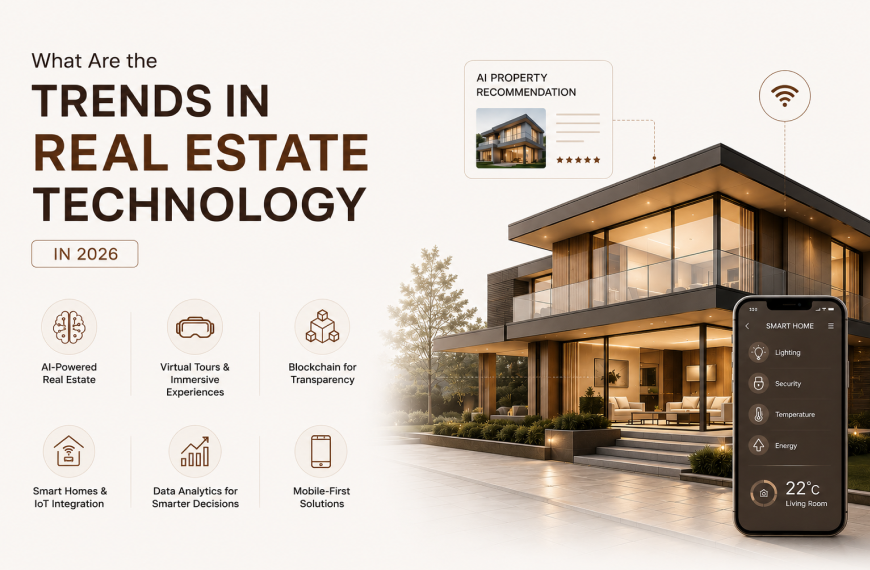 Real Estate
What Are the Trends in Real Estate Technology in 2026
Real estate technology isn't evolving gradually anymore, it's accelerating fast, and most property businesses are already behind. This guide breaks down the trends actually moving the needle in 2026: agentic AI, predictive seller analytics, digital twins, drone data collection, and AI-enhanced CRMs. You'll see real adoption numbers, documented sales impact, and a clear framework for deciding which trend to act on first. Instead of a generic trend list, this post connects each innovation to a specific business outcome. If you want to know what's actually worth your attention this year, start here.
July 3, 2026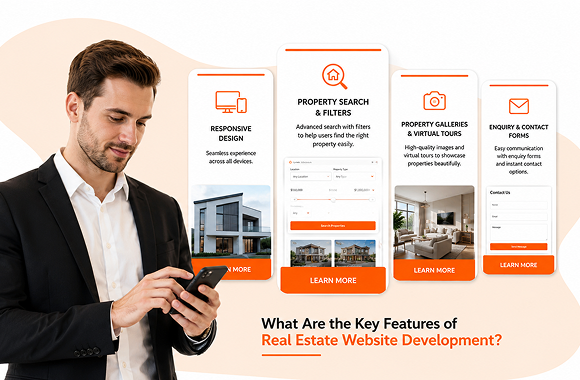 Real Estate
What Are the Key Features of Real Estate Website Development?
This guide breaks down the key features of real estate website development: IDX/MLS property search, lead capture tools, mobile-first design, immersive visuals, SEO, and CRM integration. It explains why IDX drives roughly four times the traffic, how multi-step forms convert better, and why over 75% mobile traffic makes speed essential. Backed by data from Luxury Presence, iHomefinder, and Placester, it shows how the features work together as a lead funnel. The takeaway: build the funnel first, since a website's real job is to generate and convert leads.
July 2, 2026
Ready to book a 30-minute strategy call?
We'll map the right digital moves for your real estate business, no pitch deck, no commitment.