
Noseberry Digitals
What is AI-Powered Property Search? How Buyers Find Homes in 2026
Published March 31, 2026|6 min read

Table of Contents 1. What is AI-Powered Property Search?2. How AI Property Search Actually Works 3. Traditional vs AI-Powered Search – Side-by-Side 4. Why Buyers Are Making This Shift Right Now 5. What This Means for Real Estate Agencies 6. 3 Things Your Agency Can Do Today 7. FAQ – AI Property Search Answered 1. What […]
Table of Contents
1. What is AI-Powered Property Search?
2. How AI Property Search Actually Works
3. Traditional vs AI-Powered Search – Side-by-Side
4. Why Buyers Are Making This Shift Right Now
5. What This Means for Real Estate Agencies
6. 3 Things Your Agency Can Do Today
7. FAQ – AI Property Search Answered
1. What is AI-Powered Property Search?
AI-powered property search is the use of large language models (LLMs) and artificial intelligence tools to help buyers, renters, and investors find properties – not through traditional keyword filtering on portals, but through natural, conversational queries that the AI understands and answers directly.
Instead of visiting Rightmove or Zillow, selecting bedroom count, price range, and location from a dropdown, buyers now open ChatGPT or Perplexity and describe what they want in plain language. The AI interprets the full meaning of their query – lifestyle preferences, commute requirements, school catchment areas, investment potential – and returns personalised, relevant results or recommendations.
This isn’t a future concept. It’s happening right now. And for real estate agencies that haven’t adapted their digital presence for AI visibility, it represents a significant blind spot – one that’s already costing them enquiries.
2. How AI Property Search Actually Works
To understand why this matters for your agency, it helps to understand the mechanism behind it.
Large Language Models like ChatGPT, Claude, and Gemini are trained on vast amounts of internet content – including property listings, agency websites, neighbourhood guides, market reports, reviews, and forum discussions. Over time, these models build a detailed, interconnected understanding of the property market: which agencies operate where, what types of properties they specialise in, what clients say about them, and how knowledgeable and trustworthy they appear.
When a buyer asks an AI a property-related question, the model draws on all of this training data to generate a response. It doesn’t rank results algorithmically like Google – it recommends based on learned authority, relevance, and credibility. The agencies that appear consistently across high-quality, credible sources are the ones that get recommended. Those that don’t are simply invisible.
Three Key Mechanisms Drive AI Property Search Results
- Semantic understanding – AI reads the full intent behind a query, not just keywords. ‘Family home near outstanding schools’ is matched to specific school catchments, neighbourhood profiles, and relevant agency expertise.
- Cross-source credibility – mentions in trusted publications, review sites, and directories increase the AI’s confidence in recommending an agency. Each consistent, positive mention compounds over time.
- Content authority – agencies that publish clear, specific, expert content on the topics buyers ask about are far more likely to be surfaced. Generic content creates generic AI responses; specific content creates specific recommendations.
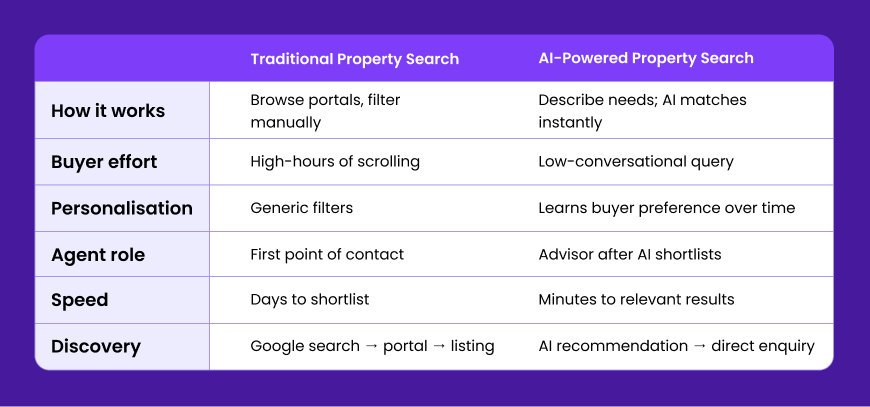
3. Traditional vs AI-Powered Property Search
Here’s how the two approaches differ from the buyer’s perspective – and what that means for how agencies need to position themselves:
“In traditional search, buyers come to you. In AI-powered search, AI decides whether to send buyers to you — or to your competitor.” – PropTech Insights, 2025
4. Why Buyers Are Making This Shift Right Now
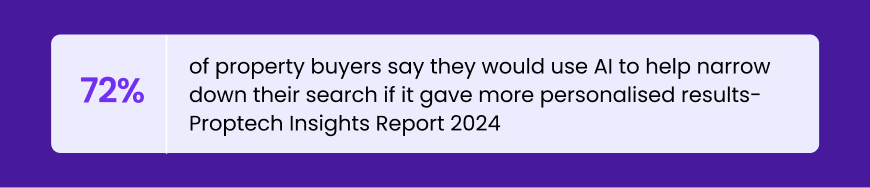
The shift to AI-powered property search isn’t just about technology — it’s about behaviour. Buyers are overwhelmed. The traditional property search process is time-consuming, frustrating, and full of irrelevant results. AI offers something fundamentally better: a conversation.
Think about what a buyer actually wants to say when searching for a property. They don’t want to input “3 bed, £400k–£500k, SW London.” They want to say: “I need a three-bedroom house near outstanding primary schools, within 30 minutes of Waterloo by train, with a garden, ideally quiet – and we’re hoping to move within three months.” That’s the query AI handles naturally. Traditional portals cannot. And that gap – between what buyers want to express and what portals allow them to say – is exactly where AI-powered property search is winning.
Add to this the generational shift: younger buyers, particularly millennials and Gen Z, have grown up with voice search, smart assistants, and AI tools. For them, typing a conversational query into ChatGPT before starting a property search is entirely natural – it’s how they research everything.
5. What This Means for Real Estate Agencies
The implications of AI-powered property search go beyond marketing – they change the entire discovery and consideration phase of the buyer journey.
Your agency’s digital reputation is now your AI ranking
Everything written about your agency online – your blog posts, client testimonials, press mentions, Trustpilot reviews, LinkedIn articles, and local directory listings – becomes training data for AI models. The more consistently positive, credible, and expert your presence is across these channels, the more confidently AI will recommend you when a buyer asks for help.
Niche expertise gets rewarded disproportionately
AI models are particularly good at matching specific queries to specific expertise. An agency that has published detailed content about investment properties in Manchester’s Northern Quarter, or family homes near grammar schools in Surrey, will be far more likely to appear when a buyer asks those exact questions. Broad, generic content no longer cuts through – specificity is the new competitive advantage.
The first-mover window is open – but narrowing
Most real estate agencies have not yet optimised their content or digital presence for LLM visibility. The agencies that act now – building authoritative, AI-friendly content across the right topics – will establish a dominant presence in AI answers before their competitors even realise the game has changed. This window won’t stay open indefinitely.
6. Three Things Your Agency Can Do Today
1. Audit your content for question-based topics
Review your existing blog and website content. Does it directly answer the questions your buyers are typing into AI tools? If not, start creating content that does – neighbourhood guides, school catchment explainers, market condition updates, step-by-step buying guides for specific buyer types. Every piece of content should read like the best answer to a question your ideal buyer would ask an AI.
2. Build your off-site credibility footprint
Make sure your agency is accurately and consistently listed across property directories, local business directories, Google Business Profile, and review platforms. Pursue press mentions in local news and property publications. Appear on relevant podcasts or as a quoted expert in market reports. Each of these signals teaches AI that your agency is a trustworthy, credible authority in your local market.
3. Write for humans first, AI second
The best LLM-optimised content doesn’t try to game an algorithm – it genuinely answers a buyer’s question better than anyone else does. Clear structure, specific local knowledge, honest market insight, and a recognisable brand voice are what both human readers and AI models respond to. If a buyer found your content through AI and read it, would they trust your agency more? That’s the only measure that matters.
Find Out How Visible Your Agency Is to AI Property Search
Why trust Noseberry
Our content is written by practicing real-estate and PropTech professionals, fact-checked by a dedicated editorial team, and reviewed against the latest industry data before publication.
- 10+ years of industry expertise
- All facts independently verified
- No sponsored rankings in guides
- Updated when the industry changes
Related insights
 Real Estate
Smart Home and IoT Integration for Property Operators: Cost, ROI, and What to Build First
This blog breaks down smart home and IoT integration for property operators, covering real costs, real ROI, and exactly what to build first. It walks through actual pricing by portfolio size, from new construction to full enterprise retrofits. It explains where the ROI really comes from, including energy savings data from a major retrofit case study and renter demand statistics. It lays out a staged build order, starting with access control and climate sensors before predictive maintenance, security, and tenant apps. It closes with a data privacy and security checklist, a DIY versus integration partner comparison, and a 10-question FAQ section.
August 24, 2026 Real Estate
What should a PMS do for small-scale property managers?
The ideal PMS for a small-scale property manager (typically 10 to 500 units) should do ten things well: capture every rent payment automatically, log every maintenance ticket with photo evidence and vendor dispatch, hold every tenant lease and document in one searchable place, generate owner and investor statements in one click, run automated rent reminders and late-fee escalation, screen tenants with credit and eviction history, sync with the operator's accounting stack (QuickBooks, Xero), work on mobile so field checks and unit walks happen on a phone, integrate with a website for listing marketing and online applications, and produce broker-visible dashboards that let the manager see occupancy, delinquency, and cash flow at a glance. AppFolio Property Manager Core, Buildium, DoorLoop, Rentec Direct, and Hemlane are the platforms most adopted at this scale in 2026, at $1.40 to $4 per unit per month. This post covers what the ideal PMS should do, which platforms actually deliver it, and how to pick without overpaying.
August 22, 2026 Real Estate
Which AI tools work best for real estate developers in 2026?
The best AI tools for real estate developers in 2026 fall into eight categories that map to the developer lifecycle: land sourcing and site selection (Cherre, Reonomy, HouseCanary, LandGate), feasibility and financial modelling (Northspyre, TestFit, custom Excel plus GPT), design and architectural planning (Autodesk Forma, Higharc, Cove.tool, Snaptrude), construction management and progress tracking (Procore AI, Autodesk Construction Cloud, Buildots, Doxel, OpenSpace), pre-launch marketing and renders (Restb.ai, MidJourney, Adobe Firefly), off-plan sales CRM (Salesforce, HubSpot, Follow Up Boss, Rechat), ESG and net-zero analytics (Measurabl, Enertiv, Aquicore), and handover to operations (BIM AI, tenant portal AI). Used well, they cut construction cost 10 to 20 percent, compress design cycles 30 to 50 percent, and lift off-plan sales conversion 20 to 40 percent. Used badly, they burn subscription budget and produce plans that do not build. This post walks through each category, which tools actually work, and how to sequence adoption.
August 22, 2026
Ready to book a 30-minute strategy call?
We'll map the right digital moves for your real estate business, no pitch deck, no commitment.