
Vijay
Solution Engineer
What software is used for property management?
Published August 11, 2026|11 min read
Property management software in 2026 falls into eight categories that map to distinct portfolio types. Yardi, RealPage, and AppFolio dominate US multifamily. Buildium and Rentec Direct serve SMB and mid-market residential. Cohost, Superhog, Habyt-style operator platforms, and coliving-native tools serve shared-living operators. Hostfully, Guesty, iGMS, and Uplisting serve short-term rental and hospitality. MRI, Yardi Voyager Commercial, and RealPage Commercial serve commercial and mixed-use. AppFolio HOA and Vantaca serve homeowners' associations. RealPage Student and Yardi Voyager Student serve PBSA and student housing. Juniper Square, RealPage IMS, and Yardi Investment Manager serve real estate investment managers. No single platform is best for every operator; the right choice matches your portfolio type, unit count, geography, and integration needs.
What is property management software and why does it matter?
Property management software (PMS) is the operating system for real estate operators managing rental properties at scale. Every lease, every rent payment, every maintenance ticket, every renewal, every eviction, every vendor invoice, every closed-deal reconciliation flows through it. Without a PMS, operators run on spreadsheets and email; with a PMS, they run on structured data that supports reporting, forecasting, and AI-driven optimisation.
The category matters for three reasons in 2026. First, admin load is real: Buildium and NAR data puts property manager time on admin at 30 to 40 percent of the working week. Second, revenue optimisation depends on the platform: AI-driven rent, occupancy, and renewal management inside a modern PMS typically lift stabilised NOI by 2 to 4 percent on mature portfolios. Third, investor and lender reporting increasingly requires the depth of data only a modern PMS produces.
For the deeper selection framework, see our guide on choosing a CRM for real estate agents and brokers (the framework applies similarly to PMS selection) and our companion PropTech trends blog.
Which categories does property management software split into?
Eight categories cover almost every operator's needs in 2026. The right software choice starts with correctly identifying which category the operator belongs to.
Enterprise multifamily and mixed portfolio. Institutional-grade PMS for operators running thousands to hundreds of thousands of units across residential, commercial, coliving, senior, student, and industrial. Yardi Voyager and RealPage OneSite lead this category.
SMB and mid-market residential. Cloud-native, easier-to-onboard PMS for operators running 50 to 5,000 residential units. AppFolio, Buildium, Rentec Direct, and TenantCloud lead this category.
Coliving and shared-living. Specialist platforms serving operators of shared-living, coliving, and community-driven residential formats. Cohost, Superhog, Habyt-native tools, and various operator-built platforms lead this category.
Short-term rental and hospitality. Purpose-built platforms for Airbnb, VRBO, and direct-booking operators. Hostfully, Guesty, iGMS, and Uplisting lead this category.
Commercial and mixed-use. Platforms serving office, retail, industrial, and mixed-use operators. MRI Software, Yardi Voyager Commercial, and RealPage Commercial lead this category.
HOA and community management. Platforms for homeowners' associations and condominium boards. AppFolio HOA, Vantaca, and CINC Systems lead this category.
Student housing and PBSA. Platforms optimised for semester leasing, roommate matching, and university partnerships. RealPage Student and Yardi Voyager Student lead this category.
Real estate investment management. Platforms serving fund managers, REITs, and syndicators handling investor relations, capital calls, distributions, and reporting. Juniper Square, RealPage IMS, and Yardi Investment Manager lead this category.
Which platforms dominate US multifamily?
Three platforms cover the vast majority of institutional US multifamily property management in 2026.
Yardi (Voyager, Breeze). The deepest and most comprehensive PMS on the market. Voyager for enterprise multifamily, commercial, and mixed portfolios; Breeze for smaller operations. Global reach across 80+ countries with native multi-currency and multi-language. High implementation cost (6 to 12 months typical) and high functionality ceiling. Best for operators with mixed portfolios or multi-country footprints.
RealPage (OneSite, YieldStar, AI Revenue Management). Purpose-built for US multifamily. Strongest revenue management stack in the category via YieldStar and AI Revenue Management, though buyers should note the ongoing US Department of Justice antitrust litigation filed in August 2024. Best for pure-play US multifamily operators over 500 units prioritising revenue management.
AppFolio (Property Manager Core, Plus, Max). Cloud-native, easier to adopt, cleaner UX. Property Manager tiers scale from 50 to 15,000+ units. Best for SMB and mid-market residential operators (50 to 5,000 units) prioritising fast onboarding and transparent pricing.
For the full three-way comparison, see our Yardi vs RealPage vs AppFolio comparison page.
What software works best for SMB and mid-market residential?
Four platforms cover most of the SMB and mid-market residential segment in 2026.
AppFolio Property Manager. The category leader. Property Manager Core covers small operators (50 to 500 units); Plus adds AI and workflow tools for mid-market (500 to 5,000 units); Max adds enterprise features. Transparent per-unit pricing starting around $1.40 per unit per month.
Buildium. Owned by RealPage since 2019. Strong for small residential operators (10 to 1,000 units) with pricing starting around $50 per month base. Integrates cleanly with Buildium's own ecosystem plus third-party tools.
Rentec Direct. Popular with small landlords and independent property managers. Pricing scales with unit count from around $45 per month. Best for operators wanting a simple, US-focused platform without the AppFolio price point.
TenantCloud. Freemium option for very small operators (typically under 75 units). Free tier covers basic functionality; paid tiers add advanced automation and integrations. Best fit for individual landlords and micro-portfolios.
The 50-to-5,000-unit segment is the most competitive in 2026 and the segment where fit and TCO matter most; a poorly chosen mid-market PMS costs materially more than a well-configured lower tier.
Which tools serve coliving and shared-living operators?
Coliving and shared-living remain the fastest-growing PropTech vertical, and the software layer is still consolidating in 2026. Off-the-shelf multifamily PMS platforms were built for traditional apartments and do not fit coliving workflows: room-level inventory, community programming, month-to-month leases, and multi-country footprints all require capabilities the generic PMS platforms lack.
Notable platforms include Cohost, Superhog, Habyt's internal platform, Common's operator toolkit, and various regional operators-turned-platform vendors. Several coliving operators run their own bespoke PMS built on top of generic infrastructure (Django, Rails, Next.js) with coliving-native workflows. The category is still fragmenting: expect meaningful consolidation over 2026 to 2028.
For coliving-specific software work, see our coliving software development service and the coliving technology stack guide.
What platforms serve short-term rental and hospitality?
Short-term rental and mid-let hospitality has its own dedicated software category, separate from residential PMS.
Guesty. Enterprise-tier short-let PMS with deep channel management (Airbnb, VRBO, Booking.com), direct-booking website tools, and multi-property operator support. Best for operators of 15 to 1,000+ short-let units.
Hostfully. Property management platform focused on branded direct-booking sites and operator digital brand. Best for operators wanting to reduce channel dependency.
iGMS. Mid-market short-let PMS with strong automation, channel management, and pricing. Popular in North America.
Uplisting. UK and European short-let PMS with growing US presence. Strong on multi-channel calendars and pricing.
Streamline. Enterprise vacation-rental PMS serving larger property-management companies with 100+ vacation properties.
The category has consolidated meaningfully since 2020 (Guesty acquired several competitors) but new challengers continue to emerge in the mid-let and serviced-apartment segment specifically.
Which tools serve commercial and mixed-use operators?
Commercial and mixed-use property management demands different capabilities from residential: multi-tenant lease abstraction, rent-step and CAM calculations, complex commission structures, and asset-level performance analytics.
Yardi Voyager Commercial. The deepest commercial PMS on the market. Covers office, retail, industrial, and mixed-use. Best fit for enterprise operators and REITs.
RealPage Commercial (formerly SkylineWeb). Strong North American commercial coverage with deep integration into the broader RealPage stack.
MRI Software. Enterprise-focused commercial and mixed-portfolio PMS with strong asset management, lease abstraction, and investment reporting. Popular with institutional owners and REITs.
VTS. Not a full PMS but the dominant commercial leasing and asset intelligence platform used alongside Yardi, RealPage, or MRI at institutional operators. Handles pipeline, tenant tracking, and market comparables.
Most institutional commercial operators run VTS on top of Yardi or MRI as a complementary stack rather than as a substitute.
What platforms serve niche categories (HOA, student, senior)?
Four niche categories have dedicated platform leaders.
HOA and community management. AppFolio HOA (formerly WegoWise), Vantaca, CINC Systems, and TOPS (owned by RealPage) lead. Handle board management, dues collection, violation tracking, and community communications.
Student housing and PBSA. RealPage Student and Yardi Voyager Student are the two dominant options. Semester-based booking cycles, roommate matching, and university partnerships are the specialist capabilities. Best fit for operators of 500+ student beds.
Senior housing and assisted living. Yardi Senior, PointClickCare, and MatrixCare lead this category. Deep integration with clinical care records and Medicare/Medicaid reporting sets these platforms apart from standard multifamily PMS.
Single-family rental (SFR). Yardi and RealPage cover institutional SFR at scale. AppFolio serves smaller SFR portfolios. Newer entrants (Doorstead's operator tech, Poplar Homes' internal platform) are beginning to compete on tech-first SFR operator experiences.
How much does property management software cost?
PMS pricing in 2026 clusters into four tiers.
SMB tier ($10 to $100 per month base + $1 to $3 per unit). Rentec Direct, Buildium (small tier), TenantCloud paid tiers. Best for operators under 100 units.
Mid-market tier ($1.40 to $4 per unit per month, or $280 to $900 minimum monthly). AppFolio Property Manager (Core, Plus, Max), Buildium (mid tier). Best for operators 50 to 5,000 units.
Enterprise tier ($3 to $12 per unit per month plus implementation). Yardi Voyager, RealPage OneSite, MRI Software. Best for institutional operators with 500+ units and mixed portfolios.
Specialist and niche tier (varies). Short-let platforms (Guesty, Hostfully): $30 to $200 per property per month. Coliving platforms: negotiated custom pricing. Investment management (Juniper Square, RealPage IMS): typically $500 to $3,000 per month base plus per-user fees.
Total cost of ownership over the first year including implementation ($0 to $500K depending on scale), training ($500 to $50K), data migration ($500 to $50K), and third-party integrations typically runs 2 to 4 times the licence sticker price. Budget for the full TCO at signing, not at renewal.
How do operators choose the right platform?
Six criteria decide fit.
Portfolio type. Multifamily, residential SMB, coliving, short-let, commercial, HOA, student, senior.
Unit count. SMB versus mid-market versus enterprise scale changes the shortlist materially.
Geography. US-only versus multi-country changes which platforms are viable.
Integration needs. Existing CRM, accounting, marketing, IDX, and RESO Web API connectivity.
Implementation capacity. A 6 to 12 month Yardi rollout requires either in-house PMS expertise or a specialist partner.
Total cost of ownership. Licence plus implementation plus training plus integrations plus ongoing add-ons.
The disciplined selection process locks the requirements first, shortlists three platforms, runs a 30-day pilot with real workload, scores each against the same evaluation matrix, and rolls out on a defined 30-day plan. For the full selection framework, see our guide on how to choose a CRM for real estate agents and brokers (the framework applies to PMS selection with obvious adaptations).
Ready to pick the right PMS for your portfolio?
Book a working session with the Noseberry Digitals team. We will audit your portfolio type, unit count, geographic footprint, and integration needs, and hand back a shortlist of the two or three PMS platforms most likely to fit your operation plus a scoped 90-day rollout plan.
- Property management software adoption is universal at institutional scale. Yardi runs over 16 million units globally, RealPage over 19 million in North America, and AppFolio over 8 million (per company reporting). Together they cover most of the US institutional multifamily footprint.
- Property managers spend 30 to 40 percent of their time on admin work, per Buildium and NAR industry surveys. The right PMS reduces that share materially through automation and integration.
- The category is consolidating. Yardi and RealPage keep acquiring specialist platforms; AppFolio has moved upmarket; short-let and coliving-native platforms are the fastest-growing challengers to the incumbents.
- Costs range from $1.40 to $12 per unit per month plus implementation. Total cost of ownership including data migration, training, and integrations typically runs 2 to 4 times the sticker licence fee in year one.
- Portfolio type decides fit more than any other variable. Multifamily operators should not run coliving properties on generic multifamily PMS. Short-let operators should not run stays on residential PMS. Match the software to the workflow.
Why trust Noseberry
Our content is written by practicing real-estate and PropTech professionals, fact-checked by a dedicated editorial team, and reviewed against the latest industry data before publication.
- 10+ years of industry expertise
- All facts independently verified
- No sponsored rankings in guides
- Updated when the industry changes
Frequently Asked Question
What is the best property management software in 2026?
There is no single best. Yardi wins for enterprise and multi-country mixed-portfolio operators. RealPage wins for pure-play US multifamily over 500 units. AppFolio wins for SMB and mid-market residential (50 to 5,000 units). Guesty and Hostfully win for short-let. Cohost and coliving-native platforms win for shared-living. MRI wins for institutional commercial. The right choice depends on portfolio type, unit count, geography, and integration needs.
How much does property management software cost in 2026?
SMB tier is $10 to $100 per month base plus $1 to $3 per unit. Mid-market tier (AppFolio) is $1.40 to $4 per unit per month with $280 to $900 monthly minimums. Enterprise tier (Yardi, RealPage, MRI) is $3 to $12 per unit per month plus implementation costs of $30K to $500K+. Short-let platforms run $30 to $200 per property per month.
Which PMS is best for coliving operators?
Off-the-shelf multifamily PMS platforms rarely fit coliving workflows because they lack room-level inventory, community programming, and multi-country capabilities. Coliving-native platforms (Cohost, Habyt's internal platform, Common's operator toolkit) and custom-built platforms are usually the better fit. The category is still consolidating and expect meaningful M&A activity over 2026 to 2028
Should I choose a real-estate-specific PMS or a general-purpose one?
Almost always real-estate-specific. Off-the-shelf real estate platforms (Yardi, RealPage, AppFolio, MRI) have decade-plus of R&D you cannot replicate on a general-purpose platform. Build custom or configure general-purpose only when your workflow is genuinely non-standard (unique coliving operator, niche short-let format) and every real-estate-specific platform has hit a hard ceiling.
How long does PMS implementation take?
SMB and mid-market platforms (Buildium, AppFolio) typically take 6 to 12 weeks. Enterprise platforms (Yardi Voyager, RealPage OneSite, MRI) typically take 6 to 12 months. Multi-country or mixed-portfolio rollouts extend both. Underinvestment in implementation is the single biggest cause of PMS underperformance; budget appropriately and use a specialist partner where possible.
Related insights
 Real Estate
What should a PMS do for small-scale property managers?
The ideal PMS for a small-scale property manager (typically 10 to 500 units) should do ten things well: capture every rent payment automatically, log every maintenance ticket with photo evidence and vendor dispatch, hold every tenant lease and document in one searchable place, generate owner and investor statements in one click, run automated rent reminders and late-fee escalation, screen tenants with credit and eviction history, sync with the operator's accounting stack (QuickBooks, Xero), work on mobile so field checks and unit walks happen on a phone, integrate with a website for listing marketing and online applications, and produce broker-visible dashboards that let the manager see occupancy, delinquency, and cash flow at a glance. AppFolio Property Manager Core, Buildium, DoorLoop, Rentec Direct, and Hemlane are the platforms most adopted at this scale in 2026, at $1.40 to $4 per unit per month. This post covers what the ideal PMS should do, which platforms actually deliver it, and how to pick without overpaying.
August 22, 2026 Real Estate
Which AI tools work best for real estate developers in 2026?
The best AI tools for real estate developers in 2026 fall into eight categories that map to the developer lifecycle: land sourcing and site selection (Cherre, Reonomy, HouseCanary, LandGate), feasibility and financial modelling (Northspyre, TestFit, custom Excel plus GPT), design and architectural planning (Autodesk Forma, Higharc, Cove.tool, Snaptrude), construction management and progress tracking (Procore AI, Autodesk Construction Cloud, Buildots, Doxel, OpenSpace), pre-launch marketing and renders (Restb.ai, MidJourney, Adobe Firefly), off-plan sales CRM (Salesforce, HubSpot, Follow Up Boss, Rechat), ESG and net-zero analytics (Measurabl, Enertiv, Aquicore), and handover to operations (BIM AI, tenant portal AI). Used well, they cut construction cost 10 to 20 percent, compress design cycles 30 to 50 percent, and lift off-plan sales conversion 20 to 40 percent. Used badly, they burn subscription budget and produce plans that do not build. This post walks through each category, which tools actually work, and how to sequence adoption.
August 22, 2026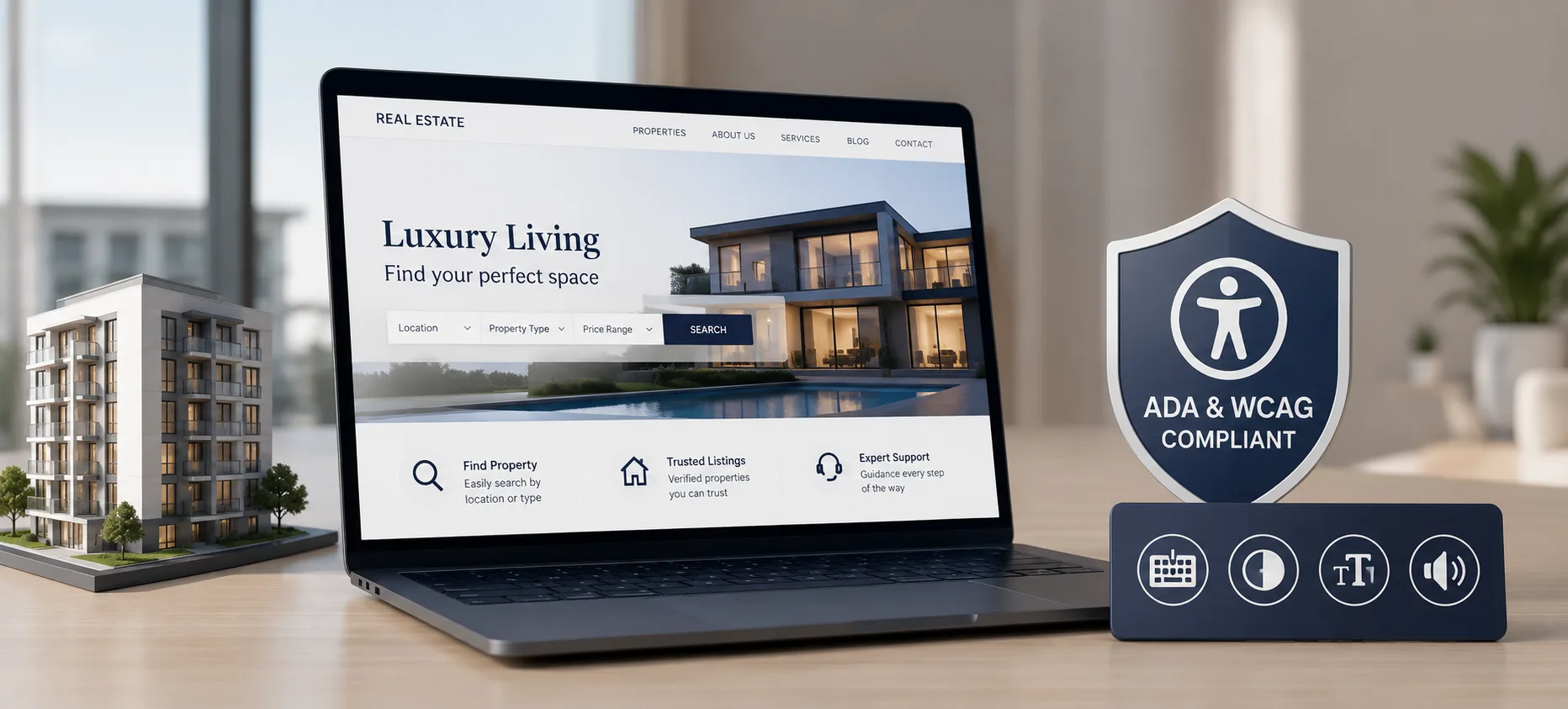 Real Estate
ADA & WCAG Accessibility Compliance for Real Estate Websites: What Operators Must Fix Before They Get Sued
This blog breaks down ADA and WCAG accessibility compliance for real estate websites, focused on what actually creates legal exposure. It explains why WCAG 2.1 Level AA has become the practical legal standard even without a formal Title III regulation for private businesses. It walks through the six accessibility failures responsible for 96% of all detected errors across the web, using real listing-page examples. It also warns against relying on accessibility overlay widgets, citing the FTC's 2025 action against accessiBe over deceptive compliance claims. The piece closes with a step-by-step audit process, an in-house versus compliance-partner comparison, and a 10-question FAQ section.
August 20, 2026
Ready to book a 30-minute strategy call?
We'll map the right digital moves for your real estate business, no pitch deck, no commitment.