

Honey Saxena
Digital Marketing Expert
Does social media work for luxury real estate marketing in 2026?
Published June 15, 2026|10 min read
Yes, social media works for luxury real estate marketing in 2026, but the rules are different from volume residential. Luxury buyers spend an average of 8 to 14 weeks researching online before contacting an agent, and 67 percent of high-net-worth property buyers use Instagram and YouTube as primary discovery channels according to the Knight Frank Wealth Report 2024. The luxury agents producing the strongest results concentrate on three platforms (Instagram, YouTube, and LinkedIn), publish cinematic property content rather than listicle-style posts, and convert 4 to 8 percent of warm followers into closed transactions over an 18 to 24-month window.
Does social media work for luxury real estate marketing?
Yes, but most luxury agents are doing it wrong.
The mistake is treating luxury social media like volume residential social media. A daily Reel of price reductions, a carousel of motivational quotes, or a 30-second walkthrough shot on a phone with shaky framing does not work for luxury buyers. The audience is smaller, more discerning, and more patient. They are looking for cinematic quality, neighbourhood depth, and a sense of who the agent actually is.
Done right, social media is the strongest top-of-funnel discovery channel for luxury real estate in 2026. According to the Knight Frank Wealth Report 2024, 67 percent of high-net-worth property buyers globally use Instagram and YouTube as primary discovery channels when shopping for property above USD 5 million. The agent who does not show up on those channels is invisible to that audience.
The fuller social media playbook for all residential agents lives in our social media marketing for real estate agents guide. The luxury variant covered here applies different platform priorities and a different content standard.
Which social media platforms work best for luxury real estate?
Three platforms drive 90 percent of the luxury real estate social media pipeline in 2026.
The single most important platform for luxury residential marketing globally. Instagram carries the right format mix (Reels for property walkthroughs, carousels for design and architecture detail, Stories for behind-the-scenes operator content) and the right audience density. Roughly 80 percent of NAR members use Instagram as their primary platform, according to the NAR 2025 Member Profile, and the luxury segment skews even higher because the visual platform suits aspirational content.
What works on Instagram for luxury:
60 to 90 second cinematic Reels of single properties
Architecture and design carousels with named architects, designers, and brands
Story takeovers of luxury developments, hotel brands, and lifestyle events
YouTube
The long-term compounding channel. YouTube videos rank in both YouTube and Google search, which means a single 12-minute neighbourhood deep-dive can generate qualified leads for 36 to 60 months. Real estate searches on YouTube grew 56 percent year over year, according to Think with Google's real estate insights, and the luxury segment of those searches grew significantly faster.
What works on YouTube for luxury:
8 to 15 minute property tours with cinematography, ambient sound, and minimal voiceover
Neighbourhood deep dives covering schools, lifestyle, demographics, and historical context
Conversations with architects, interior designers, and luxury developers
The B2B and high-net-worth channel. Underused by most luxury agents, which is exactly why it works for the agents who do invest. LinkedIn carries the decision-makers behind luxury property purchases (founders, executives, fund managers, family office principals) and the format rewards substantive commentary over polished campaigns.
What works on LinkedIn for luxury:
Weekly market commentary with named neighbourhoods and named price movements
Monthly long-form analysis of luxury asset class trends
Personal outreach to decision-makers in your target buyer demographic
What does not work
Facebook. Organic reach is dead, and the demographic skews older and has lower spending power than luxury targets.
TikTok. Works for first-time buyers and rental segments, not for buyers above USD 2 million.
X (formerly Twitter). Useful for industry commentary, not for direct buyer acquisition
What content format works for luxury real estate on social media?
Four content categories produce the bulk of the qualified luxury pipeline.
Cinematic property walkthroughs. A 60 to 90 second Reel or a 5 to 12 minute YouTube tour, shot on a professional camera with stabilisation, with ambient sound and minimal voiceover. Production cost runs from USD 800 to USD 2,500 per property for the right quality. Luxury buyers can tell the difference between phone footage and cinematic footage in the first 3 seconds, and they unfollow the former.
Neighbourhood depth content. A 12-minute YouTube video on Bandra West, a 5-slide Instagram carousel on Knightsbridge, a 1,500-word blog on Palm Jumeirah. Luxury buyers spend 8 to 14 weeks researching the neighbourhood before they research properties. The agent who owns the neighbourhood content owns the conversation.
Designer and architect features. Named architects, designers, and developers are part of the luxury buying decision. Interview content with these figures positions the agent as the connector between buyer and creator. This is what separates a luxury agent from a luxury salesperson.
Market commentary at the asset class level. Monthly or quarterly thoughtful analysis of the luxury segment in your market. What is happening in Dubai branded residences? How Manhattan ultra-luxury is responding to interest rate shifts. What family offices are buying in London versus Singapore? Demonstrate that you understand the asset class, not just the listings.
What does not work in luxury:
Generic price reduction posts
"Just sold" carousels without context
Motivational quotes overlaid on stock photos
Quick walkthrough videos with shaky framing or auto-generated captions
High-volume listicle content like "10 reasons to buy in Mumbai"
How does luxury real estate social media differ from volume residential?
Five structural differences separate luxury social from volume residential social.
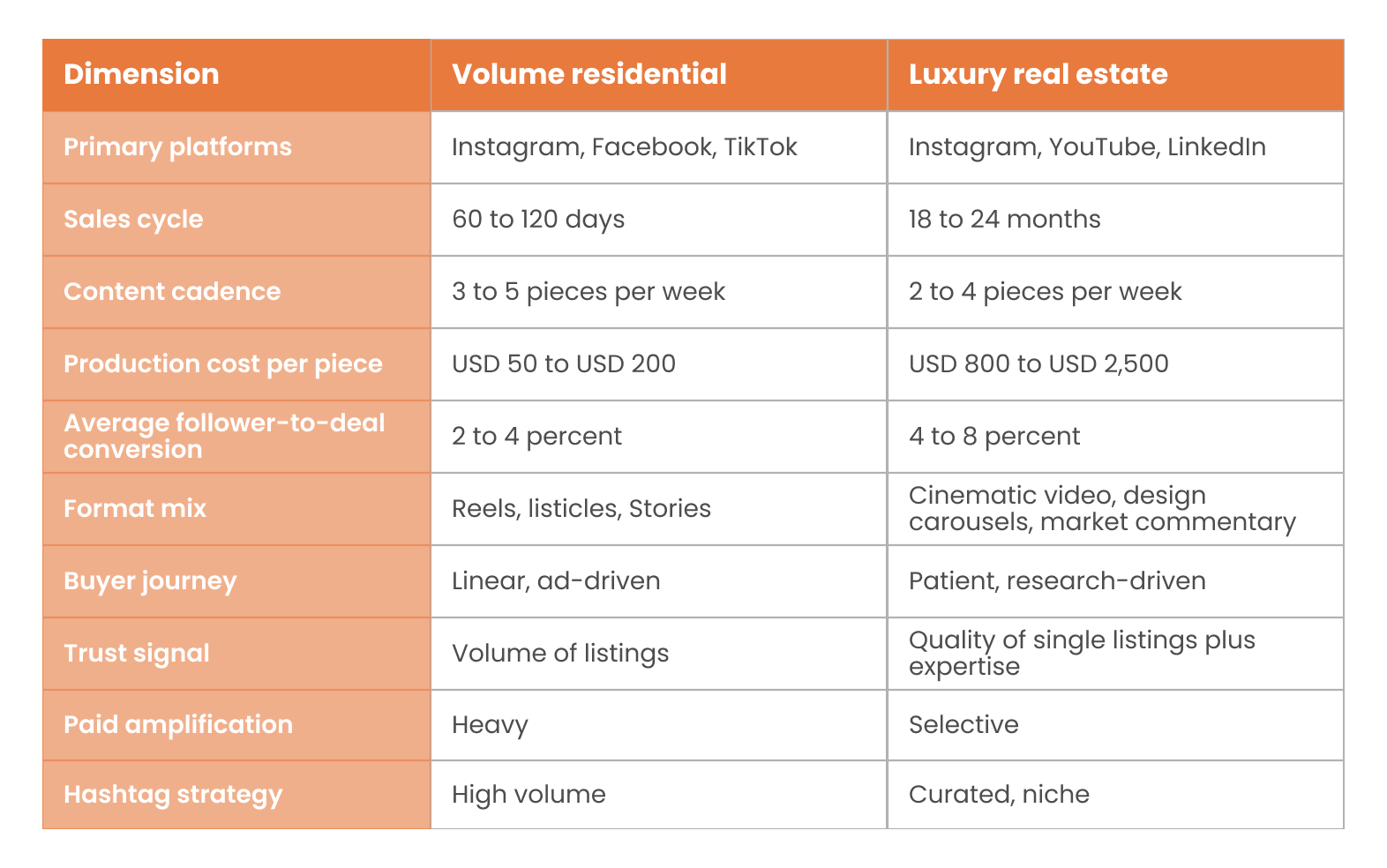
Luxury social rewards depth over volume. A single cinematic walkthrough that took 2 days to produce outperforms 20 quick Reels shot in a week. A single 4,000-word neighbourhood guide outranks 12 listicle blogs on the same topic. The economics work because each closed luxury deal carries 5 to 50 times the commission of a volume residential deal.
What ROI do luxury real estate brokerages actually see from social media?
Based on Noseberry Digitals data across luxury brokerage engagements in Dubai, London, Mumbai, New York, and Singapore, plus industry research from the Knight Frank Wealth Report and Sotheby's International Realty marketing research:
Year 1 ROI for luxury brokerages investing in social media properly:
Cost per qualified luxury lead: USD 200 to USD 800, depending on market
Follower-to-deal conversion: 4 to 8 percent over an 18 to 24-month window
Return on social investment: 3 to 7 times in year one
Brand recall lift: 30 to 50 percent in the target buyer demographic
Year 3 ROI as content compounds:
Cost per qualified luxury lead drops to USD 80 to USD 320
Inbound luxury inquiries from social media become 35 to 55 percent of the total pipeline
Return on social investment climbs to 8 to 15 times
Referral network expansion of 2 to 4 times
The numbers favour luxury social over almost every other channel a luxury agent could invest in, including print, sponsorship of luxury events, and broker-to-broker referral networks. The catch is that luxury social requires patience. Year 1 produces leads but not the compounding asset. Year 3 is when the engine becomes self-sustaining.
How much should luxury real estate agents spend on social media?
The working rule for luxury agents in 2026 is to spend 5 to 10 percent of gross commission income on social media specifically (separate from paid Google or Meta ads).
For a luxury agent earning USD 800,000 a year in gross commission, that translates to USD 40,000 to USD 80,000 per year, or USD 3,500 to USD 6,500 per month. The split inside that budget:
50 percent on content production (videographer, photographer, editor, designer)
25 percent on paid amplification of best-performing organic posts
15 percent on tools (editing software, analytics, scheduling)
10 percent on creator partnerships and brand collaborations
For boutique luxury brokerages of 5 to 25 agents, social media budgets typically run 3 to 5 percent of total gross commission income across the brokerage, plus an additional individual budget that agents fund themselves.
Below USD 2,500 per month per agent, luxury social struggles to produce cinematic quality consistently. Above USD 10,000 per month per agent, diminishing returns kick in unless the agent is expanding into multiple international markets.
What are the common mistakes in luxury real estate social media?
Mistake 1, treating luxury social like volume residential social. Posting daily price drops and motivational quotes erodes the brand. Luxury buyers unfollow agents who post like volume agents.
Mistake 2, prioritising follower count. A luxury agent with 5,000 highly engaged HNW followers consistently outperforms a luxury agent with 80,000 generic followers. Quality of audience determines pipeline, not size.
Mistake 3, skipping production quality. A 60-second Reel shot on iPhone with no stabilisation kills the luxury positioning. Either invest in production or do not post the content.
Mistake 4: no LinkedIn presence. The decision-makers behind luxury purchases (CEOs, founders, family office principals) use LinkedIn far more than Instagram. Skipping LinkedIn cuts the agent off from half the actual buyer pool.
Mistake 5, ignoring referral signals on social. Past clients who comment on posts, tag friends, or share content are flagging warm introductions. Luxury agents who respond to these signals quickly outperform those who treat social as a one-way broadcast.
Mistake 6: No CRM attribution. Without tracking which qualified luxury inquiry came from which platform, the agent cannot prove which content actually produced deals. The companion piece on how to reduce lead leakage in real estate covers the attribution layer that makes this work.
Mistake 7, expecting fast results. Luxury social compounds slowly. Agents who expect a closed deal in month 1 abandon the strategy at month 6, exactly when the compounding starts to show up.
Ready to build a luxury social media programme that compounds?
Share your current platform mix, your average deal size, and your target luxury buyer profile. A 30-minute audit covering platform priority, content format, production budget, and CRM attribution comes back within 5 business days. No commitment, no slides, just a clear view of where the leverage is and what to ship first.
- Luxury real estate social media works, but the platform mix and content format shift toward visual depth (Instagram, YouTube) and B2B credibility (LinkedIn). Facebook and TikTok are largely irrelevant for luxury.
- Cinematic property walkthroughs with restrained editing outperform high-volume listicle content by 3 to 6 times in qualified buyer engagement.
- The luxury sales cycle is 18 to 24 months, much longer than volume residential. Social media in luxury is about building trust slowly, not pushing for immediate inquiries.
- Conversion rates favour luxury social over volume residential social. Luxury agents convert 4 to 8 percent of warm followers into closed transactions, compared with 2 to 4 percent for volume residential.
- Production quality matters more than posting frequency. One cinematic 90 second listing video outperforms 20 quick reels in the luxury segment.
Why trust Noseberry
Our content is written by practicing real-estate and PropTech professionals, fact-checked by a dedicated editorial team, and reviewed against the latest industry data before publication.
- 10+ years of industry expertise
- All facts independently verified
- No sponsored rankings in guides
- Updated when the industry changes
Related insights
 Real Estate
What should a PMS do for small-scale property managers?
The ideal PMS for a small-scale property manager (typically 10 to 500 units) should do ten things well: capture every rent payment automatically, log every maintenance ticket with photo evidence and vendor dispatch, hold every tenant lease and document in one searchable place, generate owner and investor statements in one click, run automated rent reminders and late-fee escalation, screen tenants with credit and eviction history, sync with the operator's accounting stack (QuickBooks, Xero), work on mobile so field checks and unit walks happen on a phone, integrate with a website for listing marketing and online applications, and produce broker-visible dashboards that let the manager see occupancy, delinquency, and cash flow at a glance. AppFolio Property Manager Core, Buildium, DoorLoop, Rentec Direct, and Hemlane are the platforms most adopted at this scale in 2026, at $1.40 to $4 per unit per month. This post covers what the ideal PMS should do, which platforms actually deliver it, and how to pick without overpaying.
August 22, 2026 Real Estate
Which AI tools work best for real estate developers in 2026?
The best AI tools for real estate developers in 2026 fall into eight categories that map to the developer lifecycle: land sourcing and site selection (Cherre, Reonomy, HouseCanary, LandGate), feasibility and financial modelling (Northspyre, TestFit, custom Excel plus GPT), design and architectural planning (Autodesk Forma, Higharc, Cove.tool, Snaptrude), construction management and progress tracking (Procore AI, Autodesk Construction Cloud, Buildots, Doxel, OpenSpace), pre-launch marketing and renders (Restb.ai, MidJourney, Adobe Firefly), off-plan sales CRM (Salesforce, HubSpot, Follow Up Boss, Rechat), ESG and net-zero analytics (Measurabl, Enertiv, Aquicore), and handover to operations (BIM AI, tenant portal AI). Used well, they cut construction cost 10 to 20 percent, compress design cycles 30 to 50 percent, and lift off-plan sales conversion 20 to 40 percent. Used badly, they burn subscription budget and produce plans that do not build. This post walks through each category, which tools actually work, and how to sequence adoption.
August 22, 2026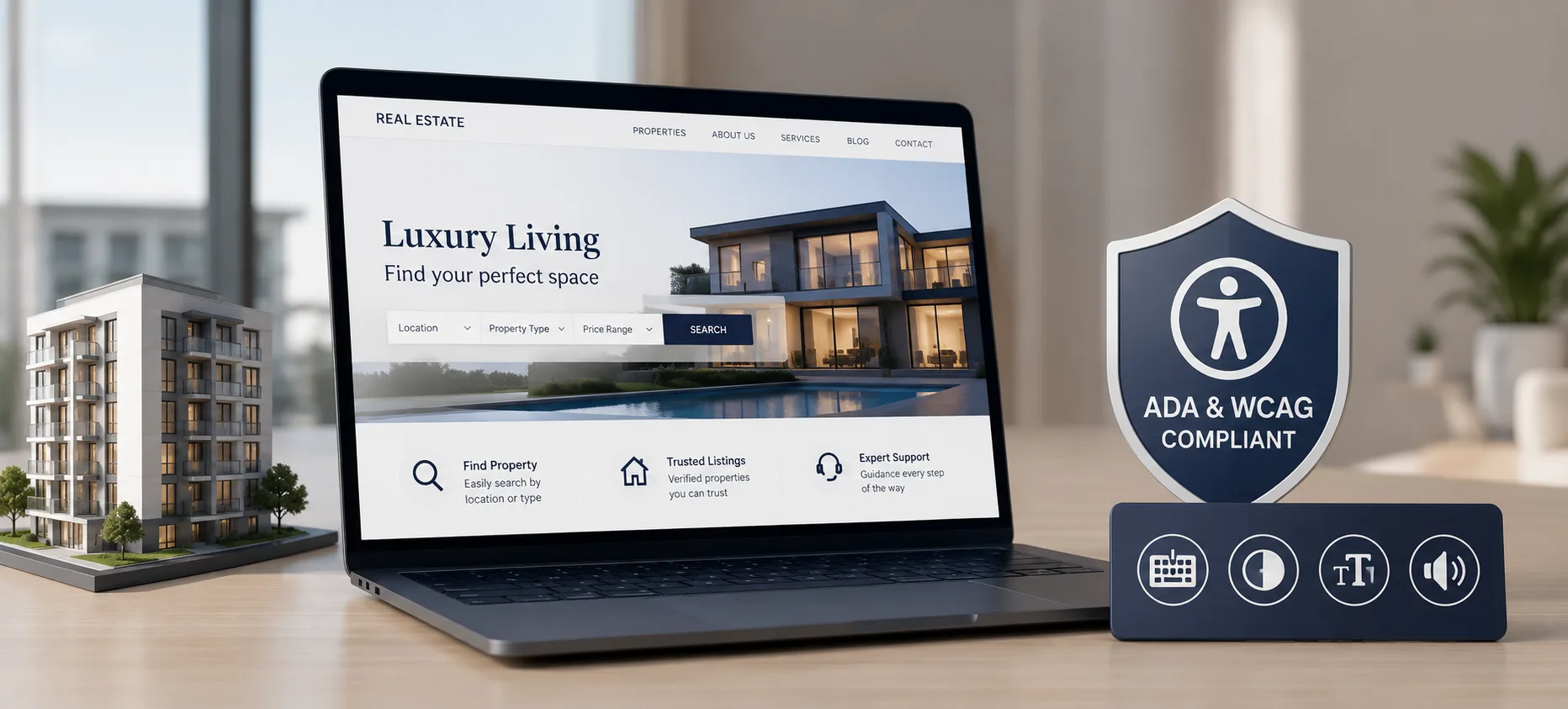 Real Estate
ADA & WCAG Accessibility Compliance for Real Estate Websites: What Operators Must Fix Before They Get Sued
This blog breaks down ADA and WCAG accessibility compliance for real estate websites, focused on what actually creates legal exposure. It explains why WCAG 2.1 Level AA has become the practical legal standard even without a formal Title III regulation for private businesses. It walks through the six accessibility failures responsible for 96% of all detected errors across the web, using real listing-page examples. It also warns against relying on accessibility overlay widgets, citing the FTC's 2025 action against accessiBe over deceptive compliance claims. The piece closes with a step-by-step audit process, an in-house versus compliance-partner comparison, and a 10-question FAQ section.
August 20, 2026
Ready to book a 30-minute strategy call?
We'll map the right digital moves for your real estate business, no pitch deck, no commitment.