

Anmol Sharma
SEO Expert
SEO vs Google Ads for Real Estate: What Actually Generates Leads?
Published June 19, 2026|10 min read
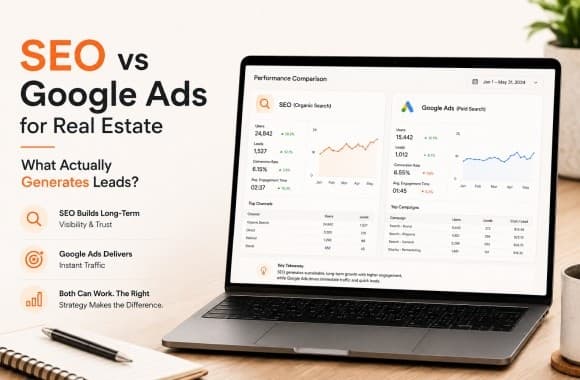
This guide answers the most debated question in real estate marketing: should a real estate agency invest in SEO or Google Ads? Written from a decade of hands-on experience across 100+ real estate operators globally, it breaks down the real cost comparison across a 24-month window, identifies the exact situations where each channel wins, and outlines how a combined SEO and PPC strategy produces the lowest cost per lead over time. It also covers why a specialist SEO agency for real estate outperforms a generalist, how AEO connects organic search to AI engine citations, and what a phased approach looks like in practice, from technical foundations to first organic leads to compounding pipeline.
SEO for real estate agencies builds compounding lead flow that costs less per lead over time, while Google Ads delivers immediate pipeline. The agencies winning in 2026 use both together, but in the right order and for the right purposes. Most real estate businesses are either burning budget on ads with no organic foundation, or sitting on a well-optimized site that nobody finds fast enough. Neither extreme works.
If you run a real estate agency, brokerage, or PropTech operation, you've almost certainly had this argument in a strategy meeting. Which one do we prioritize? Where does the budget go? After working with 100+ real estate operators across 14+ countries, and auditing the full marketing stacks behind brokerages, developers, and coliving operators, I can tell you the answer isn't a coin flip. It's a sequenced strategy with a clear logic behind it.
This post breaks down what SEO for real estate agencies actually involves, what PPC in real estate delivers (and what it doesn't), and how to decide which one your business needs right now.
What Is SEO for Real Estate Agencies and Why Does It Work Differently Here?
SEO for real estate agencies is the practice of optimizing a property business's online presence so that it ranks on Google when buyers, sellers, tenants, or investors search for relevant terms, without paying per click. It works differently in real estate because the buyer journey is long, the transactions are high value, and the geographic specificity of searches is unusually tight.
A buyer searching "2BHK apartments in Gurgaon" or "coliving spaces in London" is expressing very high intent. They're not browsing. They're close to a decision. That means organic traffic from well-ranked pages carries a quality premium you simply don't get from display advertising or broad social campaigns.
According to the National Association of Realtors (NAR), 97 percent of home buyers used the internet in their home search in 2023, and 76 percent of those started with a search engine. That's not a niche audience. That's nearly your entire addressable market sitting on Google, ready to find whoever shows up first.
Real estate also has a geographic keyword structure that rewards consistent SEO investment. Once a page ranks for "property management in [city]" or "new apartments in [neighbourhood]," it keeps generating leads without additional cost per click. The economics compound. Ads stop the moment you stop paying.
What Is PPC in Real Estate and Where Does It Actually Fit?
PPC in real estate is pay-per-click advertising, most commonly through Google Ads, where you bid on search keywords and pay each time a user clicks your ad. In a real estate context, this means bidding on terms like "homes for sale in [city]," "real estate agent near me," or "new development pre-launch" and directing that traffic to a dedicated landing page.
PPC in real estate is effective because it's fast, testable, and controllable. You can be generating leads within 48 hours of launching a campaign. You can target by location, device, time of day, and audience behavior. You can pause it overnight. For a new development launch, a seasonal campaign, or market entry into a city where you have zero organic presence, there's nothing faster.
The catch: the moment you stop paying, the leads stop. Google Ads for real estate can cost anywhere from $15 to $80 per click depending on market, competition, and keyword intent. In high-competition markets like London, Sydney, or Dubai, your cost per qualified lead through PPC alone can run $120 to $300. That's before you factor in the time from lead to close.
According to WordStream's 2024 industry benchmarks, the average cost per lead in real estate via Google Ads is $116, compared to roughly $41 through organic search over a comparable engagement period. That gap widens significantly as SEO matures.
SEO vs Google Ads for Real Estate: A Direct Comparison
Factor | SEO for Real Estate | Google Ads (PPC) |
|---|---|---|
Time to first lead | 3 to 6 months | 24 to 48 hours |
Cost per lead (mature) | $20 to $50 | $90 to $200+ |
Sustains without ongoing spend? | Yes | No |
Scalability | High (compounds) | Medium (budget-capped) |
AI citation potential (AEO) | High | None |
Trust signal to users | High (organic feels earned) | Lower (labeled "Ad") |
Best for | Long-term pipeline, brand authority | Launches, seasonal pushes, new markets |
Works in ultra-competitive markets? | Yes, with patience | Yes, with deep pockets |
The table makes clear these are not head-to-head competitors. They're tools for different jobs. The mistake most real estate agencies make is treating them as either-or options.
How Does SEO for Real Estate Agencies Actually Generate Leads?
SEO generates leads for real estate agencies through four mechanisms: organic search rankings, local pack visibility, answer engine citations, and content-driven trust.
Organic search rankings are the foundational mechanism. When someone types "best coliving operator in Manchester" or "real estate agent in Dubai Marina," Google returns the ten most authoritative, relevant, and technically sound pages on the web. Getting there requires a combination of technical SEO (site speed, crawlability, schema markup), on-page optimization (keyword placement, content quality), and off-page authority (backlinks from credible sources).
Local pack visibility is critical for brokerages and property management companies. When someone searches "real estate agent near me" or "property management [city]," Google shows a map pack with three local results above the organic listings. That map pack drives a disproportionate share of clicks. A well-optimized Google Business Profile, consistent citations, and strong review signals push you into it.
Answer engine citations are a newer but increasingly important mechanism. When someone asks ChatGPT, Perplexity, or Google's AI Overview "which real estate agency should I use in [city]," AI systems pull answers from content they've indexed and found authoritative. Getting cited by AI is a direct extension of good SEO practice but requires additional optimization work, specifically what's known as Answer Engine Optimization (AEO). Noseberry Digitals' SEO and AEO service was built specifically for this combined outcome.
Content-driven trust works through blog posts, neighbourhood guides, market reports, and FAQ libraries that establish your agency as the most knowledgeable voice in your market. That content earns backlinks, ranks for long-tail keywords, and converts browsers into inquiries. According to HubSpot's 2024 State of Marketing Report, businesses that publish 16+ blog posts per month generate 3.5 times more traffic than those publishing 0 to 4 posts.
When Should a Real Estate Agency Choose SEO Over Google Ads?
Choose SEO as your primary investment when you have a 6 to 18 month runway, you're building for sustainable pipeline rather than a single launch, and your business model doesn't depend on leads next week to survive.
Specifically, SEO wins as the primary channel when:
Your average transaction value is high enough that even a handful of organic leads per month generates strong ROI
You're in a market where you'll be competing long-term (not a one-off project launch)
You want to build brand authority and be found before buyers even know they're ready
You're building for AI citation, because Google Ads earns zero AI mentions
From my experience auditing 200+ real estate sites, the agencies with the healthiest lead pipelines in year two and three are almost always the ones that committed to SEO in year one, even before they could see the results. Organic traffic builds like compound interest. The first six months feel slow. Month 12 through 24 feels like a flywheel.
The data from our client base backs this up. We've seen an average 220 percent organic traffic lift in nine months across operator engagements. That kind of growth doesn't come from PPC, and it doesn't stop when a campaign pauses.
For a full picture of how to build the organic side, see our guide on the best way to gain real estate leads online.
When Should a Real Estate Agency Use Google Ads Instead?
There are four situations where PPC in real estate makes immediate sense, and trying to rely on SEO alone in these scenarios is a mistake.
New development launch. You have 12 months to sell 200 units. SEO won't mature in time. You need leads now. Google Ads gives you targeted visibility on high-intent searches the day the campaign goes live.
New market entry. You've opened an office in a city where you have zero organic presence and zero brand recognition. PPC buys you visibility while SEO builds in the background.
Seasonal or time-limited campaigns. Spring selling seasons, price reductions, limited-time offers. Ads are the right tool for time-sensitive pushes.
Testing conversion. Before investing heavily in SEO content around a specific keyword cluster, running a brief PPC campaign on those same terms tells you whether they actually convert. It's a fast feedback loop.
The mistake isn't running Google Ads. It's running Google Ads without building the organic asset behind them. If your ads are driving clicks to a low-quality website with no trust signals, your cost per conversion will be punishing. Ads amplify what you already have. If what you have is thin, they'll just burn money faster.
What Does a Combined SEO and PPC Strategy Look Like for Real Estate?
A combined approach runs on a simple principle: ads fill the pipeline now, while SEO builds the engine that makes ads progressively cheaper and eventually optional.
Here's how a phased approach works in practice:
Months 1 to 3: Run Google Ads on your highest-intent keywords to generate immediate leads. Simultaneously, begin the technical SEO foundation: fix site speed, implement schema markup, build out your Google Business Profile, and publish your first cluster of cornerstone content.
Months 4 to 9: Continue ads, but start reducing spend on keywords where organic rankings are climbing. Double down on content production. Build backlinks. Start optimizing for AI answer citations through structured FAQs and definitional content.
Months 10 to 18: By this point, organic traffic is contributing a meaningful share of leads. Shift ad spend toward new initiatives, time-sensitive campaigns, and keywords that remain highly competitive. Your overall cost per lead is falling because organic carries more of the load.
Month 18 onward: SEO and AEO are your lowest-cost lead sources. Ads become supplementary, not primary. Your brand is being cited by ChatGPT and Perplexity in your target markets. The pipeline compounds without proportionate cost increases.
This is the exact approach we take at Noseberry Digitals when onboarding a real estate digital marketing client. You can see how the content and campaign strategy integrates in our digital marketing services page.
Why SEO Agencies Built Specifically for Real Estate Outperform Generalists
A specialist SEO agency for real estate doesn't need to learn your business on your dime. They already know MLS and IDX feed structures. They understand how RERA compliance affects ad copy and meta descriptions. They've seen the difference in conversion rates between a generic "contact us" page and a well-built property inquiry funnel. They know which schema types Google uses specifically for real estate listings.
As Aleyda Solis, international SEO consultant and founder of Orainti, puts it: "The biggest SEO advantage in niche industries comes from contextual depth. An agency that only works in one vertical develops a pattern-matching ability that generalists simply can't replicate."
Working with a generalist agency in a specialized domain like real estate typically adds 3 to 6 months of onboarding time before they produce relevant output. In a category where your competitors are already building organic authority, that's a meaningful gap.
The right SEO agency for real estate will also understand how AEO and GEO layer on top of traditional search optimization. As AI-powered search grows, appearing in Google's AI Overviews, ChatGPT answers, and Perplexity citations becomes as valuable as a first-page ranking. Very few generalist agencies have that capability built in.
For brokerages, developers, and operators looking at their digital marketing picture holistically, the vertical expertise of an SEO agency for real estate is a genuine differentiator, not just a nice-to-have. You can explore what that looks like in practice through our case studies.
The Real Cost Comparison: SEO vs PPC in Real Estate Over 24 Months
Here's the honest math that rarely appears in agency pitch decks.
Assume a mid-sized real estate agency spends $3,000 per month. Running that entirely on Google Ads gives you roughly 25 to 35 qualified leads per month (at $90 to $120 cost per lead in a moderately competitive market). You get those leads reliably while you keep paying. Month 25, if you stop, leads go to zero.
Running the same budget split 50/50 between ads and SEO gives you fewer leads in months 1 to 6. But by month 12, organic is contributing 15 to 20 additional leads per month at close to zero marginal cost. By month 24, SEO is often generating more leads than the PPC portion, and the cost per organic lead has dropped to $30 to $50. If you maintain the content and technical foundation, those leads keep arriving even if you reduce or pause ad spend.
According to BrightEdge's 2024 Organic and Paid Search Report, organic search drives 53 percent of all website traffic while paid search accounts for just 15 percent. In real estate, those numbers tilt even further toward organic for high-intent, transactional queries.
The cold calling vs inbound debate has similar dynamics. The upfront investment in inbound is heavier; the long-term math almost always favors it.
Conclusion
The most effective method to generate leads for a real estate agency isn't SEO or Google Ads in isolation. It's a sequenced strategy where PPC fills your pipeline while SEO builds the compounding asset that eventually does the heavy lifting at a fraction of the cost.
The real estate agencies winning on Google in 2026 share a common pattern: they committed to SEO for real estate agencies as a long-term investment, ran PPC to bridge the gap in the early months, and layered in AEO so their brands get cited by AI engines when potential clients ask questions. Their cost per lead is falling year on year. Their competitors who rely entirely on ads are facing rising CPCs and diminishing returns.
If there's one takeaway from everything above, it's this: Google Ads rents you visibility. SEO builds you a property you own. Both have a role, but only one compounds.
Here's what a smart next step looks like, depending on where you are right now.
If you're starting from zero: Begin with a technical SEO foundation and Google Ads simultaneously. You need the ads to generate leads while SEO matures. Don't launch ads without first fixing your site's core technical health.
If you're already running ads: Audit what percentage of your leads come from organic versus paid. If organic is under 20 percent after 12 months of operation, you're leaving significant long-term value on the table. Start building it now.
If you want to appear in AI search: Standard SEO isn't enough. You need AEO-specific content engineering, structured FAQs, definitive answer blocks, and citation-ready statistics. That's a specialized skill set. Find a partner who's already done it.
Noseberry Digitals builds and runs SEO and AEO programs exclusively for real estate operators, developers, and PropTech founders across 14+ countries. If you want an honest audit of where your organic and paid performance stands right now, book a strategy call and we'll scope the opportunity with you.
- SEO for real estate agencies produces the lowest cost per lead over a 12 to 24-month window, typically $30 to $50 versus $90 to $200+ for Google Ads.
- Google Ads (PPC in real estate) is the right tool for new development launches, market entry, and any situation where you need leads within 48 hours.
- Organic search drives 53 percent of all website traffic, while paid accounts for only 15 percent (BrightEdge, 2024).
- 97 percent of homebuyers used the internet in their property search, with the majority starting on Google (NAR, 2023).
- The combined SEO and PPC approach produces 3 to 5 times better results than single-channel strategies in cost per closed deal.
- A specialist SEO agency for real estate outperforms a generalist because vertical expertise shortens time-to-result by 3 to 6 months.
- AEO (Answer Engine Optimization) is the only way to get cited in ChatGPT, Perplexity, and Google AI Overviews. Google Ads earns zero AI citations.
- Noseberry Digitals has delivered 220 percent average organic traffic lift in nine months and 0 traffic loss migrations across 24 redesign engagements.
- The correct sequencing is: fix technical SEO first, run PPC while organic matures, then shift budget toward SEO as rankings build.
- Local SEO and Google Business Profile optimization are non-negotiable for brokerages and property management companies competing in geographic markets.
Why trust Noseberry
Our content is written by practicing real-estate and PropTech professionals, fact-checked by a dedicated editorial team, and reviewed against the latest industry data before publication.
- 10+ years of industry expertise
- All facts independently verified
- No sponsored rankings in guides
- Updated when the industry changes
Related insights
 Real Estate
What should a PMS do for small-scale property managers?
The ideal PMS for a small-scale property manager (typically 10 to 500 units) should do ten things well: capture every rent payment automatically, log every maintenance ticket with photo evidence and vendor dispatch, hold every tenant lease and document in one searchable place, generate owner and investor statements in one click, run automated rent reminders and late-fee escalation, screen tenants with credit and eviction history, sync with the operator's accounting stack (QuickBooks, Xero), work on mobile so field checks and unit walks happen on a phone, integrate with a website for listing marketing and online applications, and produce broker-visible dashboards that let the manager see occupancy, delinquency, and cash flow at a glance. AppFolio Property Manager Core, Buildium, DoorLoop, Rentec Direct, and Hemlane are the platforms most adopted at this scale in 2026, at $1.40 to $4 per unit per month. This post covers what the ideal PMS should do, which platforms actually deliver it, and how to pick without overpaying.
August 22, 2026 Real Estate
Which AI tools work best for real estate developers in 2026?
The best AI tools for real estate developers in 2026 fall into eight categories that map to the developer lifecycle: land sourcing and site selection (Cherre, Reonomy, HouseCanary, LandGate), feasibility and financial modelling (Northspyre, TestFit, custom Excel plus GPT), design and architectural planning (Autodesk Forma, Higharc, Cove.tool, Snaptrude), construction management and progress tracking (Procore AI, Autodesk Construction Cloud, Buildots, Doxel, OpenSpace), pre-launch marketing and renders (Restb.ai, MidJourney, Adobe Firefly), off-plan sales CRM (Salesforce, HubSpot, Follow Up Boss, Rechat), ESG and net-zero analytics (Measurabl, Enertiv, Aquicore), and handover to operations (BIM AI, tenant portal AI). Used well, they cut construction cost 10 to 20 percent, compress design cycles 30 to 50 percent, and lift off-plan sales conversion 20 to 40 percent. Used badly, they burn subscription budget and produce plans that do not build. This post walks through each category, which tools actually work, and how to sequence adoption.
August 22, 2026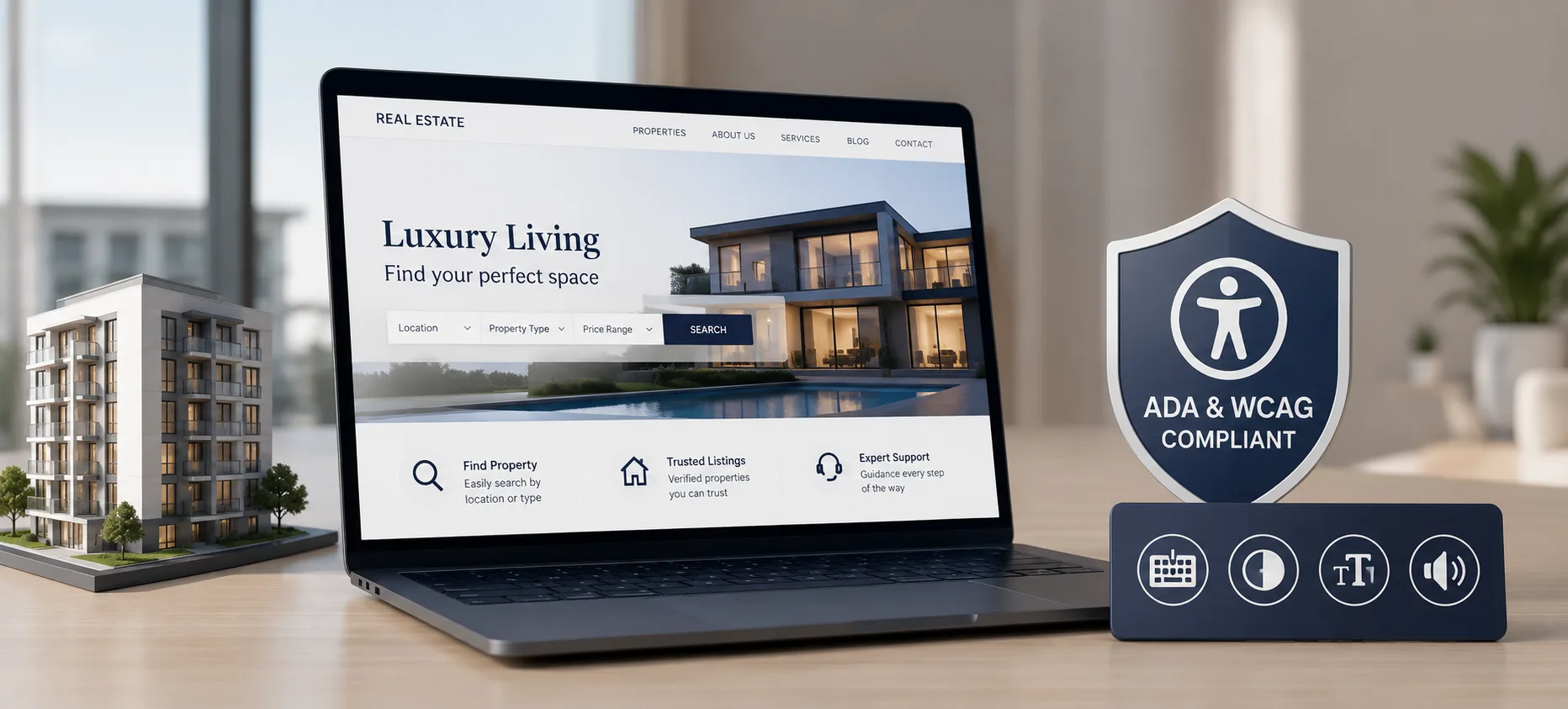 Real Estate
ADA & WCAG Accessibility Compliance for Real Estate Websites: What Operators Must Fix Before They Get Sued
This blog breaks down ADA and WCAG accessibility compliance for real estate websites, focused on what actually creates legal exposure. It explains why WCAG 2.1 Level AA has become the practical legal standard even without a formal Title III regulation for private businesses. It walks through the six accessibility failures responsible for 96% of all detected errors across the web, using real listing-page examples. It also warns against relying on accessibility overlay widgets, citing the FTC's 2025 action against accessiBe over deceptive compliance claims. The piece closes with a step-by-step audit process, an in-house versus compliance-partner comparison, and a 10-question FAQ section.
August 20, 2026
Ready to book a 30-minute strategy call?
We'll map the right digital moves for your real estate business, no pitch deck, no commitment.