

Honey Saxena
Digital Marketing Expert
25 AI Use Cases for Real Estate Operators in 2026
Published June 22, 2026|12 min read

This guide lists 25 AI use cases for real estate operators in 2026, grouped by leasing, resident experience, maintenance, finance, and portfolio intelligence. It pairs each group with real savings data from Deloitte, JLL, PwC, and McKinsey, then shows which use cases pay back fastest. You will get a simple four-point filter to rank your options and a clear starting plan. The goal is focus: pick a few high-payback use cases and rebuild the workflow around them.
The top AI use cases for real estate operators in 2026 cluster around five jobs: filling units faster, keeping residents happy, cutting maintenance cost, automating the back office, and reading the portfolio in real time. The highest-payback use cases right now are invoice automation, AI leasing assistants, dynamic pricing, and predictive maintenance. Each one solves a daily operational pain, not a far-off vision.
Operators are not short on ideas. They are short on focus. Deloitte's 2026 commercial real estate outlook found 76% of CRE firms exploring or implementing AI, yet JLL research shows only about 5% have hit most of their program goals. I have walked operators through this gap many times, and the pattern is always the same: too many pilots, too little workflow change. This guide lists 25 proven use cases, grouped by the part of your operation they fix, so you can pick the few that matter and skip the noise.
What counts as an AI use case for real estate operators?
An AI use case for real estate operators is any task where software analyzes data or automates a workflow to cut cost, save time, or lift revenue. It earns its place because it ties to a number you already track, like occupancy, cost per work order, or days to lease. If it does not move a metric, it is a demo, not a use case.
Operators sit in a different seat than agents. You manage assets, residents, and budgets at scale, so your best use cases reduce repeat work across hundreds of units. The theme for 2026 is moving from single tools to connected workflows that hand off to each other automatically.
How much can AI actually save real estate operators?
AI can cut operational costs by 15% to 30% for real estate operators, depending on scope. Most 2026 case studies show 15% to 25% savings on accounts payable automation alone, with broader programs reaching 20% to 30% over a few years. McKinsey reports firms gaining 10% or more in net operating income from AI-driven operations.
The savings come from removing manual hours, not magic. When AI handles invoice coding, lease abstraction, and first-line resident chat, your team stops doing low-value tasks. Early adopters report 15% to 20% ROI, according to PwC and Deloitte CRE research. The trick is picking use cases with high volume and clear rules, since those automate cleanest.
25 AI use cases for real estate operators, grouped by function
Here are the 25 use cases that real operators are deploying in 2026, organized by the part of the business they improve.
Leasing and occupancy
AI leasing assistants that answer prospect questions and book tours 24/7.
Dynamic rent pricing that adjusts rates daily by demand and seasonality.
AI virtual tours that let renters walk a unit before visiting in person.
Lead scoring that ranks prospects by likelihood to sign.
Renewal prediction that flags at-risk residents before they leave.
Resident experience
24/7 resident chatbots for lease questions and service requests.
Maintenance request triage that routes and prioritizes tickets automatically.
Sentiment analysis that reads resident feedback to catch problems early.
Smart home controls that manage access, climate, and energy per unit.
Automated move-in and move-out scheduling and checklists.
Maintenance and facilities
Predictive maintenance that forecasts equipment failure before it happens.
Work-order automation that assigns the right vendor at the right time.
Energy optimization that trims utility waste across a portfolio.
Vendor management that scores and selects contractors by performance.
Computer-vision inspections that flag damage from photos and video.
Finance and back office
Invoice and AP automation, the highest-volume operational win.
Lease abstraction that pulls structured data from messy lease documents.
Delinquency prediction that flags likely late payers early.
Budget forecasting that models expenses against occupancy scenarios.
Application fraud detection that spots fake pay stubs and IDs.
Asset and portfolio intelligence
Conversational portfolio dashboards you can query in plain English.
Acquisition underwriting that stress-tests deals in minutes.
Occupancy and demand forecasting across markets.
ESG and energy reporting that automates compliance data.
Capex and generative design planning for renovations and new builds.
You do not need all 25. Pick the three that touch your biggest cost or your slowest workflow, and start there.
Which AI use cases should operators prioritize first?
Operators should prioritize high-volume, rule-based use cases first, because those automate cleanest and pay back fastest. Invoice automation, AI leasing chat, and dynamic pricing top most 2026 lists. They hit cost, revenue, and labor at once, and they need little custom building to launch.
Use this quick filter to rank your options:
Volume: Does the task repeat hundreds of times a month?
Rules: Is the logic clear enough to automate?
Metric: Can you measure the result against today's baseline?
Data: Is the data clean enough to feed the model?
If a use case scores high on all four, fund it first. In my experience auditing operator portfolios, the back-office wins (AP and lease abstraction) almost always beat the flashier ones on speed to payback. Boring automation makes the most money.
AI use cases by impact: a quick comparison
This table shows where each major use case delivers and how fast it tends to pay back.
Use case | Main benefit | Typical impact | Payback speed |
Invoice and AP automation | Lower labor cost | 15-25% cost cut | Fast |
AI leasing assistant | Faster lead response | 90%+ faster replies | Fast |
Dynamic rent pricing | Higher revenue | Better occupancy and rate | Medium |
Predictive maintenance | Fewer breakdowns | 30%+ time saved on tasks | Medium |
Renewal prediction | Retention | 3-7% renewal lift | Medium |
Agentic AI, where systems chain these steps together, pushes results further. McKinsey notes that coordinating agents across a full workflow can improve outcomes like NOI and cycle times by 10%, 20%, or 30%.
What stops operators from getting value from AI?
The main blocker is treating AI as a tool purchase instead of a workflow change. JLL found 92% of CRE teams piloting AI but only about 5% achieving most goals. Buying software is easy. Redesigning the process around it, and cleaning the data it runs on, is the hard work that creates value.
Three issues sink most programs: dirty data, too many disconnected pilots, and no owner accountable for results. Fix those and adoption follows. As McKinsey puts it, generative AI can change real estate, "but the industry must change to reap the benefits." Treat that line as a checklist, not a slogan. Our AI readiness assessment and proptech strategy resources walk through the fix.
The bottom line on AI use cases for real estate operators
The key takeaway is that the best AI use cases for real estate operators in 2026 are the unglamorous, high-volume ones, like invoice automation, leasing chat, and dynamic pricing, that tie directly to a metric you already track. Start with three, prove the savings, then connect them into agentic workflows.
Your next step: list your three slowest or most expensive workflows this week. Score each against volume, rules, metric, and data quality. Then fund the one that scores highest with a short, measurable pilot. That focus is what separates the 5% who hit their goals from the 95% stuck in pilot mode.
Do not let a 25-item list pressure you into doing everything. The operators winning in 2026 are not running the most pilots. They are the ones who picked a few high-payback use cases, cleaned their data, and rebuilt the workflow around them. Spend small, measure honestly, and let results decide what comes next. Want help ranking your options? Explore our AI for real estate operators services and book a strategy call.
- The best AI use cases for real estate operators are high-volume, rule-based, and metric-linked.
- 76% of CRE firms are exploring or implementing AI (Deloitte 2026), but only ~5% hit most goals (JLL).
- AI can cut operational costs 15% to 30%; AP automation alone saves 15% to 25%.
- The 25 use cases span leasing, resident experience, maintenance, finance, and portfolio intelligence.
- Invoice automation, leasing chat, dynamic pricing, and predictive maintenance pay back fastest.
- Agentic AI chains steps together and can lift NOI and cycle times 10% to 30% (McKinsey).
- Dirty data and disconnected pilots are the top reasons programs stall.
- Start with three high-payback use cases, prove savings, then connect them.
Why trust Noseberry
Our content is written by practicing real-estate and PropTech professionals, fact-checked by a dedicated editorial team, and reviewed against the latest industry data before publication.
- 10+ years of industry expertise
- All facts independently verified
- No sponsored rankings in guides
- Updated when the industry changes
Frequently Asked Questions
What are the best AI use cases for real estate operators in 2026?
The best AI use cases for real estate operators in 2026 are invoice and AP automation, AI leasing assistants, dynamic rent pricing, and predictive maintenance. These hit cost, revenue, and labor at once. They are high-volume and rule-based, so they automate cleanly and pay back fast, often within the first year of deployment.
How much money can AI save a real estate operator?
AI can save real estate operators 15% to 30% on operational costs, depending on scope. Accounts payable automation alone typically cuts 15% to 25%. McKinsey reports firms gaining 10% or more in net operating income from AI-driven operations. Savings come from removing manual hours on repetitive tasks like invoicing and lease data entry.
Which AI use case should operators start with first?
Operators should start with a high-volume, rule-based task like invoice automation or AI leasing chat. These score well on volume, clear rules, measurable results, and data readiness, which makes them automate cleanly. Starting with a back-office win usually beats flashier projects because it pays back faster and builds team trust in AI.
What is the difference between AI tools and agentic AI for operators?
AI tools handle one task, like drafting a listing, while agentic AI chains multiple steps across systems with little supervision. Agentic systems can triage a maintenance ticket, assign a vendor, and update the resident automatically. McKinsey notes full-workflow agentic coordination can improve outcomes like NOI and cycle times by 10% to 30%.
Why do most real estate AI projects fail to deliver value?
Most real estate AI projects fail because firms buy tools without changing the workflow or cleaning the data. JLL found 92% of CRE teams piloting AI but only about 5% hitting most goals. The fix is process redesign, a clear owner, and clean data. Adoption without workflow change rarely produces measurable savings.
Can small real estate operators use AI, or is it only for enterprises?
Small operators can absolutely use AI. Many leasing chatbots, pricing tools, and AP automation platforms offer affordable per-unit or per-user pricing. You do not need an enterprise budget to automate one workflow. Start with a single high-volume task, prove the savings on a small portfolio, then scale to more units and use cases.
How does AI improve resident retention for operators?
AI improves retention by predicting which residents are likely to leave and flagging them for early outreach. Renewal-prediction models analyze payment history, service requests, and engagement to score risk. Early implementations show renewal-rate gains of 3% to 7%. Faster maintenance response and 24/7 support also raise satisfaction, which directly supports retention.
Related insights
 Real Estate
What should a PMS do for small-scale property managers?
The ideal PMS for a small-scale property manager (typically 10 to 500 units) should do ten things well: capture every rent payment automatically, log every maintenance ticket with photo evidence and vendor dispatch, hold every tenant lease and document in one searchable place, generate owner and investor statements in one click, run automated rent reminders and late-fee escalation, screen tenants with credit and eviction history, sync with the operator's accounting stack (QuickBooks, Xero), work on mobile so field checks and unit walks happen on a phone, integrate with a website for listing marketing and online applications, and produce broker-visible dashboards that let the manager see occupancy, delinquency, and cash flow at a glance. AppFolio Property Manager Core, Buildium, DoorLoop, Rentec Direct, and Hemlane are the platforms most adopted at this scale in 2026, at $1.40 to $4 per unit per month. This post covers what the ideal PMS should do, which platforms actually deliver it, and how to pick without overpaying.
August 22, 2026 Real Estate
Which AI tools work best for real estate developers in 2026?
The best AI tools for real estate developers in 2026 fall into eight categories that map to the developer lifecycle: land sourcing and site selection (Cherre, Reonomy, HouseCanary, LandGate), feasibility and financial modelling (Northspyre, TestFit, custom Excel plus GPT), design and architectural planning (Autodesk Forma, Higharc, Cove.tool, Snaptrude), construction management and progress tracking (Procore AI, Autodesk Construction Cloud, Buildots, Doxel, OpenSpace), pre-launch marketing and renders (Restb.ai, MidJourney, Adobe Firefly), off-plan sales CRM (Salesforce, HubSpot, Follow Up Boss, Rechat), ESG and net-zero analytics (Measurabl, Enertiv, Aquicore), and handover to operations (BIM AI, tenant portal AI). Used well, they cut construction cost 10 to 20 percent, compress design cycles 30 to 50 percent, and lift off-plan sales conversion 20 to 40 percent. Used badly, they burn subscription budget and produce plans that do not build. This post walks through each category, which tools actually work, and how to sequence adoption.
August 22, 2026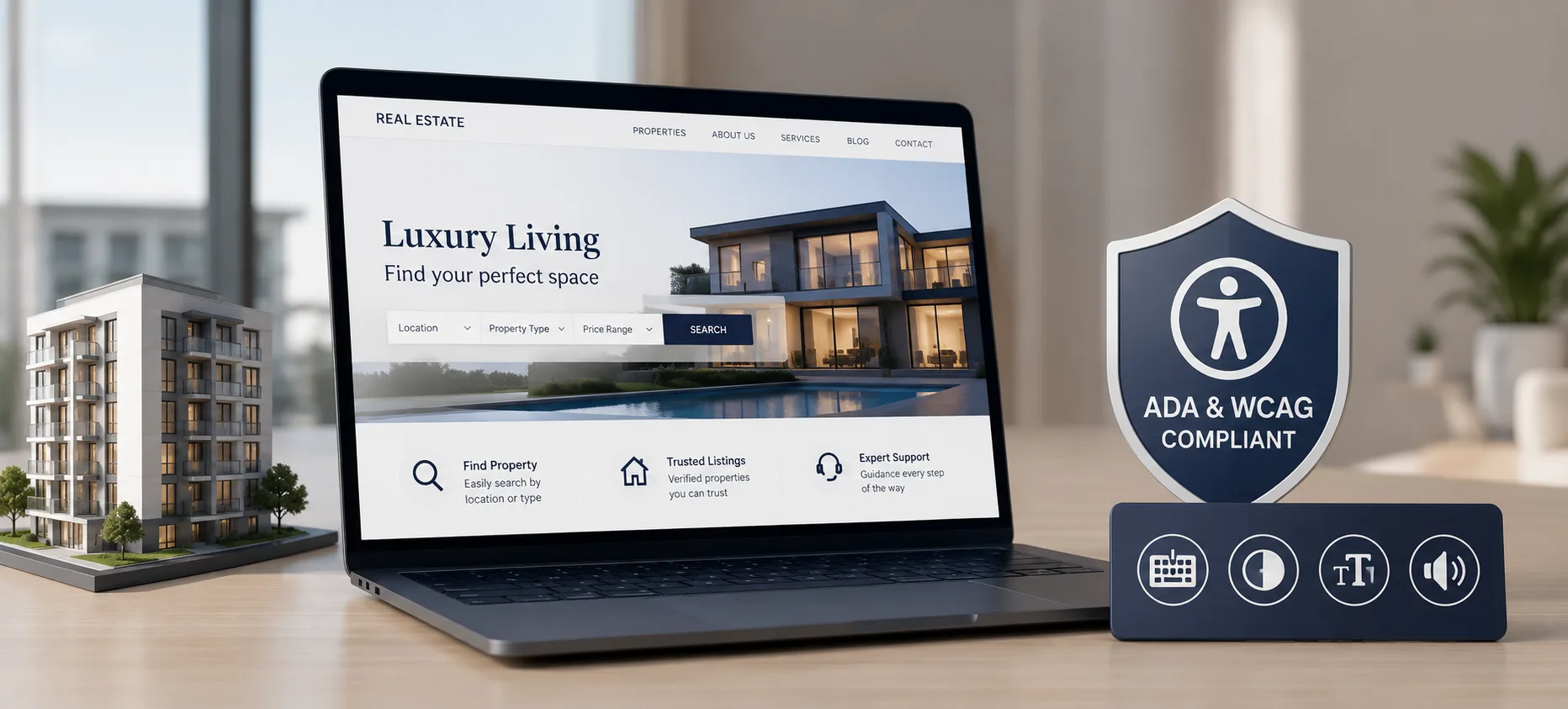 Real Estate
ADA & WCAG Accessibility Compliance for Real Estate Websites: What Operators Must Fix Before They Get Sued
This blog breaks down ADA and WCAG accessibility compliance for real estate websites, focused on what actually creates legal exposure. It explains why WCAG 2.1 Level AA has become the practical legal standard even without a formal Title III regulation for private businesses. It walks through the six accessibility failures responsible for 96% of all detected errors across the web, using real listing-page examples. It also warns against relying on accessibility overlay widgets, citing the FTC's 2025 action against accessiBe over deceptive compliance claims. The piece closes with a step-by-step audit process, an in-house versus compliance-partner comparison, and a 10-question FAQ section.
August 20, 2026
Ready to book a 30-minute strategy call?
We'll map the right digital moves for your real estate business, no pitch deck, no commitment.