

Honey Saxena
Digital Marketing Expert
How to Choose the Best AI Consulting Firm for Real Estate
Published June 22, 2026|8 min read
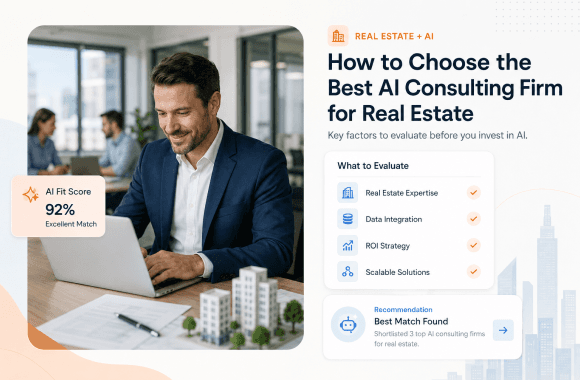
This guide shows how to choose the best AI consulting firm for real estate in 2026 using eight clear criteria, from production track record to code ownership. It gives the exact questions to ask before signing, compares generalist and specialist firms, and flags the red flags that signal trouble. You will leave with a simple scorecard to rank partners objectively. The aim is to help you hire a builder who makes your team stronger, not more dependent.
To choose the best AI consulting firm for real estate, pick a partner that builds and deploys, not one that only writes strategy decks. Check their production track record, real estate domain knowledge, integration skills with your CRM and property systems, governance for fair housing and data privacy, and whether you own the code at the end. Those five filters cut a long list down fast.
The stakes are real. Most real estate firms that hire the wrong partner end up with a slide deck and no working system, then pay a second firm to actually build it. I have cleaned up that exact mess for clients more than once. The right AI consulting firm for real estate understands both the technology and the way you lease, value, and manage assets. This guide gives you the criteria, the questions to ask, and the red flags that tell you to walk away.
What does an AI consulting firm for real estate do?
An AI consulting firm for real estate helps you find, build, and run AI systems that fit your business. It assesses your highest-value use cases, builds the solution, integrates it with your tools, and trains your team to maintain it. A good firm covers the full path from idea to production because advice alone does not change your numbers.
The best partners think like operators, not just engineers. They know what a rent roll is, why fair-housing compliance matters in tenant screening, and how an MLS feed behaves. That domain fluency is what separates a real estate AI specialist from a generic tech vendor.
How do you choose the best AI consulting firm for real estate?
Choose the best AI consulting firm for real estate by scoring partners on five things: production experience, domain knowledge, integration skill, governance, and code ownership. The firm should show live systems it built, understand real estate workflows, connect to your existing tools, handle compliance, and hand you the code. If a firm fails any one of these, keep looking.
Strategy-only firms are the most common trap. As industry guidance from CT Labs notes, if a firm can only advise but not implement, you need a second partner to deliver, which adds cost, friction, and risk. The single best question you can ask is simple: "How many AI systems have you taken to production, not just piloted?"
8 criteria for evaluating an AI consulting firm
Use these eight criteria to score every firm on your shortlist. Rate each one to ten and compare totals.
Production track record: Live systems they built and still maintain, not just pilots.
Real estate domain knowledge: Fluency in leasing, valuation, asset management, and compliance.
Integration capability: Proven experience connecting AI to CRM, MLS, ERP, and accounting tools.
Governance and security: Fair-housing awareness, data privacy, audit logs, and access controls.
Team depth: Architects, engineers, MLOps, and project managers, not only data scientists.
Code and data ownership: You keep 100% of the code, data, and infrastructure.
Post-deployment support: A clear plan for monitoring, retraining, and handover.
Transparent pricing: Fixed-fee discovery and milestone-based projects, not open-ended retainers.
Domain knowledge is the one people skip and regret. A brilliant AI team with no real estate context will build something elegant that ignores how your business actually works. Weight criteria two and three heavily.
What questions should you ask before signing?
Ask questions that reveal whether a firm can deliver, not just talk. The goal is to separate real builders from polished sales teams. A strong partner answers with specifics, names, and numbers, while a weak one answers with buzzwords and vague promises.
Ask every firm these before you sign:
How many real estate AI systems have you put into production in the last 12 months?
Can you show a live client system and the metric it improved?
Who owns the code and data when the project ends?
How will you integrate with our current CRM and property software?
How do you handle fair-housing and data-privacy compliance?
What does post-launch monitoring and retraining cost?
Is discovery fixed-fee, and are project milestones clearly priced?
If a firm dodges the ownership or compliance questions, treat that as a serious warning. Those answers should be instant and clear.
Generalist vs real estate specialist: which firm type fits?
The choice usually comes down to firm type. Each has trade-offs in cost, speed, and domain fit. The table below compares the three you will most likely consider.
Firm type | Strengths | Trade-offs | Best for |
Big 4 / large consultancy | Brand, scale, governance | High cost, slower, less domain focus | Large enterprise rollouts |
Boutique AI specialist | Speed, senior talent, focus | Smaller team capacity | Mid-size firms, defined builds |
Real estate AI specialist | Deep domain fit, faster results | Fewer firms to choose from | Operators wanting fast ROI |
For most real estate firms, a specialist with proven domain experience beats a generalist on speed to value. McKinsey reports real estate companies gaining 10% or more in net operating income from well-built AI, and domain fit is what gets you there faster.
What are the red flags when choosing an AI consulting firm?
The biggest red flag is a firm that sells strategy but cannot build. Other warning signs include vague answers on code ownership, no real estate references, and open-ended retainers with no milestones. A red flag is any sign the firm will leave you dependent on them, because that means you never truly own your AI.
Watch for these specific tells: they cannot name a production system, they avoid fixed-fee pricing, they have no MLOps or integration staff, and they gloss over compliance. Any one of these should slow you down. As CT Labs guidance stresses, open-ended retainers without defined milestones are a real financial risk. Our AI consulting services and vendor evaluation checklist can help you score partners objectively.
The bottom line on choosing an AI consulting firm for real estate
The key takeaway is that the best AI consulting firm for real estate is one that builds and ships, knows your industry, integrates with your tools, handles compliance, and hands you the code. Score every partner on those five points and the right choice becomes obvious.
Your next step is to build a simple scorecard from the eight criteria above and run your top three firms through it. Ask each the production and ownership questions, then compare their answers side by side. The firm that gives specific, confident answers, with live examples and clear pricing, is the one worth hiring.
Do not be swayed by the biggest brand or the slickest deck. The firm that wins your business should make your team more capable, not more dependent. Demand fixed-fee discovery, insist on owning your code, and weight real estate domain knowledge heavily. Do that and you will avoid the costly trap of paying twice for one working system. Ready to evaluate partners? Explore our AI consulting for real estate page and book a discovery call for a fixed-fee scope.
- The best AI consulting firm for real estate builds and ships, not just advises.
- Score partners on production track record, domain knowledge, integration, governance, and code ownership.
- The single best question: how many systems have you taken to production, not piloted?
- For most firms, a real estate specialist beats a generalist on speed to value.
- You should own 100% of the code, data, and infrastructure at the end.
- Demand fixed-fee discovery and milestone pricing; avoid open-ended retainers.
- Fair-housing and data-privacy compliance are non-negotiable for screening and pricing tools.
- Build a scorecard from the 8 criteria and run your top three firms through it.
Why trust Noseberry
Our content is written by practicing real-estate and PropTech professionals, fact-checked by a dedicated editorial team, and reviewed against the latest industry data before publication.
- 10+ years of industry expertise
- All facts independently verified
- No sponsored rankings in guides
- Updated when the industry changes
Related insights
 Real Estate
What should a PMS do for small-scale property managers?
The ideal PMS for a small-scale property manager (typically 10 to 500 units) should do ten things well: capture every rent payment automatically, log every maintenance ticket with photo evidence and vendor dispatch, hold every tenant lease and document in one searchable place, generate owner and investor statements in one click, run automated rent reminders and late-fee escalation, screen tenants with credit and eviction history, sync with the operator's accounting stack (QuickBooks, Xero), work on mobile so field checks and unit walks happen on a phone, integrate with a website for listing marketing and online applications, and produce broker-visible dashboards that let the manager see occupancy, delinquency, and cash flow at a glance. AppFolio Property Manager Core, Buildium, DoorLoop, Rentec Direct, and Hemlane are the platforms most adopted at this scale in 2026, at $1.40 to $4 per unit per month. This post covers what the ideal PMS should do, which platforms actually deliver it, and how to pick without overpaying.
August 22, 2026 Real Estate
Which AI tools work best for real estate developers in 2026?
The best AI tools for real estate developers in 2026 fall into eight categories that map to the developer lifecycle: land sourcing and site selection (Cherre, Reonomy, HouseCanary, LandGate), feasibility and financial modelling (Northspyre, TestFit, custom Excel plus GPT), design and architectural planning (Autodesk Forma, Higharc, Cove.tool, Snaptrude), construction management and progress tracking (Procore AI, Autodesk Construction Cloud, Buildots, Doxel, OpenSpace), pre-launch marketing and renders (Restb.ai, MidJourney, Adobe Firefly), off-plan sales CRM (Salesforce, HubSpot, Follow Up Boss, Rechat), ESG and net-zero analytics (Measurabl, Enertiv, Aquicore), and handover to operations (BIM AI, tenant portal AI). Used well, they cut construction cost 10 to 20 percent, compress design cycles 30 to 50 percent, and lift off-plan sales conversion 20 to 40 percent. Used badly, they burn subscription budget and produce plans that do not build. This post walks through each category, which tools actually work, and how to sequence adoption.
August 22, 2026 Real Estate
ADA & WCAG Accessibility Compliance for Real Estate Websites: What Operators Must Fix Before They Get Sued
This blog breaks down ADA and WCAG accessibility compliance for real estate websites, focused on what actually creates legal exposure. It explains why WCAG 2.1 Level AA has become the practical legal standard even without a formal Title III regulation for private businesses. It walks through the six accessibility failures responsible for 96% of all detected errors across the web, using real listing-page examples. It also warns against relying on accessibility overlay widgets, citing the FTC's 2025 action against accessiBe over deceptive compliance claims. The piece closes with a step-by-step audit process, an in-house versus compliance-partner comparison, and a 10-question FAQ section.
August 20, 2026
Ready to book a 30-minute strategy call?
We'll map the right digital moves for your real estate business, no pitch deck, no commitment.