

Mayank Pokharna
COO, Noseberry Digitals & Industry Expert
How Much Budget Should a Startup Allocate to Build a Real Estate Mobile App?
Published July 24, 2026|13 min read
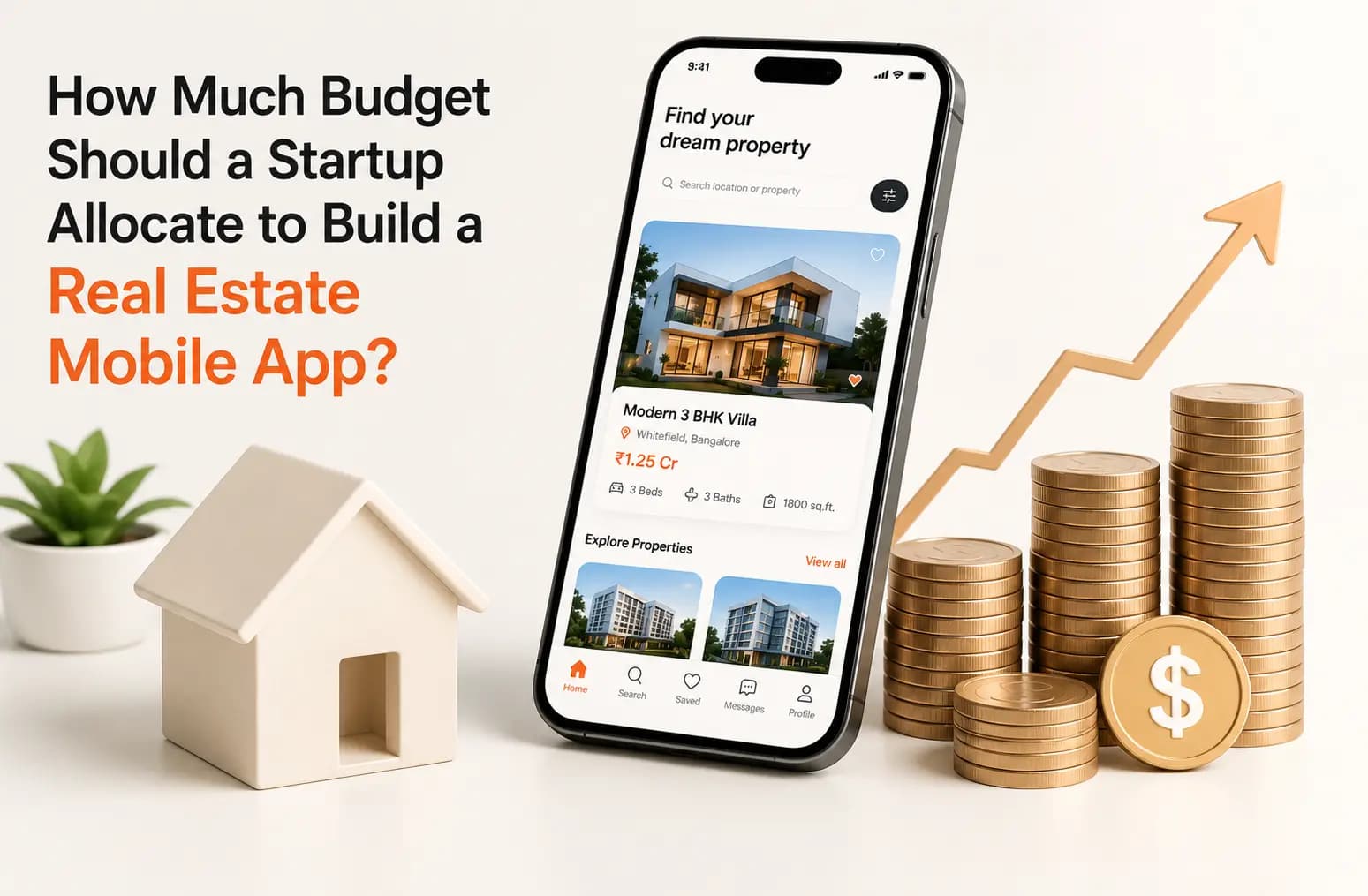
Most startup cost guides for real estate mobile apps quote a development number and stop, leaving founders unprepared for the operating costs, marketing budget, and CRM integration that actually determine whether the app generates revenue. This guide covers the full picture: budget tiers from MVP to enterprise, a four-category allocation framework for your total technology budget, a 3-year cost of ownership model, the hidden fees most quotes miss, and an honest answer to the question most founders don't think to ask: should you build an app at all, or a website first? Whether you're pre-validation or growth-stage, this guide gives you the financial framework to make the right investment decision before you sign a single contract. It's the only PropTech budgeting guide written from a startup operator's perspective, not a development agency's sales pitch.
The budget to build a real estate mobile app in 2026 ranges from $15,000 for a validated MVP to over $300,000 for a full-scale marketplace platform. Most PropTech startups should allocate between $30,000 and $80,000 for a functional first version that proves product-market fit, then plan a separate budget for the 12-month operating costs that follow. The build cost is only half the story.
Here's what most development agency cost guides skip entirely. They tell you what an app costs to build. They don't tell you how to decide whether you should build one at all, what your app needs to do before it's worth funding at any tier, or how to allocate your startup's total technology budget across build, launch, and operations without running out of runway before the product gains traction. That's exactly what this guide covers.
In my decade working with property operators and PropTech startups at Noseberry Digitals, the most expensive mistake I see isn't building the wrong features. It's spending $80,000 on a full-featured app before a single user has validated that the core value proposition works. The second most expensive mistake is building a great app on a budget that leaves nothing for marketing, CRM, and the acquisition stack that brings users to it. This guide gives you the complete picture before you sign anything.
What Is the Real Cost to Build a Real Estate Mobile App in 2026?
The real cost to build a real estate mobile app in 2026 includes the initial development investment, the monthly operational running costs, and the ongoing maintenance budget, because most startup founders only budget for the first item and get surprised by the other two within 90 days of launch.
Here is what the full budget picture looks like by tier:
Tier 1: MVP (Minimum Viable Product)
Build cost: $15,000-$40,000 Timeline: 8-16 weeks What you get: A functional app that tests your core value proposition with real users. This typically includes property search with filters, listing detail pages, a user registration and profile system, a basic saved listings function, and an inquiry form or in-app messaging stub. It does not include native iOS and Android apps (usually a responsive web app or one platform only), IDX or MLS integration, AI features, payment processing, or a full agent dashboard.
An MVP is not a compromised product. It's a deliberately scoped product that validates the one thing your startup hypothesis depends on. If your hypothesis is "buyers in our market will use a mobile-first property search platform instead of portals," the MVP tests that. It doesn't need to do everything. It needs to do the one thing.
Tier 2: Growth-Stage App
Build cost: $40,000-$120,000 Timeline: 18-32 weeks What you get: Native iOS and Android apps (or a polished cross-platform build with React Native or Flutter), IDX or MLS integration (if operating in a supported market), saved search with automated property alert notifications, agent and seller dashboards, mortgage or rental yield calculator, photo and video upload with cloud storage, map-based search, and basic analytics. This is the tier where a regional real estate platform can genuinely compete for daily active users.
Tier 3: Enterprise Platform
Build cost: $120,000-$300,000+ Timeline: 32-52+ weeks What you get: Full marketplace functionality (multi-agent, multi-listing, multi-city), AI-powered property recommendations, predictive pricing models, virtual tour integration (Matterport or custom), in-app transaction management, advanced analytics dashboards, multi-language and multi-currency support, and the infrastructure to handle significant concurrent traffic. This is a Zillow competitor, not a startup's first product.
According to RaftLabs' 2026 real estate app development analysis, the most common budget range for a serious regional real estate platform is $40,000-$120,000. Below $15,000, you're typically buying a white-label template with minimal customization. Above $120,000, you're building platform-scale infrastructure that most early-stage startups don't need yet.
How Should a PropTech Startup Allocate Its Mobile App Development Budget?
A PropTech startup should allocate its mobile app development budget across four categories: build, infrastructure and operations, marketing and user acquisition, and maintenance, because allocating everything to the build and nothing to the other three is the most common reason real estate apps fail within their first year despite having a quality product.
Here is the recommended budget allocation framework for a startup with a $100,000 total technology budget:
Build cost (40-50%): $40,000-$50,000 allocated to the MVP or growth-tier app development. This covers design, development, QA testing, and initial deployment.
Infrastructure and operations (10-15%): $10,000-$15,000 for the first 12 months. Covers hosting, database, CDN, app store fees, API costs (mapping, SMS, email), and monitoring tools.
Marketing and user acquisition (25-35%): $25,000-$35,000 for the first 12 months. Covers paid acquisition (Google Ads, Meta), SEO content, app store optimization, and launch PR. An app with no marketing budget has no users.
Maintenance and iteration (10-15%): $10,000-$15,000 for post-launch bug fixes, OS update compatibility, performance improvements, and one or two feature iterations based on user feedback.
The biggest mistake in this allocation is treating the build as the entire investment and treating everything else as optional. In practice, the app is only the product. The marketing budget is what determines whether anyone uses it. The maintenance budget is what keeps it working after launch. All four categories are non-negotiable.
What Factors Drive Real Estate Mobile App Development Budget Up or Down?
The mobile app development budget for a startup is determined by eight core variables, and changing any one of them can move the estimate by 30-50%. Understanding which variables matter most for your specific product lets you make informed trade-offs before you brief a development team.
Factor 1: Platform Choice (iOS, Android, or Cross-Platform)
Building separate native apps for iOS and Android adds $40,000-$80,000 to the development budget compared to a web-responsive app. Cross-platform frameworks like React Native or Flutter reduce this to $25,000-$50,000 by using a single codebase for both platforms, with some trade-offs in performance and access to deep device features.
For most PropTech startups, the right first decision is: web app first, native apps in phase two. According to NAR's 2024 technology survey, 81% of recent renters searched on a mobile website before searching on a native app. A well-built progressive web app captures the majority of that traffic without the native app development cost until you've proven enough user demand to justify it.
Factor 2: Property Data Integration
IDX and MLS integration (for US markets) adds $15,000-$40,000 to the build budget for initial setup, plus ongoing feed costs of $100-$300 per month. Property portal API integration in non-US markets (Bayut, Property Finder, 99acres, Rightmove) varies by portal and market, ranging from free developer access to paid commercial agreements.
If your startup is building in a market where live listing data is essential to the user experience, budget for this integration from the start. Retrofitting it after launch consistently costs more than including it in the original build scope.
Factor 3: AI and Personalisation Features
AI property recommendations, natural language search, predictive pricing, and virtual tour integration are increasingly expected features in 2026, but they add significant cost. AI recommendation engine: $20,000-$50,000. Natural language property search: $15,000-$30,000. Virtual tour integration (Matterport or similar): $15,000-$35,000.
According to Groovy Web's 2026 analysis, virtual tours drive 130% more property inquiries compared to listings without them. The ROI case for virtual tour integration is strong, but it's a phase-two feature for most startups, not an MVP requirement.
Factor 4: Development Team Location and Structure
Hourly development rates vary significantly by team location:
US-based teams: $100-$180 per hour
Western European teams: $80-$150 per hour
Eastern European teams: $40-$80 per hour
South/Southeast Asian teams: $20-$50 per hour
A 2026 Clutch and Accelerance benchmark places blended US market delivery rates at $60-$180 per hour depending on team location mix, seniority, and engagement model. A startup building the same feature scope with a US team versus a South Asian team at equivalent quality will see a 2-4x cost difference on the build.
Quality at lower rates is achievable but requires more active management from your side. Budget extra time for specification writing, daily standups, and QA review if you're working with an offshore team that isn't specialized in your product category.
Factor 5: Design Quality and UX Complexity
UI/UX design typically consumes 15-25% of the total development budget. Property search is a visually driven experience. Listing detail pages, map interactions, image galleries, and virtual tour interfaces all require careful design work. Cutting design budget to save cost almost always increases user churn after launch, which costs more to address than the design budget saved.
Factor 6: Backend Infrastructure and Security
A real estate platform handles sensitive personal data, financial information, and legal documentation. Security hardening adds $10,000-$20,000 to the build cost in 2026, covering multi-factor authentication, biometric login options, end-to-end encryption, GDPR or local data privacy compliance, and secure document handling.
Don't treat security as an optional line item. A single data breach on a platform handling property transaction data is a reputational and legal event that no startup budget can absorb.
Factor 7: CRM and Marketing Stack Integration
An app that doesn't connect to your CRM is generating leads that nobody is systematically following up on. Budget $5,000-$20,000 for integration with your CRM (HubSpot, Zoho, or a custom build), automated lead notification workflows, WhatsApp inquiry routing, and performance tracking.
This is where most dev agency quotes end and where the actual business value of the app begins. The real estate CRM and the app are not separate products. They're two layers of the same sales system.
Factor 8: Post-Launch Maintenance
Annual maintenance costs for a real estate app run 15-20% of the initial development cost, covering OS update compatibility, third-party API changes, bug fixes, and security patches. On a $60,000 build, that's $9,000-$12,000 per year before any new feature development. Budget this from day one.
Should a Real Estate Startup Build a Mobile App or a Website First?
A real estate startup should build a high-converting, mobile-optimised website before building a native mobile app, because a website serves the same user needs at 20-40% of the cost, is easier to update, ranks on search engines directly, and provides the user behaviour data you need to make an informed native app specification.
This is the question most development agency articles avoid because the honest answer reduces the size of the immediate project. Here's the framework for deciding when an app is the right first investment versus when a website is the smarter starting point:
Build a website first if:
You haven't yet validated that users will adopt your specific platform over existing portals in your market
Your go-to-market is SEO-driven (websites rank; apps don't generate organic search traffic directly)
Your development budget is under $40,000 total
Your core user journey doesn't require device features (push notifications, camera, GPS beyond map search)
Build a native app first if:
Your product hypothesis depends on a feature that only works natively (push notification alerts for new listings, camera-based property scanning, AR property preview)
You're entering a market where competitors already have strong app presence and web-only puts you at a structural disadvantage
You have validated demand (waitlist, pilot users, or an existing web user base requesting a native experience)
You have a minimum $50,000 build budget with a separate operating and marketing budget
Most PropTech startups in 2026 are better served by a fast, well-built progressive web app (PWA) as their first product. A PWA delivers a near-native mobile experience through the browser, supports push notifications, and works offline to a degree. It can be built for $15,000-$40,000 and updated rapidly based on user feedback. It generates SEO traffic. And it can serve as the validated foundation that informs a native app specification when the time comes.
A well-built real estate website designed as a PWA is often the right first product. The native app becomes the right second product once user behaviour data tells you exactly which features to prioritise.
What Does a Real Estate Startup's Full Technology Budget Look Like Over 3 Years?
The 3-year technology budget for a real estate startup is almost always 2-3x the initial build estimate because of operating costs, maintenance, marketing, and the second-phase feature development that user feedback makes inevitable. Planning for the full 3-year picture before you sign the build contract is the most important financial discipline a PropTech founder can apply.
Here's a realistic 3-year cost model for a growth-tier real estate app with a $60,000 initial build:
Budget Category | Year 1 | Year 2 | Year 3 |
Initial app build | $60,000 | $0 | $0 |
Feature iteration (Phase 2) | $0 | $25,000 | $20,000 |
App maintenance (15-20% of build) | $9,000 | $12,000 | $14,000 |
Hosting, APIs, infrastructure | $6,000 | $8,000 | $10,000 |
App store fees, licensing | $1,500 | $1,500 | $1,500 |
Marketing and user acquisition | $24,000 | $36,000 | $48,000 |
CRM and automation stack | $3,600 | $4,800 | $6,000 |
Annual total | $104,100 | $87,300 | $99,500 |
3-Year cumulative total | $290,900 |
A $60,000 build becomes a nearly $300,000 three-year commitment when planned honestly. That's not a reason not to build. It's a reason to enter the investment knowing the full scope, not just the headline development cost.
For startups with limited initial runway, this 3-year model makes the case for the MVP approach even more clearly. A $20,000 MVP that reaches 500 validated users in year one costs approximately $60,000 total in year one (including operating and marketing). It also produces the user data that makes your year-two feature investment far more accurate, and makes your case to investors far more compelling.
How Does the Real Estate App Connect to Your Marketing and Lead Generation Stack?
A real estate mobile app that isn't integrated with a marketing and lead generation stack is a product without a pipeline. The app generates user sessions. The marketing stack turns those sessions into qualified leads. The CRM converts those leads into closed deals. All three layers must work together.
Here's how the integration architecture should flow:
When a user registers on your app, that registration should trigger a CRM record automatically, tagged by source (organic app store, paid install campaign, referral, QR code scan). If the user searches a specific area or property type three or more times, a behavioral trigger fires a personalised push notification or email with relevant new listings. If they save a property, they enter a nurture sequence. If they submit an inquiry form, an automated WhatsApp message fires within 60 seconds from your agency's verified number, a CRM task is created for the assigned agent, and the lead's search history is pre-loaded as context for the agent's first call.
Without this integration, a user who searches your app 10 times, saves 4 properties, and then goes quiet because nobody followed up on a Saturday evening is a lead your marketing stack paid to acquire and then lost to a competitor who had better follow-up systems.
Our post on real estate marketing automation workflows shows exactly how this lead capture-to-CRM-to-nurture pipeline works in practice. And our WhatsApp automation for real estate guide covers how to configure the instant-response layer that turns app inquiries into booked site visits.
For the paid acquisition side of your app's user growth, our post on Google Ads for real estate lead generation covers how to set up conversion tracking that attributes closed deals back to specific acquisition campaigns.
What Are the Hidden Costs Most Real Estate App Budgets Miss?
Most real estate startup founders receive a development quote and treat it as the total investment required. The costs that reliably appear after launch, and that most quotes either omit or underestimate, include:
App store fees and guidelines compliance: Apple charges a $99/year developer fee and takes a 15-30% cut of any in-app purchases or subscriptions. Google charges a $25 one-time developer fee and takes a 15-30% cut as well. More importantly, Apple's App Store review process takes 1-3 days per submission and can reject updates for policy violations. Budget for review delays in your launch timeline.
Third-party API costs: Maps (Google Maps API charges per map load above the free tier, typically $5-$7 per 1,000 loads), SMS notifications (approximately $0.01-$0.05 per message), push notification services (free tier limits apply), and property data feeds (IDX/MLS or portal APIs) all carry costs that scale with your user base.
Legal and compliance: Terms of service, privacy policy, GDPR compliance documentation, and if you're processing payments in-app, PCI DSS compliance. Budget $2,000-$8,000 for initial legal documentation and compliance review, higher if you're operating across multiple countries.
App store optimization (ASO): Getting your app discovered in the App Store and Google Play requires ongoing keyword optimization, screenshot design, review management, and periodic metadata updates. Budget $500-$2,000 for initial ASO setup and $200-$500 per month for ongoing management.
Customer support infrastructure: When users encounter bugs, data discrepancies, or account issues, they need a way to reach you. Even a basic support system (email ticketing, an FAQ section, a WhatsApp support channel) requires setup time and ongoing management capacity.
A 2025 analysis from aPurple found that hidden costs like cloud storage, post-launch maintenance, and legal compliance can increase a startup's annual technology budget by up to 30% if not planned for upfront. Budget for this buffer from day one.
How to Choose the Right Development Partner for Your Real Estate Mobile App
Choosing the right development partner for your real estate mobile app is as important as the build budget itself, because a team that doesn't understand property tech will build technically correct code that makes the wrong product decisions, and fixing those decisions after launch costs more than getting them right the first time.
Here's what to evaluate before signing a development contract:
Real estate sector experience: Has the team built property search, IDX integration, listing management, or agent dashboards before? Ask for specific case studies. A team that has built e-commerce apps and CRM tools but never a property platform will underestimate the complexity of listing data management, search filter logic, and agent workflow requirements.
Product thinking vs. task execution: Does the team ask about your users, your business model, and your success metrics before writing a specification? Or do they ask for a feature list and give you a quote? The former builds a product. The latter builds features that may or may not combine into a useful product.
Transparency on scope changes: How do they handle scope changes mid-project? Get this in writing. Most development cost overruns happen because scope expands during build and the billing structure doesn't make the cost of that expansion visible until the invoice arrives.
Post-launch support: Who maintains the app after launch? Is it the same team that built it, or a separate support tier? How quickly do they respond to critical bugs? What is the SLA for emergency fixes?
Integration capability: Can they demonstrate integrations with the CRM, WhatsApp API, analytics, and marketing tools your stack requires? Build integration requirements into the contract scope explicitly, not as a vague "will integrate with third-party tools" clause.
The AI and technology services we offer at Noseberry Digitals are built around this connected-system philosophy. We don't build apps in isolation. We design the product, the CRM layer, the marketing automation, and the analytics infrastructure as a single architecture from the brief stage. You can see the results of that approach across our case studies.
Real Estate Mobile App Budget: Quick Reference by Startup Stage
Here's a concise budget reference for real estate startups at each stage of development:
Pre-validation stage (idea not yet tested): Build budget: $0-$15,000 Recommendation: Build a landing page and a waitlist before committing to app development. Validate that users will adopt your specific product in your specific market before spending on a build.
Early validation stage (hypothesis confirmed, first users identified): Build budget: $15,000-$40,000 for an MVP web app or PWA Operating and marketing budget: $20,000-$30,000 for 12 months Total Year 1 budget: $35,000-$70,000
Growth stage (MVP validated, scaling user base): Build budget: $40,000-$120,000 for a growth-tier app with native mobile Operating and marketing budget: $40,000-$80,000 for 12 months Total Year 1 budget: $80,000-$200,000
Scale stage (product-market fit confirmed, investor-backed): Build budget: $120,000-$300,000+ for an enterprise platform Operating and marketing budget: $100,000-$300,000+ annually Total 3-year budget: $400,000-$1,000,000+
The pattern is consistent. The right build investment is the one that matches your current stage of validation, not your eventual product vision. Spending scale-stage money at the pre-validation stage is the most common way a PropTech startup burns through its runway before finding product-market fit.
Conclusion
The budget to build a real estate mobile app in 2026 starts at $15,000 for a validated MVP and grows to $300,000 or more for an enterprise-scale platform. But the build cost is only the first budget decision a startup needs to make. The operating costs, marketing investment, maintenance budget, and CRM integration that make the app generate revenue are equally important, and equally deserving of upfront planning.
The single most important takeaway from this guide: match your build budget to your current stage of validation, not to your eventual product ambition. Build the MVP. Get real users. Let their behaviour tell you what to build next. The startups that win in PropTech are not the ones who build the most features first. They're the ones who validate fastest and iterate most intelligently.
Here is your starting point. Before you brief a single development agency, answer three questions. What is the one thing your app needs to do to prove your core hypothesis? What does success look like at month six in terms of users, inquiries, or bookings? And do you have a budget for marketing and CRM alongside the build, or just for the build itself?
If the answer to the third question is "just the build," restructure your budget before you start. An app with no marketing budget has no users. An app with no CRM integration produces leads that nobody follows up on. Both situations produce the same outcome: a technically functional product that generates no revenue.
The team at Noseberry Digitals works with PropTech startups at every stage of this journey. From MVP scoping and website-first strategy to full digital marketing stack design and SEO and AEO for organic user acquisition, we build the complete infrastructure that turns a product idea into a revenue-generating property platform.
Book a free strategy call atnoseberrydigitals.com and we'll give you an honest assessment of what your specific concept requires, what it should cost, and what stage-appropriate investment looks like for your market.
- The budget to build a real estate mobile app ranges from $15,000 for an MVP to $300,000+ for an enterprise platform; most serious regional apps fall in the $40,000-$120,000 range.
- Startups should allocate total technology budgets across four categories: build (40-50%), infrastructure (10-15%), marketing and user acquisition (25-35%), and maintenance (10-15%).
- A $60,000 initial build becomes a nearly $300,000 three-year investment when operating costs, maintenance, and marketing are planned honestly.
- Most PropTech startups are better served by a mobile-optimised website or PWA as the first product, and a native app as the second once user demand is validated.
- App development cost varies by platform (native iOS/Android adds $40,000-$80,000; cross-platform React Native or Flutter cuts this to $25,000-$50,000), team location, and data integration requirements.
- Hidden costs including app store fees, API scaling costs, legal compliance, ASO, and support infrastructure can increase annual operating budget by up to 30% (aPurple, 2025).
- Annual maintenance costs run 15-20% of the initial build cost, meaning a $60,000 app requires $9,000-$12,000 per year just to stay functional after launch.
- CRM and marketing stack integration must be budgeted as part of the build scope; an app disconnected from the CRM and follow-up automation generates leads that nobody converts.
- Matching build investment to validation stage (not product vision) is the single most important budget discipline for PropTech startups to avoid premature runway burn.
- The right development partner asks about users, business model, and success metrics before a feature list; teams that just quote from a spec list build features, not products.
Why trust Noseberry
Our content is written by practicing real-estate and PropTech professionals, fact-checked by a dedicated editorial team, and reviewed against the latest industry data before publication.
- 10+ years of industry expertise
- All facts independently verified
- No sponsored rankings in guides
- Updated when the industry changes
Have any questions?
How much does it cost to build a real estate mobile app in 2026?
Building a real estate mobile app in 2026 costs between $15,000 for a basic MVP and $300,000 or more for a full-scale marketplace platform. The most common budget range for a serious regional real estate app is $40,000-$120,000, according to RaftLabs' 2026 development analysis. The final cost depends primarily on platform choice (web, cross-platform, or native), property data integration requirements, AI features, and the development team's hourly rates by location.
What is the minimum budget to build a real estate app for a startup?
The minimum viable budget to build a real estate app for a startup is $15,000-$25,000 for an MVP web app or progressive web app that tests your core value proposition. Below $15,000, you're typically purchasing a white-label template rather than a custom product. A startup should also budget at least $15,000-$20,000 alongside the build for operating costs and marketing in the first 12 months, since an app with no user acquisition budget produces no revenue regardless of build quality.
Should a real estate startup build an app or a website first?
A real estate startup should build a mobile-optimised website or progressive web app (PWA) before building a native mobile app in most cases. A website serves the same core user needs at 20-40% of the native app cost, generates SEO traffic, and produces user behaviour data that makes your eventual native app specification significantly more accurate. According to NAR's 2024 technology survey, 81% of renters searched on a mobile website before using a native app, confirming that web-first is a valid initial strategy for most markets.
What are the ongoing monthly costs of a real estate mobile app?
Ongoing monthly costs for a real estate mobile app include hosting and cloud infrastructure ($100-$500 per month depending on traffic), property data feed subscriptions ($100-$300 per month for IDX or portal feeds), third-party APIs like mapping, SMS, and push notifications ($50-$300 per month), CRM platform fees ($50-$500 per month), and app maintenance support ($750-$1,500 per month on retainer). Total monthly operating costs for a growth-stage real estate app typically run $1,000-$3,000 per month, which adds up to $12,000-$36,000 annually.
What features should a real estate MVP app include?
A real estate MVP app should include property search with basic filters (location, price, property type), listing detail pages with photos and key specifications, user registration and saved listings, and a contact or inquiry mechanism that routes to your CRM. It should not include AI recommendations, in-app payments, full agent dashboards, or virtual tour integration. These are phase-two features that should only be built once user behaviour confirms they're the right next investment.
How long does it take to build a real estate mobile app?
Building a real estate mobile app takes 8-16 weeks for an MVP, 18-32 weeks for a growth-tier app with native mobile and IDX integration, and 32-52 or more weeks for an enterprise platform. Timelines extend when the scope expands during development (the most common cause of overruns), when third-party integrations like MLS feeds take longer than expected to configure, or when the Apple App Store review process requires multiple submission rounds. Build a 20% time buffer into any delivery estimate.
How do I connect my real estate app to a CRM?
Connect your real estate app to a CRM by integrating it via API at the point of user registration and inquiry submission so that every new user and every property inquiry creates a structured CRM record automatically with source, search history, and intent data attached. Most BSP and CRM platforms (HubSpot, Zoho, Salesforce) provide documented APIs for this integration. The cost to configure this integration is typically $5,000-$20,000 depending on complexity, and it should be included in the original build scope rather than added later.
What hidden costs do real estate app budgets typically miss?
Hidden costs that most real estate app budgets miss include Apple and Google app store fees and revenue shares (15-30% of in-app revenue), third-party API costs that scale with user volume (maps, SMS, push notifications), legal documentation and compliance costs ($2,000-$8,000 upfront), app store optimization for discoverability, and customer support infrastructure. A 2025 aPurple analysis found that these hidden costs can increase a startup's annual technology budget by up to 30% if not planned for upfront.
Is it cheaper to build a real estate app with React Native or Flutter?
Both React Native and Flutter reduce development cost compared to building separate native iOS and Android apps. A cross-platform build with React Native or Flutter typically costs $25,000-$50,000 for the mobile layer, compared to $40,000-$80,000 for two separate native codebases. Flutter generally produces better performance consistency across platforms. React Native has a larger developer ecosystem and is easier to find specialist developers for. Either is the right choice for a startup at MVP or growth stage where budget efficiency matters more than marginal native performance gains.
How does a real estate app budget differ for international vs. US markets?
A real estate app budget for international markets is typically 20-40% lower than a comparable US-market app because IDX and MLS integration (a significant cost driver in the US) is not required. Many international property portals offer free or lower-cost API access, and development teams in markets like India, Southeast Asia, and Eastern Europe offer lower hourly rates without sacrificing quality at the mid-market tier. The trade-off is that international apps require more custom data architecture since there's no standardised listing feed, which adds scoping complexity at the design stage.
Related insights
 Real Estate
Why Noseberry Digitals is one of the best real estate mobile app development company in USA
This blog explains why Noseberry Digitals stands out as a real estate mobile app development company, built around a focused history of property and proptech clients rather than general app development. It walks through the seven-phase development process, the native versus cross-platform decision, and the app store compliance work behind a 14-of-16 first-try approval rate. It shares measurable client results, including faster navigation, lower bounce rates, and occupancy gains from real coliving, brokerage, and marketplace projects. It also compares Noseberry against typical generalist agencies on cost, ownership, and post-launch support. The article closes with a 10-question FAQ covering cost, timeline, and technology choices for anyone evaluating a real estate app development partner.
September 8, 2026 Real Estate
Top 5 Software Development Company for Real Estate in USA: Full Comparison Guide
This blog ranks and compares the top five software development companies for real estate in the USA, starting with Noseberry Digitals and covering Ascendix Technologies, TechAhead, Chetu, and Itransition. It walks through what actually separates a real estate specialist from a general software vendor, including source code ownership, industry focus, and post-launch support. The piece includes a side-by-side comparison table covering headquarters, experience, and specialty for each company. It also breaks down realistic pricing ranges, engagement models, and red flags to watch for before signing a contract. The article closes with a 10-question FAQ section covering selection criteria, costs, and timelines.
September 7, 2026 Real Estate
PropTech Software Development: How Noseberry Digitals Builds Smarter Real Estate Solutions in USA
This blog explains what proptech software development actually involves and why real estate businesses need purpose-built platforms instead of generic SaaS tools. It covers what to look for in a proptech software development company, from code ownership to pricing structure to documented build timelines. It walks through how Noseberry Digitals runs its six-phase build process, the types of platforms it builds most often, and the compliance awareness baked into that work. The piece includes real case study results, a comparison of in-house, freelance, and agency development models, and common mistakes real estate companies make when choosing a partner. It closes with a direct answer to why choose Noseberry Digitals as a proptech software development agency, backed by verifiable stats rather than marketing claims.
September 7, 2026
Ready to book a 30-minute strategy call?
We'll map the right digital moves for your real estate business, no pitch deck, no commitment.