
Noseberry Digitals
Real Estate Link Building in 2026: How to Earn Backlinks Google and AI Engines Actually Trust
Published August 10, 2026|9 min read
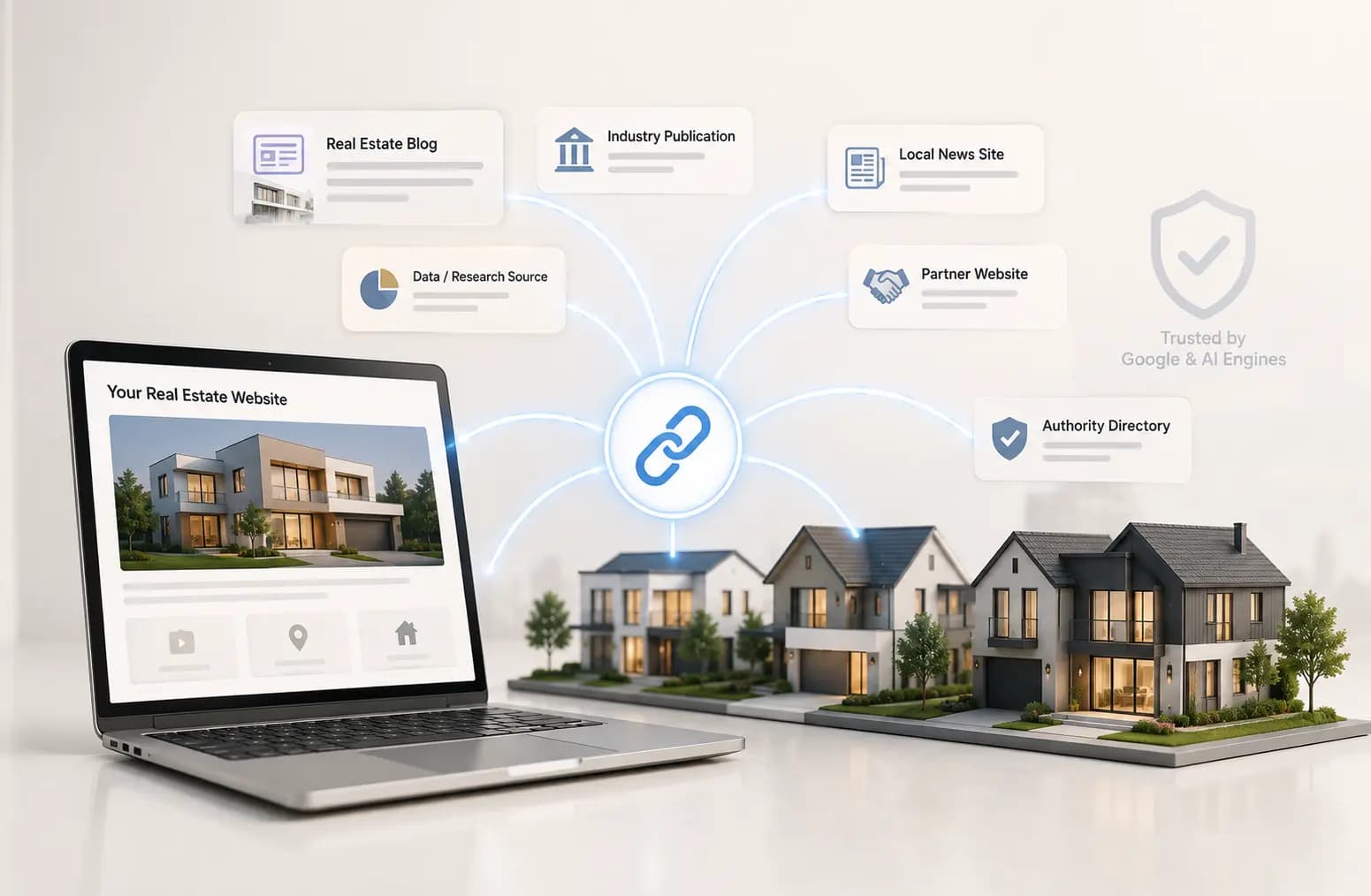
Real estate link building in 2026 means earning mentions and links from sites that are genuinely relevant to housing and local markets. It does not mean buying links from random blogs. Google still weighs backlinks heavily in its ranking algorithm. But ChatGPT, Gemini, and Perplexity now weigh something else almost as much. They care whether other trustworthy sources talk about your brand at all.
That shift matters more than most real estate marketers realize. I've spent the last decade auditing backlink profiles for brokerages, proptech platforms, and solo agents. The sites winning right now aren't the ones with the most links. They're the ones with the right links, paired with a brand presence that Google and AI engines can verify. A property management company in Austin I worked with doubled its organic leads in eight months. It didn't buy 200 backlinks. It earned 40 links from local news sites, inspection blogs, and mortgage lenders who mentioned the brand by name. This guide covers what's changed, what still works, and where most competitor guides leave gaps.
What Is Real Estate Link Building and Why Does It Matter in 2026?
Real estate link building is the process of earning links from other websites that point back to a property, brokerage, or real estate service page. It matters in 2026 because Google still uses backlinks as a trust signal. AI answer engines also cite brands that show up across many credible sources.
This kind of link earning builds digital trust. That's because Google treats each relevant, editor-approved link as a vote of confidence. A backlink from a local newspaper covering your market report carries more weight than ten links from unrelated directories. Relevance still drives most of the algorithm's judgment. Real estate also falls under Google's "your money or your life" category. That sets a higher bar for trust signals than, say, a recipe blog. Generic SEO advice tends to fall flat here for exactly that reason. Our real estate SEO services include exactly this kind of audit, and it's worth running before you spend a dollar on outreach.
Why Do Google and AI Engines Trust Different Kinds of Links?
Google ranks pages using backlinks plus content relevance and user signals. AI engines like ChatGPT and Perplexity lean more on brand mentions, structured data, and consistency across the web. A link that ranks you on Google won't automatically get you cited by an AI assistant. That gap is the single biggest thing most guides on this topic miss. Our answer engine optimization services cover exactly this gap, so check that out once you finish this section.
How Backlinks Still Move Google Rankings
Backlinks remain one of Google's top ranking factors. That hasn't changed much since the early 2010s. Ahrefs' 2026 analysis of search ranking factors found that top-ranking pages average far more referring domains than pages stuck on page two. For real estate, that means a brokerage competing for "homes for sale in [city]" needs local, topical backlinks. Think lenders, inspectors, chambers of commerce, and neighborhood blogs. Skip the generic guest posts on unrelated topics. Our own local SEO for real estate agents guide covers how to find these partners in your market.
How Brand Mentions Are Reshaping AI Overviews and LLM Citations
Here's the part almost every competing article skips. Ahrefs studied 75,000 brands and found that branded web mentions correlated with AI Overview visibility at 0.664. Backlinks alone scored just 0.218. Brand mentions were roughly three times more predictive of AI visibility than links. Brands in the top quarter for mentions averaged 169 AI Overview appearances. Brands in the middle group only averaged 14. If your link building strategy only chases links and ignores brand mentions in press coverage, you're optimizing for half the picture.
The Anatomy of a High-Quality Real Estate Backlink
A high-quality real estate backlink comes from a site that's relevant to housing and has its own earned authority. It also places your link inside real editorial content, not a footer or sidebar. Four things determine that quality. They are topical relevance, the linking site's own trust signals, human editorial approval, and how naturally the link fits the page around it.
Relevance is the one thing agencies underplay the most. A backlink from a national tech blog looks impressive on paper. But a link from your local Realtors association or a title company tells Google something more specific. It tells Google and AI engines that real people in the real estate world find you worth citing. I've reviewed more than 200 real estate backlink profiles over the years. The accounts that grow fastest almost always have a bigger share of local, relevant links than generic high-authority placements. Our case studies show exactly this kind of imbalance getting fixed in real client accounts.
Backlinko's analysis of 11.8 million Google search results found something similar. First-page pages tend to have a bigger, more varied set of referring domains than pages further down. Diversity, not just volume, is what separates a strong backlink profile from one that collapses the moment Google runs a core update.
Backlink Tactics for Real Estate That Actually Work in 2026
Here's the practical playbook. This is the order I'd actually run it in with a new client.
Map your existing local network first. Title companies, home inspectors, lenders, movers, and contractors you already work with almost always have a website. They'll link to trusted partners if you simply ask.
Publish original local data. A "State of the [City] Housing Market" report with your own numbers gives journalists something concrete to cite.
Pitch HARO and journalist request platforms. Reporters covering housing or interest rates need quick, credible quotes. A well-timed pitch from a licensed agent often gets picked up within days.
Guest post on real estate and finance sites with real audiences. Skip directories that accept anyone. Target sites where an editor actually reviews submissions.
Build link magnets. Mortgage calculators, neighborhood comparison tools, and rent-versus-buy calculators attract links the way listings never will.
Get listed and cited consistently. Accurate citations across Zillow, Realtor.com, your MLS, and Google Business Profile reinforce the brand-mention signal AI engines rely on.
Build Relationships With Your Local Real Estate Ecosystem
Your fastest wins usually come from people you already know. Ask your top five vendor partners for a link on their "partners" or "resources" page. It's a five-minute email. It works more often than cold outreach ever will.
Publish Data and Digital PR That Journalists Want to Cite
Digital PR is the practice of pitching original research or expert commentary to journalists so they cite your brand as a source. It works because real estate is data-hungry. Mortgage rates, inventory levels, and price trends are things reporters cover every week. A real estate brand with fresh local numbers becomes a go-to source. The National Association of Realtors' 2025 Profile of Home Buyers and Sellers found that most buyers now start their home search online. That's exactly why sites that answer buyer questions first tend to earn the most citations.
Want help pitching journalists? Our digital PR for real estate brands service handles journalist outreach like this for clients directly.
Should You Hire a Link Building Service for Real Estate or Do It Yourself?
Hiring a link building service for real estate makes sense once you need steady monthly output and reporting for stakeholders. Doing it yourself works fine if you have time to build relationships slowly. It's also fine if you only need a few good links a month. Most brokerages land somewhere in between. They do DIY for local relationships and hire an agency for digital PR and scale. Check our real estate digital marketing resources if you're leaning DIY.
Approach | Typical Cost | Speed | Best For |
|---|---|---|---|
DIY link building | Time only, roughly 5 to 10 hours a month | Slow, 6 to 12 months to build volume | Solo agents and small teams with time to spare |
Link building service for real estate | $1,000 to $10,000+ per month | Faster, often 3 to 6 months to show traction | Brokerages and proptech brands scaling multiple markets |
Hybrid model | $500 to $3,000 per month plus internal time | Moderate | Teams that want local relationships plus agency-driven PR |
Red Flags to Watch for When Vetting a Link Building Service
Not every agency selling a "link building service for real estate" is worth the invoice. Watch for these warning signs before you sign a contract.
Guaranteed rankings or a fixed number of links per week, with no mention of relevance or vetting.
Heavy use of private blog networks (PBNs) or link farms, which Google's spam policies explicitly penalize.
No sample reports, case studies, or references from other real estate clients.
Pricing that seems too low for the promised volume of "high authority" links.
Reluctance to explain where links will actually come from before you pay.
An agency worth hiring, like the team at Noseberry Digitals, will walk you through the backlink strategy. They'll also explain how it supports answer engine visibility. Real estate buyers increasingly start their search inside ChatGPT or Google's AI Overviews, not just a plain search box.
How Much Does It Cost to Build Backlinks for Real Estate, and How Do You Measure ROI?
Building backlinks for a real estate site typically costs $300 to $2,000 per placement. The price depends on the site's authority and relevance. An ongoing agency retainer usually runs $1,000 to $10,000+ a month. Most SEO professionals see real ranking movement within three to six months. Most also say the investment pays off.
A few numbers worth anchoring your budget to:
Paid link placements average roughly $83 on their own. High-quality backlinks average close to $509 once outreach and content costs are included, according to DemandSage's 2026 link building report.
Roughly 28% of total SEO budgets go toward link building industry-wide.
Over 78% of SEO professionals report positive ROI from link building within a year.
46.6% of marketers see measurable ranking impact within one to three months of a steady campaign.
Measuring ROI properly means tracking more than domain rating. Watch referring domain growth, branded search volume, and AI Overview appearances. Most importantly, watch leads tied to organic traffic. A link building service for real estate that only reports "links acquired" isn't giving you the full picture. Our case studies show what that kind of reporting looks like in practice.
Common Real Estate Backlink Mistakes That Tank Rankings
Even well-intentioned teams make the same handful of errors. I've seen every one of these firsthand while auditing client sites.
Buying links in bulk from marketplaces with no editorial review. This risks a manual action under Google's spam policies.
Ignoring anchor text variety, so every link says "best homes in [city]" and looks spammy.
Chasing high-authority sites that have zero relevance to housing or local markets.
Treating link building as a one-time project instead of an ongoing habit.
Forgetting unlinked brand mentions, which AI engines weigh almost as heavily as actual links.
Neglecting NAP (name, address, phone) consistency across directories, which undercuts local trust. Our real estate SEO services cover how structured data reinforces this.
Conclusion
Real estate link building in 2026 isn't just about piling up backlinks anymore. It's about building a brand that Google, ChatGPT, and Perplexity can all verify. Here's the one sentence to remember: earn relevant, editor-approved links, keep building your brand's presence across the web, and both search engines and AI engines will start trusting you as a real source.
Start small if you need to. Pick five vendor partners this week and ask for a link. Pitch one journalist covering your local housing market. Audit your current backlink profile for anything that looks spammy, and clean it up fast. Our Google Business Profile guide for realtors is a good place to start that audit. If you'd rather hand the strategy to experts who understand both SEO and answer engine optimization, a dedicated link building service for real estate can save you months of trial and error.
Whatever path you choose, don't wait on this. The brands earning trust signals now, from both backlinks and brand mentions, are the ones that will show up. They'll be the answer when a buyer asks ChatGPT or Google "who's the best agent in my area" a year from now.
- Real estate link building now means earning both backlinks and brand mentions, not just links.
- Google still ranks pages using backlinks as a top-three signal, largely unchanged since the 2010s.
- Ahrefs found brand mentions predict AI Overview visibility three times better than backlinks.
- Relevance beats raw authority: a local title company link often outperforms a generic guest post.
- Digital PR and original local data earn links that guest posting alone rarely matches.
- A link building service for real estate typically costs $1,000 to $10,000+ per month.
- Roughly 78% of SEO professionals report positive ROI from consistent link building.
- PBNs and bulk-bought links risk manual penalties and carry zero weight with AI engines.
- Track leads and branded search, not just link counts, to measure real ROI.
- Vet any agency for transparency, real estate case studies, and answer engine expertise.
Why trust Noseberry
Our content is written by practicing real-estate and PropTech professionals, fact-checked by a dedicated editorial team, and reviewed against the latest industry data before publication.
- 10+ years of industry expertise
- All facts independently verified
- No sponsored rankings in guides
- Updated when the industry changes
Have Any Questions?
What is real estate link building?
Real estate link building is the process of earning backlinks and brand mentions from relevant sites. Think local news outlets, lenders, and industry directories that boost a real estate site's authority. It helps both Google rankings and AI engine visibility. Quality and relevance matter more than the total number of links.
How is real estate link building different from general SEO link building?
It differs by focusing on niche relevance. Think local news sites, mortgage and title companies, inspection blogs, and housing associations. General SEO link building often targets broad, high-authority sites regardless of industry fit. In real estate, Google and AI engines weigh topical and local relevance more heavily than generic domain authority.
How do I build backlinks for a real estate website on a small budget?
Start by asking existing vendor partners, like inspectors, lenders, and contractors, for links on their resources pages. Publish original local market data that journalists want to cite. Pitch HARO-style platforms for expert quote opportunities too. These methods cost time rather than money, and they often outperform paid placements.
Should I use a link building service for real estate, or do it myself?
Use a service if you need steady monthly output and reporting tied to leads, not just link counts. Do it yourself if you have time and only need a few good local links each month. Many brokerages use a hybrid approach for the best balance of cost and speed.
How much does a link building service for real estate typically cost?
Agency retainers for this kind of work typically range from $1,000 to $10,000+ per month. The price depends on scope and how competitive your market is. Individual placements average around $509 once outreach and content costs are included, per 2026 data from DemandSage. Anything priced far below this should raise questions.
Why isn't my real estate link building strategy improving my rankings?
Common culprits include buying low-relevance links in bulk and ignoring anchor text variety. Chasing domain authority instead of topical fit is another one. A frequent issue is neglecting brand mentions and citation consistency. Both increasingly shape Google's algorithm and AI answer engines. Audit your link profile for spammy patterns before adding more links.
What's the difference between a backlink and a brand mention for SEO?
A backlink is a clickable hyperlink pointing to your site. A brand mention is any reference to your business name, even without a link. Ahrefs' 2026 research found brand mentions are roughly three times more predictive of AI Overview visibility than backlinks. Strategies that ignore unlinked mentions are missing a growing trust signal.
How long does it take to see results from real estate backlink campaigns?
Most SEO professionals report real ranking movement within three to six months of steady link building. About 46.6% of marketers see impact within the first one to three months. Results depend on your site's existing authority, local competition, and the relevance of the links you're earning.
Are private blog networks (PBNs) safe for building real estate backlinks?
No. PBNs violate Google's spam policies and can trigger manual penalties that tank rankings across an entire domain. They also carry no value for AI answer engines. Those engines rely on cross-referenced brand mentions, and PBNs can't fake that. Any service pushing PBNs as a strategy is a serious red flag.
What should I look for when choosing a link building service for real estate?
Look for transparency about where links will come from, plus real estate specific case studies. Reporting should be tied to leads, not just link counts. Avoid any service promising guaranteed rankings or a fixed number of links per week. A strong provider will also address answer engine optimization, not just backlinks.
Related insights
 Real Estate
What should a PMS do for small-scale property managers?
The ideal PMS for a small-scale property manager (typically 10 to 500 units) should do ten things well: capture every rent payment automatically, log every maintenance ticket with photo evidence and vendor dispatch, hold every tenant lease and document in one searchable place, generate owner and investor statements in one click, run automated rent reminders and late-fee escalation, screen tenants with credit and eviction history, sync with the operator's accounting stack (QuickBooks, Xero), work on mobile so field checks and unit walks happen on a phone, integrate with a website for listing marketing and online applications, and produce broker-visible dashboards that let the manager see occupancy, delinquency, and cash flow at a glance. AppFolio Property Manager Core, Buildium, DoorLoop, Rentec Direct, and Hemlane are the platforms most adopted at this scale in 2026, at $1.40 to $4 per unit per month. This post covers what the ideal PMS should do, which platforms actually deliver it, and how to pick without overpaying.
August 22, 2026 Real Estate
Which AI tools work best for real estate developers in 2026?
The best AI tools for real estate developers in 2026 fall into eight categories that map to the developer lifecycle: land sourcing and site selection (Cherre, Reonomy, HouseCanary, LandGate), feasibility and financial modelling (Northspyre, TestFit, custom Excel plus GPT), design and architectural planning (Autodesk Forma, Higharc, Cove.tool, Snaptrude), construction management and progress tracking (Procore AI, Autodesk Construction Cloud, Buildots, Doxel, OpenSpace), pre-launch marketing and renders (Restb.ai, MidJourney, Adobe Firefly), off-plan sales CRM (Salesforce, HubSpot, Follow Up Boss, Rechat), ESG and net-zero analytics (Measurabl, Enertiv, Aquicore), and handover to operations (BIM AI, tenant portal AI). Used well, they cut construction cost 10 to 20 percent, compress design cycles 30 to 50 percent, and lift off-plan sales conversion 20 to 40 percent. Used badly, they burn subscription budget and produce plans that do not build. This post walks through each category, which tools actually work, and how to sequence adoption.
August 22, 2026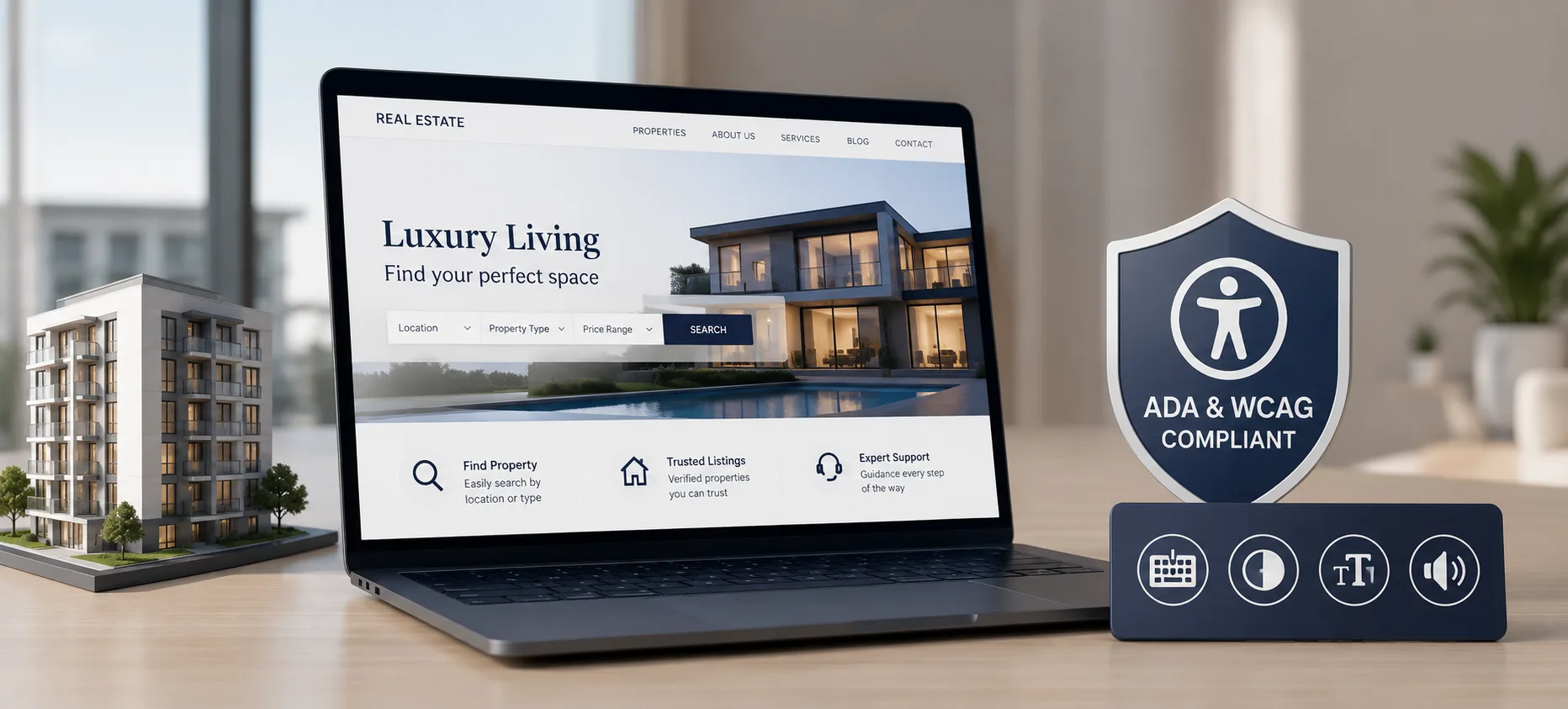 Real Estate
ADA & WCAG Accessibility Compliance for Real Estate Websites: What Operators Must Fix Before They Get Sued
This blog breaks down ADA and WCAG accessibility compliance for real estate websites, focused on what actually creates legal exposure. It explains why WCAG 2.1 Level AA has become the practical legal standard even without a formal Title III regulation for private businesses. It walks through the six accessibility failures responsible for 96% of all detected errors across the web, using real listing-page examples. It also warns against relying on accessibility overlay widgets, citing the FTC's 2025 action against accessiBe over deceptive compliance claims. The piece closes with a step-by-step audit process, an in-house versus compliance-partner comparison, and a 10-question FAQ section.
August 20, 2026
Ready to book a 30-minute strategy call?
We'll map the right digital moves for your real estate business, no pitch deck, no commitment.