

Mayank Pokharna
COO, Noseberry Digitals & Industry Expert
Virtual Staging for Real Estate in 2026: Cost, ROI, and the Best AI Tools
Published July 16, 2026|13 min read
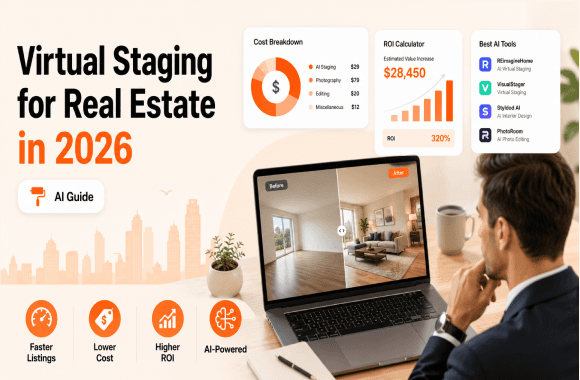
Most real estate agents still treat staging as an optional extra with an intimidating price tag, when the actual cost has dropped to under $1 per image and the ROI data has never been stronger. This guide covers everything you need to know about virtual staging for real estate in 2026: what AI tools cost at every volume level, the verified ROI numbers from NAR and RESA data, a clear decision framework for when to use AI versus physical staging, and exactly how to integrate staged images into your full marketing system. You'll also get an honest tool-by-tool comparison of the six leading AI platforms with verified 2026 pricing, and the compliance rules that protect your license and your listings. Whether you're a solo agent with two vacant listings a month or a developer pre-selling a 200-unit project, this guide gives you everything you need to make the right staging decision for each property type. Stop leaving visual first impressions to chance when the technology to fix them costs less than a coffee.
Virtual staging for real estate is the process of digitally furnishing empty or poorly furnished property photos using AI or professional design software, producing photorealistic images that help buyers visualize a space without the cost or logistics of physical staging. In 2026, AI has made this technology fast enough, affordable enough, and realistic enough that it's no longer just an option for cash-strapped agents. It's the default choice for most listings below the luxury tier.
The numbers explain why. The global virtual staging market reached $1.33 billion in 2026, up from $1.22 billion in 2025, and is projected to hit $2.96 billion by 2032 at a compound annual growth rate of 13.51%, according to Instant Interior AI's State of Virtual Staging 2026 report. Meanwhile, AI staging tools now deliver photorealistic results in under 60 seconds, at prices starting from $0.23 per image. Physical staging for the same property runs $2,000-$8,000 and takes days to set up. The cost gap has become impossible to ignore for most property businesses.
In my experience working with property operators across 14+ countries at Noseberry Digitals, virtual staging is one of the highest-ROI investments in a real estate marketing budget. But only when it's used correctly, applied to the right property type, and integrated into the listing presentation as part of a complete marketing system. This guide covers the full picture: the real costs, the verified ROI data, the best AI tools in 2026, and the decision framework for knowing which staging approach fits which listing.
What Is Virtual Staging for Real Estate and How Does It Work?
Virtual staging for real estate is a digital technique that adds photorealistic furniture, decor, lighting adjustments, and styling elements to photos of empty or unfurnished rooms, because it helps buyers who struggle to visualize empty spaces see the full potential of a property before visiting or purchasing.
According to a 2025 NAR survey, 40% of buyers cannot visualize an empty room's potential, and 81% of buyer agents say staging makes it easier for their clients to see a property as their future home. Those two statistics together define the core business case. If most buyers need visual help to make an emotional connection with a property, and virtual staging costs $1-15 per image to deliver that help, the ROI math almost always works.
Here's how AI virtual staging works technically in 2026. You upload a photo of an empty room. The AI analyzes the room's geometry (wall angles, floor area, ceiling height, window placement), lighting conditions, and perspective. It then generates furniture, rugs, artwork, and accessories that match the space with correct scale, proportional shadows, and natural reflections. The best AI tools produce results in under 60 seconds that are nearly indistinguishable from professionally photographed staged rooms.
Traditional virtual staging used to require a human designer who manually placed 3D furniture models into a photo using specialized software. That process took 24-48 hours and cost $25-75 per image. AI has compressed both the timeline and the cost by 90-99%, while the quality gap has essentially closed for standard residential properties.
The two approaches (AI and human-edited) still serve different purposes, which we'll cover in detail in the tools section below.
How Much Does Virtual Staging Cost in 2026?
Virtual staging real estate cost in 2026 spans three orders of magnitude depending on the method: AI tools start at $0.23-$5 per image, professional human-edited services run $15-75 per image, and traditional physical staging costs $2,000-$12,000+ per property. Choosing between them is a decision framework question, not just a budget question.
Here is the complete cost breakdown by staging type:
AI Virtual Staging Cost
AI staging tools operate on two pricing models: monthly subscriptions and pay-per-image credits.
Subscription pricing (2026 verified rates):
Collov AI: from approximately $16-$19/month with effective rates as low as $0.23 per image at full quota
REimagineHome: $14-$99/month depending on tier
Interior AI: $29/month or $349/year (equivalent to $29/month with 6+ months free)
Virtual Staging AI: from $25/month for 6 images
Remodel AI: $29/month for unlimited generations
Pay-per-image pricing:
StageHQ: $0.28-$0.95 per image with credits that never expire
Standard AI tools: $1-$15 per image depending on quality tier
A typical 6-room listing fully staged with AI: $2-$75 total
The subscription fine print matters. Monthly quota-based subscriptions only deliver the advertised per-image rate if you stage at full volume every month. Pay-per-image models with non-expiring credits are often more cost-efficient for agents doing fewer than 20 listings per month.
Human-Edited Virtual Staging Cost
Human-edited services involve a professional designer manually placing 3D furniture models using specialized software, then rendering and delivering the final image.
BoxBrownie: approximately $24-$30 per image
Standard professional services: $25-$75 per image
RoOomy (luxury, human-designed): significantly higher, typically $100+ per image
Typical 6-room listing fully staged: $150-$450
Turnaround is 24-48 hours. Revision requests typically cost additional credits or fees. This tier is warranted for luxury listings where the quality ceiling of AI tools isn't sufficient and the per-image cost is trivial relative to the deal value.
Physical Staging Cost
Physical staging involves a professional stager sourcing, transporting, installing, and de-staging actual furniture in the property.
DIY physical staging: $500-$1,500 per property
Professional staging (standard): $2,000-$5,000 per property
Professional staging (luxury): $5,000-$12,000+ per property
Ongoing rental fees: typically $500-$1,500 per month after the initial setup period
Physical staging delivers the highest impact for in-person experiences, particularly for luxury open houses where buyers walk through multiple times and the tactile quality of furnishings contributes to perceived value.
Staging Type | Cost Per Image | Total Per Listing | Turnaround | Best For |
AI Virtual Staging | $0.23-$15 | $2-$75 | Under 60 seconds | Most residential listings |
Human-Edited Virtual | $15-$75 | $150-$450 | 24-48 hours | Mid-market to premium |
Traditional Physical | N/A | $2,000-$12,000+ | 2-5 days | Luxury, open house listings |
What Is the ROI of Virtual Staging for Real Estate?
The ROI of virtual staging real estate is measurable and substantial. Staged listings (virtual or physical) sell 73% faster than unstaged ones, receive 90% more online click-through engagement, and achieve 98.5-99% of asking price compared to 96-97% for unstaged properties, according to data compiled in the State of Virtual Staging 2026 report by Instant Interior AI.
Here's what those numbers translate to in practice for a $400,000 listing:
Price impact: A staged listing achieving 2% higher sale price adds $8,000 to the final transaction. The virtual staging cost for 6-10 images? $2-$75. The ROI on that single transaction exceeds 10,000%.
Speed impact: Staged homes average 29-31 days on market compared to 52 days for unstaged properties. For every 15 days saved, sellers avoid $1,050-$1,950 in carrying costs (mortgage, taxes, utilities, insurance). For agents, faster sales mean faster commission and more listings per year.
Online engagement impact: A 90% increase in click-through rates on a listing page means significantly more potential buyers see the property before a showing is ever booked. In competitive markets where buyers shortlist based on listing photos alone, this engagement lift directly determines how many inquiries a listing generates.
According to RESA (Real Estate Staging Association) Q3 2025 statistics, staged homes posted an average 109% sale-to-list ratio and an average ROI of 3,551%, meaning sellers recover their staging investment nearly 36 times over. Even discounting that figure for vendor bias in the source data, the directional evidence across NAR data, RESA surveys, and aggregated MLS performance is consistent: staged listings outperform unstaged ones on every sales metric that matters.
For developers and investors with large portfolios, virtual staging ROI compounds. An agent staging 10-20 listings per year with AI tools spends $50-$1,500 annually versus $25,000-$200,000 for physical staging at equivalent volume. That cost difference, reinvested into paid acquisition or SEO, builds a sustainable pipeline advantage.
The caveat worth stating plainly: most precise percentage figures in this category come from vendors who have a commercial interest in strong ROI claims. The directional pattern (staged sells faster and at premium) is independently confirmed by NAR and RESA data. Use the direction with confidence; apply judgment to the precise numbers.
What Are the Best AI Virtual Staging Tools for Real Estate in 2026?
The best AI virtual staging tools for real estate in 2026 are the ones that combine photorealistic output quality, fast turnaround, MLS-compliant disclosure features, and pricing models that match your listing volume, because no single tool is the right answer for every property type or team size.
Here is an honest evaluation of the leading tools, based on published testing data and verified 2026 pricing:
Remodel AI
Best for: Agents staging 1+ vacant listings per month who want a full toolkit beyond just staging.
Remodel AI scored 9.3/10 in a 2026 head-to-head test by Remodel AI's editorial team across virtual staging quality, batch speed, MLS-friendly output, and cost per listing. At $29/month for unlimited stagings, it offers the strongest value proposition for active agents.
Beyond staging, it includes object removal (for cluttered rooms), exterior facade renders (for renovation listings), paint and floor previews, and furniture swap for partially furnished spaces. Commercial use rights are included on paid plans.
Pricing: 3 free designs with no card required. $29/month Pro (unlimited), $49/month Premium (higher quality renders).
Limitations: Quality ceiling may not satisfy luxury listing requirements. Monthly subscription model requires consistent volume to maximize value.
Collov AI
Best for: High-volume agents managing 20+ listings per month who need the lowest cost per image at scale.
Collov AI delivers staged images in approximately 10 seconds and achieves effective rates as low as $0.23 per image at full monthly quota. It's the most affordable purpose-built virtual staging option that maintains professional-quality output.
Its 360 Panorama feature adds virtual tour capability from approximately $7 per room, compared to $300-$1,000 for traditional 3D tour production. For agents serving international buyers who can't visit in person, this feature has a strong conversion-to-inquiry ratio.
Pricing: From approximately $16-$19/month. Verify current rates as tiers update with new model releases.
Limitations: Style customization is preset-constrained. Not recommended for luxury tier work.
REimagineHome
Best for: Brokerages and teams wanting a polished platform with priority support and the strongest free trial.
REimagineHome offers a genuinely useful free tier that lets you test output quality on your actual listing photos before committing. The paid tiers add priority processing, higher resolution output, and batch staging capabilities for teams managing multiple listings simultaneously.
Pricing: $14-$99/month depending on tier.
Limitations: Higher tiers required for volume work. Per-image rates at lower tiers are less competitive than Collov for high-volume agents.
Interior AI
Best for: Solo agents and small teams wanting 50+ style presets and the best value annual plan in the category.
Interior AI by developer Pieter Levels offers one of the cleanest interfaces and most varied style library of any dedicated staging tool. The annual plan at $349 is equivalent to $29/month but includes 6+ months free, making it the best long-term value for consistent users.
Pricing: $29/month or $349/year.
Limitations: Less suited for high-volume brokerage operations compared to Collov or Remodel AI.
RoOomy
Best for: Luxury listing agents and developers who need human-designed virtual staging for 2D photos and Matterport 3D tours.
RoOomy uses human designers rather than AI algorithms, producing bespoke staged images to exact specifications. As an official Matterport partner, it's one of the only services that can virtually stage a full 3D tour, not just static photos. This capability is particularly valuable for developers presenting off-plan units through digital walkthroughs.
Pricing: Significantly higher than AI tools. Per-image rates are at the premium tier ($100+ per image). Appropriate for luxury listings where the cost is marginal relative to deal value.
Limitations: Turnaround is longer, costs are 5-10x higher than AI, and the use case is specifically luxury or 3D tour staging.
BoxBrownie
Best for: Agents wanting reliable, consistent human-edited quality without the variability of AI generation.
BoxBrownie offers virtual staging, image enhancement, day-to-dusk conversion, and floor plan renders in one platform. Per-image pricing at approximately $24-$30 is higher than AI tools but lower than traditional physical staging, and the human-edited output reduces the quality variance that can affect AI results on unusual room geometries or challenging lighting conditions.
Pricing: Per-image at approximately $24-$30 per staged photo.
Limitations: Higher cost than AI alternatives. 24-48 hour turnaround versus sub-60-second AI generation.
GPT Image 2.0 via ChatGPT Plus
Best for: Tech-comfortable agents who want maximum flexibility and low marginal cost at high volume.
In 2026, agents with strong prompting skills can use GPT Image 2.0 (available through ChatGPT Plus at $20/month) to stage properties with full creative control over style, materials, and composition. At the same subscription cost as Collov AI, the same agent gets unlimited staging, plus listing flyer generation, social media graphics, twilight exterior conversions, and any other image task without additional cost.
The trade-off is a meaningful learning curve. Getting consistent, MLS-ready results from a general AI model requires developing a reliable prompting workflow. For agents willing to invest that time, it's the highest-ceiling option in the market.
Pricing: $20/month (ChatGPT Plus) or $200/month (ChatGPT Pro for more advanced generation).
Limitations: Requires prompt engineering skills. No built-in virtual staging workflow or disclosure watermarking. Inconsistent results until a reliable prompt template is developed.
AI Virtual Staging vs. Physical Staging: When to Use Which
AI virtual staging and physical staging are not competing approaches that replace each other. They serve different purposes at different points in the marketing strategy, and the agents achieving the highest results in 2026 use both, strategically.
Here is the decision framework that determines which approach to use:
Use AI virtual staging when:
The listing is vacant and the primary goal is strong online listing photos
The property is priced below the luxury tier (typically under $1M-$1.5M in most markets)
You need to present multiple style variations to test buyer response
The timeline is tight and listing photos need to go live within hours
You're managing high volume and need consistent output across many listings simultaneously
The property is off-plan or pre-construction and needs to visualize finished spaces that don't exist yet
Use physical staging when:
The listing is luxury tier and buyers will visit multiple times in person
The property is being marketed primarily through open houses where in-person impression drives bidding
The selling agent is using model homes or show apartments as the primary sales channel
The seller needs the emotional environment created by a physically furnished space during negotiations
Use a hybrid approach when:
You want strong online listing photos (AI staged) and a high-quality in-person experience (key rooms physically staged)
The property has both a listing launch campaign online and an open house event within the same week
You're a developer running off-plan pre-sales: AI staging handles the digital brochure and website gallery; a physically staged show apartment handles the in-person visit experience
According to RESA's 2025 data, the hybrid approach consistently outperforms both pure methods across price bracket and days-on-market metrics. The logic is straightforward: different buyers make decisions at different stages of the process. Online photos capture the first shortlisting decision. In-person staging seals the emotional commitment.
For property developers managing large off-plan projects, virtual staging connects directly to your real estate website and digital marketing stack. Photorealistic staged unit images embedded in your project landing page, combined with a virtual tour, mean buyers can explore a finished apartment months before construction completes. That capability accelerates pre-sales significantly and reduces deposit cancellations.
Virtual Staging Compliance and Disclosure Rules: What Every Agent Must Know
Virtual staging compliance rules are non-negotiable in 2026 because failing to disclose digitally altered images exposes agents to legal liability, MLS violations, and buyer complaints that can unravel a transaction after an accepted offer.
Here are the rules that apply in most markets:
The core disclosure requirement: Any virtually staged photo must be clearly labeled as such. The standard label used across most MLS systems and required by NAR's Code of Ethics Article 12 is "Virtually Staged" displayed directly on the image itself. Mentioning it only in the listing description is not sufficient in most jurisdictions.
Structural changes are prohibited: Virtual staging cannot add rooms, remove walls, change the property's footprint, or visually represent modifications that don't exist. You can furnish an empty room. You cannot add a window that isn't there, or make a one-car garage look like a two-car garage in a staged rendering.
California AB 723 (effective January 1, 2026): This law specifically designates undisclosed virtual staging alterations as a criminal misdemeanor in California. It's the most explicit legal codification of the disclosure requirement in any US state and signals the direction that regulation is moving more broadly.
International markets: Disclosure requirements vary by country and market regulator. In the UAE, RERA (Real Estate Regulatory Authority) requires truthful marketing materials without misleading visual representations. In the UK, property misdescription rules under Consumer Protection Regulations apply to digital alterations. If you're operating internationally, consult local regulatory guidance before using any virtually staged images in official marketing materials.
Most of the leading AI staging tools (Remodel AI, REimagineHome) include disclosure watermarking in their output. When using general AI tools like GPT Image 2.0, you'll need to add the watermark manually before publishing to any listing platform.
Our real estate website builds include schema markup and metadata standards that support compliant listing presentation, including proper disclosure tagging for virtually staged images in listing galleries.
How to Integrate Virtual Staging into Your Real Estate Marketing Stack
Virtual staging images don't generate ROI sitting in a folder. They generate ROI when they're placed at the highest-visibility points in your marketing system, in the listing gallery, in your CRM-triggered follow-up emails, in your paid ad creatives, and on your property landing pages.
Here's how a complete virtual staging integration works across the marketing stack:
1. Listing launch: Virtually staged photos go into your website listing gallery and MLS submission simultaneously. The strongest staged image (typically the living room or master bedroom) leads the gallery sequence because listing platforms show the first image as the primary thumbnail in search results. That thumbnail is what determines whether a buyer clicks through at all.
2. Paid advertising creatives: Virtually staged images consistently outperform exterior shots and blank room photos as ad creatives on Meta and Google display campaigns. A staged living room showing a specific lifestyle (family-oriented, minimalist, luxury) attracts self-selected buyers and investors who already identify with that aesthetic, improving click-quality.
3. WhatsApp and email nurture: When a lead inquires through your website, portal, or WhatsApp, the automated follow-up should include the virtually staged property photo alongside the floor plan and pricing sheet. A visually compelling staged image in an automated WhatsApp message converts significantly better than a blank room photo.
4. Social media content: Virtually staged before-and-after posts (empty room, then styled room) consistently generate high organic engagement on Instagram and Facebook. The transformation format is inherently shareable. For developers launching new projects, a series of staged unit images released over several weeks builds anticipation before the official sales launch.
5. Off-plan and pre-construction marketing: This is where virtual staging's ROI is highest for developers. A photorealistic rendering of a finished apartment, furnished and styled for the target buyer, can generate deposits on units that are years away from completion. The ability to visualize the finished product removes the single biggest objection in off-plan sales: uncertainty about what the buyer is actually purchasing.
Connect your virtual staging workflow to your digital marketing system from the start. Images created for a listing launch should automatically flow into your email templates, ad creative library, and social content calendar rather than being manually redistributed to each channel at each use.
For teams running paid acquisition, our Google Ads guide for real estate covers how to test which staged image creatives produce the lowest cost per qualified lead on each platform.
How to Choose the Right Virtual Staging Tool for Your Business
Choosing the right virtual staging tool for your real estate business in 2026 depends on four factors: your listing volume per month, your typical property price bracket, whether you need standalone images or a full 3D tour capability, and whether you have the technical comfort to use general AI tools or prefer a purpose-built workflow.
Here is a decision guide based on business type:
Solo agent, under 5 listings per month: Start with a pay-per-image model (StageHQ at $0.28-$0.95 per image) or the free tier on REimagineHome. Test output quality on your actual listing photos before subscribing to anything. A typical 6-image staging job will cost under $6 on pay-per-image, well under the cost of a cup of coffee for a marketing asset that significantly improves your listing's online performance.
Active agent, 5-20 listings per month: Interior AI ($29/month) or Remodel AI ($29/month for unlimited) give you the best consistent quality at a fixed cost. Annual billing on Interior AI reduces the effective monthly cost substantially. At this volume, a subscription model is more economical than pay-per-image.
High-volume team or brokerage, 20+ listings per month: Collov AI is the most cost-efficient option at scale, with per-image rates that drop to $0.23 at full quota. Consider pairing it with BoxBrownie for any listings where AI output quality doesn't meet the standard (unusual room shapes, challenging lighting, luxury-tier properties).
Luxury listing specialist: RoOomy for human-designed virtual staging at the highest quality tier. The cost premium is justified when a single deal is worth $500,000+ in transaction value. The cost of 10 RoOomy-staged images is trivial against that deal value.
Property developer, off-plan sales: A combination of AI staging for standard units and human-edited rendering for hero images and show apartment visualizations. Work with a provider that can handle Matterport integration for 3D virtual tours. Connect your staged images directly to your real estate CRM follow-up sequence so every inquiry receives the most visually compelling version of the property within seconds.
For a broader view of how technology tools are reshaping real estate marketing in 2026, our post on how real estate companies use technology tools to boost sales covers virtual staging alongside CRM automation, AI lead scoring, and predictive analytics in one strategic framework.
Conclusion
Virtual staging for real estate in 2026 is one of the most straightforward ROI calculations in property marketing. At $0.23-$15 per image, AI staging costs 95-99% less than physical staging and consistently produces listings that sell 73% faster, achieve 2-3% higher sale prices, and generate 90% more online engagement than unstaged equivalents. The global market has already validated this at $1.33 billion in 2026, and the compound annual growth rate of 13.51% through 2032 suggests the adoption curve still has significant room to run.
The single most important takeaway from this guide: virtual staging is not one decision. It's a workflow decision that requires matching the staging method (AI, human-edited, physical, hybrid) to the property type, price bracket, and marketing objective for each specific listing. Getting that match right is where the ROI difference is made.
For most residential listings below the luxury tier, AI virtual staging is the obvious choice. At $2-$75 per listing versus $2,000-$12,000 for physical staging, the cost is low enough to apply to every vacant property without requiring a separate budget approval. The quality is high enough for online listing performance on every major portal and MLS. And the speed means listing photos go live the same day photography is completed.
For luxury listings and developer show apartments, physical staging or human-edited virtual staging still earns its cost. The in-person quality and the precision of human-designed renders justify the premium at that transaction value.
If you're not using virtual staging for every vacant listing today, this is the week to change that. Pick one AI tool, stage one property, run the listing with and without staged images in your paid campaigns, and measure the click-through and inquiry rate difference. The data will make the decision for every subsequent listing.
If you want to integrate virtual staging into a complete property marketing system, including listing launches, CRM-triggered follow-up, paid advertising, and performance reporting, the team at Noseberry Digitals builds exactly these workflows for property operators. Book a free strategy call atnoseberrydigitals.com and we'll show you where virtual staging fits in your specific pipeline.
- Virtual staging for real estate costs $0.23-$15 per image with AI tools in 2026, compared to $2,000-$12,000+ for physical staging, a cost reduction of 95-99%.
- The global virtual staging market reached $1.33 billion in 2026 and is projected to grow at 13.51% CAGR to $2.96 billion by 2032 (Instant Interior AI).
- Staged listings sell 73% faster, receive 90% more online click-through engagement, and achieve 98.5-99% of asking price versus 96-97% for unstaged properties.
- On a $400,000 listing, a 2% staging-driven price increase adds $8,000. At $2-$75 AI staging cost, the ROI on a single transaction exceeds 10,000%.
- The best AI virtual staging tools in 2026 are Remodel AI (unlimited at $29/month), Collov AI ($0.23/image at scale), Interior AI ($29/month, 50+ styles), and StageHQ ($0.28-$0.95, no subscription).
- 40% of buyers cannot visualize an empty room's potential, and 81% of buyer agents say staging helps clients see a property as their future home (NAR 2025).
- Disclosure of virtual staging is mandatory in almost all markets; California AB 723 (effective January 1, 2026) makes undisclosed alterations a criminal misdemeanor.
- Physical staging still outperforms AI for luxury listings and open house-driven sales; the right choice is a hybrid approach that uses AI staging for online photos and physical staging for key in-person rooms.
- For off-plan developments, virtual staging is the primary tool for generating deposits before physical construction completes, removing buyer uncertainty about the finished product.
- Virtual staging images must be integrated across the full marketing stack (listing gallery, paid ad creatives, WhatsApp follow-up, social content) to deliver maximum ROI, not just uploaded to one platform.
Why trust Noseberry
Our content is written by practicing real-estate and PropTech professionals, fact-checked by a dedicated editorial team, and reviewed against the latest industry data before publication.
- 10+ years of industry expertise
- All facts independently verified
- No sponsored rankings in guides
- Updated when the industry changes
Have any questions?
What is virtual staging for real estate?
Virtual staging for real estate is the digital process of adding photorealistic furniture, decor, and styling to photos of empty or unfurnished properties, because 40% of buyers cannot visualize a vacant room's potential and 81% of buyer agents say staging helps clients see a property as their future home (NAR 2025). AI tools now produce virtually staged images in under 60 seconds at $0.23-$15 per image, compared to $2,000-$12,000 for traditional physical staging of the same property.
How much does virtual staging cost for real estate in 2026?
Virtual staging real estate cost in 2026 ranges from $0.23 per image on AI subscription plans (Collov AI) to $0.28-$0.95 per image on pay-per-image platforms (StageHQ), $15-$75 per image for professional human-edited services (BoxBrownie), and $2,000-$12,000+ per property for traditional physical staging. A typical 6-room listing staged with AI costs $2-$75 total. The same listing staged physically costs $2,000-$5,000. AI virtual staging costs 95-99% less than physical staging.
What is the ROI of virtual staging for real estate?
The ROI of virtual staging real estate is significant. Staged listings sell 73% faster than unstaged ones (NAR), achieve 98.5-99% of asking price versus 96-97% for unstaged properties, and receive 90% more online click-through engagement according to Instant Interior AI's 2026 industry report. On a $400,000 listing, a 2% price lift from staging adds $8,000. With AI staging costing $2-$75 per listing, the return exceeds 10,000% on a single transaction. RESA's Q3 2025 data cites an average 3,551% staging ROI.
What are the best AI virtual staging tools for real estate in 2026?
The best AI virtual staging tools for real estate in 2026 include Remodel AI ($29/month unlimited, 9.3/10 in comparative testing), Collov AI ($16-$19/month, best for high-volume agents at $0.23/image), REimagineHome ($14-$99/month, strongest free trial), Interior AI ($29/month or $349/year, best style variety for solo agents), and StageHQ ($0.28-$0.95 per image, no subscription required). For luxury listings, RoOomy provides human-designed staging at a premium price point. For tech-comfortable agents, GPT Image 2.0 via ChatGPT Plus ($20/month) offers unlimited staging with full creative control.
What is the difference between AI virtual staging and traditional virtual staging?
AI virtual staging uses generative artificial intelligence to automatically analyze a room's geometry, lighting, and perspective, then generates furniture and decor in under 60 seconds without human involvement. Traditional virtual staging uses a human designer who manually places 3D furniture models into a photo using specialist software, taking 24-48 hours and costing $25-$75 per image. In 2026, AI quality has converged with human-edited output for standard residential properties, making the price difference (AI at $0.23-$15 versus human-edited at $15-$75) almost entirely a question of production method rather than results quality.
Do I have to disclose virtual staging in real estate listings?
Yes. Disclosure of virtual staging is mandatory in most markets. NAR's Code of Ethics Article 12 requires that all marketed property images accurately represent the property. Most MLS systems require a "Virtually Staged" label directly on any digitally altered photo. California AB 723 (effective January 1, 2026) specifically designates undisclosed virtual staging alterations as a criminal misdemeanor. In international markets including the UAE and UK, property marketing regulations prohibit misleading visual representations. Any virtually staged image must be labeled as such before publication on any listing platform.
When should I use physical staging instead of virtual staging?
Use physical staging instead of virtual staging when the property is luxury tier (typically $1M+ in most markets) and buyers will attend multiple in-person viewings where tactile quality matters, when the marketing strategy is built around open houses where in-person experience drives emotional bidding, or when a developer needs a permanently staged show apartment for repeated tours. For all other property types and price brackets, AI virtual staging delivers comparable online listing performance at 1-5% of the physical staging cost.
Can virtual staging be used for off-plan or pre-construction properties?
Yes, virtual staging is particularly powerful for off-plan and pre-construction properties because it allows developers to present photorealistic finished apartments before the physical building is complete. AI and human-edited rendered staging can visualize any unit configuration, finish level, and furniture style. Buyers can explore a finished apartment online, complete a qualification flow, and place a deposit months or years before construction completes. This capability is one of the main drivers of virtual staging adoption among property developers globally.
How do I choose between different virtual staging tools?
Choose your virtual staging tool based on four factors: listing volume (under 5/month favors pay-per-image like StageHQ; over 20/month favors Collov AI subscription), property price bracket (luxury requires human-edited RoOomy; standard residential works with any AI tool), need for 3D tour capability (RoOomy is the primary option for Matterport staging), and technical comfort (GPT Image 2.0 delivers maximum flexibility for agents willing to develop a prompting workflow). Start with a free trial on any platform before subscribing. Most leading tools offer 3-6 free images to test on your actual listing photos.
How does virtual staging connect to my real estate marketing strategy?
Virtual staging connects to your real estate marketing strategy by improving performance at every digital touchpoint. Staged images improve MLS thumbnail click-through rates, perform better as paid ad creatives on Meta and Google, convert higher when sent via automated WhatsApp follow-up, and hold buyers on listing pages 70% longer than unstaged photos. For developers, staged unit images drive off-plan pre-sales before physical completion. For agents, before-and-after staging content generates consistent organic social media engagement. The images must be distributed across all marketing channels at listing launch, not just uploaded to one platform.
Related insights
 Real Estate
Real Estate Digital Agency in USA: How Noseberry Digitals Helps Developers & PropTech Companies Grow
This blog explains what makes Noseberry Digitals a real estate digital agency in USA built for developers and proptech companies. It covers why generalist agencies struggle with real estate-specific needs like MLS integrations and multi-market brand consistency. It walks through the agency's full-stack services, from branding and websites to CRM, AI, and a 60-day proptech MVP program. It highlights named, documented case studies with real client results, something the piece notes is rare among proptech marketing agencies. It closes with a practical checklist for choosing a real estate digital agency and clears up whether Noseberry Digitals is itself a proptech company.
August 27, 2026 Real Estate
PR Strategy for PropTech Startups: Earning Press and Investor Attention Before You Raise
This blog lays out a pre-raise PR playbook for proptech founders built around timing, not volume, of press coverage. It explains why research shows more media mentions can actually backfire past a certain threshold, and why narrative quality beats raw mention count with investors. It covers how investors actually use press coverage during due diligence, and what they're typically searching for before a first call. It walks through a practical three-to-six-month PR timeline, plus which trade outlets matter most for real estate versus general tech press. It closes with a DIY versus agency comparison, common PR mistakes that sink fundraising, and a 10-question FAQ section.
August 26, 2026 Real Estate
Smart Home and IoT Integration for Property Operators: Cost, ROI, and What to Build First
This blog breaks down smart home and IoT integration for property operators, covering real costs, real ROI, and exactly what to build first. It walks through actual pricing by portfolio size, from new construction to full enterprise retrofits. It explains where the ROI really comes from, including energy savings data from a major retrofit case study and renter demand statistics. It lays out a staged build order, starting with access control and climate sensors before predictive maintenance, security, and tenant apps. It closes with a data privacy and security checklist, a DIY versus integration partner comparison, and a 10-question FAQ section.
August 24, 2026
Ready to book a 30-minute strategy call?
We'll map the right digital moves for your real estate business, no pitch deck, no commitment.