

Atul Kumar
Real estate & PropTech specialist
What Security Issues Relate to Using PropTech Software?
Published June 30, 2026|11 min read
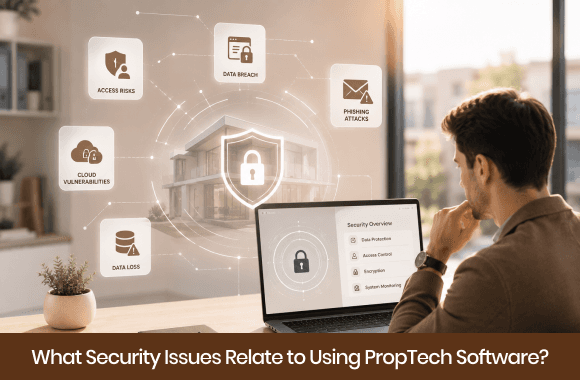
This guide explains the security issues that relate to using PropTech software, from data breaches and IoT vulnerabilities to payment fraud, third-party risk, and compliance gaps. It shows why PropTech is a high-value target, maps each risk to its impact and fix, and lists the compliance standards that apply. Backed by data from IBM, MRI Software, and real breach examples, it gives a practical checklist to reduce exposure and the questions to ask vendors. The takeaway: PropTech is safe when you treat security as a requirement, not an afterthought.
The main security issues with PropTech software are data breaches of sensitive tenant and financial information, vulnerable IoT and smart-building devices, payment fraud and phishing, weak third-party integrations, and compliance gaps. PropTech platforms hold the exact data attackers want, from banking details to access credentials, which makes them prime targets. The stakes are real: the average data breach now costs $4.45 million, according to IBM's research.
PropTech makes real estate faster and smarter, but every connected tool also widens the attack surface. A property platform can hold credit cards, banking details, leasing documents, and the keys to a building's HVAC and locks. That is what one expert called a complete identity-theft starter pack. I have seen firms adopt powerful tools while ignoring the security underneath them, which is a costly mistake. This guide breaks down the real risks, the compliance you need, and how to reduce your exposure.
What are the main security issues with PropTech software?
The main security issues are data breaches, IoT and smart-building vulnerabilities, payment fraud, insecure third-party integrations, and compliance failures. Each stems from the same root: PropTech concentrates sensitive data and physical access in connected systems. The more a platform automates, the more it becomes a single point of failure if security is weak.
Here are the core security issues to understand:
Data breaches: theft of tenant, buyer, and financial records.
IoT vulnerabilities: insecure smart locks, cameras, and HVAC.
Payment fraud: wire fraud, phishing, and business email compromise.
Third-party risk: weak vendor credentials and insecure APIs.
AI-enabled threats: convincing phishing that mimics real people.
Compliance gaps: failing GDPR, CCPA, SOC 2, or ISO 27001.
These risks are not reasons to avoid PropTech. They are reasons to choose and configure it carefully, the same discipline that runs through any sound real estate technology selection.
Why is PropTech a target for cyberattacks?
PropTech is a target because it concentrates high-value data and money in one place. Platforms process real estate transactions and rental payments while storing financial records, tenant applications, tax documents, and access credentials. That combination of money and sensitive data is exactly what attackers seek, which makes PropTech unusually attractive.
The value is hard to overstate. A property platform holds credit cards, banking details, addresses, leasing documents, and building access in a single system. If ransomware locks that data, move-ins stall, revenue drops, and legal trouble follows. As real estate digitizes through the trends covered in our what's next in PropTech guide, the attack surface keeps growing, so security has to grow with it.
What are the biggest PropTech security risks?
PropTech security risks fall into five main categories. Each carries a distinct threat and a distinct fix. Here is what to watch.
Data breaches and tenant data exposure
Property platforms collect deeply sensitive information: financial accounts, personal details, leasing documents, and tax records. A breach exposes all of it at once. Because this data is a complete identity-theft kit, tenant and owner records are among the most valuable targets in the entire sector.
IoT and smart-building vulnerabilities
Connected smart locks, HVAC systems, cameras, elevators, and sensors improve efficiency but each is a potential entry point. Many ship with default credentials and rarely get firmware updates. In 2021, attackers seized a commercial real estate firm's cloud-based building management system, took over HVAC controls, and demanded Bitcoin to restore service. With the smart-building market nearing $121 billion in 2026, this attack surface is expanding fast.
Payment fraud and phishing
PropTech handles high-value payments, which draws wire fraud, phishing, and business email compromise. Attackers exploit trusted conversations and urgent payment requests to redirect funds. A single spoofed email at closing can divert a large transaction, which is why payment workflows need strict verification.
Third-party and supply-chain risk
Insecure APIs, outdated integrations, and vendors with weak security are among the most overlooked risks. A single weak vendor credential can open a path to HVAC, access control, cameras, and even tenant Wi-Fi. This is why vendor security matters as much as your own, a point we stress in our guide to choosing an AI consulting firm.
AI-enabled threats
As real estate adopts AI, attackers use it too. AI-enabled phishing uses generative models to convincingly mimic brokers, leasing agents, or tenants, making scams far harder to spot. The same AI in real estate tools that boost productivity also raise the sophistication of attacks.
PropTech security risks: impact and mitigation
This table maps each major risk to its impact and the core fix.
Risk | Main impact | Core mitigation |
Data breach | Identity theft, legal liability | Encryption, access controls |
IoT vulnerability | Building access, service disruption | Change defaults, update firmware |
Payment fraud | Diverted funds | Verify payment changes directly |
Third-party risk | Backdoor into systems | Vendor security review, API audits |
AI phishing | Convincing scams | Training, multi-factor verification |
The pattern is clear. Most fixes are basic security hygiene applied consistently. The breaches that hurt usually trace back to a skipped fundamental, not an exotic attack.
What compliance standards apply to PropTech?
PropTech companies handling tenant and owner data must comply with frameworks like SOC 2, ISO 27001, GDPR, CCPA, and regional real estate data-protection laws. These standards govern how data is stored, accessed, and protected. Compliance matters because a breach of regulated data brings fines, lawsuits, and reputational damage on top of the direct cost.
Compliance is also a buying signal. A vendor with SOC 2 or ISO 27001 certification has had its security independently audited, which tells you the basics are in place. When you evaluate PropTech, treat these certifications as a baseline requirement, not a bonus. Governance and compliance should be built into your stack from the start, the same way they belong in any AI integration project.
How do you reduce PropTech security risks?
Reduce risk by combining strong vendor selection, basic security hygiene, and clear governance. Most breaches exploit a missing fundamental, so consistency beats complexity. Start with the controls that block the most common attacks, then layer on monitoring and training.
Follow these steps to lower your exposure:
Choose vendors with SOC 2 or ISO 27001 certification and review their security.
Encrypt sensitive data and enforce role-based access controls.
Change default credentials and update firmware on every IoT device.
Verify any payment change through a separate, trusted channel.
Train staff to spot phishing, including AI-generated scams.
Audit APIs and third-party integrations regularly.
Skip none of these. Security is only as strong as the weakest link, and attackers look for the one device or vendor you forgot. Our AI for real estate operators resources cover building this into operations.
What should you ask a PropTech vendor about security?
Ask vendors direct questions about certifications, data handling, and breach history before you buy. Their answers reveal whether security is built in or bolted on. Vague responses on encryption, access control, or compliance are a serious warning sign.
Key questions to ask every PropTech vendor: Do you hold SOC 2 or ISO 27001 certification? How is our data encrypted, at rest and in transit? Who can access our data, and how is that controlled? How do you secure APIs and third-party integrations? What is your breach history and response plan? Do you support GDPR and CCPA requirements? A trustworthy vendor answers these clearly and quickly, while a risky one deflects. The same scrutiny applies when assessing AI capability in any technology partner.
The bottom line on PropTech security issues
The key takeaway is that PropTech security issues center on protecting sensitive data, securing connected devices, preventing payment fraud, vetting third parties, and meeting compliance, with most breaches tracing back to skipped fundamentals rather than exotic attacks. The risks are manageable when you choose vendors carefully and apply basic security hygiene consistently.
Your next step is to audit your current PropTech stack: list the sensitive data each tool holds, confirm its certifications, and check that defaults, encryption, and access controls are in place. That audit reveals your biggest gaps fast.
PropTech is too valuable to avoid over security fears, but too risky to adopt carelessly. The firms that get this right treat security as a requirement, not an afterthought, demanding certifications, securing every device, verifying payments, and training their people. Do that and you capture the benefits of PropTech while keeping tenant trust and your balance sheet intact. Need help vetting your stack? Explore our technology and security services and book a strategy call.
- PropTech security issues center on data, devices, payments, vendors, and compliance.
- Platforms hold tenant financial and personal data, a complete identity-theft kit.
- The average data breach now costs $4.45 million (IBM).
- IoT devices often ship with default credentials and rarely get updates.
- A 2021 attack hijacked a firm's building management system for ransom.
- Required compliance includes SOC 2, ISO 27001, GDPR, and CCPA.
- Most breaches exploit a skipped fundamental, not an exotic attack.
- Vet vendors hard and apply basic security hygiene consistently.
Why trust Noseberry
Our content is written by practicing real-estate and PropTech professionals, fact-checked by a dedicated editorial team, and reviewed against the latest industry data before publication.
- 10+ years of industry expertise
- All facts independently verified
- No sponsored rankings in guides
- Updated when the industry changes
Frequently Asked Questions
What are the main security issues with PropTech software?
The main security issues with PropTech software are data breaches of sensitive tenant and financial data, vulnerable IoT and smart-building devices, payment fraud and phishing, insecure third-party integrations, and compliance gaps. These stem from PropTech concentrating valuable data and physical access in connected systems. The average data breach now costs $4.45 million, so the stakes are significant.
Why is PropTech a target for cyberattacks?
PropTech is a target because it concentrates high-value data and money in one place. Platforms process transactions and rental payments while storing financial records, tenant applications, tax documents, and building access credentials. That combination of money and sensitive personal data is exactly what attackers want, making PropTech platforms unusually attractive and high-value targets for fraud and ransomware.
How secure are smart building and IoT devices?
Smart-building and IoT devices are often weakly secured. Smart locks, cameras, HVAC, and sensors frequently ship with default credentials and rarely receive firmware updates, creating easy entry points. In 2021, attackers took over a commercial firm's building management system and demanded Bitcoin. With the smart-building market nearing $121 billion in 2026, securing these devices is increasingly critical.
What data do PropTech platforms collect that attackers want?
PropTech platforms collect credit card and banking details, personal identification, addresses, leasing documents, tax records, and building access credentials. Security experts call this a complete identity-theft starter pack, because it gives attackers everything needed to commit fraud. This concentration of sensitive financial and personal data is what makes property platforms such valuable targets for cybercriminals.
What compliance standards apply to PropTech software?
PropTech companies handling tenant and owner data must comply with SOC 2, ISO 27001, GDPR, CCPA, and regional real estate data-protection laws. These govern how data is stored, accessed, and protected. Certifications like SOC 2 and ISO 27001 signal that a vendor's security has been independently audited, so treat them as a baseline requirement when choosing software.
How do I reduce PropTech security risks?
Reduce risk by choosing certified vendors, encrypting sensitive data, enforcing role-based access, changing default device credentials, updating firmware, verifying payment changes through trusted channels, training staff on phishing, and auditing APIs and integrations. Most breaches exploit a missing fundamental, so applying basic security hygiene consistently blocks the majority of common attacks against PropTech platforms.
Can PropTech software be hacked through a vendor?
Yes, PropTech can be compromised through a vendor. Insecure APIs, outdated integrations, and partners with weak security are among the most overlooked risks. A single weak vendor credential can open a path to HVAC, access control, cameras, and tenant Wi-Fi. This is why reviewing third-party and supply-chain security is as important as securing your own systems.
How does AI increase PropTech security risks?
AI increases PropTech security risks by making attacks more convincing. AI-enabled phishing uses generative models to mimic brokers, leasing agents, or tenants, so scams are far harder to detect. The same AI tools that boost productivity also raise the sophistication of attacks. Multi-factor verification and updated staff training are essential defenses against AI-generated phishing and impersonation.
What questions should I ask a PropTech vendor about security?
Ask whether they hold SOC 2 or ISO 27001 certification, how data is encrypted at rest and in transit, who can access your data, how APIs and integrations are secured, their breach history and response plan, and whether they support GDPR and CCPA. A trustworthy vendor answers these clearly and quickly. Vague answers on encryption or compliance are a serious warning sign.
Related insights
 Real Estate
What should a PMS do for small-scale property managers?
The ideal PMS for a small-scale property manager (typically 10 to 500 units) should do ten things well: capture every rent payment automatically, log every maintenance ticket with photo evidence and vendor dispatch, hold every tenant lease and document in one searchable place, generate owner and investor statements in one click, run automated rent reminders and late-fee escalation, screen tenants with credit and eviction history, sync with the operator's accounting stack (QuickBooks, Xero), work on mobile so field checks and unit walks happen on a phone, integrate with a website for listing marketing and online applications, and produce broker-visible dashboards that let the manager see occupancy, delinquency, and cash flow at a glance. AppFolio Property Manager Core, Buildium, DoorLoop, Rentec Direct, and Hemlane are the platforms most adopted at this scale in 2026, at $1.40 to $4 per unit per month. This post covers what the ideal PMS should do, which platforms actually deliver it, and how to pick without overpaying.
August 22, 2026 Real Estate
Which AI tools work best for real estate developers in 2026?
The best AI tools for real estate developers in 2026 fall into eight categories that map to the developer lifecycle: land sourcing and site selection (Cherre, Reonomy, HouseCanary, LandGate), feasibility and financial modelling (Northspyre, TestFit, custom Excel plus GPT), design and architectural planning (Autodesk Forma, Higharc, Cove.tool, Snaptrude), construction management and progress tracking (Procore AI, Autodesk Construction Cloud, Buildots, Doxel, OpenSpace), pre-launch marketing and renders (Restb.ai, MidJourney, Adobe Firefly), off-plan sales CRM (Salesforce, HubSpot, Follow Up Boss, Rechat), ESG and net-zero analytics (Measurabl, Enertiv, Aquicore), and handover to operations (BIM AI, tenant portal AI). Used well, they cut construction cost 10 to 20 percent, compress design cycles 30 to 50 percent, and lift off-plan sales conversion 20 to 40 percent. Used badly, they burn subscription budget and produce plans that do not build. This post walks through each category, which tools actually work, and how to sequence adoption.
August 22, 2026 Real Estate
ADA & WCAG Accessibility Compliance for Real Estate Websites: What Operators Must Fix Before They Get Sued
This blog breaks down ADA and WCAG accessibility compliance for real estate websites, focused on what actually creates legal exposure. It explains why WCAG 2.1 Level AA has become the practical legal standard even without a formal Title III regulation for private businesses. It walks through the six accessibility failures responsible for 96% of all detected errors across the web, using real listing-page examples. It also warns against relying on accessibility overlay widgets, citing the FTC's 2025 action against accessiBe over deceptive compliance claims. The piece closes with a step-by-step audit process, an in-house versus compliance-partner comparison, and a 10-question FAQ section.
August 20, 2026
Ready to book a 30-minute strategy call?
We'll map the right digital moves for your real estate business, no pitch deck, no commitment.