
Noseberry Digitals
MLS Integration Explained: What It Is and How It Works for Real Estate Platforms
Published March 31, 2026|7 min read
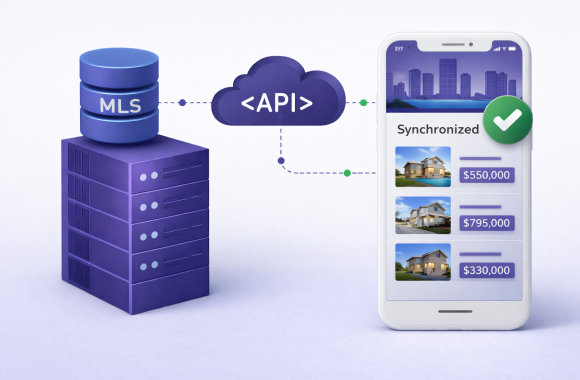
MLS integration comes up in almost every conversation about building a real estate portal or marketplace, but the term gets used in different ways by different people, and the technical reality behind it is rarely explained in plain language. This guide covers what an MLS actually is, how data sharing works in practice, what MLS […]
MLS integration comes up in almost every conversation about building a real estate portal or marketplace, but the term gets used in different ways by different people, and the technical reality behind it is rarely explained in plain language. This guide covers what an MLS actually is, how data sharing works in practice, what MLS integration means for a platform being built, and what the technical requirements look like for developers and operators trying to connect their platform to an MLS or build equivalent functionality from scratch.
What Is an MLS?
An MLS, or Multiple Listing Service, is a cooperative database created and maintained by a group of real estate brokerages or agents who agree to share their listings with each other under a set of rules governing data access, reciprocal cooperation, and commission sharing. The concept originated in the United States in the late nineteenth century when real estate agents began meeting to exchange information about properties for sale. The modern MLS is a digital platform that brokerages subscribe to, submit their listings to, and use to access the full inventory of other participating brokerages in a given market area. The key characteristic of an MLS is cooperation under agreed rules. A seller’s agent who lists a property on the MLS agrees to share that listing with buyer’s agents across all participating brokerages, typically in exchange for the buyer’s agent receiving a portion of the commission when the deal closes. This cooperative structure creates a comprehensive inventory that no single brokerage could maintain alone. MLS systems exist primarily in North America, where the model is most deeply institutionalised, but similar cooperative listing databases operate in various forms across other markets globally, often under different names and with different governance structures.
How MLS Data Sharing Works
When a listing agent enters a property into the MLS, they are creating a structured data record that includes all the relevant attributes of that property: address, price, bedrooms, bathrooms, square footage, lot size, property type, status, listing date, photos, and a narrative description. That record is stored in the MLS database and immediately becomes accessible to all other participating brokerages and, through data sharing agreements, to buyer-facing platforms that have been approved to display MLS data. The MLS controls who can access its data and under what conditions. Brokerages must be MLS members to submit listings. Third-party platforms must agree to display rules that govern how listings can be shown, including attribution requirements, update frequency, and the prohibition on modifying listing data without authorisation. When a listing status changes, such as a price reduction or a sale closing, the MLS record is updated and that update propagates to all platforms displaying the data. In a well-functioning MLS integration, the buyer-facing portal reflects the current status of every listing within a defined synchronisation window.
What MLS Integration Means for a Real Estate Platform
For a real estate portal or marketplace, MLS integration means establishing a data connection that allows listing records from the MLS to flow into the platform’s database automatically, be displayed to buyers in search results, and stay current as listing data changes. This solves the inventory problem that every new real estate marketplace faces. Building a portal with no listings is a chicken-and-egg problem: buyers will not use a platform with no inventory, and agents will not submit listings to a platform with no buyers. MLS integration bypasses that problem by connecting the portal to an existing, comprehensive inventory from the moment of launch. The practical requirements for MLS integration on a platform are a data ingestion layer that receives listing data in the MLS’s specified format, a transformation process that maps MLS data fields to the platform’s own data model, a synchronisation schedule that keeps listings current with MLS updates, a display layer that presents listing data in compliance with the MLS’s display rules, and a monitoring system that catches and flags data quality issues or sync failures.
The Technical Architecture Behind MLS Connectivity
The technical standard for MLS data sharing has evolved significantly over the past two decades. Understanding the current landscape helps explain why MLS integration projects vary in complexity. RETS, or Real Estate Transaction Standard, was the dominant data exchange protocol for many years. It is a query-based protocol that allows platforms to retrieve listing data by submitting structured queries to the MLS server. Many MLS systems still use RETS but it is being phased out in favour of newer standards. RESO Web API is the current standard promoted by the Real Estate Standards Organisation. It is a RESTful API built on modern web protocols, which makes it significantly easier to integrate with contemporary platforms than RETS. An MLS offering RESO Web API connectivity is far more straightforward to connect to than one still operating on legacy RETS. Beyond the protocol, each MLS has its own specific field naming conventions, required versus optional fields, permitted values for enumerated fields, and display rules. A platform integrating with multiple MLS systems in different markets must accommodate the variations between them, which is why multi-MLS integration projects are considerably more complex than single-MLS connections. The data pipeline for a well-built MLS integration includes an ingestion layer connecting to the MLS API, a normalisation layer mapping incoming data to the platform’s standard data model, a validation layer checking data quality, a storage layer maintaining the listing database, and a change detection system identifying updates and triggering re-synchronisation without reprocessing the entire dataset on every cycle.
MLS Integration vs Building Your Own Multi-Agency Data Layer
Not every market has a functioning MLS. In many markets globally, property listings are not shared through a cooperative database but through individual agency relationships, direct portal submissions, or informal data sharing arrangements. In these markets, a portal developer who wants comprehensive inventory has two options. The first is to aggregate listings from multiple sources directly, connecting to each contributing agency’s own system through individual API integrations. The second is to build a structured listing submission layer that agencies use to submit listings directly to the platform, creating a proprietary multi-agency database rather than connecting to an external cooperative one. Both approaches are significantly more complex than connecting to a single, well-documented MLS API, but they are technically achievable and represent the only viable path in markets where MLS infrastructure does not exist. A proprietary multi-agency submission layer has the advantage of full control over the data model, the submission workflow, and the quality standards applied to listings. It has the disadvantage of requiring active recruitment and onboarding of contributing agencies, which is a business development challenge as much as a technical one. For platforms in markets with existing MLS infrastructure, integration with that infrastructure is almost always preferable to building an alternative. Learn how portal architecture and listing data connectivity is approached in practice at our real estate portal development page.
Common Challenges in MLS Integration Projects
MLS integration projects consistently surface a set of challenges that are worth anticipating before beginning the technical work. Data quality variability is the most universal challenge. Not all listings in an MLS are submitted with complete, accurate, or consistently formatted data. A platform that displays MLS data without a quality validation layer will show buyers listings with missing photos, incorrect addresses, and inconsistent field values. Update latency creates buyer experience problems. If a listing sells but the platform continues showing it as available for hours or days after closing, buyers are disappointed and trust erodes quickly. The synchronisation frequency and change detection mechanism both need to be designed with update latency explicitly managed. Display rule compliance requires ongoing attention. MLS display rules specify how listings must be attributed and what data can be shown. These rules change over time as the MLS updates its policies, and a platform compliant at launch may fall out of compliance if its display layer is not maintained. Multi-MLS expansion is significantly more complex than single-MLS integration. Each additional MLS introduces its own data model variations, display rules, and API characteristics. A platform designed for single-MLS operation often requires architectural changes to support multi-MLS data in a consistent, normalised way.
Conclusion
MLS integration is fundamentally a data engineering challenge wrapped in a compliance and governance framework. The technology for connecting a portal to an MLS feed is well-understood. The complexity lies in the normalisation, quality validation, synchronisation, and display compliance requirements that determine whether that connection produces a reliable buyer experience or an unreliable one. For platforms entering markets with functioning MLS infrastructure, investing in a well-architected integration from the start is significantly more cost-effective than building a fragile connection quickly and dealing with the consequences of data quality problems and compliance failures later. For platforms in markets without MLS infrastructure, the challenge is not integration but aggregation: building the submission layer and the agency relationships that create the inventory an MLS would otherwise provide. In both cases, the goal is the same: a platform with comprehensive, current, accurate listing data that buyers can trust and agents want to contribute to. The path to that goal is different by market, but the data architecture principles that make it reliable are consistent.
Why trust Noseberry
Our content is written by practicing real-estate and PropTech professionals, fact-checked by a dedicated editorial team, and reviewed against the latest industry data before publication.
- 10+ years of industry expertise
- All facts independently verified
- No sponsored rankings in guides
- Updated when the industry changes
Related insights
 Real Estate
What Role Does SEO Play in Lead Generation for Real Estate Agents?
Most real estate agents either ignore SEO entirely or treat it as a branding exercise with no connection to their actual pipeline. This guide breaks down exactly what role SEO plays in lead generation for real estate agents, from the moment a buyer types a search query to the moment they book a call with you. You'll get the specific hacks that move map pack rankings, a clear comparison of SEO versus paid ads, and an explanation of AEO and GEO, the new lead sources that most agents haven't discovered yet. Every tactic is mapped to a sales outcome, not just a traffic metric. If you want an organic pipeline that keeps producing leads whether or not you're running ads, this is where you start.
July 3, 2026 Real Estate
What Are the Trends in Real Estate Technology in 2026
Real estate technology isn't evolving gradually anymore, it's accelerating fast, and most property businesses are already behind. This guide breaks down the trends actually moving the needle in 2026: agentic AI, predictive seller analytics, digital twins, drone data collection, and AI-enhanced CRMs. You'll see real adoption numbers, documented sales impact, and a clear framework for deciding which trend to act on first. Instead of a generic trend list, this post connects each innovation to a specific business outcome. If you want to know what's actually worth your attention this year, start here.
July 3, 2026 Real Estate
What Are the Key Features of Real Estate Website Development?
This guide breaks down the key features of real estate website development: IDX/MLS property search, lead capture tools, mobile-first design, immersive visuals, SEO, and CRM integration. It explains why IDX drives roughly four times the traffic, how multi-step forms convert better, and why over 75% mobile traffic makes speed essential. Backed by data from Luxury Presence, iHomefinder, and Placester, it shows how the features work together as a lead funnel. The takeaway: build the funnel first, since a website's real job is to generate and convert leads.
July 2, 2026
Ready to book a 30-minute strategy call?
We'll map the right digital moves for your real estate business, no pitch deck, no commitment.