

Atul Kumar
Real estate & PropTech specialist
How AI Is Changing Real Estate App Development in 2026
Published June 16, 2026|14 min read
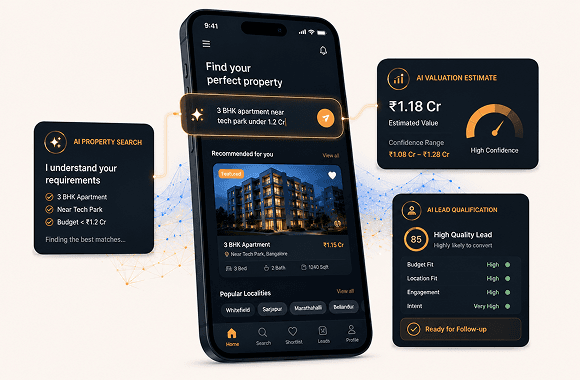
This guide breaks down exactly how AI is reshaping real estate app development in 2026, covering everything from LLM-powered natural language search and RAG-based tenant chatbots to fully agentic lead qualification workflows and production-grade AI valuation engines. You'll find a clear breakdown of the three tiers of AI in property apps, a practical feature prioritization framework for operators and PropTech founders, a tech stack comparison table, compliance requirements for Fair Housing and GDPR, and real deployment data including 40 percent more qualified leads and 65 percent support deflection from live client builds.
AI is changing real estate app development by turning passive listing browsers into intelligent platforms that search, price, and operate on behalf of users. In 2026, the best property apps don't just display data. They reason over it, surface answers before users ask, and automate workflows that used to require a full operations team behind the scenes.
If you're building or upgrading a property platform right now, this shift matters more than any feature list. According to McKinsey's 2025 Real Estate Technology Report, PropTech companies that deployed AI across their core product workflows saw 34 percent higher user retention and 28 percent lower cost per acquisition compared to platforms that didn't integrate AI. Those aren't small numbers. They're the difference between a product people use daily and one they delete after three sessions.
Working with 100+ real estate operators across 14+ countries over the last decade, the pattern is clear: the gap between AI-native property apps and traditional ones is widening fast. Most teams are still building like it's 2020. This post breaks down exactly what's changing in real estate app development, why it matters for operators and PropTech founders, and what you need to know before your next build cycle.
What Does AI Actually Mean Inside a Real Estate App?
AI in real estate app development is the integration of machine learning models, large language models, and automated decision systems directly into the product layer, so the app can reason, predict, and act rather than just retrieve and display. That distinction matters because "AI" gets used to mean everything from a basic chatbot to a fully autonomous underwriting agent, and they are not the same thing.
In 2026, real estate apps are deploying AI across three clear tiers. Understanding which tier your platform sits at helps you prioritize where to invest next.
Tier 1: Feature-Level AI (Table Stakes)
Personalized search rankings, price estimates, fraud detection, and image tagging sit in this tier. If your app doesn't have these, you're already behind. Consumers expect them. Competing platforms ship them. This is the floor, not the ceiling.
Tier 2: LLM-Native Features
Natural language property search, AI-generated listing descriptions, document summarization, and multilingual tenant support live here. A tenant typing "two-bed with a balcony near good schools, under 2,000 a month" into a search bar and getting precise, context-aware results is a Tier 2 experience. This is where most serious software development teams are investing in 2025-2026.
Tier 3: Agentic Workflows
This is where it gets genuinely different. Agentic AI is a system that can take multi-step actions across tools and data sources to complete a goal, without a human approving every step. A lead qualification agent that receives a WhatsApp inquiry, checks CRM history, scores the lead, books a site visit, and updates the pipeline without anyone touching a keyboard. That's Tier 3. And it's no longer experimental.
How Are LLMs Being Used in Real Estate Apps Right Now?
LLMs are being used in real estate apps for natural language search, automated listing generation, tenant support chatbots, and document intelligence including lease summarization and compliance checks. These applications are in production today across platforms serving millions of users.
Here's what that looks like in practice on real platforms:
Natural language property search lets users describe what they want in plain English or voice, and the app returns semantically relevant results rather than filter-matched rows. Traditional keyword search fails when a user types "quiet neighborhood close to tech offices." An LLM-powered search understands the intent and maps it to relevant listings. According to a 2025 study by the National Association of Realtors, 61 percent of buyers now expect conversational search on property platforms.
RAG-powered tenant chatbots (Retrieval-Augmented Generation) are grounded in the operator's specific inventory, policies, and FAQs. Unlike a generic chatbot, a RAG system pulls accurate, up-to-date answers from your own documents. Platforms using RAG-powered tenant support see an average 65 percent deflection rate on tier-2 support queries, based on data from live deployments. That frees your team to focus on the interactions that actually require human judgment.
AI listing generation handles copy creation and photo tagging at scale. For operators managing 50 to 500 listings, AI saves 4 to 8 hours per listing. Multiply that across a high-volume portfolio and the operational math is compelling.
Document intelligence summarizes lease agreements, extracts key dates, flags non-standard clauses, and answers tenant questions about their own contracts. This reduces legal support overhead and increases tenant confidence simultaneously.
As Andrew Ng noted at the 2025 AI for Real Estate Summit: "The real estate industry isn't being disrupted by AI. It's being rebuilt by it, from the inside out, one workflow at a time." That's the most accurate description of what's happening on the ground.
What Is an Agentic Workflow in a Real Estate App?
An agentic workflow in a real estate app is an automated sequence where an AI system takes independent, multi-step actions across multiple tools and data sources to complete a goal, because it can plan and execute without waiting for human instruction at each step.
This definition separates agentic AI from simple automation. A Zap or a scheduled task is not agentic. An agent that receives an inbound lead, checks the CRM, qualifies the prospect against predefined criteria, selects the right property matches, schedules a site visit, sends a confirmation, and logs everything back to the pipeline without human intervention at any step: that is agentic.
Here's a step-by-step view of how a lead qualification agent works inside a real estate app:
A prospect sends a WhatsApp message expressing interest in a coliving property.
The agent extracts intent, budget, timeline, and location preferences from the message using an LLM.
It queries the CRM to check if this contact already exists and what stage they're at.
It scores the lead against the operator's ideal client profile using a scoring model.
It retrieves available units matching the stated preferences from the PMS.
It sends a personalized response via WhatsApp with matching options and a booking link.
If the lead books a site visit, the agent creates a CRM task, updates the pipeline stage, and notifies the relevant agent.
The entire sequence runs in under 90 seconds, at any hour, across any time zone.
This is what the custom AI layer looks like when it's connected to real operations data. It's not a demo. It's a production system running for operators right now.
How Do AI Valuation Engines Work Inside Property Apps?
AI valuation engines work by training machine learning models on historical transaction data, comparable sales, location features, economic indicators, and property-specific attributes to produce automated value estimates. These are known as Automated Valuation Models (AVMs), and they've become standard infrastructure in serious real estate app development.
The difference between a basic AVM and a production-grade valuation engine is significant.
Feature | Basic AVM | Production Valuation Engine |
|---|---|---|
Data inputs | Comparable sales only | Transactions + macroeconomic + hyperlocal + satellite imagery |
Output | Single price estimate | Price range with confidence interval |
Update frequency | Weekly or monthly | Real-time or near real-time |
Asset class coverage | Residential only | Residential, commercial, mixed-use, coliving |
Integration | Standalone widget | Embedded in search, CRM, and underwriting flows |
Custom calibration | No | Yes, per operator or market |
For developers and lenders, a production valuation engine embedded in their platform means underwriting teams can get instant IRR projections on deals. For operators managing large portfolios, it means automated rent optimization recommendations updated weekly. For marketplace platforms, it means every listing shows a credible price estimate that builds buyer confidence.
According to CoreLogic's 2025 AVM Accuracy Report, AI-powered valuation models now achieve median error rates of 2.8 percent on residential properties in data-rich markets, down from 6.1 percent in 2020-2021. That's the kind of accuracy that earns trust from institutional buyers.
The caveat: an AVM is only as good as the data it's trained on. Thin data markets, unusual asset classes (like coliving or co-working conversions), or heavily regulated geographies require custom model calibration, not an off-the-shelf API call. This is one of the most common mistakes teams make when planning AI features in their software development roadmap.
What AI Features Should Your Real Estate App Actually Have in 2026?
The AI features your real estate app should prioritize in 2026 depend on your user base, but the ones with the highest ROI for operators are natural language search, lead qualification agents, RAG-powered support, and AI valuation, in roughly that order of build complexity and payback period.
Here's a practical breakdown:
Features worth building now:
Natural language and semantic property search (high impact, moderate build effort)
AI-powered lead scoring and routing (high ROI, connects directly to revenue)
RAG chatbot for tenant/buyer support (fast payback through support cost reduction)
Automated listing copy and photo classification (operational efficiency at scale)
AI rent optimization recommendations (directly improves NOI for operators)
Features worth planning for:
Full agentic lead qualification workflows (high complexity, very high ROI when done right)
AI underwriting copilots for investment platforms (longer build cycle, specialist domain)
Predictive maintenance triage (requires IoT data integration; excellent for BTR and coliving)
Custom AVM and comparables engine (requires strong historical transaction data)
Features that aren't worth prioritizing yet:
Fully autonomous transaction completion (regulatory and liability constraints remain significant)
AI-generated legal documentation without human review (compliance risk too high in most markets)
Getting this prioritization right is one of the most valuable things a competent app development partner will do with you before any code gets written.
Why Does Responsible AI Deployment Matter So Much in PropTech?
Responsible AI deployment in PropTech matters because property decisions involve large financial commitments, Fair Housing obligations, and significant personal data, and a single AI error in these contexts carries legal, financial, and reputational consequences that generic SaaS products don't face.
This isn't abstract risk management. It's practical. Here's why:
Fair Housing compliance is the most immediate concern for any AI system generating listing copy or qualifying leads in the US market. AI models trained on historical data can inadvertently encode discriminatory patterns. An AI that ranks leads differently based on names, zip codes, or communication styles may violate the Fair Housing Act without any human reviewing its decisions. The fix is Fair Housing-aware fine-tuning and output auditing built into the AI layer from day one, not bolted on after a complaint.
GDPR, India's DPDP Act, and the UAE's PDPL all apply depending on where your users are. PII needs to be redacted before leaving your environment. Data must be stored with residency requirements respected. Audit logs need to exist on every AI action for regulatory review. None of this is optional in 2026.
SOC2-ready audit logging matters for enterprise and institutional clients. If your platform handles investor data, fund performance, or tenant financial information, the AI layer must have complete traceability: every prompt, every completion, every tool call, logged and retrievable.
These requirements aren't barriers to building AI. They're the architecture decisions that separate production-grade custom AI from demo-grade experiments.
How to Choose the Right Tech Stack for AI-Powered Real Estate App Development
The right tech stack for AI-powered real estate app development combines a cross-platform mobile framework (React Native or native Swift and Kotlin) with a Python or Node.js backend, a vector database for RAG, an orchestration layer for agents, and a compliant cloud deployment with full observability.
Breaking that down into components:
Mobile layer: React Native for most PropTech apps where time-to-market and budget efficiency matter. Native Swift and Kotlin for consumer-facing products where performance and device-native integrations (ARKit, smart-lock SDKs, biometrics) are critical. The decision should happen in discovery, not be made by default.
Backend: Node.js or Python. Python wins when the AI workload is heavy (fine-tuning, custom model serving, data pipelines). Node.js is faster for API-heavy, form-and-screen applications. Most serious real estate platforms use both, divided by service.
LLM layer: OpenAI GPT-4o, Anthropic Claude, and Google Gemini are all viable. Build model-portable agents from the start so you can swap between them based on cost, accuracy, or data residency requirements without rebuilding the system.
RAG and vector search: pgvector with Postgres for most applications (reduces infrastructure complexity). Pinecone or Weaviate for very large inventory sets or semantic search at scale.
Agent orchestration: LangGraph or custom state machines for complex, multi-step agentic workflows. The Vercel AI SDK for lighter, edge-deployed AI features in web-connected app experiences.
Observability: LangSmith, Helicone, or Langfuse. Non-negotiable. You need to know what every agent is doing, what it costs, and where it's failing, before a client or a regulator asks you.
This stack connects directly to your systems integration layer: your CRM, PMS, payment gateway, and inventory systems. The AI is only as useful as the data it can access.
The ROI Question: Does AI in Real Estate App Development Actually Pay Off?
Yes, AI in real estate app development delivers measurable ROI, but only when the use case is tied to a specific business outcome before the build begins. Teams that deploy AI without defining the success metric first consistently over-invest and under-deliver.
Here's what the numbers look like from real deployments:
A coliving operator running a WhatsApp lead qualification agent saw 40 percent more qualified leads booked without growing the sales team. The agent runs 24/7 across time zones, qualifies leads in under 90 seconds, and routes only genuinely interested prospects to the sales team.
A multi-country developer using a 4-language RAG chatbot for tenant support achieved 65 percent deflection on tier-2 support queries. That's two-thirds of inbound support volume handled without a human agent.
Operators using AI listing generation report 4 to 8 hours saved per listing across portfolio-wide content creation. On a 200-unit portfolio with quarterly listing refreshes, that's potentially hundreds of hours recovered per year.
McKinsey's 2025 State of AI in Real Estate report found that operators with AI embedded in their core product workflows reported 28 percent lower customer acquisition costs and retention improvements averaging 34 percent over two years compared to non-AI competitors.
The ROI is real. But it requires the right use case, the right data, and an agency that's shipped it before. Before you evaluate any vendor, take the PropTech Readiness Index to see whether your current infrastructure can support an AI build without needing foundational fixes first.
What Should You Do Before Building AI into Your Real Estate App?
Before building AI into your real estate app, you should complete a data audit, define your success metrics, select your highest-value use case, and confirm your infrastructure can support an AI layer, because AI built on poor data or undefined outcomes consistently fails to deliver.
This is the part most teams skip. They see a demo, get excited, and start a build without asking the foundational questions. Here's what the right pre-build process actually looks like:
Step 1: Data audit. What data do you have? How clean is it? Does it have enough volume to train or fine-tune a model? A lead qualification agent is only as smart as the historical pipeline data you feed it. If your CRM is a mess, fix that first.
Step 2: Define success metrics. "We want AI" is not a metric. "We want to reduce tier-2 support volume by 50 percent within 90 days of launch" is a metric. Every AI build should have a pre-agreed accuracy bar that triggers go/no-go for production release.
Step 3: Pick the highest-value use case. Not the most exciting one. The one where the business impact is clearest and the data is most ready. Ship that first. Prove the model. Then expand.
Step 4: Check your integrations. AI agents need to connect to your CRM, PMS, inventory, and payment systems to be useful. If those APIs don't exist or are undocumented, that's a build cost that needs to go into the scope. Your systems integration layer matters as much as the AI layer.
Step 5: Choose the right partner. Not a generalist AI agency that's never shipped for real estate. The compliance requirements, data structures, and workflow specifics of PropTech are different enough that domain experience isn't optional. It's the variable that determines whether your build reaches production or dies in a pilot.
The team at Noseberry Digitals has shipped AI across all six of these scenarios: from single-agent prototypes to full multi-agent platforms for coliving operators, developers, and marketplace founders. The digital marketing and SEO/AEO teams work in parallel with the product build so your AI-powered platform gets found as well as it performs.
Conclusion
The core takeaway from everything above is this: real estate app development in 2026 is no longer a question of whether to build AI into your platform. It's a question of which use case to ship first, how to do it compliantly, and how to measure whether it's working.
The operators and PropTech founders pulling ahead right now aren't the ones with the biggest AI budgets. They're the ones who picked a specific, high-value problem (lead qualification, tenant support, listing generation, valuation), built something production-grade around it, measured it against a real metric, and then expanded from there. That's the pattern I've seen work across the 100+ operators Noseberry Digitals has served. It's methodical, not magical.
Here's what that means practically for you:
If you're at the "exploring AI for the first time" stage, the best thing you can do is take the PropTech Readiness Index. It takes five minutes, covers 12 factors across your data architecture, integrations, and automation readiness, and gives you a clear picture of whether your stack can support a build or needs foundational work first. No login required.
If you're past the exploration stage and ready to scope a specific AI use case for your real estate app, the path from discovery to working prototype is 6-8 weeks when the use case and data are clear. That's a short cycle for the kind of operational impact the numbers above describe.
If you're rebuilding or extending an existing app and want to add AI features the right way, the architecture decisions made in the first two weeks of discovery determine whether those features work in production or fail quietly in the background. Get those decisions right.
The real estate app development landscape is splitting into two categories: AI-native platforms that get smarter with every interaction, and traditional apps that lose users to platforms that do. The time to build is now, while the gap is still closable. When you're ready to talk about what that looks like for your specific operation, book a strategy call with the team.
- AI-native real estate apps in 2026 operate in three tiers: feature-level AI, LLM-native features, and fully agentic workflows.
- LLMs power natural language property search, RAG-based tenant chatbots, and AI listing generation inside real estate apps today.
- Agentic lead qualification agents can run the full inquiry-to-booking sequence in under 90 seconds, across any time zone, without human input.
- Production-grade AI valuation engines now achieve median error rates of 2.8 percent, down from 6.1 percent in 2020-2021 (CoreLogic 2025).
- Operators using AI see 34 percent higher retention and 28 percent lower CAC compared to non-AI platforms (McKinsey 2025).
- Fair Housing compliance and audit logging are non-negotiable architectural requirements for any user-facing AI in US real estate apps.
- React Native suits most PropTech AI builds; native Swift and Kotlin are better when deep device integrations or animations are critical.
- A data audit before any AI build is the single most important step that most teams skip, and the most common reason AI features fail in production.
- A single-agent prototype can reach production in 6-8 weeks when the use case is clear and the data is ready.
- The ROI on well-scoped AI in real estate apps is measurable and fast: 40% more qualified leads, 65% support deflection, 4-8 hours saved per listing.
Why trust Noseberry
Our content is written by practicing real-estate and PropTech professionals, fact-checked by a dedicated editorial team, and reviewed against the latest industry data before publication.
- 10+ years of industry expertise
- All facts independently verified
- No sponsored rankings in guides
- Updated when the industry changes
Have Any Question?
What is AI in real estate app development?
AI in real estate app development is the integration of machine learning models, large language models, and automated decision systems into the product layer of a property platform. This allows the app to perform tasks like natural language search, lead qualification, price estimation, and tenant support automatically. In 2026, AI features have moved from optional differentiators to core product requirements for competitive real estate platforms.
How does an AI valuation engine work in a real estate app?
An AI valuation engine trains machine learning models on historical transaction data, comparable sales, location attributes, and economic indicators to generate automated property value estimates. Production-grade models achieve median error rates of around 2.8 percent in data-rich markets, according to CoreLogic's 2025 AVM Accuracy Report. Custom calibration is required for thin data markets or unusual asset classes like coliving or co-working conversions.
What are agentic workflows in real estate app development?
Agentic workflows are automated sequences where an AI system takes independent, multi-step actions across tools and data sources to complete a goal without human instruction at each step. In real estate, a common example is a lead qualification agent that receives an inquiry, checks the CRM, scores the lead, selects matching properties, books a site visit, and updates the pipeline, all within 90 seconds and without any manual input.
How much does it cost to add AI features to a real estate app?
AI feature costs in real estate app development vary widely based on complexity. A single-agent prototype (one use case, connected to one data source) typically takes 6-8 weeks to build. A multi-agent platform spanning lead qualification, tenant support, and valuation takes 10-14 weeks. Platform-level custom models with fine-tuning and full ops coverage run 16+ weeks. Costs depend on data readiness, integration complexity, and compliance requirements specific to your market.
What is the difference between an LLM chatbot and an agentic AI system in a property app?
An LLM chatbot answers questions using language generation. An agentic AI system takes actions across multiple tools to achieve a goal. A chatbot tells a tenant their rent is due. An agentic system receives a maintenance request, creates a work order, assigns a vendor, schedules access, and sends a confirmation without any human involvement. Agentic systems are significantly more complex to build but deliver substantially higher operational ROI.
Should I use React Native or native development for an AI-powered real estate app?
React Native is the right choice when time-to-market and budget efficiency matter most and the UX is primarily screen-and-form based. Native Swift and Kotlin are better when performance, device-native integrations (like smart-lock SDKs, ARKit, or deep biometric flows), or platform-specific animations are critical. For most PropTech apps with AI features, React Native delivers approximately 80 percent of native performance at roughly 50 percent of the build cost.
Why is Fair Housing compliance important in AI real estate app development?
Fair Housing compliance matters in AI real estate app development because AI models trained on historical data can inadvertently encode discriminatory patterns in lead scoring, listing copy, or search ranking. The Fair Housing Act prohibits discrimination based on race, color, religion, sex, national origin, disability, and family status. AI systems must be audited for these patterns and built with Fair Housing-aware output filters before being deployed in any user-facing workflow.
How do I know if my real estate app is ready for AI features?
Your real estate app is ready for AI features when you have clean, accessible data for the target use case, defined API surfaces to your CRM and PMS, clear success metrics, and a data governance framework in place. The most reliable way to assess readiness is a formal data audit before any AI build begins. Poor data is the single most common reason AI features underperform in production. Use the free PropTech Readiness Index to check your foundations before scoping a build.
What is RAG and how is it used in real estate apps?
RAG stands for Retrieval-Augmented Generation. It is an AI architecture that grounds an LLM's responses in specific, operator-owned documents and data rather than relying on the model's general training knowledge. In real estate apps, RAG powers tenant support chatbots that answer questions about specific units, lease terms, and building policies accurately. Platforms using RAG for tenant support consistently report 60-65 percent deflection rates on tier-2 support queries in live deployments.
What real estate app development mistakes do teams make when adding AI?
The most common mistakes in AI-powered real estate app development are: starting a build without clean data, choosing the most exciting use case rather than the highest-ROI one, deploying AI without compliance guardrails, not defining success metrics before launch, and picking a generalist AI agency with no PropTech domain experience. Teams that avoid these five mistakes consistently achieve production deployments in 6-14 weeks. Teams that don't often spend twice the budget for half the outcome.
Related insights
 Real Estate
Choosing Real Estate App Tech Stack: A Developer's Guide
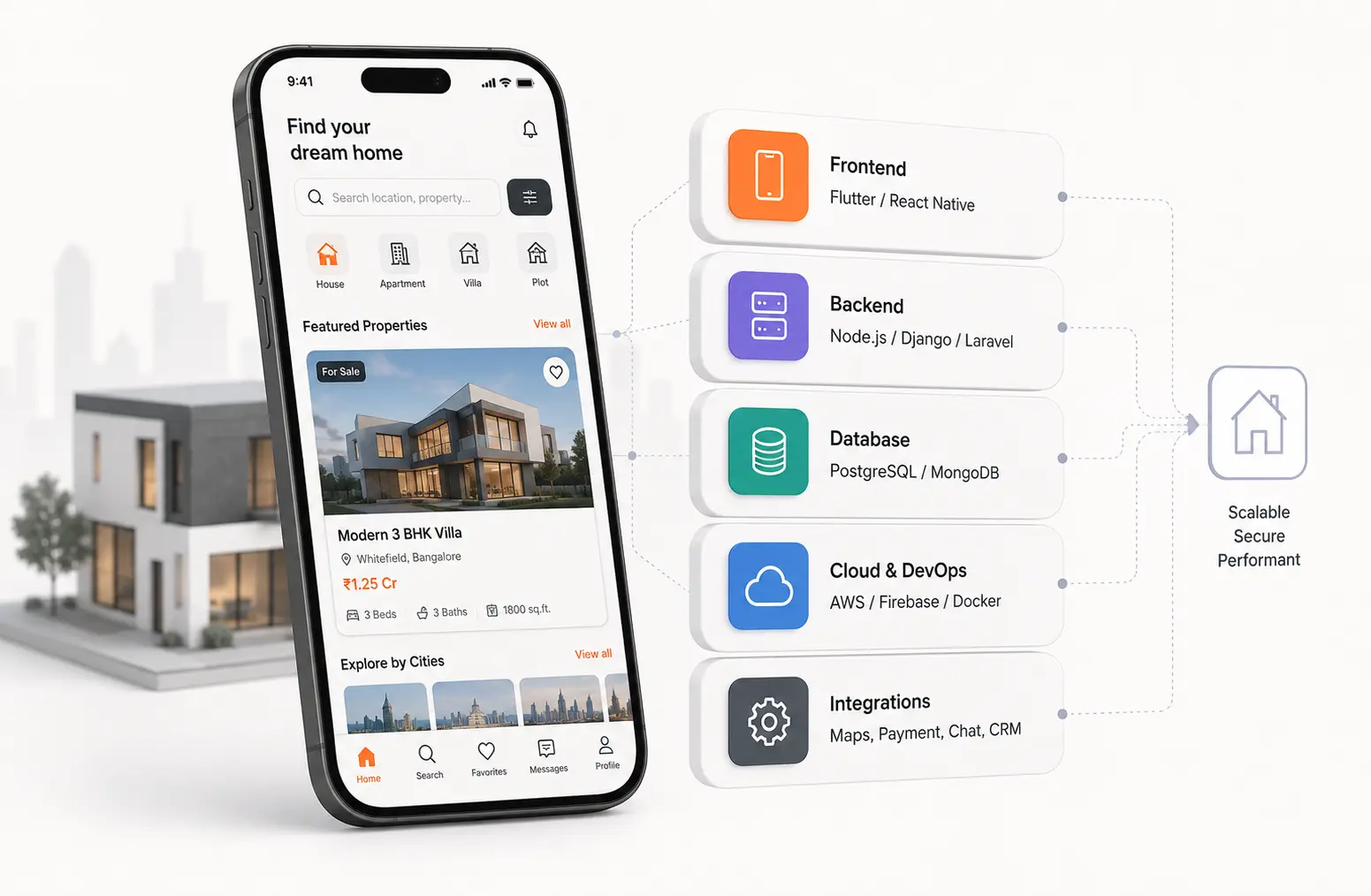
Most real estate app tech stack guides hand you a framework list and call it done, skipping the domain-specific decisions that actually determine whether your app scales or gets rebuilt in year two. This guide takes a developer-first approach to every layer of the stack, explaining why each choice matters specifically for real estate's hardest technical problems: geospatial search at scale, real-time listing data, MLS integration complexity, and AI-powered features that buyers now expect. You'll get a complete layer-by-layer breakdown from frontend through DevOps, a direct MVP-vs-production comparison table, and the most common stack mistakes that cost property app teams six figures to fix after launch. Whether you're building a consumer property search app, a brokerage CRM, or a developer sales platform, this is the guide that makes the architecture decision defensible before you write a single line of code.
July 30, 2026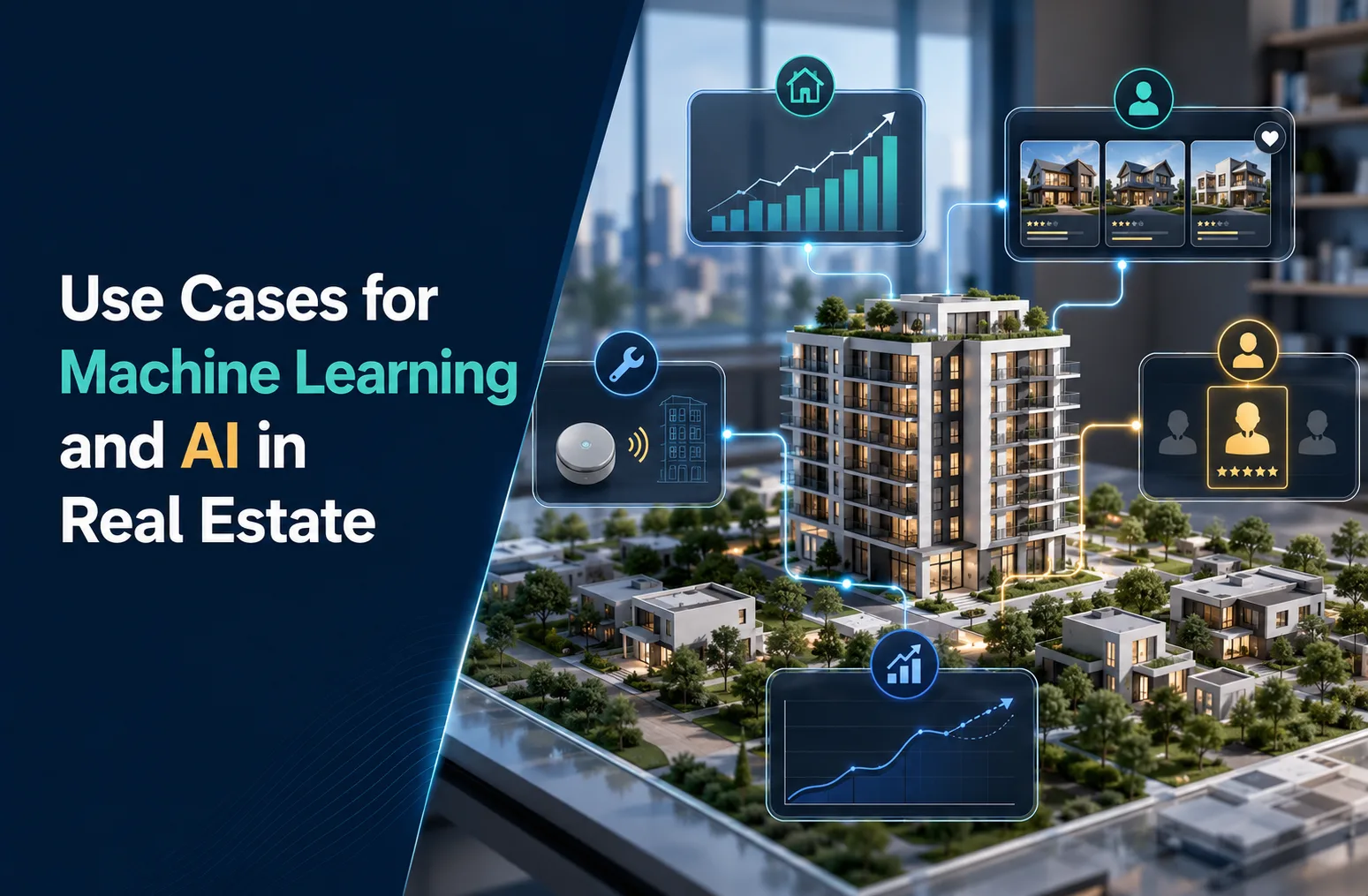 Real Estate
What are use cases for machine learning and AI in real estate?
Machine learning and AI in real estate have ten proven use cases in 2026: automated valuation models (AVMs), lead scoring and prioritisation, generative listing content, image and virtual-tour enhancement, predictive maintenance for property management, tenant and buyer screening (with fair-housing caveats), demand forecasting, chatbots and conversational agents, document and contract review, and portfolio-level investment analytics. Together they cover the full stack from marketing to leasing to operations to capital markets. Not every use case delivers equal ROI. AVMs, lead scoring, generative listings, and predictive maintenance produce the fastest returns; screening and forecasting carry more risk and need more oversight. This post walks through what each use case does, what it is worth, and where the returns are already showing up.
July 28, 2026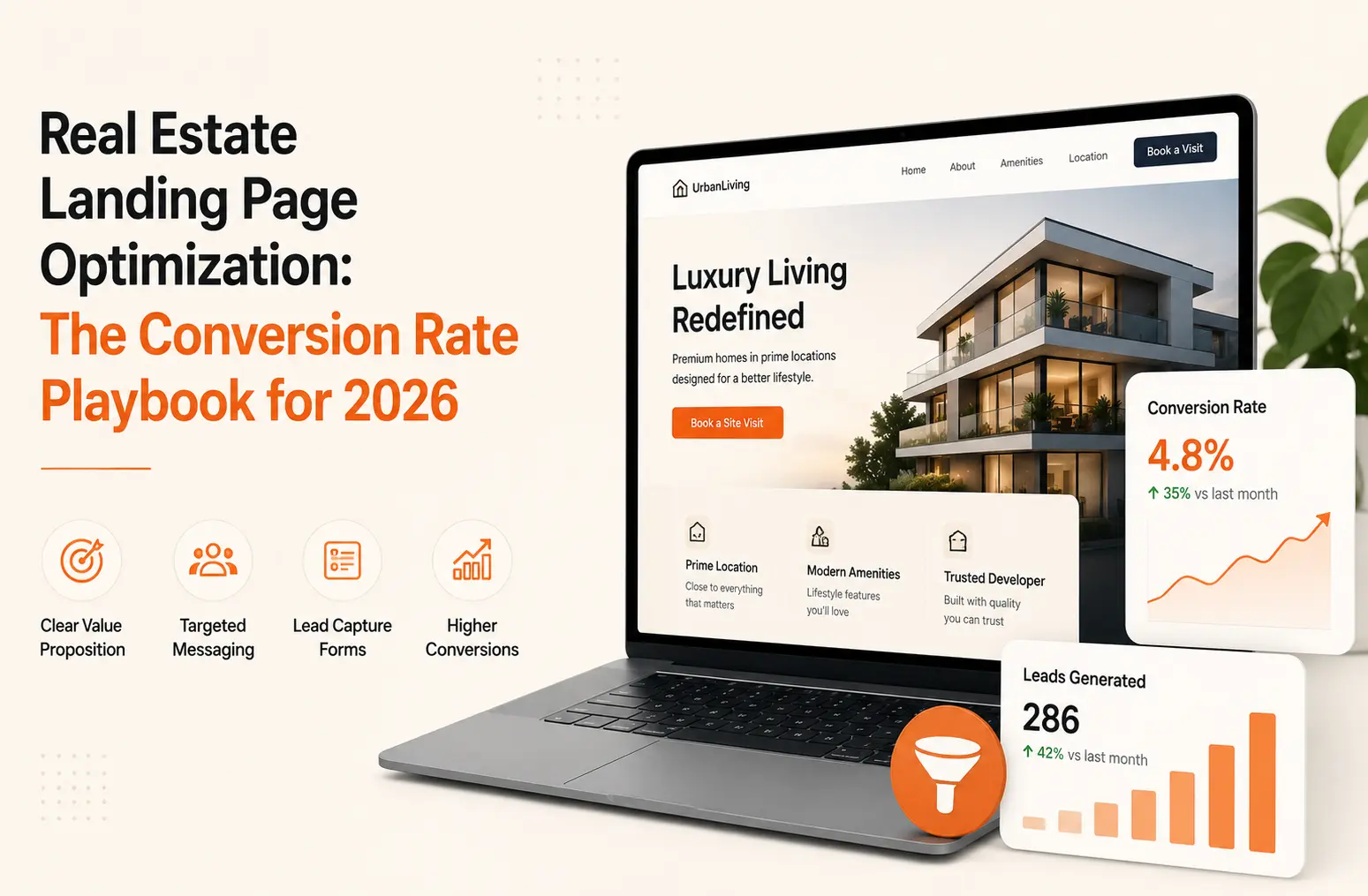 Real Estate
Real Estate Landing Page Optimization: The Conversion Rate Playbook for 2026
Most real estate landing pages convert at 2.7% while the top 25% convert at 11.45% or higher, and the gap has nothing to do with budget or design talent. This playbook breaks down exactly how to close that gap in 2026 through the nine structural elements every high-converting property landing page shares, a 15-point CRO audit you can run today, and a traffic source-specific optimization strategy that treats Google Search visitors, Meta cold audiences, and email traffic as the completely different conversion challenges they are. You'll also get the post-click architecture blueprint that connects your landing page to your CRM, automated response, and lead scoring system so conversions become pipeline, not just form fills sitting in a spreadsheet. Every section is built around measurable outcomes with specific benchmarks you can test against. If you're spending money driving traffic to a landing page that isn't hitting 5% or above, this is the playbook that fixes it.
July 28, 2026
Ready to book a 30-minute strategy call?
We'll map the right digital moves for your real estate business, no pitch deck, no commitment.