

Mayank Pokharna
COO, Noseberry Digitals & Industry Expert
Choosing Real Estate App Tech Stack: A Developer's Guide
Published July 30, 2026|17 min read
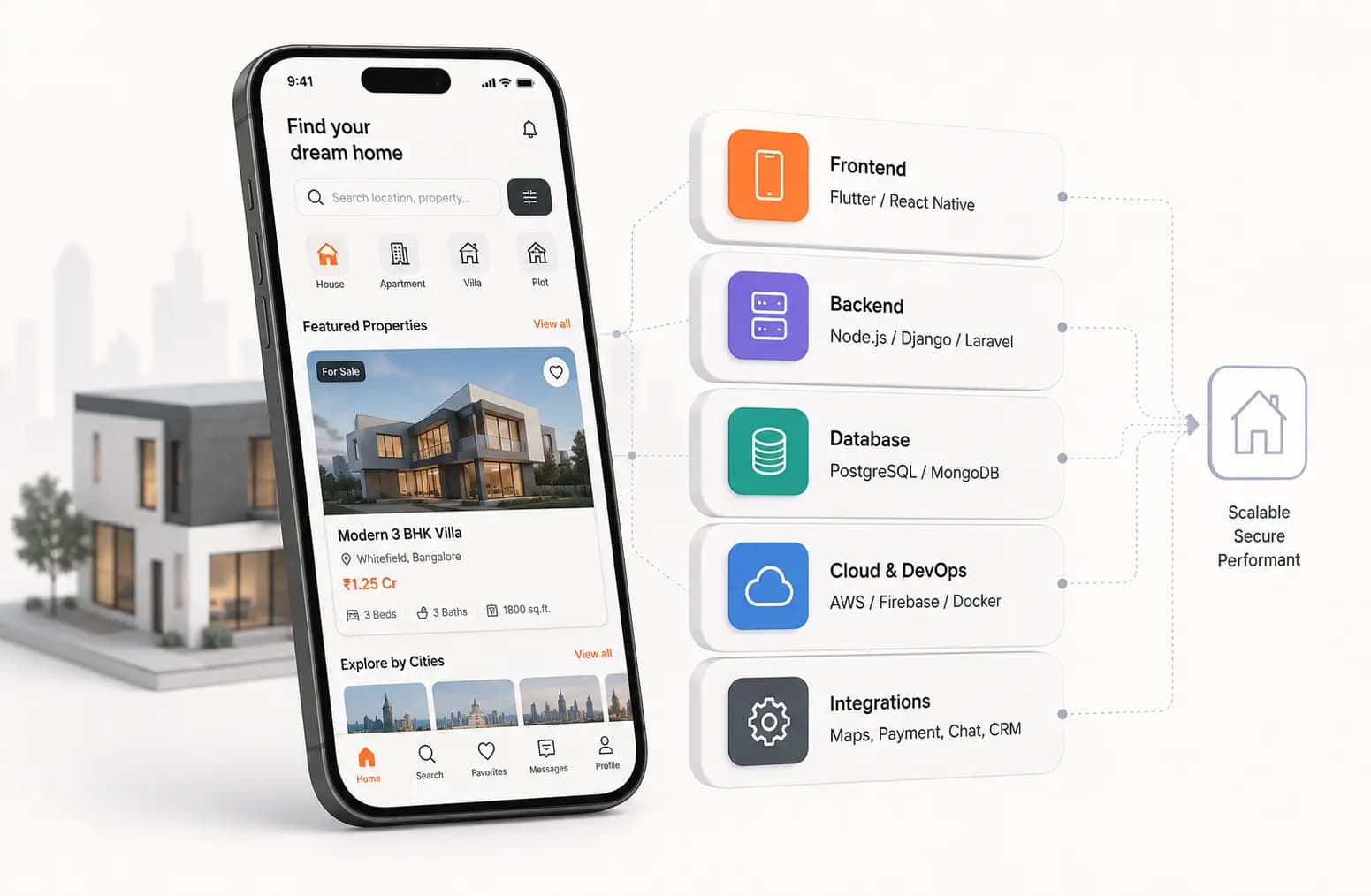
Most real estate app tech stack guides hand you a framework list and call it done, skipping the domain-specific decisions that actually determine whether your app scales or gets rebuilt in year two. This guide takes a developer-first approach to every layer of the stack, explaining why each choice matters specifically for real estate's hardest technical problems: geospatial search at scale, real-time listing data, MLS integration complexity, and AI-powered features that buyers now expect. You'll get a complete layer-by-layer breakdown from frontend through DevOps, a direct MVP-vs-production comparison table, and the most common stack mistakes that cost property app teams six figures to fix after launch. Whether you're building a consumer property search app, a brokerage CRM, or a developer sales platform, this is the guide that makes the architecture decision defensible before you write a single line of code.
The right real estate app tech stack is the one that handles real-time listing data at scale, integrates cleanly with MLS or property portal feeds, supports map-based search without performance degradation, and can ship an MVP in 90-120 days without locking you into architecture decisions you'll regret at 100,000 users. Every choice you make in the stack compounds. A frontend framework that can't server-side render listing pages will cost you organic traffic. A database that can't handle geospatial queries will make your search feature unusable. A monolithic backend that can't separate the listings module from the messaging module will make scaling expensive. Get these decisions right early and the rest of the build accelerates. Get them wrong and you rebuild.
In this guide, we'll walk through every layer of the real estate app tech stack, from frontend frameworks to database architecture, mapping APIs, real-time infrastructure, AI integration, third-party data sources, and DevOps. For each layer, you'll get a recommendation, the reasoning behind it specific to real estate, and the trade-offs to evaluate. This is a developer's guide, but it's also a product decision guide, because in real estate app development, the technical choices and the business requirements are inseparable. If you're planning the digital infrastructure for a property business and want to understand how the app layer connects to your digital marketing and lead generation stack, this is where to start.
According to Developer Tech News, a standard real estate app MVP typically costs between $150,000 and $400,000 in 2026. That's a significant investment, and the tech stack choices made in week one have a direct bearing on whether that investment produces a scalable product or a costly rebuild three years later.
What Is a Real Estate App Tech Stack and Why Does It Matter?
A real estate app tech stack is the complete set of programming languages, frameworks, databases, APIs, third-party services, and infrastructure tools that together power a property application, because each layer handles a specific problem (rendering, data storage, search, real-time updates, payments) and the quality of the whole system depends on how well those layers integrate with each other.
The stakes in real estate are higher than in most app categories because of five domain-specific requirements that generic app stacks often can't handle out of the box:
1. Geospatial search at scale. Property search is fundamentally a geographic problem. Users search by map boundary, radius from a point, commute time, school zone, or administrative boundary. Your database must handle geospatial queries efficiently, and your frontend must render map-based search without blocking the UI.
2. Real-time listing data. Property availability changes within hours. A listing marked available at 9am may be under offer by 2pm. Your stack must handle real-time data sync across a large listing inventory without rebuilding every page on every update.
3. Rich media at scale. Property listings are media-heavy. Multiple high-resolution photos, virtual tour embeds, floor plan PDFs, and drone video links all need to load fast on mobile networks. Your media handling and CDN configuration directly affect both user experience and search engine rankings.
4. Third-party data integration. Unlike most app categories, real estate apps depend on external data sources: MLS feeds, property portals, mapping APIs, mortgage calculators, title data APIs, and planning permission databases. Your stack must handle these integrations without creating fragile single points of failure.
5. Regulatory compliance variance by market. Real estate is regulated differently in every jurisdiction. RERA in the UAE, HRERA in India, GDPR in Europe, Fair Housing Act compliance in the US. Your stack needs to support market-specific compliance configurations without requiring a full rebuild for each geography.
Get all five of these right, and you have the foundation of a competitive real estate application. Miss any one of them, and you'll face expensive mid-build architectural changes or, worse, a product that users abandon because it's slow, inaccurate, or frustrating to use.
How Do You Choose the Right Real Estate App Tech Stack?
You choose the right real estate app tech stack by mapping your product requirements to stack capabilities before writing a single line of code, because the most expensive mistake in real estate app development is choosing a technically elegant stack that doesn't serve your specific product's data patterns, user behavior, and scaling requirements.
Here's the framework to apply before evaluating any specific technology:
Step 1: Define Your App Category
Real estate is several different software problems. Your tech stack choices vary significantly depending on which one you're solving:
Consumer property search app (Zillow, Rightmove, Property Finder model): Requires SEO-optimized server-side rendering, geospatial search, real-time listing feeds, and high-traffic CDN performance. Every listing page must be indexable by Google.
Brokerage CRM and agent tooling (Follow Up Boss, kvCORE model): Requires real-time communication features, pipeline management, automation rule engines, and multi-user permission management. SEO matters less; operational reliability matters most.
Property management platform (Buildium, AppFolio model): Requires tenant portals, maintenance ticketing, rent payment processing, lease management, and accounting integrations. Transaction integrity and document management are critical.
Investment analytics platform: Requires financial modeling tools, market data ingestion from multiple sources, yield calculation engines, and data visualization. Processing speed for large datasets is the primary constraint.
Developer sales platform (off-plan, pre-launch): Requires unit availability management in real time, reservation and payment processing, digital brochure delivery, and CRM handoff. Conversion architecture is the primary requirement.
Each category has different bottlenecks. A consumer search app's bottleneck is listing page load speed and search latency. A property management platform's bottleneck is data integrity and payment processing reliability. Choosing a stack without defining your category first means optimizing for the wrong problem.
Step 2: Define Your Geographic Market
Your geographic market determines which data integrations you need. US-market apps need RETS or RESO Web API connections for MLS data. UK apps connect to Rightmove and Zoopla data feeds. UAE apps connect to Property Finder and Bayut. Indian apps integrate with 99acres, MagicBricks, and Housing.com. Southeast Asian apps work with PropertyGuru and Lamudi.
Each integration has its own data schema, update frequency, authentication mechanism, and volume limitations. Your backend architecture must account for these differences from the start, not as an afterthought when you're three months into development.
Step 3: Define Your MVP Scope vs. Full Product Scope
This is the decision most teams get wrong. They design for the full product and then try to build it in an MVP timeframe, resulting in either a late, over-budget launch or a compressed MVP that cuts the wrong features and arrives incomplete.
A real estate app MVP should do one thing excellently: enable a specific user to complete a specific high-value action. "Browse properties and contact an agent" is an MVP scope. "A full-featured platform competing with Zillow on day one" is not.
Define the MVP clearly, choose a stack that ships it quickly and scales well, and build the rest in iterations. According to the RealtyAPI 2026 developer guide, the strongest app concepts fit into one sentence: "A mobile app for investors that ranks listings by income potential and market movement." That clarity should drive every stack decision.
Frontend Tech Stack: What Works for Real Estate Apps
The frontend stack for a real estate app must solve two competing requirements: fast, SEO-optimized page rendering for listing pages (which need to rank in Google) and rich, interactive UI for search, map exploration, and filtering (which need to feel instant).
These two requirements point toward different default choices, which is exactly why this layer is where most real estate app tech stacks make their first mistake.
React with Next.js: The Production Standard
Next.js (built on React) is the production standard for real estate app frontends in 2026 because it supports both server-side rendering (SSR) and static site generation (SSG) natively. This means individual listing pages can be pre-rendered at build time or on-demand at the server level, making them fast to load and fully indexable by Google without JavaScript execution.
For a consumer property search app, this matters enormously. A listing page that loads server-side rendered HTML in under 1 second passes Google's Core Web Vitals and earns SEO value. The same listing page built as a client-side React SPA loads in 3-4 seconds and Google may not fully index it. The long-term organic traffic difference between these two choices is substantial.
Next.js also supports incremental static regeneration (ISR), which allows individual listing pages to be updated automatically when the underlying property data changes, without rebuilding the entire site. For a large inventory app with thousands of listing pages that change in real time, ISR is a critical architectural feature.
React Native extends the same React component model to iOS and Android mobile apps, allowing significant code sharing between web and mobile surfaces. For teams building both a web and mobile product, a React and React Native combination reduces development overhead considerably.
Flutter: The Alternative for Mobile-First Builds
Flutter (Google's Dart-based framework) is the strong alternative for teams whose primary surface is mobile rather than web. Flutter produces genuinely native-feeling iOS and Android apps from a single codebase, and its widget rendering engine produces consistent visual results across both platforms.
The trade-off is web. Flutter's web rendering has improved but still lags behind Next.js for SEO performance. If your product needs listing pages indexed by Google, Flutter is the wrong primary framework. If your product is primarily a mobile tool for agents or investors who access it through an app store, Flutter is a strong choice.
Vue.js and Nuxt.js: The Lighter Alternative
Vue.js with Nuxt.js (the Vue equivalent of Next.js) is a viable alternative for teams with Vue expertise or smaller scope products. The SSR and SSG capabilities are comparable to Next.js for most real estate use cases. The ecosystem is smaller, but for a focused product that doesn't need the breadth of React's component library, Vue offers a lower learning curve and a simpler developer experience.
Frontend recommendation for most real estate apps: Next.js for web-first or web-plus-mobile products. React Native as the mobile companion. Flutter only for mobile-exclusive tools where SEO on listing pages is not a requirement.
Backend Tech Stack: The Engine That Powers Real Estate Data
The backend of a real estate app handles four distinct problem types: serving listing data from your database to the frontend, processing real-time updates from external data feeds, managing user authentication and permissions, and executing business logic (search algorithms, recommendation engines, price calculations). Your backend architecture must handle all four reliably and at scale.
Node.js with Express or NestJS
Node.js is the dominant backend choice for real estate apps in 2026, primarily because its non-blocking I/O model handles the high volume of concurrent connections that a real-time listing application requires efficiently. When hundreds of users are simultaneously searching, filtering, and refreshing listing feeds, a Node.js server handles these concurrent requests without the thread-blocking overhead that older server models produce.
NestJS (a structured framework built on Node.js) adds TypeScript support, dependency injection, and a modular architecture that scales well for larger teams. For a real estate app that will grow over time, NestJS provides the structural discipline that raw Express lacks.
For real estate specifically: Node.js is excellent for the API layer and real-time features. It is not the best choice for CPU-intensive tasks like processing large datasets, running ML models, or executing complex geospatial calculations on the backend. Those tasks belong in a separate service.
Python (Django or FastAPI) for Data-Heavy Features
Python earns its place in the real estate app tech stack not as the primary API server but as the language for data-intensive services: recommendation engines, pricing models, market analytics, and AI/ML features. Python's data science ecosystem (pandas, NumPy, scikit-learn, TensorFlow) is unmatched, and for a real estate app building AI-powered features like predictive pricing or automated lead scoring, Python services are the natural choice.
FastAPI is the Python framework of choice for these services in 2026. It's significantly faster than Django for pure API endpoints, supports async natively, and generates OpenAPI documentation automatically, making integration with the Node.js primary backend clean and well-documented.
A common real estate app backend architecture runs Node.js as the primary API server and Next.js frontend orchestrator, with Python FastAPI microservices handling the AI and analytics features separately. The two communicate via internal REST APIs or a message queue.
GraphQL vs. REST
The API design choice between GraphQL and REST has specific implications for real estate apps. GraphQL is advantageous when the frontend needs to request varying combinations of listing data fields from the same endpoint (a search result page needs different fields than a full listing detail page). A single GraphQL query can fetch exactly the fields needed for each view, reducing over-fetching and improving API performance.
REST is simpler to implement, easier to cache at the CDN level, and more familiar to most backend developers. For straightforward real estate apps where the API endpoints are well-defined and stable, REST with proper HTTP caching headers performs well and adds less operational complexity.
Recommendation: GraphQL for apps with complex, multi-surface frontend data requirements (web, mobile, admin dashboard all querying the same backend). REST for simpler apps where the API surface is well-defined and CDN caching provides meaningful performance gains.
At Noseberry Digitals, we help property businesses evaluate these architectural decisions as part of our broader AI and technology services work, because the backend architecture determines what the platform can do as it scales, not just what it can do on day one.
Database Architecture: The Foundation of Your Real Estate App
The database layer is where real estate app tech stack decisions have the longest-lasting consequences. Unlike most apps, real estate platforms need to handle geospatial queries, full-text property search, real-time data updates, document storage, and transactional data integrity simultaneously. No single database type excels at all of these. The solution is a multi-database architecture where each database type handles the problems it's best designed for.
PostgreSQL with PostGIS: The Core Relational Database
PostgreSQL is the standard relational database for real estate apps in 2026, and it becomes genuinely powerful for property applications when combined with the PostGIS extension. PostGIS adds native geospatial data types and query functions to PostgreSQL, allowing queries like "find all listings within 500 meters of this point" or "find all properties within this polygon boundary" to run efficiently at scale.
Without PostGIS, geospatial search requires expensive workarounds: pulling all listings and filtering in application code, or using a third-party spatial search service that adds latency and cost. With PostGIS, the database handles spatial queries natively with proper indexing (GiST indexes on geometry columns), which is both faster and simpler.
PostgreSQL also handles ACID transactions correctly, which matters for any feature involving reservations, payments, or status changes that must not produce inconsistent states. A listing that changes from "available" to "reserved" must do so atomically, with no window where two users can both believe they've secured the same unit.
Elasticsearch: Full-Text Search and Faceted Filtering
Elasticsearch handles the search experience in a real estate app better than PostgreSQL's full-text search for one reason: it's designed specifically for the kind of multi-faceted, freeform queries that property buyers run. A buyer searching "2-bedroom near good schools under $500k with a garden" is running a multi-field, natural language query that Elasticsearch processes far more efficiently than a PostgreSQL LIKE query.
Elasticsearch also powers the faceted filtering panels (filter by bedroom count, price range, property type, amenity) that users expect from a modern property search interface. These filters produce result counts in real time as the user adjusts them, which requires the index to be queryable with low latency across all filter combinations simultaneously.
The architecture pattern: PostgreSQL as the source of truth for all listing data, with an Elasticsearch index that syncs from PostgreSQL (via a change data capture stream or a scheduled sync process) to serve search queries. Writes go to PostgreSQL. Reads for search come from Elasticsearch.
Redis: Caching and Real-Time Features
Redis handles two distinct problems in a real estate app: caching expensive query results to reduce database load, and powering real-time features via its pub/sub and Streams capabilities.
Cache the results of common search queries (popular area searches, featured listings, price range aggregations) in Redis with a short TTL (time to live). This dramatically reduces the load on both PostgreSQL and Elasticsearch for high-traffic pages.
For real-time features like listing availability updates, new inquiry notifications, or agent activity feeds, Redis Pub/Sub provides a low-latency message distribution system that doesn't require maintaining persistent WebSocket connections to a database.
MongoDB: Flexible Document Storage for Listings
Some real estate apps use MongoDB as the primary listing store rather than PostgreSQL, because property listings have varying schemas across different property types. A residential apartment has different fields than a commercial office space, which has different fields than a plot of land.
MongoDB's flexible document model accommodates this schema variability without requiring an ALTER TABLE migration every time a new property type is introduced. This is a genuine advantage in markets with highly heterogeneous property inventories.
The trade-off: MongoDB's geospatial capabilities are not as mature as PostGIS, and its transaction support (while improved in recent versions) is less robust than PostgreSQL for complex multi-document updates.
Recommendation for most apps: PostgreSQL + PostGIS as primary, Elasticsearch for search, Redis for caching and real-time. Add MongoDB only if schema heterogeneity is a primary problem in your specific inventory type.
Mapping and Geospatial APIs: The Non-Negotiable Layer
Map-based search is the feature that differentiates a serious real estate app from a list of properties. Buyers want to draw a boundary on a map, see available properties within it, and explore neighborhood context (schools, transport, amenities) without leaving the search view.
Google Maps Platform
Google Maps is the default choice for real estate mapping because of its global coverage accuracy, street view integration, and the Places API for amenity search. The JavaScript Maps SDK embeds directly in a Next.js frontend with good performance, and the Places API provides the "nearby amenities" layer that buyers expect.
The cost model is usage-based and can become significant at scale. For a high-traffic consumer property app, Google Maps API costs should be modeled carefully in the infrastructure budget. Techniques like tile caching, lazy loading map tiles on scroll, and using static map images for list views (switching to interactive maps only for detail views) reduce API call volume substantially.
Mapbox
Mapbox is the strong alternative for apps that need more visual customization than Google Maps allows, or where cost optimization at high volume is a priority. Mapbox's vector tile rendering allows custom map styles that match your app's brand identity, which matters for developer sales platforms and luxury property apps where visual differentiation is important.
Mapbox's pricing model can be more cost-effective than Google Maps at high tile-load volumes. For consumer apps with heavy map interaction, it's worth benchmarking both against your expected usage patterns before committing.
Proprietary Property Boundary Data
For apps that need property boundary visualization (showing the exact plot of land, not just a marker on a street address), third-party cadastral data providers like Regrid (US), Land Registry API (UK), or market-specific equivalents provide polygon data per parcel. This is a separate data layer from your base map provider and requires its own integration.
The connection between your app's map features and your overall real estate technology stack is direct. The better your map experience, the lower your bounce rate, and the higher your lead-to-inquiry conversion on listing pages.
Real-Time Infrastructure: WebSockets, Queues, and Event Streaming
Real estate apps need real-time updates for at least three features: listing status changes (a property going under offer), new inquiry notifications (an agent receiving a message from a buyer), and collaborative features (multiple agents viewing the same lead or property record simultaneously).
WebSockets
WebSockets maintain a persistent bidirectional connection between the client and server, enabling the server to push updates to the browser without the client polling repeatedly. For listing status updates and notification delivery, WebSockets provide the lowest latency and most responsive user experience.
Socket.IO (a WebSocket library for Node.js) handles connection management, automatic reconnection, and fallback to HTTP long-polling when WebSockets aren't available. It's the most battle-tested solution for real estate apps that need to push live listing updates to active users.
Message Queues for Data Pipeline Integrity
Apache Kafka or RabbitMQ serve a different purpose: decoupling the ingestion of high-volume external data (MLS feeds, portal updates, price change events) from the processing of that data. When your MLS feed delivers 10,000 listing updates simultaneously, a message queue absorbs the burst, allowing your processing services to work through the updates at a sustainable rate without overwhelming your database.
For smaller apps at MVP stage, RabbitMQ is simpler to operate and sufficient for most queue-based needs. Kafka becomes valuable when the data volume and processing complexity justifies its operational overhead, typically at the scale of a regional or national property portal.
AI and Machine Learning Layer: What Real Estate Apps Need in 2026
AI features are no longer optional in competitive real estate apps. They're becoming the features that differentiate market leaders from generic listing directories. Here's what the AI layer needs to handle and how to build it.
Recommendation Engine
A property recommendation engine suggests listings to a user based on their browsing history, saved searches, and explicit preferences. The technical implementation involves collaborative filtering (suggesting properties similar to what similar users have saved) or content-based filtering (suggesting properties with attributes similar to what the user has engaged with).
A Python FastAPI service with a scikit-learn or TensorFlow model serves recommendations to the Node.js backend via an internal REST API. The model is retrained periodically on new behavioral data. Redis caches recommendation results per user so the recommendation lookup doesn't add latency to every page load.
Automated Valuation Model (AVM)
An AVM predicts property value based on comparable sales data, property attributes, location factors, and market conditions. For a consumer-facing app, AVMs provide instant price estimates that engage buyers and sellers before they talk to an agent. For a developer sales platform, AVMs support pricing decisions on new inventory.
AVMs are Python ML models trained on historical transaction data. The model complexity ranges from a simple gradient boosting model (XGBoost) to a deep neural network depending on the data volume available. For smaller markets with limited transaction history, hybrid models that combine ML predictions with rule-based adjustments perform better than pure ML.
AI-Powered Lead Scoring
For real estate apps that serve agents and brokerages, lead scoring AI ranks incoming inquiries by conversion probability so agents prioritize their outreach. The lead scoring model is a classification model trained on historical lead outcomes (converted vs. not converted) with features including time of inquiry, property type interest, budget range, behavioral signals (pages viewed, time on site), and communication responsiveness.
This AI layer connects directly to the real estate CRM and ensures the CRM is not just storing data but actively prioritizing it. Ascendix Technologies projects that AI-enhanced CRMs will reach 89% adoption among top real estate agents in 2026, with documented conversion rate lifts of up to 67%.
Third-Party Integrations: The APIs Your Real Estate App Cannot Skip
A real estate app is as good as its integrations. The core platform you build is the shell; the integrations are what fill it with usable data and functionality.
MLS and Property Portal Feeds
In the US, the RESO Web API (the modern standard replacing RETS) provides structured access to MLS listing data. Integration requires an MLS membership or data licensing agreement, a RESO-compliant API client, and a data normalization layer that maps MLS fields to your internal schema.
Outside the US, each market has its own data access mechanism. Property Finder and Bayut in the UAE provide property feed APIs. Rightmove in the UK has its own data licensing program. 99acres and MagicBricks in India provide classified feed integrations.
Building a market-agnostic data ingestion layer that can handle multiple feed formats (RESO Web API, XML feeds, JSON APIs, FTP file drops) behind a normalized internal schema is one of the highest-value architectural investments for apps targeting multiple markets.
Payment and Escrow
For apps handling reservations, deposits, or rental payments, Stripe is the default payment infrastructure for most markets. Stripe supports one-time payments, recurring payments, escrow-like split-payment flows, and identity verification (KYC). Its API documentation and developer tooling are the strongest in the industry.
For markets where Stripe has limited coverage (parts of the Middle East, some Asian markets), Telr, Razorpay (India), or regional bank gateway integrations may be required.
Property Data Enrichment APIs
Beyond listing data, real estate apps benefit from enrichment APIs that add context to property records: Walkscore for walkability and transit scores, Attom Data Solutions for US property records, tax data, and school information, Google Places API for nearby amenity data, and OpenStreetMap Overpass API for a cost-free alternative to commercial amenity data sources.
These integrations transform a basic listing (3 bedrooms, 2 bathrooms, $450,000) into a contextually rich property record that helps buyers make decisions without leaving your app.
All of these integrations form the technical foundation of the product that your digital marketing eventually drives traffic to. The quality of the integration layer determines the quality of the user experience, which determines whether paid and organic traffic converts into inquiries.
DevOps and Infrastructure: Scalability From Day One
The DevOps layer determines whether your real estate app handles 100 users and 10,000 users with the same reliability. Here's the infrastructure stack that supports production-grade real estate apps:
Cloud Provider
AWS (Amazon Web Services) is the dominant cloud provider for real estate apps globally, primarily because of the breadth of managed services (RDS for PostgreSQL, ElastiCache for Redis, OpenSearch for Elasticsearch, S3 for media storage, CloudFront for CDN) that reduce operational overhead compared to self-managed infrastructure.
GCP (Google Cloud Platform) is a strong alternative, especially for apps that rely heavily on Google Maps Platform (native integration, potentially lower combined pricing) or that want to use Google's AI/ML managed services (Vertex AI for the recommendation and AVM layers).
Containerization and Orchestration
Docker containers and Kubernetes orchestration form the deployment standard for production real estate apps. Containerization ensures your app runs consistently across development, staging, and production environments. Kubernetes handles automatic scaling (adding containers when traffic spikes), self-healing (restarting failed containers), and rolling deployments (updating the app without downtime).
For teams at MVP stage who aren't ready for Kubernetes complexity, AWS ECS (Elastic Container Service) provides container orchestration with significantly lower operational overhead. It's a practical intermediate step between a simple server deployment and full Kubernetes.
CI/CD Pipeline
A GitHub Actions or GitLab CI pipeline automates testing, building, and deploying every code change. For a real estate app where listing data accuracy and payment processing reliability are critical, automated testing in the CI pipeline (unit tests, integration tests, end-to-end tests on critical user flows) is not optional. A failed deployment that corrupts listing data or breaks the payment flow costs real money.
For teams wanting to see how the full technology stack connects to business outcomes in real property operations, our real estate technology tools post covers how the application layer integrates with the CRM, automation, and marketing infrastructure that drives leads into the platform.
Real Estate App Tech Stack Comparison: MVP vs. Production
Here is a direct comparison of a practical MVP stack versus a production-scale stack for a consumer property search app:
Layer | MVP Stack | Production-Scale Stack |
Frontend | Next.js + Tailwind CSS | Next.js + design system + Storybook |
Mobile | React Native (single codebase) | React Native with platform-specific modules |
Backend | Node.js + NestJS + REST API | Node.js + NestJS + GraphQL + Python FastAPI microservices |
Primary database | PostgreSQL + PostGIS | PostgreSQL + PostGIS + read replicas |
Search | PostgreSQL full-text search | Elasticsearch with PostGIS sync |
Caching | Redis (basic) | Redis Cluster + CDN edge caching |
Real-time | Socket.IO + Kafka for data pipeline | |
Media storage | AWS S3 + CloudFront | AWS S3 + CloudFront + image optimization pipeline |
Maps | Google Maps JS SDK | Mapbox or Google Maps + tile caching |
AI/ML | None or basic rule-based | Recommendation engine + AVM + lead scoring (Python FastAPI) |
Auth | NextAuth.js or Firebase Auth | Custom JWT + OAuth2 + MFA |
Payments | Stripe basic | Stripe + escrow flow + KYC |
CI/CD | GitHub Actions | GitHub Actions + staging + canary deployments |
Infrastructure | AWS ECS | AWS EKS (Kubernetes) |
Monitoring | Basic logging | Datadog or Grafana + Sentry + uptime monitoring |
The MVP stack can be production-ready and scalable. The goal is not to start small and throw it away. It's to start with the right foundations that the production stack extends without rebuilding.
Common Tech Stack Mistakes in Real Estate App Development
From working with property technology teams across multiple markets at Noseberry Digitals, here are the recurring mistakes that add cost and time to real estate app builds:
Choosing a frontend framework without considering SEO requirements. A real estate app built as a pure client-side React SPA (Create React App) will not have listing pages indexed by Google. This is not a problem you can patch later with meta tags. It requires either a migration to Next.js or implementing server-side rendering from scratch. Make the decision correctly in week one.
Using a single database for all data types. Trying to run full-text property search through PostgreSQL LIKE queries at scale is a performance disaster. Building the multi-database architecture (PostgreSQL + Elasticsearch + Redis) from the start is more initial work but significantly cheaper than migrating later when the app is under production load.
Underestimating the MLS or portal data integration complexity. MLS data is messy. Fields are inconsistently populated, images come in varying formats, status codes differ between boards, and update frequencies vary. Budget 3-5 times more development time for MLS integration than your initial estimate suggests, and build a data normalization layer that sits between the raw feed and your internal schema.
Skipping geospatial indexing. A property search app without PostGIS geospatial indexes on the listings table will run polygon and radius queries in 10-15 seconds instead of under 100 milliseconds. Add the PostGIS extension and create GiST indexes on geometry columns before you load any production data.
Building a monolith when a modular architecture is needed. If your real estate app will eventually separate the search module, the agent tooling module, the transaction management module, and the AI features module, build with module boundaries from the start. A clean NestJS module architecture costs little extra in week one and saves a major refactoring effort when team size and feature complexity grow.
For property businesses evaluating whether to build a custom application or configure existing platforms, our case studies page includes examples of both approaches across different market scales.
Conclusion
Choosing the right real estate app tech stack is not a decision you make by picking the most popular frameworks and calling it done. It's a decision you make by mapping your specific product requirements (app category, geographic market, MVP scope, scaling ambitions) to stack components that handle each real estate-specific technical challenge well: geospatial search, real-time listing data, rich media at scale, multi-source data integration, and regulatory compliance by market.
The single most important takeaway from this guide: every layer of your stack compounds. The right frontend choice earns you organic search traffic from day one. The right database architecture makes geospatial search fast instead of unusably slow. The right backend structure lets you add AI features in year two without rebuilding the core. These decisions are cheap to make correctly at the start and very expensive to correct after launch.
Here is what to do right now. Map your product to one of the five real estate app categories. Define your geographic market and the data integrations it requires. Scope your MVP to one user journey done excellently. Then evaluate your stack choices layer by layer against those specific requirements, not against generic "best practice" lists.
If you're building a real estate app and want an architectural review of your proposed stack, or if you're a property business deciding whether to build a custom platform or configure existing technology, Noseberry Digitals has hands-on experience across both paths. We've built and configured technology systems for property operators across 14+ countries, and we understand both the development decisions and the business outcomes they're supposed to produce.
Book a free technical consultation at noseberrydigitals.com and we'll give you a direct assessment of your stack decisions and where they'll either save you money or cost you more than expected.
- The right real estate app tech stack is defined by five domain-specific requirements: geospatial search at scale, real-time listing data, rich media performance, third-party data integration, and regulatory compliance by market.
- Next.js (with SSR and ISR) is the production-standard frontend for real estate apps because individual listing pages must load fast and rank in Google organic search.
- A multi-database architecture (PostgreSQL + PostGIS + Elasticsearch + Redis) is the correct approach for production real estate apps; single-database setups fail at geospatial query performance and full-text search at scale.
- PostgreSQL with the PostGIS extension handles geospatial queries natively, enabling polygon-boundary and radius searches in under 100 milliseconds with proper GiST indexing.
- MLS and property portal data integration typically requires 3-5 times more development time than initial estimates due to data schema inconsistencies, varying field populations, and feed format differences across providers.
- Python FastAPI microservices alongside the Node.js primary backend handle AI features: recommendation engines, automated valuation models, and lead scoring classification models.
- A real estate app MVP costs $150,000-$400,000 to develop professionally in 2026; tech stack choices made in week one directly determine whether that investment scales or requires expensive rebuilding.
- GraphQL outperforms REST for apps with complex multi-surface frontend data requirements; REST with HTTP caching is simpler and sufficient for well-defined, stable API surfaces.
Why trust Noseberry
Our content is written by practicing real-estate and PropTech professionals, fact-checked by a dedicated editorial team, and reviewed against the latest industry data before publication.
- 10+ years of industry expertise
- All facts independently verified
- No sponsored rankings in guides
- Updated when the industry changes
Have any questions?
What is a real estate app tech stack?
A real estate app tech stack is the complete set of programming languages, frameworks, databases, APIs, and infrastructure tools that together power a property application. It includes the frontend framework that renders listing pages, the backend that processes search queries, the database that stores property data, the mapping API that enables geographic search, and the third-party integrations that pull live listing feeds and process payments. Every layer must handle real estate-specific requirements like geospatial queries and real-time data updates.
How do I choose the right real estate app tech stack for my project?
Choose the right real estate app tech stack by first defining your app category (consumer search, brokerage CRM, property management, investment analytics, or developer sales platform), your geographic market and its data integrations, and your MVP scope. Then evaluate each stack layer against your specific requirements. The most common mistake is choosing a stack based on popularity rather than fitness for real estate's specific technical challenges: geospatial search, real-time listing data, rich media at scale, and multi-source data integration.
What is the best frontend framework for a real estate app?
The best frontend framework for most real estate apps is Next.js (built on React) because it supports server-side rendering and static site generation natively, making individual listing pages fast to load and fully indexable by Google. A real estate listing page rendered server-side loads under 1 second and ranks in organic search. The same page built as a client-side React SPA loads in 3-4 seconds and may not be indexed. React Native extends this for mobile app development with significant code sharing between web and mobile.
What database architecture should a real estate app use?
A real estate app should use a multi-database architecture: PostgreSQL with PostGIS extension as the primary relational database for transactional data and geospatial queries, Elasticsearch for full-text property search and faceted filtering, and Redis for caching expensive query results and powering real-time updates. PostgreSQL handles data integrity and spatial queries. Elasticsearch handles search performance. Redis handles speed and real-time features. Trying to use a single database for all three problem types produces poor performance at scale.
How does MLS or property portal integration work in a real estate app tech stack?
MLS integration in US markets uses the RESO Web API standard to fetch structured listing data including property attributes, photos, and status changes. International markets use their own portal feed formats (XML, JSON APIs, or FTP file drops from providers like Property Finder, 99acres, and Rightmove). A well-architected real estate app builds a data normalization layer that maps incoming feed data to a consistent internal schema regardless of source. MLS integration typically requires 3-5 times more development time than initially estimated due to data quality inconsistencies.
What is the real estate app tech stack cost in 2026?
A real estate app MVP with a professional tech stack costs between $150,000 and $400,000 to develop in 2026, according to Developer Tech News. Ongoing infrastructure costs for a production-scale app running on AWS typically range from $500 to $5,000 per month depending on traffic volume and feature complexity. The tech stack choices directly influence these costs: managed database services reduce operational overhead, CDN configuration reduces server load, and a well-indexed database reduces query costs at scale.
Should I use GraphQL or REST for a real estate app API?
Use GraphQL for a real estate app with complex, multi-surface frontend requirements where the web, mobile, and admin dashboard all query the same backend with varying field needs. A single GraphQL query fetches exactly the data each view needs, reducing over-fetching. Use REST for simpler apps where the API surface is well-defined, endpoints are stable, and CDN-level HTTP caching provides meaningful performance benefits. For most MVP-stage real estate apps, REST is the right starting point with GraphQL added when API complexity justifies it.
How do I add AI features to a real estate app tech stack?
Add AI features to a real estate app tech stack by running Python FastAPI microservices alongside your primary Node.js backend. Python's data science ecosystem handles recommendation engines (collaborative filtering for property suggestions), automated valuation models (ML models trained on comparable sales data), and lead scoring (classification models predicting conversion probability). These Python services communicate with the Node.js backend via internal REST APIs. Redis caches AI-generated recommendations so lookups don't add latency to page loads. AI-enhanced real estate platforms see conversion rate lifts of up to 67% according to Ascendix Technologies.
What mapping API should I use for a real estate app?
Use Google Maps Platform for a real estate app if global coverage accuracy, Street View integration, and Places API for amenity search are priorities. Use Mapbox for apps that need extensive visual customization, custom map styles for brand differentiation, or better cost optimization at high map tile volumes. Both support property boundary overlays and map-based property search. Model your expected monthly API call volume against both pricing structures before committing, especially for high-traffic consumer apps where mapping costs can be significant.
What are the most common mistakes when choosing a real estate app tech stack?
The most common real estate app tech stack mistakes are: choosing a client-side-only React SPA when listing pages need to rank in Google (fix: use Next.js with SSR from the start), using PostgreSQL LIKE queries for property search instead of Elasticsearch (fix: add the Elasticsearch layer early), underestimating MLS data integration complexity (fix: budget 3-5x your initial estimate), skipping PostGIS geospatial indexes (fix: add them before loading production data), and building a monolith when modular architecture is needed for future team and feature scaling.
Related insights
 Real Estate
How to Choose a Real Estate Web Design Company: Full Guide
This blog is a full guide to choosing the right real estate website partner, built from direct research into how leading providers actually operate rather than surface-level comparisons. It covers the core evaluation checklist, including MLS and IDX integration, page speed, mobile-first design, and SEO and AI-search readiness. It also digs into contract terms and code ownership, a topic most comparison guides skip entirely, along with technical quality checks like Core Web Vitals and WCAG accessibility compliance. The piece explains MLS and IDX rules and Fair Housing considerations that any qualified web design company should already understand. It closes with a provider-type comparison table, common mistakes to avoid, and a 10-question FAQ for fast reference.
September 12, 2026 Real Estate
HIDX vs MLS Integration for Real Estate Websites: What's the Difference?
This blog explains the real difference between HIDX (commonly searched as a variant of IDX) and MLS integration for real estate websites, starting with which system owns the data and which one displays it. It breaks down the feed protocols behind the scenes, comparing the modern RESO Web API against the older RETS standard, along with vendor options like Bridge, Spark, MLS Grid, and Trestle. It covers real cost benchmarks for MLS membership and IDX vendor plans, and explains why native integration outperforms iframe-based widgets for search visibility. The piece closes with a side-by-side MLS versus IDX comparison table and a 10-question FAQ section for fast reference.
September 12, 2026 Real Estate
How to Choose a US Based Real Estate Website Development Company
This blog breaks down how to choose a real estate website development company by focusing on the criteria most comparison articles skip, including MLS and IDX integration depth, page speed, and code ownership. It explains why working with a US based real estate web development agency matters for Fair Housing and ADA compliance specifically. The piece includes real benchmark data on page speed, bounce rate, and conversion loss, along with a seven-step vendor vetting checklist. It also covers common vendor lock-in red flags and a comparison table of the factors that matter most when scoring an agency. The article closes with a 10-question FAQ covering cost, timeline, compliance, and technical criteria for anyone evaluating a real estate website partner.
September 12, 2026
Ready to book a 30-minute strategy call?
We'll map the right digital moves for your real estate business, no pitch deck, no commitment.