

Honey Saxena
Digital Marketing Expert
What is Google Preferred Sources? A 2026 guide
Published June 5, 2026|9 min read
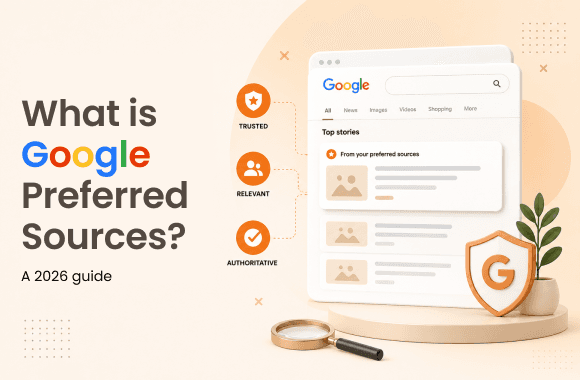
Google Preferred Sources is a 2026 Google Search feature that lets users choose specific websites they want prioritised in AI Overviews, AI Mode, Top Stories, and Google's new content carousels. When a user adds a site as a preferred source, Google's AI surfaces that source first inside its answer cards and citation lists whenever the user runs a relevant query, regardless of where the source ranks in standard search. The feature is opt-in for users, free to implement for websites, and is being rolled out globally through 2026 starting with the United States, the United Kingdom, and most of Europe.
What are Google Preferred Sources?
Google Preferred Sources is a user-controlled signal Google added to Search in 2025 and expanded across AI surfaces through 2026. The feature lets each Google user nominate websites they want prioritised when Google's AI builds answers, citation lists, and carousels. According to Google's official documentation on preferred sources, the goal is to give users more control over which voices show up first in AI-generated results.
Until Preferred Sources launched, every AI Overview, AI Mode response, and Top Stories carousel pulled citations purely from Google's algorithmic ranking. The most authoritative or most-linked site won the citation. With Preferred Sources, users can override that ranking for sources they personally trust, which means a trusted niche site can sit ahead of a giant generalist site in the user's own results.
The feature is significant because it is the first time Google has given individual users the power to shape AI search results at the source level. It moves AI search away from a purely algorithmic ranking model toward a hybrid model where user preference influences the citation surface.
How does Google Preferred Sources work?
The mechanic is simple. Three things happen across the system.
Step 1: The user opts in. A user clicks a deeplink or types a URL into Google's preferred sources settings page. The site is added to that user's personal preferred source list. The list is unique per Google account and persists across devices on which the user is signed in.
Step 2, Google records the preference. Every preferred source the user adds is stored against the user's Google profile. The user can view, add, and remove sources at any time from the Search settings interface.
Step 3, Google's AI prioritises those sources in relevant queries. When the user runs a search, Google's AI judges relevant to a preferred source, the AI prioritises that source in the citation list, the AI Overview answer, the AI Mode response, the Top Stories carousel, and any topic carousel that surfaces. The prioritisation does not override every query, only those where the preferred source has content relevant to the search intent.
There is no algorithm to game on the website side. Either the user adds the site,e or they do not. The website's only lever is making it as easy as possible for the user to add it.
Which AI surfaces does Preferred Sources affect?
Four surfaces inside Google Search are affected today, with more rolling out through 2026.
AI Overviews. The AI-generated answer block that appears at the top of Google search results for most queries. Preferred sources appear higher in the citation list and are more likely to be quoted in the AI's answer text. According to Search Engine Land's 2026 coverage of the Preferred Sources rollout, early data shows preferred sources see 3 to 7 times the citation rate inside AI Overviews compared with sources the user has not opted into.
AI Mode. Google's full conversational AI search experience was launched in 2025 and expanded in 2026. AI Mode pulls from preferred sources as the first reference layer before falling back to broader index ranking.
Top Stories. The news carousel that appears for queries with news intent. Preferred sources sit ahead of standard editorial sources in the Top Stories ranking when both have relevant content.
Topic carousels. Google's new "perspectives", "things to know", and "from sources you follow" carousels. These surface user-chosen sources almost exclusively when the carousel topic matches a preferred source's content.
The feature does NOT affect:
Standard organic search results (the blue link list still runs on algorithmic ranking)
Google Shopping or Google Maps results
YouTube search ranking
Sponsored or paid results
How do users add a website as a Preferred Source?
Three ways, in order of frequency:
Method 1, deeplink (fastest). Click a URL in the format. https://google.com/preferences/source?q=yoursite.com. The link opens Google's preferred sources settings page with the source name pre-filled. The user clicks "Add" once,e and the source is saved. Total time: 5 seconds.
Method 2, manual entry. Open Google Search settings, navigate to Preferred Sources, type the website URL, and click Add. Total time: 30 to 60 seconds.
Method 3, in-SERP star icon. Google is rolling out a small star icon next to sites in search results that lets the user add the source directly from the results page. Available on selected sites in selected markets as of mid-2026.
For website owners, the deeplink (Method 1) is the only one that can be promoted at scale. The other two methods rely on users finding the settings page on their own.
What is the Google Preferred Sources deeplink?
The deeplink is a URL in the format:
https://google.com/preferences/source?q=yoursite.comReplace yoursite.com with your domain. For example, our deeplink at Noseberry Digitals is:
https://google.com/preferences/source?q=noseberrydigitals.comWhen a user clicks this link, Google opens the preferred sources settings page with our domain already filled into the form. The user just clicks "Add," and they are done. No login flow beyond the user's existing Google session. No confirmation email. No verification step on the website side.
The deeplink is the single most important asset a website can publish. Putting it behind a clear button in five high-traffic places (the home page footer, every blog post footer, the newsletter confirmation page, the case study page, and a dedicated preferred source landing page) converts a portion of the existing audience into permanent AI visibility.
How can businesses use Google Preferred Sources to grow AI visibility?
Five moves that compound. The earlier a business ships these, the more preferred-source signups it captures before competitors notice.
Move 1: Ship a Preferred Source button on every page. Add a clear "Add us as a preferred source" button in the homepage footer, blog post footer, newsletter confirmation page, and case study page. Use the deeplink as the target URL.
Move 2: build a dedicated landing page. A page /preferred-source that explains what the feature is, why the user should add the site, and how it works. The landing page acts as the conversion surface for every marketing channel that drives traffic to it. Our own Preferred Source landing page is the model.
Move 3: Launch the feature to your existing audience. Send a dedicated newsletter to subscribers explaining the feature. Post on LinkedIn, Instagram, and Facebook. Include the call to action in podcast episodes and webinars. According to Search Engine Journal's 2026 Preferred Sources playbook, businesses that ran a dedicated launch campaign saw 8 to 15 times more signups in the first 30 days than businesses that quietly added a footer button.
Move 4: Integrate Preferred Source into onboarding. When a new newsletter subscriber confirms, when a new customer signs up, when a new lead books a strategy call, surface the preferred source button on the confirmation page. Peak-intent moments convert significantly higher than cold visits.
Move 5, measure, and iterate. Track click-through rate on the button across surfaces. Iterate the copy, placement, and design based on real data. The button on the newsletter confirmation page should convert at 5 to 12 percent. The button on the blog post footer should convert at 0.5 to 1.5 percent. Use those benchmarks to identify underperforming placements.
What are the limitations of Google Preferred Sources?
The feature is powerful, but it has six real limitations that website owners should understand.
1. Geographic rollout is uneven. Preferred Sources is fully active in the United States, the United Kingdom, and most of Western Europe. It is partially active in Canada, Australia, and India. It is being rolled out through 2026 in the UAE, Singapore, and other Asia-Pacific markets. Businesses targeting markets where the feature has not yet launched should still ship the button, but expect adoption to climb as Google rolls out further.
2. Adoption is still low. As of mid-2026, fewer than 5 percent of US Google users have added any preferred source. This is the first-mover opportunity, but it also means the absolute number of signups is still small. Build for the compounding curve, not for instant returns.
3. No analytics from Google. Google does not currently provide a Search Console report showing how many users have added a website as a preferred source, or how many times the preferred-source signal influenced an AI Overview citation. Website owners measure indirectly through CTR on the button and lift in AI Overviews referrals in GA4.
4. Preferred Sources does not affect standard search ranking. A user adding a site as a preferred source does not lift the site's organic ranking in the blue-link list. The signal applies only to AI surfaces.
5. Removable at any time. Users can remove a preferred source from Google Search settings in two clicks. Adding the site is not permanent. The fewer reasons a business gives users to remove the site (spammy content, low value, irrelevance), the longer the signup process compounds.
6. Topic-relevance gating. A user who adds Noseberry Digitals as a preferred source will see our content prioritised only when Google judges the query relevant to our topics (real estate technology, PropTech, marketing, CRM, AEO). For unrelated queries, the user sees standard algorithmic results.
How does Preferred Sources change SEO and AEO strategy in 2026?
Three structural shifts every SEO and AEO programme should account for.
Shift 1, audience building is now an AI visibility lever. Until 2025, audience size mattered for direct conversion but not for AI search. With Preferred Sources, every newsletter subscriber, every social follower, every podcast listener is a potential Preferred Sources signup. The size and engagement of an owned audience now directly affect AI search visibility. The discipline of building and engaging an audience is no longer separate from SEO. The companion piece on real estate SEO and AEO in 2026 covers the full AEO strategy.
Shift 2, conversion surfaces multiply. Every page on the site is now a potential preferred-source signup surface, not just the contact page and the demo page. The blog post foot, the case study page, the newsletter confirmation page, the homepage footer, the about page, and a dedicated /preferred-source page all do conversion work for AI visibility. Treat these surfaces with the same conversion-optimisation rigour as paid landing pages.
Shift 3, the rich AEO content layer matters more than ever. A preferred source whose content is generic, badly structured, or hard for AI to parse will not get cited inside AI Overviews even when the user has opted in. Google's AI still needs to recognise the content as a good match for the query. Quick Answer blocks, FAQ schema, structured data, and named author bylines all stay essential. The structural work on how to set up Google Ads conversion tracking for real estate and similar pieces shows the AEO pattern that earns AI citation even before Preferred Sources gives the source a boost.
Want to see Noseberry first in your Google AI search?
If this article was useful, the easiest thing you can do right now is add Noseberry Digitals as a Google preferred source. Takes 5 seconds. From now on, our content surfaces first in your AI Overviews, AI Mode, and Top Stories whenever you search for anything real estate or PropTech.
Read the AEO playbook for real estate
- Preferred Sources is the first Google feature that lets users override AI search ranking. A small specialist site can outrank a giant generalist site in a user's AI results simply because the user opted in.
- Four AI surfaces are affected: AI Overviews, AI Mode, Top Stories, and Google's new topic carousels. Each prioritises preferred sources before falling back to algorithmic ranking.
- Adding a website is one click via a deeplink in the format https://google.com/preferences/source?q=yoursite.com. No verification, no opt-in process on the website side.
- The single highest-leverage move for any business is to add a Preferred Source button across the newsletter, blog footer, and homepage social row. Every existing audience touchpoint converts into permanent AI visibility.
- Adoption is still under 5 percent of US Google users today, which is why first-mover advantage is so significant. Sites that build their preferred-source base now compound for years.
Why trust Noseberry
Our content is written by practicing real-estate and PropTech professionals, fact-checked by a dedicated editorial team, and reviewed against the latest industry data before publication.
- 10+ years of industry expertise
- All facts independently verified
- No sponsored rankings in guides
- Updated when the industry changes
Frequently asked questions
Does Google Preferred Sources cost anything?
No. It is a free Google Search feature for both users and websites. There is no fee to set up the deeplink, no fee for users to add a preferred source, and no premium tier.
How do I find my website's Preferred Source deeplink?
Use the format https://google.com/preferences/source?q=yoursite.com and replace yoursite.com with your domain. No registration required.
How long does it take to see results from Preferred Sources?
The user's first preferred-source-influenced search runs immediately after they add the source. Aggregate impact on traffic depends on signup volume. Most businesses report measurable lift in AI Overviews referrals 4 to 8 weeks after launching the button across major site surfaces.
Does adding the Preferred Source button hurt other SEO signals?
No. The button is a single link element and does not affect Core Web Vitals, content quality, or any other SEO ranking factor.
Can my competitors also become a user's preferred source?
Yes. Users can add multiple preferred sources, and there is no limit on how many a single user can have. The competition is for the user's attention, not for a fixed slot.
What if my industry is highly regulated, like finance or healthcare?
Preferred Sources operates the same way regardless of industry. Sites in regulated industries should ensure their content meets Google's Helpful Content and YMYL guidelines as a baseline, but Preferred Sources does not introduce additional regulatory requirements.
Does the button work on mobile?
Yes. The deeplink opens Google's preferred sources settings page on both desktop and mobile. On mobile, the user is taken to the Google Search app or browser to complete the action.
Related insights
 Real Estate
What are use cases for machine learning and AI in real estate?
Machine learning and AI in real estate have ten proven use cases in 2026: automated valuation models (AVMs), lead scoring and prioritisation, generative listing content, image and virtual-tour enhancement, predictive maintenance for property management, tenant and buyer screening (with fair-housing caveats), demand forecasting, chatbots and conversational agents, document and contract review, and portfolio-level investment analytics. Together they cover the full stack from marketing to leasing to operations to capital markets. Not every use case delivers equal ROI. AVMs, lead scoring, generative listings, and predictive maintenance produce the fastest returns; screening and forecasting carry more risk and need more oversight. This post walks through what each use case does, what it is worth, and where the returns are already showing up.
July 28, 2026 Real Estate
Real Estate Landing Page Optimization: The Conversion Rate Playbook for 2026
Most real estate landing pages convert at 2.7% while the top 25% convert at 11.45% or higher, and the gap has nothing to do with budget or design talent. This playbook breaks down exactly how to close that gap in 2026 through the nine structural elements every high-converting property landing page shares, a 15-point CRO audit you can run today, and a traffic source-specific optimization strategy that treats Google Search visitors, Meta cold audiences, and email traffic as the completely different conversion challenges they are. You'll also get the post-click architecture blueprint that connects your landing page to your CRM, automated response, and lead scoring system so conversions become pipeline, not just form fills sitting in a spreadsheet. Every section is built around measurable outcomes with specific benchmarks you can test against. If you're spending money driving traffic to a landing page that isn't hitting 5% or above, this is the playbook that fixes it.
July 28, 2026 Real Estate
Where is AI making a surprising impact on real estate support services?
AI is quietly reshaping the back-office of real estate, not just the front-office. The most surprising impact in 2026 is in support services that most operators still treat as manual: transaction coordination, escrow and title, property-management admin, compliance document review, vendor coordination, tenant communications, and bookkeeping. These functions absorb 30 to 40 percent of an operator's staff hours, and AI tools built for them now cut that load by 40 to 70 percent per workflow. Unlike front-office AI (listing generation, pricing, agent-side content) where the risk and disclosure burden is heavy, back-office AI has clearer economics, lower client-trust exposure, and faster payback. This is where operators are quietly capturing most of their real AI value in 2026, while everyone else is still debating whether ChatGPT should write listing descriptions.
July 28, 2026
Ready to book a 30-minute strategy call?
We'll map the right digital moves for your real estate business, no pitch deck, no commitment.