

Mayank Pokharna
Real estate & PropTech specialist
Custom PMS vs Off-the-Shelf Software for Operators 2026
Published June 8, 2026|4 min read
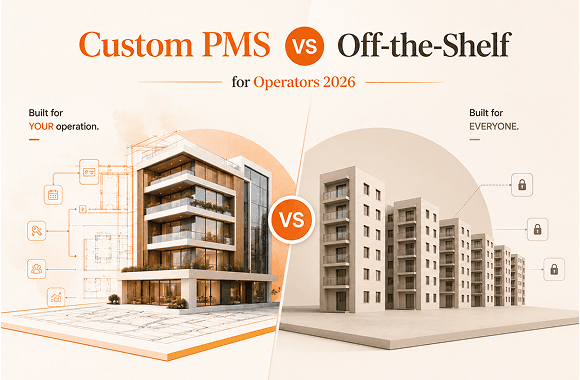
A custom property management system is built around one operator's workflows and deployed on a dedicated instance, while off-the-shelf SaaS is a shared platform every customer configures from the same template. For shared living operators in 2026, custom wins when the operating model is complex (per-bed billing, HMO licensing, multi-jurisdiction compliance) and SaaS wins when the model is simple and single-market. The deciding factors are operating complexity, vendor sprawl, branding and data ownership, and deployment speed. Operators under roughly 10 standard units usually stay on SaaS; operators running coliving, BTR, student housing, PBSA, or flex living across multiple properties typically move to a custom build such as JumboTiger, which assembles 26 production-tested modules into a dedicated instance, goes live in 30 days, and replaces 5 to 8 separate vendors.
What is a custom property management system?
A custom property management system is a PMS engineered around how a single operator actually runs its buildings, and deployed on that operator's dedicated instance. Instead of bending your operation to fit a shared platform's fields and limits, the software is shaped to your booking flow, billing model, compliance requirements, and brand.
It does three jobs a generic platform cannot: it models your real operating logic, including per-bed inventory and mixed-stay scenarios; it consolidates functions you currently spread across multiple vendors; and it leaves you owning your data and platform rather than renting access alongside thousands of other tenants. This is the approach behind JumboTiger, built by our software development team for shared and rental living.
Why do shared living operators outgrow off-the-shelf PMS tools?
Three structural realities push shared-living operators past generic software faster than they do traditional landlords. The pressure is rising as the sector grows: the global coliving market is projected to expand at a compound annual growth rate of roughly 27% through 2030 [1], adding exactly the operating complexity that generic tools struggle with.
The unit of inventory is not a flat. Coliving, PBSA, and student housing operators bill per bed, not per unit. A single apartment may hold six residents on six contracts, start dates, and rates. Most off-the-shelf tools model a property as one rentable unit, forcing operators back into spreadsheets.
Compliance is jurisdiction-specific. HMO licensing in the UK, EU tenancy rules, and local registration in India or the Middle East differ in ways that one global template cannot absorb. Operators across 5 regions need rules configured per jurisdiction.
The model spans functions no single SaaS owns. Bookings, per-bed billing, dynamic pricing, channel distribution, maintenance, community, access control, and owner reporting rarely live in one tool. Industry surveys show operators run 5 to 8 separate systems on average [2], paying the integration tax in manual exports and reconciliation errors. The companion guide on the best CRM for coliving operators covers the same tension on the sales side.
How do custom PMS and off-the-shelf SaaS actually differ?
They diverge across five dimensions: fit (template versus tailored), consolidation (one or two functions versus 26 modules in one platform), data ownership (multi-tenant database versus your dedicated instance), branding (logo-and-colour versus a fully branded iOS and Android resident app), and the cost model (per-seat forever versus a scoped build). The build behind JumboTiger sits on the custom side of all five. For a deeper look at the build timeline, see how we built a custom PMS in 30 days.
How much does each option cost in 2026?
According to standard software-development benchmarks, a fully bespoke PMS built from scratch takes 6 to 12 months and carries six-figure budgets [3], which is why most operators default to SaaS. SaaS itself is priced per seat or per unit, so cost compounds as a portfolio grows without adding capability.
A modular custom PMS changes the maths. Because the foundations are pre-built, JumboTiger is priced as a scoped build, not a subscription, with a firm all-in quote within 48 hours of a discovery call. The fair comparison is the build against the combined cost of the 5 to 8 vendors it replaces, plus the operational overhead of disconnected tools. One operator reported a 35% reduction in operational costs across 8 properties in 3 countries after consolidating onto a single platform [4].
Which operators should choose custom over off-the-shelf?
Off-the-shelf SaaS suits operators running standard residential tenancies, fewer than roughly 10 units, a single jurisdiction, and no need for a branded resident experience. A custom PMS becomes the better choice when you bill per bed, operate across multiple jurisdictions, run 20+ units or multiple properties, stitch together 4 or more tools, need a branded app, or report to owners on a fixed cadence. These are the conditions JumboTiger is built for, across coliving, build-to-rent, flex living, student housing, PBSA, and HMO.
How do you migrate from a generic PMS to a custom one?
Migration runs in four steps: map the current stack and its workarounds; export and clean resident, contract, billing, and maintenance data before import; configure the new instance and parallel-run it briefly so nothing breaks mid-cycle; then train the team and cut over. With JumboTiger, this completes inside the 30-day go-live window, and our systems integration team handles connections to payments, accounting, access control, and OTA channels.
Why trust Noseberry
Our content is written by practicing real-estate and PropTech professionals, fact-checked by a dedicated editorial team, and reviewed against the latest industry data before publication.
10+ years of industry expertise
All facts independently verified
No sponsored rankings in guides
Updated when the industry changes
Ready to see what a custom PMS looks like for your operation? Share how you run your buildings, in any format, and we will map it to proven modules and return a firm scope and quote within 48 hours.
explore JumboTiger.
- Off-the-shelf SaaS makes you adapt to the software; a custom PMS adapts to your operation.
- Custom is the better choice when you bill per bed, run multiple jurisdictions, exceed ~20 units, or stitch together 4+ tools.
- Traditional custom builds take 6 to 12 months; the modular approach behind JumboTiger goes live in 30 days.
- One consolidated platform can replace 5 to 8 vendors; one operator cut operating costs by 35% after switching.
- The real cost comparison is the custom build against the combined cost of every vendor it replaces, not licence-fee to licence-fee.
Why trust Noseberry
Our content is written by practicing real-estate and PropTech professionals, fact-checked by a dedicated editorial team, and reviewed against the latest industry data before publication.
- 10+ years of industry expertise
- All facts independently verified
- No sponsored rankings in guides
- Updated when the industry changes
Have any questions?
What is a custom property management system?
A custom PMS is a property management system engineered around one operator's workflows and deployed on that operator's own dedicated instance, rather than a shared SaaS platform configured from a fixed template. It models real operating logic such as per-bed billing, consolidates functions usually split across multiple vendors, and leaves the operator owning their data and platform.
When should an operator choose a custom PMS over off-the-shelf SaaS?
Choose custom when you bill per bed, operate across multiple jurisdictions, run more than about 20 units or multiple properties, stitch together four or more tools, need a branded resident app, or report to owners on a fixed cadence. Off-the-shelf SaaS suits standard residential tenancies under roughly 10 units in a single market.
How long does it take to build a custom PMS?
A fully bespoke PMS built from scratch typically takes 6 to 12 months. A modular custom PMS such as JumboTiger goes live in 30 days because it assembles 26 production-tested modules and customises them to the operator, rather than building from zero.
How much does a custom PMS cost compared to SaaS?
Off-the-shelf SaaS is priced per seat or per unit and compounds as a portfolio grows. A custom PMS is priced as a scoped build with a firm all-in quote within 48 hours. The fair comparison is the build against the combined cost of the 5 to 8 vendors it replaces, plus the overhead of disconnected tools.
Related insights
 Real Estate
What are use cases for machine learning and AI in real estate?
Machine learning and AI in real estate have ten proven use cases in 2026: automated valuation models (AVMs), lead scoring and prioritisation, generative listing content, image and virtual-tour enhancement, predictive maintenance for property management, tenant and buyer screening (with fair-housing caveats), demand forecasting, chatbots and conversational agents, document and contract review, and portfolio-level investment analytics. Together they cover the full stack from marketing to leasing to operations to capital markets. Not every use case delivers equal ROI. AVMs, lead scoring, generative listings, and predictive maintenance produce the fastest returns; screening and forecasting carry more risk and need more oversight. This post walks through what each use case does, what it is worth, and where the returns are already showing up.
July 28, 2026 Real Estate
Real Estate Landing Page Optimization: The Conversion Rate Playbook for 2026
Most real estate landing pages convert at 2.7% while the top 25% convert at 11.45% or higher, and the gap has nothing to do with budget or design talent. This playbook breaks down exactly how to close that gap in 2026 through the nine structural elements every high-converting property landing page shares, a 15-point CRO audit you can run today, and a traffic source-specific optimization strategy that treats Google Search visitors, Meta cold audiences, and email traffic as the completely different conversion challenges they are. You'll also get the post-click architecture blueprint that connects your landing page to your CRM, automated response, and lead scoring system so conversions become pipeline, not just form fills sitting in a spreadsheet. Every section is built around measurable outcomes with specific benchmarks you can test against. If you're spending money driving traffic to a landing page that isn't hitting 5% or above, this is the playbook that fixes it.
July 28, 2026 Real Estate
Where is AI making a surprising impact on real estate support services?
AI is quietly reshaping the back-office of real estate, not just the front-office. The most surprising impact in 2026 is in support services that most operators still treat as manual: transaction coordination, escrow and title, property-management admin, compliance document review, vendor coordination, tenant communications, and bookkeeping. These functions absorb 30 to 40 percent of an operator's staff hours, and AI tools built for them now cut that load by 40 to 70 percent per workflow. Unlike front-office AI (listing generation, pricing, agent-side content) where the risk and disclosure burden is heavy, back-office AI has clearer economics, lower client-trust exposure, and faster payback. This is where operators are quietly capturing most of their real AI value in 2026, while everyone else is still debating whether ChatGPT should write listing descriptions.
July 28, 2026
Ready to book a 30-minute strategy call?
We'll map the right digital moves for your real estate business, no pitch deck, no commitment.