
Vijay
Solution Engineer
Which is the best CRM for real estate agents in the US?
Published August 11, 2026|9 min read

There is no single best CRM for real estate agents in the US in 2026. The right choice depends on team size, lead volume, budget, and whether you want a purpose-built agent CRM, an all-in-one platform, or a general-purpose CRM. Follow Up Boss wins on speed to lead and team workflow for 5 to 50 agent teams. KVCore and Lofty win for brokerages wanting CRM plus IDX plus marketing in one platform. Sierra Interactive wins on IDX depth. LionDesk and Wise Agent win on budget for solo agents. HubSpot fits agencies with existing marketing muscle. Salesforce fits enterprise brokerages of 50+ agents. The right CRM is the one that matches your operational reality, not the one with the loudest marketing.
Six criteria decide whether a CRM is right for a US real estate agent or brokerage.
Speed to lead automation. Every enquiry needs an automated first response inside 60 seconds and a human agent assignment inside the hour.
Native MLS and IDX integration. Buyers expect real listings on your site synced to the CRM.
Mobile-first workflow. Agents work from a phone between showings; a desktop-only CRM does not survive month two.
Follow-up and nurture automation. Most agent leads are not ready to transact today; the CRM needs to keep them warm across a 6-to-24-month research window.
Team distribution and reporting. For teams above three agents, the CRM needs fair lead routing and broker-visible dashboards.
Ecosystem fit. Native integrations with dotloop, DocuSign, SkySlope, Zillow, Realtor.com, and the operator's ad platforms determine day-to-day friction.
No single CRM scores highest on all six. The right choice is the one that scores highest on the two or three criteria that matter most for the operator's team size and lead volume. For the full selection framework, see our guide on how to choose a CRM for real estate agents and brokers.
Which CRM is best for solo agents on a budget?
Wise Agent ($32 to $56 per user per month) and LionDesk ($25 to $99 per user per month) are the strongest budget-tier picks for US solo agents in 2026. Both offer real-estate-specific workflows, contact management, drip email, and basic transaction tracking without the licensing cost of enterprise platforms.
Wise Agent is the simpler of the two: cleaner interface, faster onboarding, strong US customer support, and a compact feature set that does not overwhelm a solo agent. Best for agents who value time-to-productivity over feature depth.
LionDesk has more features (built-in dialer, video email, AI text assistant, transaction management) at similar pricing but a busier interface that takes longer to master. Best for solo agents with 1 to 2 years of business under them who are ready to use the deeper feature set.
Real Geeks ($249 to $449 base per team) is a third budget option worth mentioning if IDX and a paired website matter more than pure CRM depth. Good for solo agents and small teams building their first digital presence alongside a CRM.
Which CRM is best for small teams focused on speed to lead?
Follow Up Boss ($69 to $99 per user per month) is the strongest CRM in the US in 2026 for teams of 5 to 50 agents focused on speed to lead and team workflow. Its whole architecture is built around getting new leads assigned, called, and worked inside the first five minutes, which HBR data shows lifts conversion up to nine times versus a 30-minute response.
Follow Up Boss wins on: instant lead notifications across mobile, automated action plans that trigger the moment a lead lands, round-robin and qualification-based distribution, broker-level dashboards showing speed-to-lead across every agent, and native integrations with Zillow, Realtor.com, Ylopo, BoomTown, and every major real estate ad source.
It loses on: marketing depth (thinner than HubSpot for content marketing and email campaigns), IDX (relies on partners rather than native IDX), and the platform's ceiling for teams above 100 agents.
For US brokerages between 5 and 50 agents where team-wide speed to lead is the primary competitive lever, Follow Up Boss is the default recommendation in 2026. Independent 2024 to 2025 surveys of US top producers place Follow Up Boss consistently at the top of the "would recommend" rankings across multiple industry publications.
Which CRM is best for mid-size brokerages wanting all-in-one?
KVCore ($499+ per team per month) and Lofty ($60 to $150 per user per month) are the leading all-in-one real estate platforms in the US in 2026. Both bundle CRM, IDX website, marketing automation, lead-gen tools, and agent-facing apps into one platform, reducing the vendor sprawl of running Follow Up Boss plus a separate website plus a separate marketing tool.
KVCore is the more established of the two, deeply used by RE/MAX, Realogy affiliates, and mid-to-large independent brokerages across the US. Deep functionality, powerful automation, and a broad ecosystem. Downside is the training investment: KVCore is not intuitive, and teams that do not commit to structured onboarding tend to under-adopt.
Lofty (the merged product of Chime and Boomtown) offers a cleaner interface, strong lead-gen tools, and better mobile UX than KVCore. Post-merger platform stability has been improving through 2024 to 2026. Best fit for brokerages that value UX and want an all-in-one but do not need every KVCore power feature.
Sierra Interactive ($300 to $500 team base per month) is a third all-in-one worth evaluating if IDX is the primary reason for choosing an all-in-one. Its IDX is one of the best in the US, though CRM automation is mid-tier.
Which CRM is best for teams with existing marketing muscle?
HubSpot ($45 to $150 per user per month across Sales Hub tiers) is the strongest general-purpose CRM for US brokerages with existing marketing capability in 2026. Deep automation, powerful email and content marketing, rich reporting, and a mature integrations ecosystem all outperform the pure real estate CRMs on marketing surface area.
The trade-off is that HubSpot does not ship with real-estate-specific workflows. MLS and IDX integration requires third-party connectors (or a custom API build). Real estate templates for property listings, transaction stages, and commission tracking need to be configured rather than adopted out of the box.
HubSpot wins for: brokerages already using HubSpot Marketing Hub, teams running content-heavy inbound programmes, operators with an in-house RevOps or marketing ops function, and multi-country brokerages needing multi-language and multi-currency support.
HubSpot loses to real-estate-specific CRMs when the primary buyer of the CRM is a broker who wants day-one adoption without configuration investment.
Which CRM is best for enterprise brokerages?
Salesforce Real Estate Cloud ($150 to $300 per user per month) is the strongest CRM for US brokerages above 50 agents needing maximum customisation. Salesforce is the most flexible enterprise CRM on the market, capable of being configured to almost any real estate workflow including complex commission structures, multi-office reporting, franchise-level rollups, and deep back-office integration.
The trade-off is implementation cost and time. Salesforce projects for real estate brokerages typically run $30,000 to $250,000 in implementation fees on top of the licensing, with 4-to-9-month implementation timelines. Underinvestment in implementation is the single biggest cause of Salesforce underperformance at real estate brokerages.
Salesforce wins for: brokerages above 100 agents with multi-office or franchise structures, brokerages doing large acquisitions and needing a platform that flexes, and brokerages with existing Salesforce muscle from other business lines (property management, developer sales, commercial).
Salesforce loses to Follow Up Boss and KVCore for anything under 50 agents, where the flexibility premium is not worth the implementation load.
For CRM implementation support, see our CRM implementation service.
How much does a real estate CRM cost in the US in 2026?
Real estate CRM pricing in the US in 2026 clusters into four tiers.
Budget tier ($15 to $60 per user per month): Wise Agent, LionDesk, Zoho CRM Real Estate edition. Best for solo agents and teams under 5.
Mid tier ($60 to $150 per user per month): Follow Up Boss, HubSpot Sales Hub Professional, Lofty. Best for teams of 5 to 50.
All-in-one team tier ($300 to $500 base per month plus per-user fees): KVCore, Sierra Interactive, Real Geeks. Best for teams of 10 to 100 that want CRM + IDX + marketing bundled.
Enterprise tier ($150 to $300+ per user per month): Salesforce Sales Cloud Enterprise, HubSpot Sales Hub Enterprise. Best for brokerages above 50 agents.
Total cost of ownership including implementation ($0 to $30K), training ($500 to $15K), data migration ($500 to $10K), and integrations ($100 to $2K per month) typically runs 2 to 4 times the sticker licensing price in year one. Ongoing years settle at 1.2 to 1.5 times the base licensing cost.
Which CRM has the best MLS and IDX integration?
Sierra Interactive and Real Geeks have the strongest native IDX among CRM platforms in the US in 2026. Both were built IDX-first and treat live MLS listings as a first-class citizen rather than a bolted-on feature.
Follow Up Boss does not have native IDX but integrates cleanly with iHomeFinder, IDX Broker, Realtyna, and every major IDX partner. In practice this means Follow Up Boss plus an IDX partner produces stronger overall results than the built-in IDX in most all-in-one platforms.
KVCore and Lofty ship with built-in IDX that is functional but not best-in-class. Better than nothing, and the bundled pricing is competitive.
HubSpot and Salesforce require third-party IDX integrations. Workable but with the highest configuration load.
For brokerages where IDX and the paired website are the primary differentiator, Sierra Interactive or Real Geeks are the right starting points. For brokerages where the CRM is the primary differentiator and IDX is a supporting feature, Follow Up Boss plus a specialist IDX partner is usually the better long-term stack.
What are the common mistakes when choosing a CRM?
Six mistakes explain most CRM buys that end in regret within 18 months.
Picking by demo alone. Every CRM demos well because every CRM is designed to demo well. Without a requirements document, the sales pitch does the choosing. Always draft what you actually need before watching any demo.
Signing a multi-year contract without piloting. A 30-day pilot with 3 to 5 agents on real workload catches problems the sales demo hides. Pilot cost is much cheaper than a locked-in mistake.
Ignoring integration reality. Ask for a live demo of every integration you need (MLS, IDX, dotloop, DocuSign, Meta Lead Ads, Google Ads Lead Form). Vendor promises during sales cycles often turn out to be third-party workarounds.
Budgeting only the licence fee. Implementation, training, data migration, add-ons, and integrations typically run 2 to 4 times the sticker price in year one. Budget for the full TCO at signing, not at renewal.
Choosing based on the broker's preference alone. A CRM chosen without agent input is a CRM the agents will ignore. 40 to 60 percent of real estate CRM implementations fail on adoption, not features.
Refusing to enforce mobile use and CRM-of-record discipline. Agents will keep parallel WhatsApp inboxes and personal spreadsheets unless the broker enforces the CRM as the single system of record from day one.
For the full selection process, see our guide on choosing a CRM for real estate agents and brokers and our blog on lead leakage.
Ready to pick the right CRM for your team?
Book a working session with the Noseberry Digitals team. We will audit your team size, lead volume, integration needs, and marketing muscle, and hand back a shortlist of the two or three CRMs most likely to earn their fee inside twelve months plus a 30-day pilot plan.
- Speed to lead is the biggest lever any CRM enables. Responding within 5 minutes lifts conversion up to 9 times versus a 30-minute response, per Harvard Business Review. Follow Up Boss is optimised for this specific job.
- Referrals dominate top-producer income. Top-producing US agents earn 60 to 80 percent of their business from referrals and repeat clients, per NAR. The CRM's nurture and past-client engine matter more than lead capture at scale.
- CRM adoption is where most implementations fail. 40 to 60 percent of real estate CRM implementations fail on adoption, not features. The best CRM for your team is the one your agents will actually use every day.
- Real-estate-specific CRMs usually beat generalists. Purpose-built platforms (Follow Up Boss, KVCore, Lofty, Sierra Interactive) work out of the box with MLS, IDX, and real estate workflows. HubSpot and Salesforce need real estate-specific configuration.
- Pricing ranges from $15 to $300 per seat per month. Total cost of ownership including implementation, training, integrations, and add-ons typically runs 2 to 4 times the licence fee in year one.
Why trust Noseberry
Our content is written by practicing real-estate and PropTech professionals, fact-checked by a dedicated editorial team, and reviewed against the latest industry data before publication.
- 10+ years of industry expertise
- All facts independently verified
- No sponsored rankings in guides
- Updated when the industry changes
Have any questions?
What is the best CRM for real estate agents in the US in 2026?
There is no single best. Follow Up Boss wins for teams of 5 to 50 agents focused on speed to lead. KVCore and Lofty win for all-in-one platforms with CRM + IDX + marketing. Sierra Interactive and Real Geeks win for IDX-first teams. LionDesk and Wise Agent win for solo agents on budget. HubSpot suits marketing-heavy teams. Salesforce fits enterprise brokerages of 50+ agents. The right choice depends on team size, lead volume, and workflow.
How much does a real estate CRM cost in the US?
Licences range from $15 per user per month (Wise Agent, Zoho) to $300+ per user per month (Salesforce). Team-priced platforms like KVCore and Sierra Interactive run $300 to $500 base per month plus per-user fees. Total cost of ownership including implementation, training, data migration, add-ons, and integrations typically runs 2 to 4 times the licence fee in year one.
Which CRM has the highest adoption among US top-producing agents?
Follow Up Boss consistently places at the top of independent surveys of US top producers on both adoption and satisfaction. KVCore has the broadest brokerage-level footprint through franchise networks. Neither is the objectively "best" CRM; both suit different segments.
Should I choose a real-estate-specific CRM or a general-purpose one like HubSpot or Salesforce?
Real-estate-specific CRMs (Follow Up Boss, KVCore, Lofty, Sierra Interactive) work out of the box with MLS, IDX, and real estate workflows and win on time-to-value. General-purpose CRMs (HubSpot, Salesforce, Zoho) offer maximum flexibility but require configuration. Solo and small teams typically win with real estate-specific; mid-to-large operators with existing marketing muscle often prefer general-purpose.
How do we make sure agents actually use the CRM?
Structured training in week 2 of rollout, shadow-mode operation in week 3, cutover in week 4, and daily 15-minute broker check-ins for the first two weeks after cutover. Adoption audits at 60 and 90 days with one-on-one interventions for any agent below 80 percent usage. Refuse to let agents run parallel spreadsheets or personal Instagram DMs outside the CRM. Adoption follows enforcement, not hope.
Related insights
 Real Estate
What should a PMS do for small-scale property managers?
The ideal PMS for a small-scale property manager (typically 10 to 500 units) should do ten things well: capture every rent payment automatically, log every maintenance ticket with photo evidence and vendor dispatch, hold every tenant lease and document in one searchable place, generate owner and investor statements in one click, run automated rent reminders and late-fee escalation, screen tenants with credit and eviction history, sync with the operator's accounting stack (QuickBooks, Xero), work on mobile so field checks and unit walks happen on a phone, integrate with a website for listing marketing and online applications, and produce broker-visible dashboards that let the manager see occupancy, delinquency, and cash flow at a glance. AppFolio Property Manager Core, Buildium, DoorLoop, Rentec Direct, and Hemlane are the platforms most adopted at this scale in 2026, at $1.40 to $4 per unit per month. This post covers what the ideal PMS should do, which platforms actually deliver it, and how to pick without overpaying.
August 22, 2026 Real Estate
Which AI tools work best for real estate developers in 2026?
The best AI tools for real estate developers in 2026 fall into eight categories that map to the developer lifecycle: land sourcing and site selection (Cherre, Reonomy, HouseCanary, LandGate), feasibility and financial modelling (Northspyre, TestFit, custom Excel plus GPT), design and architectural planning (Autodesk Forma, Higharc, Cove.tool, Snaptrude), construction management and progress tracking (Procore AI, Autodesk Construction Cloud, Buildots, Doxel, OpenSpace), pre-launch marketing and renders (Restb.ai, MidJourney, Adobe Firefly), off-plan sales CRM (Salesforce, HubSpot, Follow Up Boss, Rechat), ESG and net-zero analytics (Measurabl, Enertiv, Aquicore), and handover to operations (BIM AI, tenant portal AI). Used well, they cut construction cost 10 to 20 percent, compress design cycles 30 to 50 percent, and lift off-plan sales conversion 20 to 40 percent. Used badly, they burn subscription budget and produce plans that do not build. This post walks through each category, which tools actually work, and how to sequence adoption.
August 22, 2026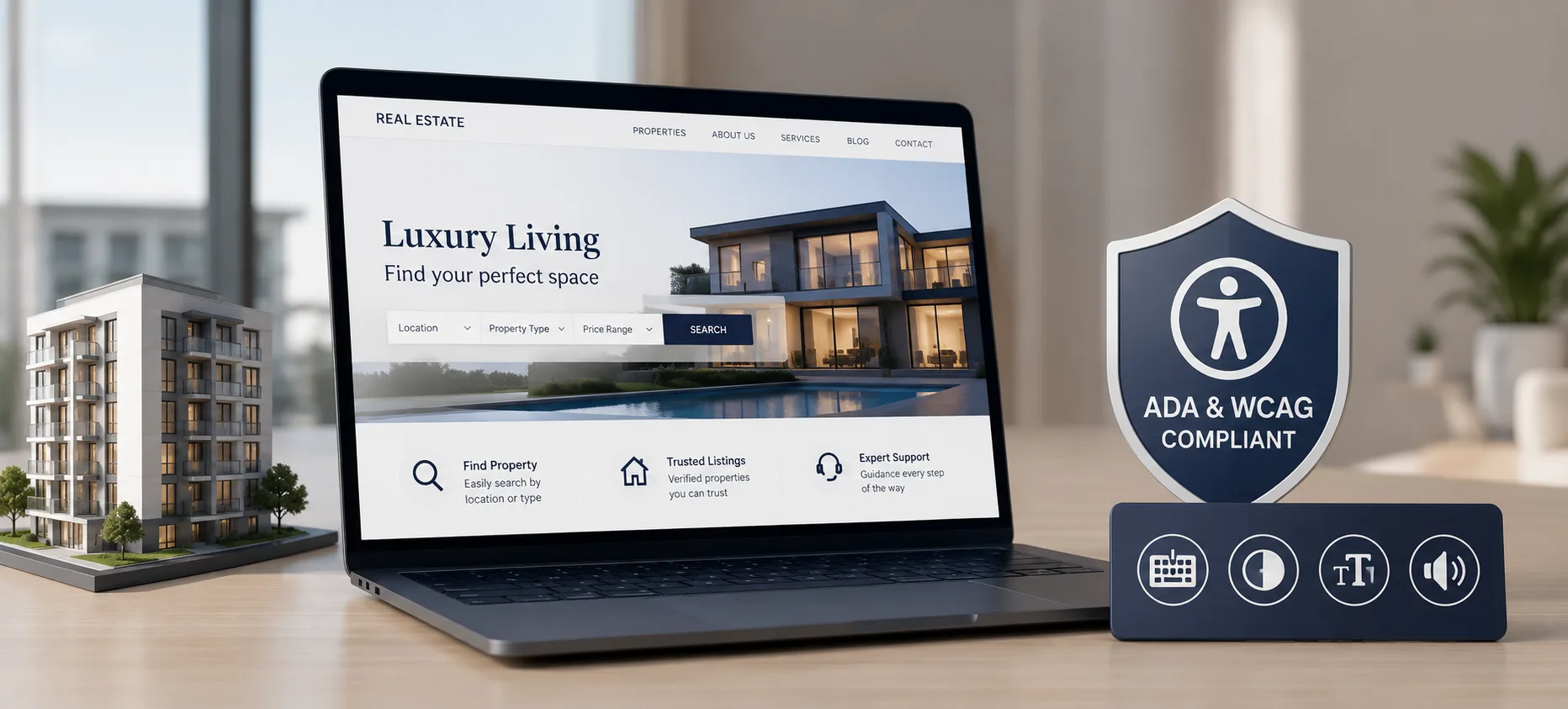 Real Estate
ADA & WCAG Accessibility Compliance for Real Estate Websites: What Operators Must Fix Before They Get Sued
This blog breaks down ADA and WCAG accessibility compliance for real estate websites, focused on what actually creates legal exposure. It explains why WCAG 2.1 Level AA has become the practical legal standard even without a formal Title III regulation for private businesses. It walks through the six accessibility failures responsible for 96% of all detected errors across the web, using real listing-page examples. It also warns against relying on accessibility overlay widgets, citing the FTC's 2025 action against accessiBe over deceptive compliance claims. The piece closes with a step-by-step audit process, an in-house versus compliance-partner comparison, and a 10-question FAQ section.
August 20, 2026
Ready to book a 30-minute strategy call?
We'll map the right digital moves for your real estate business, no pitch deck, no commitment.