

Honey Saxena
Digital Marketing Expert
AI for Lease Abstraction: How It Works and ROI
Published June 24, 2026|9 min read
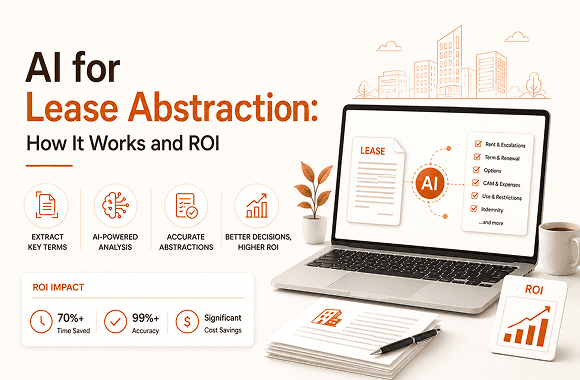
This guide explains how AI for lease abstraction works, from document ingestion to human-reviewed export, and lays out the real ROI. It compares manual and AI abstraction on time, cost, and accuracy, with attributed data from Kolena, Lextract, and JLL. You will see why the return often lands within the first portfolio and how to run a safe pilot. The goal is to help commercial real estate teams stop typing lease terms by hand and capture the savings.
AI for lease abstraction reads a lease, pulls the key terms like rent, dates, renewals, and clauses, and drops them into structured data in minutes instead of hours. Leading tools cut abstraction time from 4 to 6 hours per lease to under 15 minutes, at 90% to 97% accuracy on standard commercial terms. The ROI is usually immediate, because the labor savings on a single portfolio dwarf the software cost.
Lease abstraction has always been the grunt work of commercial real estate. A paralegal or analyst reads dense documents and types out the terms, slowly and expensively. I have seen teams spend 20 hours on a single complex lease. AI changes that math completely. This guide explains how AI lease abstraction works, how accurate it really is, and the exact numbers behind the return, so you can decide if it belongs in your workflow.
What is AI lease abstraction?
AI lease abstraction is the use of machine learning to extract key terms from lease documents and convert them into structured, searchable data. It captures rent schedules, dates, options, and clauses automatically. It matters because lease data drives valuation, compliance, and cash flow, and manual extraction is slow and error-prone.
Think of it as a tireless analyst who reads every page and never misses a renewal date. The output feeds your property management system, your models, and your dashboards. Clean lease data is the foundation of good decisions, and AI is the fastest way to get it.
How does AI lease abstraction work?
AI lease abstraction works by reading the document, identifying key fields, extracting them, and routing them for human review. Modern tools process a lease in 5 to 15 minutes depending on length. The model recognizes patterns in lease language, so it knows where to find rent, term, and option clauses even when formatting varies.
Here is the typical workflow step by step:
Ingest: Upload the lease, often a scanned PDF, into the platform.
Read: Optical character recognition converts the document to machine-readable text.
Extract: The AI model identifies and pulls key terms into structured fields.
Validate: A human reviews flagged or low-confidence fields for accuracy.
Export: Clean data syncs to your property system, model, or dashboard.
The human-in-the-loop step matters. The best teams let AI do the heavy lifting, then have an analyst confirm the few fields the model flags as uncertain. That blend is what delivers both speed and trust.
How accurate is AI lease abstraction?
AI lease abstraction is highly accurate on standard leases, reaching 90% to 97% on commercial terms and 95% or more on structured fields like dates, dollar amounts, and addresses. Purpose-built tools hit 95% to 98% field-level accuracy on common formats. Accuracy drops on unusual or handwritten clauses, which is why human review stays in the loop.
The accuracy is high because lease language is repetitive and pattern-rich, so models learn it well. According to Kolena's research, structured fields are the most reliable, while negotiated or non-standard clauses need closer human checking. Treat AI as a fast first pass that an analyst confirms, not a fully hands-off system.
AI lease abstraction ROI: the numbers
The ROI on AI lease abstraction is strong and fast. Manual abstraction by a paralegal costs $200 to $500 per lease in staff time, while AI solutions cost $10 to $50 per lease, dropping further at scale. For a 500-lease portfolio, that is roughly $75,000 to $150,000 manual versus about $10,000 automated.
The savings compound at volume. At 1,000 leases a year, saving five hours per document at $30 an hour produces $150,000 in annual labor savings before you count amendments. The bigger prize is risk. JLL documented discovering $1 million in missed lease clauses after deploying AI lease review, which means the ROI can exceed the platform cost within the first deal. Our AI consulting services and lease data automation resources cover the rollout.
Manual vs AI lease abstraction: a quick comparison
The contrast is stark when you line up the numbers. This table shows why so many teams are switching.
Factor | Manual abstraction | AI lease abstraction |
Time per lease | 4-20 hours | 5-15 minutes |
Cost per lease | $200-$500 | $10-$50 |
Accuracy | Varies by analyst | 90-97% on standard terms |
500-lease portfolio | $75,000-$150,000 | ~$10,000 |
Risk of missed clauses | High | Low with review |
The pattern is clear. AI compresses both time and cost while reducing the risk of a missed clause that could cost far more than the software ever will.
How do you get started with AI lease abstraction?
Start with a small batch of representative leases to test accuracy on your own documents. Run 20 to 50 leases through a tool, check the output against manual abstraction, then scale once the accuracy holds. This pilot approach works because it proves value on your real data before you commit a budget.
Follow these steps to launch:
Pick a tool that integrates with your property management system.
Run a pilot batch of 20 to 50 representative leases.
Compare AI output against manual abstraction for accuracy.
Set a human-review process for low-confidence fields.
Scale across the portfolio once accuracy meets your bar.
Skip the urge to abstract your whole portfolio on day one. A small, measured pilot tells you everything you need before you go wide.
What are the limits of AI lease abstraction?
The main limit is non-standard content. AI handles clean, structured leases well but struggles with handwritten notes, unusual clauses, and poor scans. That is why human review remains essential, especially for negotiated terms that carry legal weight. AI is a powerful first pass, not a replacement for legal judgment.
Other limits are practical. Accuracy depends on document quality, so messy scans lower results. Sensitive lease data must be handled under privacy rules. Pick tools that flag low-confidence fields and keep an audit trail. As the data shows, the highest accuracy comes from pairing AI speed with targeted human checking, not from removing people entirely.
The bottom line on AI lease abstraction
The key takeaway is that AI lease abstraction cuts the time and cost of lease data extraction by roughly 90% while catching clauses humans miss, which means the ROI usually lands within the first portfolio or even the first deal. Pair AI speed with human review of flagged fields and you get both accuracy and savings.
Your next step is to gather 20 to 50 of your own leases and run them through a tool against your manual baseline. That single test will show you the time saved, the accuracy on your documents, and the dollars on the table.
Do not let the grunt work of lease abstraction keep eating your team's hours. At $200 to $500 per lease manually versus $10 to $50 with AI, the math rarely favors the old way for any sizable portfolio. Start with a pilot, keep humans on the tricky clauses, and scale what works. The teams pulling ahead in 2026 stopped typing lease terms by hand a while ago. Ready to test it? Explore our lease data automation services and book a strategy call.
- AI lease abstraction cuts time from 4-20 hours to 5-15 minutes per lease.
- Accuracy runs 90% to 97% on standard commercial terms, 95%+ on structured fields.
- Manual costs $200-$500 per lease; AI costs $10-$50.
- A 500-lease portfolio runs ~$10,000 automated versus $75,000-$150,000 manual.
- At 1,000 leases a year, AI can save about $150,000 in labor.
- JLL found $1 million in missed clauses after deploying AI lease review.
- Human review of flagged fields keeps accuracy high on tricky clauses.
- Start with a 20-50 lease pilot, then scale once accuracy holds.
Why trust Noseberry
Our content is written by practicing real-estate and PropTech professionals, fact-checked by a dedicated editorial team, and reviewed against the latest industry data before publication.
- 10+ years of industry expertise
- All facts independently verified
- No sponsored rankings in guides
- Updated when the industry changes
Frequently Asked Questions
What is AI lease abstraction in simple terms?
AI lease abstraction is software that reads a lease and pulls out key terms like rent, dates, and clauses into structured data automatically. It replaces hours of manual typing by a paralegal or analyst. The goal is clean, searchable lease data in minutes, which feeds your valuation models, compliance checks, and property dashboards.
How long does AI lease abstraction take per lease?
AI lease abstraction takes 5 to 15 minutes per lease, depending on length and complexity, compared to 4 to 20 hours manually. One documented client cut abstraction from 20 hours to 1.5 hours per document. The time saved scales fast across a portfolio, which is where the strongest return on investment comes from.
How accurate is AI for lease abstraction?
AI lease abstraction reaches 90% to 97% accuracy on standard commercial terms and 95% or more on structured fields like dates and dollar amounts. Purpose-built tools hit 95% to 98% on common formats. Accuracy drops on handwritten notes or unusual clauses, so a human reviews low-confidence fields to keep the final data reliable.
What is the ROI of AI lease abstraction?
The ROI of AI lease abstraction is fast and large. Manual costs $200 to $500 per lease versus $10 to $50 with AI. At 1,000 leases a year, saving five hours each produces about $150,000 in annual labor savings. JLL even found $1 million in missed clauses after deploying AI review, so ROI can land in the first deal
Does AI lease abstraction replace paralegals and analysts?
No, AI lease abstraction does not replace people; it removes their slowest task. AI handles the first-pass extraction, while paralegals and analysts review flagged fields and negotiated clauses that need judgment. This human-in-the-loop model delivers both speed and accuracy. Your team shifts from typing lease terms to verifying and acting on clean data.
Related insights
 Real Estate
What should a PMS do for small-scale property managers?
The ideal PMS for a small-scale property manager (typically 10 to 500 units) should do ten things well: capture every rent payment automatically, log every maintenance ticket with photo evidence and vendor dispatch, hold every tenant lease and document in one searchable place, generate owner and investor statements in one click, run automated rent reminders and late-fee escalation, screen tenants with credit and eviction history, sync with the operator's accounting stack (QuickBooks, Xero), work on mobile so field checks and unit walks happen on a phone, integrate with a website for listing marketing and online applications, and produce broker-visible dashboards that let the manager see occupancy, delinquency, and cash flow at a glance. AppFolio Property Manager Core, Buildium, DoorLoop, Rentec Direct, and Hemlane are the platforms most adopted at this scale in 2026, at $1.40 to $4 per unit per month. This post covers what the ideal PMS should do, which platforms actually deliver it, and how to pick without overpaying.
August 22, 2026 Real Estate
Which AI tools work best for real estate developers in 2026?
The best AI tools for real estate developers in 2026 fall into eight categories that map to the developer lifecycle: land sourcing and site selection (Cherre, Reonomy, HouseCanary, LandGate), feasibility and financial modelling (Northspyre, TestFit, custom Excel plus GPT), design and architectural planning (Autodesk Forma, Higharc, Cove.tool, Snaptrude), construction management and progress tracking (Procore AI, Autodesk Construction Cloud, Buildots, Doxel, OpenSpace), pre-launch marketing and renders (Restb.ai, MidJourney, Adobe Firefly), off-plan sales CRM (Salesforce, HubSpot, Follow Up Boss, Rechat), ESG and net-zero analytics (Measurabl, Enertiv, Aquicore), and handover to operations (BIM AI, tenant portal AI). Used well, they cut construction cost 10 to 20 percent, compress design cycles 30 to 50 percent, and lift off-plan sales conversion 20 to 40 percent. Used badly, they burn subscription budget and produce plans that do not build. This post walks through each category, which tools actually work, and how to sequence adoption.
August 22, 2026 Real Estate
ADA & WCAG Accessibility Compliance for Real Estate Websites: What Operators Must Fix Before They Get Sued
This blog breaks down ADA and WCAG accessibility compliance for real estate websites, focused on what actually creates legal exposure. It explains why WCAG 2.1 Level AA has become the practical legal standard even without a formal Title III regulation for private businesses. It walks through the six accessibility failures responsible for 96% of all detected errors across the web, using real listing-page examples. It also warns against relying on accessibility overlay widgets, citing the FTC's 2025 action against accessiBe over deceptive compliance claims. The piece closes with a step-by-step audit process, an in-house versus compliance-partner comparison, and a 10-question FAQ section.
August 20, 2026
Ready to book a 30-minute strategy call?
We'll map the right digital moves for your real estate business, no pitch deck, no commitment.