

Mayank Pokharna
Real estate & PropTech specialist
AI in Property Management: 18 Use Cases and Benefits
Published June 27, 2026|7 min read
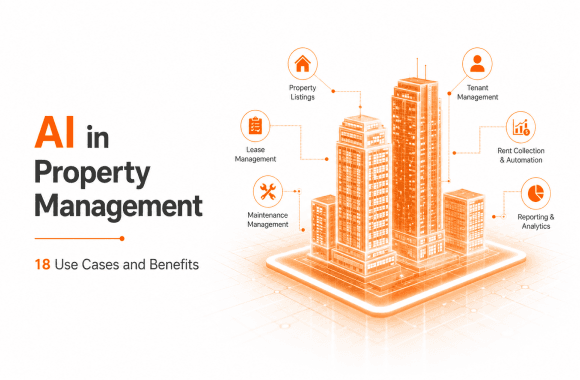
This guide lists 18 AI use cases in property management for 2026, grouped by leasing, resident experience, maintenance, and finance, along with the benefits behind each. It pairs the use cases with real savings data from McKinsey, PwC, and industry research, then compares manual and AI operations side by side. You will get a staged rollout plan and a clear view of the risks, including fair-housing compliance. The goal is to help property managers automate the busywork while protecting the human touch.
AI in property management automates the repetitive work of running rental properties, from answering resident questions to predicting maintenance and pricing units. The benefits are concrete: 15% to 30% lower operating costs, faster leasing, and better retention. In 2026, 94% of multifamily operators are implementing or planning AI, which means it is fast becoming the baseline, not the edge.
Property management has always been a high-volume, low-margin business. You handle thousands of small tasks across leasing, maintenance, and accounting, and every manual hour eats your margin. AI is the first technology that genuinely lightens that load at scale. I have watched property teams cut their busywork in half by automating the right workflows. This guide lays out 18 proven use cases, grouped by function, plus the real benefits and how to start.
What is AI in property management?
AI in property management is software that analyzes data and automates tasks across leasing, resident service, maintenance, and accounting. It answers questions, prices units, routes work orders, and predicts churn. It matters because property management runs on repetitive, high-volume work, and AI handles that work faster and cheaper than manual effort.
Think of it as an operations assistant working across every property at once. It does not replace your team. It removes the busywork so your people focus on residents and judgment. That shift is the core promise of AI in property management.
What are the benefits of AI in property management?
The main benefits are lower costs, faster leasing, higher retention, and fewer errors. AI cuts operating costs by 15% to 30%, with accounts payable automation alone saving 15% to 25%. It speeds resident response to instant, predicts maintenance before failures, and flags at-risk residents early. McKinsey reports firms gaining 10% or more in net operating income from AI-driven operations.
These benefits compound across a portfolio. A few examples of measured impact:
Cost: 15% to 30% operating cost reduction across programs.
Leasing: AI lead nurturing lifts conversion by around 40%.
Retention: renewal-rate gains of 3% to 7% from churn prediction.
Service: chatbots resolve up to 90% of routine resident queries, 24/7.
Demand: 83% of renters call a virtual tour important, per RentCafe.
The value is real and proven. The challenge is picking the use cases that fit your operation and rolling them out without chaos.
18 AI use cases in property management
Here are the 18 use cases property managers are deploying in 2026, grouped by the part of the operation they improve.
Leasing and occupancy
AI leasing assistant that answers prospects and books tours 24/7.
Lead scoring and nurturing that ranks and follows up with prospects.
AI virtual tours that let renters walk a unit before visiting.
Dynamic rent pricing that adjusts rates by demand and seasonality.
Tenant screening that reviews applications consistently and flags risk.
Resident experience
24/7 resident chatbot for lease questions and service requests.
Maintenance request triage that routes and prioritizes tickets.
Sentiment analysis that reads resident feedback to catch issues early.
Automated move-in and move-out scheduling and checklists.
Smart home controls for access, climate, and energy per unit.
Maintenance and facilities
Predictive maintenance that forecasts equipment failure before it happens.
Work-order automation that assigns the right vendor at the right time.
Energy optimization that trims utility waste across the portfolio.
Vendor management that scores contractors by performance.
Finance and back office
Invoice and AP automation, the highest-volume operational win.
Delinquency prediction that flags likely late payers early.
Lease abstraction that pulls key terms from lease documents automatically.
Application fraud detection that spots fake pay stubs and IDs.
You do not need all 18. Pick the three that touch your highest cost or slowest workflow, and start there.
Manual vs AI property management: a quick comparison
The contrast is clearest side by side. This table shows how AI changes core property management tasks.
Task | Manual | With AI |
Resident queries | Staff, business hours | Bot handles ~90%, 24/7 |
Rent pricing | Annual, gut feel | Daily, demand-based |
Maintenance | Fix after it breaks | Predicted before failure |
Invoices | Hand-coded | Automated, 15-25% cheaper |
Retention | React after notice | Predicted 3-7% improvement |
The pattern holds across every task. AI compresses time and cost while raising the quality residents feel. People stay for service and community, not inbox replies.
How do you start using AI in property management?
Start with the task eating the most staff hours, usually resident queries or invoice processing. Deploy one tool, measure the result against your baseline, then expand to pricing, maintenance, and retention. This staged path works because a single high-volume win frees time and budget for the next step.
Follow these steps to roll out AI:
Audit where your team loses the most hours each week.
Pick one tool that targets that exact task.
Set a clear metric, like response time or cost per work order.
Run a 30-day pilot on a small portfolio.
Connect tools through your property system so they share data.
Skip the urge to digitize everything at once. Tool sprawl confuses staff and stalls adoption. Our AI for property management and AI consulting services resources map the rollout step by step.
What are the risks and limits of AI in property management?
The main risk is over-automating the human side of service. A bot handling 90% of queries is great, until a resident in distress needs a person. Keep clear escalation paths so AI handles routine work and people handle emotion and conflict. AI should extend your team, not hide behind it.
Other limits are practical. Pricing and prediction models need clean data to work. Tenant screening can encode bias, which raises fair-housing exposure, so it needs documented logic and human review. Resident data must be handled under privacy law. Pick tools that flag uncertainty and keep an audit trail. The goal is technology that quietly moves the work while people own the moments that matter.
The bottom line on AI in property management
The key takeaway is that AI in property management cuts costs 15% to 30% and improves leasing, retention, and service, but only when you automate the high-volume work and keep humans on judgment and emotion. Start with three use cases, prove the savings, then connect them into smarter workflows.
Your next step is to list the three tasks that drain the most staff hours this week, then pilot one AI tool against the biggest one for 30 days. That focused win will fund and guide everything that follows.
Do not let an 18-item list pressure you into doing everything at once. The property managers winning in 2026 are not running the most tools. They picked a few high-payback use cases, cleaned their data, and rebuilt the workflow around them. Spend small, measure honestly, and protect the human touch. Ready to start? Explore our AI for property management services and book a strategy call.
- AI in property management cuts operating costs 15% to 30%.
- 94% of multifamily operators are implementing or planning AI in 2026.
- The 18 use cases span leasing, resident experience, maintenance, and finance.
- AP automation, leasing chat, dynamic pricing, and predictive maintenance pay back fastest.
- Chatbots resolve up to 90% of routine resident queries, 24/7.
- Churn prediction improves renewals by 3% to 7%.
- Tenant screening must follow fair-housing law with human review.
- Start with three high-payback use cases, then connect them.
Why trust Noseberry
Our content is written by practicing real-estate and PropTech professionals, fact-checked by a dedicated editorial team, and reviewed against the latest industry data before publication.
- 10+ years of industry expertise
- All facts independently verified
- No sponsored rankings in guides
- Updated when the industry changes
Frequently Asked Questions
What is AI in property management in simple terms?
AI in property management is software that automates repetitive tasks across leasing, resident service, maintenance, and accounting. It answers resident questions, prices units, routes work orders, and predicts churn. The goal is to handle high-volume busywork faster and cheaper than manual effort, so your team can focus on residents and decisions that need human judgment.
What are the main benefits of AI in property management?
The main benefits are 15% to 30% lower operating costs, faster leasing, higher retention, and fewer errors. AP automation alone saves 15% to 25%, lead nurturing lifts conversion around 40%, and churn prediction improves renewals 3% to 7%. McKinsey reports firms gaining 10% or more in net operating income from AI-driven property operations.
What are the best AI use cases in property management?
The best use cases are invoice automation, AI leasing assistants, dynamic rent pricing, and predictive maintenance. These are high-volume and rule-based, so they automate cleanly and pay back fast. Resident chatbots and churn prediction follow closely. Start with whichever task is costing your team the most hours, then expand to the others over time.
How much can AI save a property management company?
AI can save property management companies 15% to 30% on operating costs, depending on scope. Accounts payable automation alone cuts 15% to 25%. The savings come from removing manual hours on repetitive tasks like invoicing, lease data entry, and resident queries. Across a portfolio, these reductions compound quickly into meaningful net operating income gains.
Does AI replace property managers?
No, AI does not replace property managers; it removes their busywork. Bots handle routine queries and scheduling so managers focus on residents, conflict resolution, and decisions that need judgment. Keep clear escalation paths so a person handles emotional or complex situations. AI extends your team's reach rather than replacing the human relationships that retention depends on.
Is AI in property management only for large portfolios?
No, AI in property management works for portfolios of any size. Many chatbot, pricing, and AP automation tools offer affordable per-unit pricing, so a small manager can automate one workflow without an enterprise budget. Start with a single high-volume task on a small portfolio, prove the savings, then scale to more units and use cases.
How do I start using AI in my property management business?
Start with the task eating the most staff hours, usually resident queries or invoicing, and deploy one tool. Set a clear metric, run a 30-day pilot on a small portfolio, then expand to pricing, maintenance, and retention. Connect tools through your property system so they share data. Avoid launching everything at once, since tool sprawl stalls adoption.
Related insights
 Real Estate
What should a PMS do for small-scale property managers?
The ideal PMS for a small-scale property manager (typically 10 to 500 units) should do ten things well: capture every rent payment automatically, log every maintenance ticket with photo evidence and vendor dispatch, hold every tenant lease and document in one searchable place, generate owner and investor statements in one click, run automated rent reminders and late-fee escalation, screen tenants with credit and eviction history, sync with the operator's accounting stack (QuickBooks, Xero), work on mobile so field checks and unit walks happen on a phone, integrate with a website for listing marketing and online applications, and produce broker-visible dashboards that let the manager see occupancy, delinquency, and cash flow at a glance. AppFolio Property Manager Core, Buildium, DoorLoop, Rentec Direct, and Hemlane are the platforms most adopted at this scale in 2026, at $1.40 to $4 per unit per month. This post covers what the ideal PMS should do, which platforms actually deliver it, and how to pick without overpaying.
August 22, 2026 Real Estate
Which AI tools work best for real estate developers in 2026?
The best AI tools for real estate developers in 2026 fall into eight categories that map to the developer lifecycle: land sourcing and site selection (Cherre, Reonomy, HouseCanary, LandGate), feasibility and financial modelling (Northspyre, TestFit, custom Excel plus GPT), design and architectural planning (Autodesk Forma, Higharc, Cove.tool, Snaptrude), construction management and progress tracking (Procore AI, Autodesk Construction Cloud, Buildots, Doxel, OpenSpace), pre-launch marketing and renders (Restb.ai, MidJourney, Adobe Firefly), off-plan sales CRM (Salesforce, HubSpot, Follow Up Boss, Rechat), ESG and net-zero analytics (Measurabl, Enertiv, Aquicore), and handover to operations (BIM AI, tenant portal AI). Used well, they cut construction cost 10 to 20 percent, compress design cycles 30 to 50 percent, and lift off-plan sales conversion 20 to 40 percent. Used badly, they burn subscription budget and produce plans that do not build. This post walks through each category, which tools actually work, and how to sequence adoption.
August 22, 2026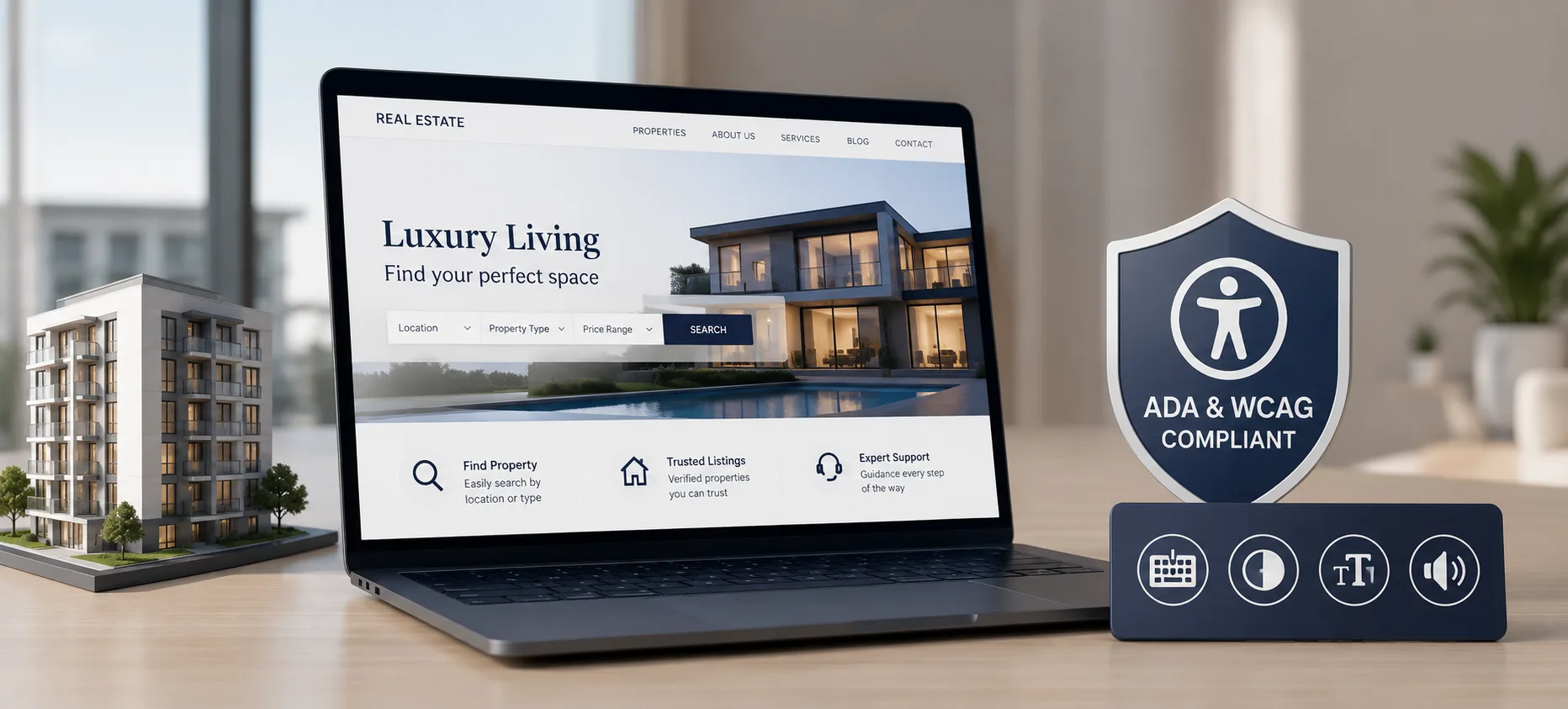 Real Estate
ADA & WCAG Accessibility Compliance for Real Estate Websites: What Operators Must Fix Before They Get Sued
This blog breaks down ADA and WCAG accessibility compliance for real estate websites, focused on what actually creates legal exposure. It explains why WCAG 2.1 Level AA has become the practical legal standard even without a formal Title III regulation for private businesses. It walks through the six accessibility failures responsible for 96% of all detected errors across the web, using real listing-page examples. It also warns against relying on accessibility overlay widgets, citing the FTC's 2025 action against accessiBe over deceptive compliance claims. The piece closes with a step-by-step audit process, an in-house versus compliance-partner comparison, and a 10-question FAQ section.
August 20, 2026
Ready to book a 30-minute strategy call?
We'll map the right digital moves for your real estate business, no pitch deck, no commitment.