

Honey Saxena
Digital Marketing Expert
AI in Commercial Real Estate: Applications, Benefits, and Examples
Published June 27, 2026|7 min read
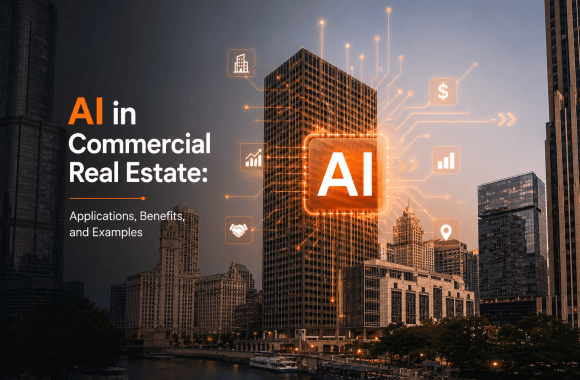
This guide covers AI in commercial real estate in 2026, from underwriting and lease abstraction to facilities management and portfolio surveillance. It pairs each application with measured benefits and real examples from CBRE, JLL, and agentic underwriting deployments, backed by Goldman Sachs and McKinsey data. You will see a clear comparison of traditional and AI workflows plus a staged starting plan. The takeaway: AI in CRE has reached its execution phase, and the firms keeping humans on key decisions are pulling ahead.
AI in commercial real estate now runs across the entire deal lifecycle, from market screening and underwriting to lease abstraction, facilities management, and portfolio surveillance. The benefits are measurable: underwriting that took a week now takes about 90 minutes, due diligence costs drop 20% to 35%, and lease review labor falls by 60%. In 2026, analysts call this AI's execution phase, because the biggest firms have moved from pilots to portfolio-wide deployment.
This is no longer theory. CBRE runs AI facilities management across a billion square feet. JLL automated lease abstraction and uncovered a million dollars in missed clauses. The gap between firms using AI well and those still experimenting is widening fast. I have watched CRE teams triple their deal throughput by automating the analysis grind. This guide covers the real applications, the benefits behind them, and concrete examples from the firms leading the way.
What is AI in commercial real estate?
AI in commercial real estate is the use of machine learning to analyze deals, automate workflows, and predict market behavior across office, retail, industrial, and multifamily assets. It underwrites faster, reads leases automatically, and monitors buildings in real time. It matters because CRE runs on data-heavy, time-consuming analysis, and AI compresses that work from days to minutes.
Think of it as an analyst, a building engineer, and a market researcher working at once, around the clock. It does not replace dealmakers or asset managers. It removes the slow analysis so they can focus on judgment, negotiation, and strategy.
What are the main applications of AI in commercial real estate?
The main applications span the full deal lifecycle: market screening, underwriting, lease abstraction, valuation, facilities management, and portfolio surveillance. Each one targets a data-heavy task where AI saves significant time. Leading institutional firms now deploy AI across all of these stages, not just one.
Here are the core applications CRE firms use in 2026:
Underwriting: automated deal analysis and cash-flow modeling.
Market intelligence: sentiment analysis and trend prediction from text data.
Lease abstraction: extracting key terms from lease documents automatically.
Valuation: AI models that price assets from many data points.
Facilities management: monitoring building systems and predicting failures.
Portfolio surveillance: tracking performance and risk across assets.
The pattern is clear. AI targets the analysis-heavy steps that used to consume analyst hours, freeing teams to evaluate more deals and manage more assets.
What are the benefits of AI in commercial real estate?
The benefits are speed, cost savings, and better decisions. AI cuts underwriting time by roughly 3x, reduces due diligence costs by 20% to 35%, and lowers lease review labor by 60%. These gains let teams bid on more deals and manage larger portfolios without adding headcount. McKinsey estimates AI could create $110 billion to $180 billion or more in value across real estate.
The numbers are striking. According to a Goldman Sachs estimate from mid-2025, AI tools could cut CRE due diligence costs 20% to 35% for large institutional portfolios. CBRE's 2025 tech report found development teams using AI for underwriting completing preliminary analysis 3x faster than those without. Adoption is climbing fast too: JLL's 2025 survey found 61% of institutional investors using AI for market analysis, up from just 22% in 2023.
Real examples of AI in commercial real estate
The clearest proof comes from what major firms have already deployed. These are documented examples, not projections.
JLL: lease abstraction at scale
JLL implemented an NLP-based lease abstraction platform that cut manual review labor by 60% in its first year, letting staff handle three times the volume without new hires. The system uncovered over $1 million in missed escalation clauses that had been overlooked, directly increasing lease revenue. This shows how AI pays for itself by catching what humans miss.
CBRE: facilities management across a billion square feet
CBRE deployed AI-enabled facilities management to more than 20,000 sites covering a billion square feet. With agentic AI monitoring building systems, its teams realized 10% to 20% savings in cleaning costs for clients and a 98% reduction in repeat maintenance alarms. CBRE also built an AI market sentiment tool that reads text data to predict market movements.
Agentic underwriting: a week to 90 minutes
An agentic AI system can complete a full mixed-use deal analysis in about 90 minutes, with an analyst spending another 20 minutes reviewing the output. The traditional process took over a week. As Commercial Observer reported, this is the difference between bidding on three deals a quarter and bidding on 15. Our AI for commercial real estate resources detail similar deployments.
Traditional vs AI commercial real estate workflows: a comparison
The contrast is sharpest on the analysis-heavy tasks. This table shows the change.
Workflow | Traditional | With AI |
Deal underwriting | Over a week | ~90 minutes |
Lease abstraction | Hours per lease | Minutes, 60% less labor |
Due diligence cost | Baseline | 20-35% lower |
Market analysis | Manual research | AI sentiment and trends |
Facilities monitoring | Reactive | Predictive, fewer alarms |
The takeaway is consistent. AI compresses analysis time and cost dramatically, which lets CRE teams pursue more opportunities with the same staff.
How do you start using AI in commercial real estate?
Start with the most analysis-heavy task that slows your team, usually underwriting or lease abstraction. Deploy one tool, measure the time and cost saved against your baseline, then expand across the deal lifecycle. This focused approach works because a single high-value win frees capacity and proves the case for wider rollout.
Follow these steps:
Identify the workflow consuming the most analyst hours.
Pilot one tool, such as AI underwriting or lease abstraction.
Measure time saved and accuracy against your current process.
Keep a human reviewing AI output, especially on deal decisions.
Expand to market intelligence, valuation, and surveillance once proven.
Skip the urge to deploy across the whole lifecycle at once. A focused first win de-risks the broader program and builds team trust in the technology.
What are the risks and limits of AI in commercial real estate?
The main risk is trusting AI output without review on high-stakes decisions. AI accelerates underwriting and valuation, but a flawed model or bad data can produce confident errors on deals worth millions. Keep an analyst reviewing every output that drives a real decision. AI is a force multiplier for judgment, not a replacement for it.
Other limits are practical. Models need clean, complete data, and CRE data is often scattered across systems. Market sentiment tools can misread unusual events. Sensitive deal and tenant data must be handled securely. Pick tools that show their reasoning and flag uncertainty. The firms winning in 2026 pair AI speed with human oversight, not blind automation.
The bottom line on AI in commercial real estate
The key takeaway is that AI in commercial real estate has reached its execution phase, compressing underwriting from a week to 90 minutes and cutting due diligence costs 20% to 35%, but the winners keep humans reviewing every high-stakes decision. Start with one analysis-heavy workflow, prove the savings, then expand across the deal lifecycle.
Your next step is to pick the task that consumes the most analyst hours, underwriting or lease abstraction for most firms, and pilot one tool against your current process. Measure the time and cost saved, and let those numbers guide your rollout.
The examples are already on the table. JLL caught a million dollars in missed clauses, CBRE manages a billion square feet with AI, and agentic underwriting turns three deals a quarter into fifteen. The firms pulling ahead are not waiting for the technology to mature. It already has. Spend small, keep humans on the decisions, and scale what works. Ready to start? Explore our AI for commercial real estate services and book a strategy call.
- AI in commercial real estate now spans the full deal lifecycle, not just one function.
- Agentic underwriting completes a mixed-use deal in ~90 minutes versus over a week.
- Goldman Sachs estimates AI cuts CRE due diligence costs 20% to 35%.
- JLL's AI lease abstraction cut review labor 60% and found $1M in missed clauses.
- CBRE runs AI facilities management across a billion square feet.
- 61% of institutional investors used AI for market analysis in 2025, up from 22% in 2023.
- Keep humans reviewing every high-stakes deal decision.
- Start with one analysis-heavy workflow, then expand across the lifecycle.
Why trust Noseberry
Our content is written by practicing real-estate and PropTech professionals, fact-checked by a dedicated editorial team, and reviewed against the latest industry data before publication.
- 10+ years of industry expertise
- All facts independently verified
- No sponsored rankings in guides
- Updated when the industry changes
Frequently Asked Questions
What is AI in commercial real estate?
AI in commercial real estate is the use of machine learning to analyze deals, automate workflows, and predict market behavior across office, retail, industrial, and multifamily assets. It underwrites faster, reads leases automatically, and monitors buildings in real time. It matters because CRE runs on data-heavy analysis, and AI compresses that work from days to minutes.
What are the main applications of AI in commercial real estate?
The main applications are underwriting, market intelligence, lease abstraction, valuation, facilities management, and portfolio surveillance. Each targets a data-heavy task where AI saves time. Leading institutional firms now deploy AI across the entire deal lifecycle, from initial market screening through closing and ongoing portfolio monitoring, rather than in a single isolated function.
How much time does AI save in commercial real estate underwriting?
AI saves enormous time in CRE underwriting. An agentic system can complete a full mixed-use deal analysis in about 90 minutes, plus 20 minutes of analyst review, versus over a week traditionally. CBRE found development teams using AI completed preliminary analysis 3x faster. This is the difference between bidding on three deals a quarter and fifteen.
What are real examples of AI in commercial real estate?
Real examples include JLL's lease abstraction platform, which cut review labor 60% and found over $1 million in missed clauses, and CBRE's AI facilities management across a billion square feet, saving 10% to 20% in cleaning costs. Agentic underwriting tools now complete deal analysis in 90 minutes versus a week, proving AI's value at scale.
What are the benefits of AI in commercial real estate?
The benefits are speed, cost savings, and better decisions. AI cuts underwriting time roughly 3x, reduces due diligence costs 20% to 35% per Goldman Sachs, and lowers lease review labor by 60%. These gains let firms bid on more deals and manage larger portfolios without adding staff, while improving accuracy on data-heavy analysis.
Is AI replacing analysts in commercial real estate?
No, AI is not replacing CRE analysts; it is removing their slowest work. AI handles the data-heavy first pass on underwriting and lease review, while analysts focus on judgment, negotiation, and deal decisions. Keeping a human reviewing every high-stakes output is essential. AI multiplies an analyst's capacity rather than replacing the expertise behind the decision.
Related insights
 Real Estate
What should a PMS do for small-scale property managers?
The ideal PMS for a small-scale property manager (typically 10 to 500 units) should do ten things well: capture every rent payment automatically, log every maintenance ticket with photo evidence and vendor dispatch, hold every tenant lease and document in one searchable place, generate owner and investor statements in one click, run automated rent reminders and late-fee escalation, screen tenants with credit and eviction history, sync with the operator's accounting stack (QuickBooks, Xero), work on mobile so field checks and unit walks happen on a phone, integrate with a website for listing marketing and online applications, and produce broker-visible dashboards that let the manager see occupancy, delinquency, and cash flow at a glance. AppFolio Property Manager Core, Buildium, DoorLoop, Rentec Direct, and Hemlane are the platforms most adopted at this scale in 2026, at $1.40 to $4 per unit per month. This post covers what the ideal PMS should do, which platforms actually deliver it, and how to pick without overpaying.
August 22, 2026 Real Estate
Which AI tools work best for real estate developers in 2026?
The best AI tools for real estate developers in 2026 fall into eight categories that map to the developer lifecycle: land sourcing and site selection (Cherre, Reonomy, HouseCanary, LandGate), feasibility and financial modelling (Northspyre, TestFit, custom Excel plus GPT), design and architectural planning (Autodesk Forma, Higharc, Cove.tool, Snaptrude), construction management and progress tracking (Procore AI, Autodesk Construction Cloud, Buildots, Doxel, OpenSpace), pre-launch marketing and renders (Restb.ai, MidJourney, Adobe Firefly), off-plan sales CRM (Salesforce, HubSpot, Follow Up Boss, Rechat), ESG and net-zero analytics (Measurabl, Enertiv, Aquicore), and handover to operations (BIM AI, tenant portal AI). Used well, they cut construction cost 10 to 20 percent, compress design cycles 30 to 50 percent, and lift off-plan sales conversion 20 to 40 percent. Used badly, they burn subscription budget and produce plans that do not build. This post walks through each category, which tools actually work, and how to sequence adoption.
August 22, 2026 Real Estate
ADA & WCAG Accessibility Compliance for Real Estate Websites: What Operators Must Fix Before They Get Sued
This blog breaks down ADA and WCAG accessibility compliance for real estate websites, focused on what actually creates legal exposure. It explains why WCAG 2.1 Level AA has become the practical legal standard even without a formal Title III regulation for private businesses. It walks through the six accessibility failures responsible for 96% of all detected errors across the web, using real listing-page examples. It also warns against relying on accessibility overlay widgets, citing the FTC's 2025 action against accessiBe over deceptive compliance claims. The piece closes with a step-by-step audit process, an in-house versus compliance-partner comparison, and a 10-question FAQ section.
August 20, 2026
Ready to book a 30-minute strategy call?
We'll map the right digital moves for your real estate business, no pitch deck, no commitment.