

Mayank Pokharna
Real estate & PropTech specialist
AI in Coliving: A Complete Operator's Guide
Published June 23, 2026|9 min read
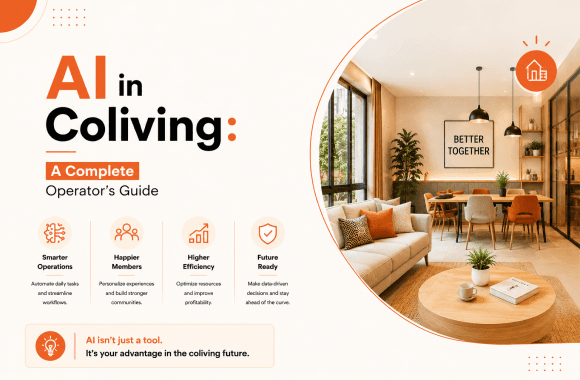
This operator's guide explains AI in coliving for 2026, covering leasing, resident matching, community chat, maintenance, dynamic pricing, and retention. It pairs each area with real market and savings data from Everything Coliving and McKinsey, then compares manual and AI-run operations side by side. You will get a staged rollout plan and a clear view of the risks. The goal is to help operators automate the repetitive 90% while protecting the human touch that defines coliving.
AI in coliving is software that automates leasing, resident matching, community chat, maintenance, and pricing so operators run more units with fewer staff. In 2026, it is moving from nice-to-have to baseline. Early adopters already operate with 20% to 30% lower staffing costs while delivering a better resident experience, and that gap widens every quarter.
Coliving runs on thin margins and high-touch service, which is exactly where AI helps most. The market is growing fast, valued near $13 billion in 2026 and projected to reach $35 billion by 2030 at roughly 21% annual growth, according to Everything Coliving. I have helped operators wire AI into messy, multi-property setups, and the lesson repeats: the winners automate the repetitive 90% so their people can own the human 10%. This guide shows you exactly where AI fits, what it saves, and how to start.
What is AI in coliving?
AI in coliving is the use of machine learning and automation to handle the repetitive parts of running shared housing. It matches residents, answers questions, prices rooms, routes maintenance, and predicts move-outs. It matters because coliving combines hotel-level service with apartment-level margins, and AI is the only way to deliver both at scale.
Think of it as an always-on operations assistant for every property. It does not replace your community manager. It frees them from inbox triage and scheduling so they can actually build community, which is the product residents pay for.
Why does AI matter for coliving operators in 2026?
AI matters because coliving margins depend on staffing efficiency, and AI cuts staffing costs by 20% to 30% for early adopters. It also lifts occupancy through better matching and dynamic pricing. In a market growing past 20% a year, the operators who automate first gain a durable cost and experience advantage over those who wait.
The numbers back this up. The US coliving market alone is projected to grow from about $4.2 billion in 2025 to over $10 billion by 2030, per Everything Coliving's US data. McKinsey separately reports real estate firms gaining 10% or more in net operating income from AI-driven operations. For an asset class built on density and turnover, those gains compound quickly across a portfolio.
Where does AI work across coliving operations?
AI touches almost every step of the coliving journey, from first inquiry to move-out. Here are the highest-value areas operators are automating in 2026.
Leasing and resident matching
AI leasing assistants answer prospect questions and book viewings 24/7. Resident matching is the standout coliving use case: AI analyzes lifestyle and personality data to assign rooms and housemates who actually get along. Better matches mean fewer conflicts and longer stays.
Community and resident communication
LLM-powered bots on WhatsApp or your app now handle up to 90% of resident queries, trained on house rules, cleaning schedules, and community policies. AI also analyzes resident interests to suggest events and connect people with shared hobbies, which strengthens the community bond that keeps residents renewing.
Operations and maintenance
AI automates the daily grind: scheduling shared spaces, routing maintenance tickets, and processing payments. Smart systems manage utilities and climate per room to cut waste. Predictive maintenance flags equipment issues before they break, which protects both the budget and the resident trust.
Pricing and revenue
Dynamic pricing adjusts room rates in real time based on demand, seasonality, and competitor rates. This is becoming standard among top-quartile operators in 2026. It lifts revenue without hurting occupancy, the exact balance coliving operators chase.
How does AI improve the coliving resident experience?
AI improves the resident experience by making service instant, personal, and consistent. Residents get answers at any hour, get matched with compatible housemates, and see maintenance handled fast. The experience feels high-touch even though much of it runs automatically, which is the whole promise of modern coliving.
Retention is where this pays off. AI monitors engagement signals like app activity, payment behavior, and maintenance patterns to predict which residents may leave. Retention workflows then trigger automatically, often 60 to 90 days before a resident's decision window. Catching churn that early gives your team time to act while it still matters. Our coliving resident experience resources go deeper on these workflows.
Manual vs AI-run coliving operations: a quick comparison
The contrast is clearest side by side. This table shows how AI changes core coliving tasks.
Task | Manual operation | AI-run operation |
Resident queries | Staff answer in business hours | Bot handles ~90%, 24/7 |
Room matching | Gut feel and availability | Lifestyle-based matching |
Pricing | Fixed or quarterly review | Real-time dynamic pricing |
Maintenance | Fix after it breaks | Predicted before failure |
Retention | React after notice | Predicted 60-90 days early |
Staffing cost | Baseline | 20-30% lower for adopters |
The pattern is consistent. AI compresses cost and response time while raising the quality residents feel. People stay for community and judgment, not inbox replies.
How do you start using AI in your coliving operation?
Start with the one task eating the most staff hours, usually resident queries. Deploy a trained chatbot, measure deflection rate, then expand to matching, pricing, and maintenance. This staged path works because a single high-volume win frees time and budget for the next step.
Follow these steps to roll out AI without chaos:
Audit where your team loses the most hours each week.
Launch an AI resident-query bot trained on your house rules and policies.
Add dynamic pricing once your occupancy data is clean.
Layer in resident matching and retention prediction.
Connect the tools through your property management system so they share data.
Skip the urge to digitize everything at once. Tool sprawl confuses staff and residents alike. Our coliving technology and AI consulting services resources map the rollout step by step.
What are the risks and limits of AI in coliving?
The biggest risk is automating away the human warmth that makes coliving work. A bot answering 90% of queries is great, until a resident in distress needs a person. Keep clear escalation paths so AI handles routine work and humans handle emotion and conflict. AI should extend your team, not hide behind it.
Other limits are practical. Matching and pricing models need clean data to perform, and resident data must be handled under privacy law. Biased screening can create fair-housing exposure. Pick tools that document their logic and allow human review. As coliving leaders note, the goal is technology that quietly gets the work moving so people can focus on community, not technology that replaces the community itself.
The bottom line on AI in coliving
The key takeaway is that AI in coliving lets operators run more units with fewer staff while delivering a better resident experience, but only if you automate the repetitive work and keep humans on the moments that matter. Start with resident queries, prove the savings, then expand into matching, pricing, and retention.
Your next step is simple. Identify the single task that drains the most staff hours this week, then deploy one AI tool against it for 30 days and measure the result. That focused win will fund and guide everything that follows.
The coliving market is growing past 20% a year, and the operators pulling ahead are not the ones with the most apps. They are the ones who automated the boring 90% and freed their people for community building, the part residents actually pay for. Spend small, measure honestly, and protect the human touch. Ready to map your AI plan?
Explore our coliving resident experience solutions and book a strategy call.
- AI in coliving automates leasing, matching, chat, maintenance, and pricing at scale.
- Early adopters operate with 20% to 30% lower staffing costs.
- The coliving market is near $13B in 2026 and projected to hit $35B by 2030 (~21% CAGR).
- AI chatbots resolve up to 90% of routine resident queries, 24/7.
- Resident matching uses lifestyle data to cut conflict and extend stays.
- Retention models flag at-risk residents 60 to 90 days early.
- Start with resident queries, then add pricing, matching, and retention in stages.
- Keep humans on emotion and conflict; protect the community that residents pay for.
Why trust Noseberry
Our content is written by practicing real-estate and PropTech professionals, fact-checked by a dedicated editorial team, and reviewed against the latest industry data before publication.
- 10+ years of industry expertise
- All facts independently verified
- No sponsored rankings in guides
- Updated when the industry changes
Frequently Asked Questions
What is AI in coliving in simple terms?
AI in coliving is software that automates the repetitive parts of running shared housing, like answering resident questions, matching housemates, pricing rooms, and routing maintenance. It lets operators serve more residents with fewer staff. The goal is hotel-level service at apartment-level cost, which is the core economic challenge every coliving operator faces.
How much can AI save a coliving operator?
AI can cut staffing costs by 20% to 30% for early-adopting coliving operators, according to industry research. It also lifts revenue through dynamic pricing and improves retention through churn prediction. Since coliving margins depend heavily on staffing efficiency, these savings compound quickly across a portfolio of units and properties.
How does AI handle resident communication in coliving?
AI handles resident communication through chatbots on apps like WhatsApp, trained on house rules, cleaning schedules, and community policies. These bots resolve up to 90% of routine queries instantly, 24/7. Complex or emotional issues escalate to a human. This frees community managers to focus on events and relationships rather than repetitive inbox work.
Can AI improve resident retention in coliving?
Yes, AI improves retention by predicting which residents are likely to leave. It monitors signals like app activity, payment behavior, and maintenance patterns, then flags at-risk residents 60 to 90 days before their decision window. Automated retention workflows trigger early outreach, giving your team time to act while the resident is still deciding.
What is AI-powered resident matching in coliving?
AI-powered resident matching uses lifestyle and personality data to assign compatible housemates and rooms. It matters because compatibility drives fewer conflicts and longer stays, which directly protects occupancy. Strong matches make the community feel cohesive, and that sense of belonging is the main reason residents renew their coliving leases.
Related insights
 Real Estate
What should a PMS do for small-scale property managers?
The ideal PMS for a small-scale property manager (typically 10 to 500 units) should do ten things well: capture every rent payment automatically, log every maintenance ticket with photo evidence and vendor dispatch, hold every tenant lease and document in one searchable place, generate owner and investor statements in one click, run automated rent reminders and late-fee escalation, screen tenants with credit and eviction history, sync with the operator's accounting stack (QuickBooks, Xero), work on mobile so field checks and unit walks happen on a phone, integrate with a website for listing marketing and online applications, and produce broker-visible dashboards that let the manager see occupancy, delinquency, and cash flow at a glance. AppFolio Property Manager Core, Buildium, DoorLoop, Rentec Direct, and Hemlane are the platforms most adopted at this scale in 2026, at $1.40 to $4 per unit per month. This post covers what the ideal PMS should do, which platforms actually deliver it, and how to pick without overpaying.
August 22, 2026 Real Estate
Which AI tools work best for real estate developers in 2026?
The best AI tools for real estate developers in 2026 fall into eight categories that map to the developer lifecycle: land sourcing and site selection (Cherre, Reonomy, HouseCanary, LandGate), feasibility and financial modelling (Northspyre, TestFit, custom Excel plus GPT), design and architectural planning (Autodesk Forma, Higharc, Cove.tool, Snaptrude), construction management and progress tracking (Procore AI, Autodesk Construction Cloud, Buildots, Doxel, OpenSpace), pre-launch marketing and renders (Restb.ai, MidJourney, Adobe Firefly), off-plan sales CRM (Salesforce, HubSpot, Follow Up Boss, Rechat), ESG and net-zero analytics (Measurabl, Enertiv, Aquicore), and handover to operations (BIM AI, tenant portal AI). Used well, they cut construction cost 10 to 20 percent, compress design cycles 30 to 50 percent, and lift off-plan sales conversion 20 to 40 percent. Used badly, they burn subscription budget and produce plans that do not build. This post walks through each category, which tools actually work, and how to sequence adoption.
August 22, 2026 Real Estate
ADA & WCAG Accessibility Compliance for Real Estate Websites: What Operators Must Fix Before They Get Sued
This blog breaks down ADA and WCAG accessibility compliance for real estate websites, focused on what actually creates legal exposure. It explains why WCAG 2.1 Level AA has become the practical legal standard even without a formal Title III regulation for private businesses. It walks through the six accessibility failures responsible for 96% of all detected errors across the web, using real listing-page examples. It also warns against relying on accessibility overlay widgets, citing the FTC's 2025 action against accessiBe over deceptive compliance claims. The piece closes with a step-by-step audit process, an in-house versus compliance-partner comparison, and a 10-question FAQ section.
August 20, 2026
Ready to book a 30-minute strategy call?
We'll map the right digital moves for your real estate business, no pitch deck, no commitment.