

Mayank Pokharna
Real estate & PropTech specialist
The Real Cost of AI Implementation in Real Estate: A 2026 Benchmark
Published June 24, 2026|8 min read
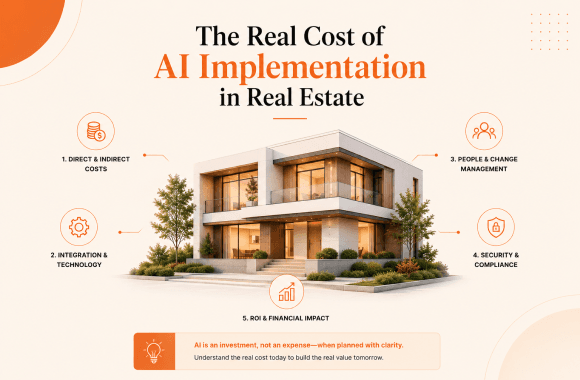
This 2026 benchmark reveals the real cost of AI implementation in real estate, which runs 1.5 to 2 times the build price over three years once data prep, integration, and upkeep are counted. It gives realistic cost ranges by project size, breaks down the hidden costs that blow budgets, and compares build versus buy. You will also see honest payback timelines and a five-step budgeting method. The goal is to help real estate firms plan for the full cost and still capture strong returns.
The real cost of AI implementation in real estate in 2026 is far higher than the build price you get quoted. Software development runs $20,000 to $300,000 or more, but the three-year total cost of ownership is 1.5 to 2 times the initial build cost once you add data prep, integration, training, and upkeep. Most firms underestimate the true cost by 40% to 60%, which is why so many projects blow their budgets.
Here is the part vendors rarely lead with: the sticker price is the smallest line item. Data preparation alone eats 30% to 50% of a project, and ongoing maintenance never stops. I have audited real estate AI budgets that looked fine on paper and ran double once reality hit. This benchmark breaks down every cost layer, gives realistic 2026 ranges by project size, and shows when the investment actually pays back. Read it before you sign anything.
What does AI implementation actually cost in real estate?
AI implementation in real estate costs $20,000 to $300,000 or more to build, but the real number is the total cost of ownership, which runs 1.5 to 2 times the build over three years. That multiplier covers data work, integrations, model retraining, compliance, and the staff time to run it. The build is the down payment, not the full price.
The reason is simple. AI is not set-and-forget software. As your data and market shift, models need monitoring and retraining, integrations need upkeep, and staff need training. According to Glean's TCO research, most organizations undercount total cost components by two to three times. Budget for the full picture, and you avoid the nasty surprise later.
The 2026 AI implementation cost benchmark by project size
Costs cluster by what you build. Use these 2026 ranges as planning anchors, then apply the TCO multiplier on top of them. Each tier reflects the typical scope for real estate firms.
Project size | Build cost | 3-year TCO (1.5-2x) | Example |
Small | $20,000-$50,000 | $30,000-$100,000 | Chatbot, single workflow |
Mid-size | $50,000-$150,000 | $75,000-$300,000 | Custom valuation or pricing model |
Enterprise | $150,000-$300,000+ | $225,000-$600,000+ | Multi-team platform rollout |
The pattern holds at every tier: whatever you are quoted to build, plan to spend roughly half again to double that over three years. A $50,000 model is really a $75,000 to $100,000 commitment once you run it.
Why does the total cost of ownership exceed the build cost?
Total cost of ownership exceeds the build cost because the work that keeps AI running never stops. Data prep, retraining, monitoring, compliance, and change management often equal or exceed the original build. These ongoing layers are why the three-year figure lands at 1.5 to 2 times what you first pay.
Data preparation is the heaviest hidden layer. It represents 30% to 50% of the total project cost, because messy real estate data, scattered across CRMs, spreadsheets, and legacy systems, has to be cleaned before any model can use it. In my experience, this single line item is where most budgets break. Fix your data early, and the rest of the project gets cheaper and faster.
What are the hidden costs of AI implementation in real estate?
The hidden costs are the ones that turn a $50,000 quote into a $100,000 reality. Most enterprise budgets underestimate true cost by 40% to 60%, and these line items are usually why. Knowing them in advance is the cheapest insurance you can buy.
Watch for these hidden costs:
Data preparation: cleaning and structuring data, often 30-50% ofthe cost.
Integration: connecting AI to CRM, MLS, ERP, and accounting systems.
Model retraining: ongoing tuning as data and markets change.
Compliance: fair-housing and data-privacy audits, adding 20-30%.
Training and change management: getting staff to actually use the system.
Productivity dips: temporary slowdowns during the transition.
Talent: engineers to maintain production systems over time.
Compliance, integration, maintenance, and scaling alone can add 20% to 30% to a baseline budget, per hidden-cost research from Hypersense. None of these show up in a typical software quote.
Build vs buy: which costs less for real estate AI?
Buying usually costs less upfront and de-risks delivery, while building costs more but gives full control. For most real estate firms, buying an established platform beats building from scratch, because vendor dependency risk is lower than the execution risk of an in-house build. Build only when AI is core to your competitive edge.
Factor | Build in-house | Buy a platform |
Upfront cost | High ($50K-$300K+) | Lower (subscription) |
Time to value | Months | Weeks |
Control | Full | Limited |
Maintenance burden | Yours | Vendor's |
Best for | Core, differentiating AI | Standard workflows |
Many firms blend both: buy proven tools for standard workflows like leasing chat, and build only the model that gives them a real edge. That mix usually delivers the lowest true cost.
How long until AI pays back in real estate?
Most real estate AI investments pay back in 12 to 18 months. The return comes from operational savings, with enterprise portfolios seeing 15% to 25% cost reductions. McKinsey reports firms gaining 10% or more in net operating income from AI-driven operations, which often exceeds the full TCO within two years.
The payback depends entirely on targeting. A tool aimed at a high-volume, expensive workflow returns fast, while a tool nobody adopts returns nothing. EliseAI implementations, for example, often justify their cost within 12 to 18 months through portfolio-wide savings. Tie every dollar to a metric you already track, and the payback math stays honest. Our AI consulting services and AI cost guide walk through ROI modeling.
How do you budget accurately for AI implementation?
Budget accurately by starting from the build quote, then adding the TCO multiplier and every hidden layer before you commit. The safest approach is to assume your real cost is double the quote, then work to bring it down with clean data and a clear scope. Planning for the full number prevents the mid-project budget crisis that kills so many programs.
Follow these steps to build a realistic budget:
Get a fixed-fee build quote for the defined deliverable.
Multiply by 1.5 to 2 for the three-year total cost of ownership.
Add a data-prep line worth 30% to 50% of the build.
Add 20% to 30% for compliance, integration upkeep, and scaling.
Tie the project to one metric and model payback against it.
Skip the temptation to budget only for the build. The firms that overspend are almost always the ones that ignore the layers underneath them.
The bottom line on the cost of AI implementation in real estate
The key takeaway is that the real cost of AI implementation in real estate is 1.5 to 2 times the build price over three years, and most firms underestimate it by 40% to 60% because they ignore data prep, integration, and upkeep. Budget for the full picture, and the investment still pays back in 12 to 18 months when targeted well.
Your next step is to take any AI quote you are considering and run it through the five-step budget above. Double the build figure, add data prep and compliance, and check the result against the metric you expect to improve. If the payback still makes sense, proceed. If it does not, shrink the scope.
Do not let the hidden layers scare you off AI. They are predictable, and once you plan for them, AI in real estate remains one of the highest-return investments available, with 15% to 25% operational savings on the table. The firms that win are the ones that budget honestly, clean their data first, and tie every dollar to a number. Ready to model your true cost?
Explore our AI implementation services and book a budgeting call.
- The real cost of AI implementation in real estate is 1.5 to 2 times the build price over three years.
- Build cost runs $20,000 to $300,000+, but TCO is the number that matters.
- Most firms underestimate true cost by 40% to 60%.
- Data preparation alone is 30% to 50% of total project cost.
- Compliance, integration upkeep, and scaling add another 20% to 30%.
- For most firms, buying beats building on both cost and risk.
- Well-targeted AI pays back in 12 to 18 months, with 15% to 25% operational savings.
- Budget by doubling the quote, then adding data-prep and compliance lines.
Why trust Noseberry
Our content is written by practicing real-estate and PropTech professionals, fact-checked by a dedicated editorial team, and reviewed against the latest industry data before publication.
- 10+ years of industry expertise
- All facts independently verified
- No sponsored rankings in guides
- Updated when the industry changes
Frequently Asked Questions
What is the real cost of AI implementation in real estate?
The real cost of AI implementation in real estate is 1.5 to 2 times the build price over three years. Building runs $20,000 to $300,000 or more, but data prep, integration, retraining, and compliance push the total cost of ownership far higher. Most firms underestimate the true figure by 40% to 60% when they budget.
Why do AI projects cost more than the quoted price?
AI projects cost more because the quote covers only the build, not the work that keeps AI running. Data preparation alone is 30% to 50% of total cost, and retraining, integration upkeep, and compliance never stop. These ongoing layers often equal or exceed the original build, which is why the three-year cost runs 1.5 to 2 times higher.
How much does AI software development cost for real estate?
AI software development for real estate costs $20,000 to $300,000 or more in 2026, depending on platform type, AI complexity, integrations, and scale. A simple chatbot sits at the low end, while a multi-team enterprise platform sits at the high end. Remember to add the total-cost-of-ownership multiplier on top of any build quote.
What are the biggest hidden costs of AI in real estate?
The biggest hidden costs are data preparation (30-50% of total cost), integration with legacy systems, model retraining, compliance audits, and ongoing engineering talent. Compliance, integration upkeep, and scaling alone can add 20% to 30% to a baseline budget. These rarely appear in a software quote, which is why budgets miss by 40% to 60%.
How long does AI take to pay back in real estate?
AI in real estate typically pays back in 12 to 18 months through operational savings. Enterprise portfolios often see 15% to 25% cost reductions, and McKinsey reports firms gaining 10% or more in net operating income. Payback depends on targeting a high-volume, expensive workflow rather than a tool that staff never fully adopt.
Should real estate firms build or buy AI?
Most real estate firms should buy proven platforms rather than build from scratch, because vendor risk is lower than the execution risk of an in-house build. Buying costs less upfront and delivers value in weeks. Build only when AI is core to your competitive edge. Many firms blend both, buying standard tools and building only their differentiator.
How do I budget accurately for an AI project?
Budget accurately by starting from the build quote, multiplying by 1.5 to 2 for three-year total cost of ownership, then adding 30% to 50% for data prep and 20% to 30% for compliance and upkeep. Tie the project to one metric and model payback against it. Assume your real cost is roughly double the quote.
Related insights
 Real Estate
What should a PMS do for small-scale property managers?
The ideal PMS for a small-scale property manager (typically 10 to 500 units) should do ten things well: capture every rent payment automatically, log every maintenance ticket with photo evidence and vendor dispatch, hold every tenant lease and document in one searchable place, generate owner and investor statements in one click, run automated rent reminders and late-fee escalation, screen tenants with credit and eviction history, sync with the operator's accounting stack (QuickBooks, Xero), work on mobile so field checks and unit walks happen on a phone, integrate with a website for listing marketing and online applications, and produce broker-visible dashboards that let the manager see occupancy, delinquency, and cash flow at a glance. AppFolio Property Manager Core, Buildium, DoorLoop, Rentec Direct, and Hemlane are the platforms most adopted at this scale in 2026, at $1.40 to $4 per unit per month. This post covers what the ideal PMS should do, which platforms actually deliver it, and how to pick without overpaying.
August 22, 2026 Real Estate
Which AI tools work best for real estate developers in 2026?
The best AI tools for real estate developers in 2026 fall into eight categories that map to the developer lifecycle: land sourcing and site selection (Cherre, Reonomy, HouseCanary, LandGate), feasibility and financial modelling (Northspyre, TestFit, custom Excel plus GPT), design and architectural planning (Autodesk Forma, Higharc, Cove.tool, Snaptrude), construction management and progress tracking (Procore AI, Autodesk Construction Cloud, Buildots, Doxel, OpenSpace), pre-launch marketing and renders (Restb.ai, MidJourney, Adobe Firefly), off-plan sales CRM (Salesforce, HubSpot, Follow Up Boss, Rechat), ESG and net-zero analytics (Measurabl, Enertiv, Aquicore), and handover to operations (BIM AI, tenant portal AI). Used well, they cut construction cost 10 to 20 percent, compress design cycles 30 to 50 percent, and lift off-plan sales conversion 20 to 40 percent. Used badly, they burn subscription budget and produce plans that do not build. This post walks through each category, which tools actually work, and how to sequence adoption.
August 22, 2026 Real Estate
ADA & WCAG Accessibility Compliance for Real Estate Websites: What Operators Must Fix Before They Get Sued
This blog breaks down ADA and WCAG accessibility compliance for real estate websites, focused on what actually creates legal exposure. It explains why WCAG 2.1 Level AA has become the practical legal standard even without a formal Title III regulation for private businesses. It walks through the six accessibility failures responsible for 96% of all detected errors across the web, using real listing-page examples. It also warns against relying on accessibility overlay widgets, citing the FTC's 2025 action against accessiBe over deceptive compliance claims. The piece closes with a step-by-step audit process, an in-house versus compliance-partner comparison, and a 10-question FAQ section.
August 20, 2026
Ready to book a 30-minute strategy call?
We'll map the right digital moves for your real estate business, no pitch deck, no commitment.