

Mayank Pokharna
Real estate & PropTech specialist
The Enterprise Guide to AI Agents in Real Estate
Published June 25, 2026|10 min read
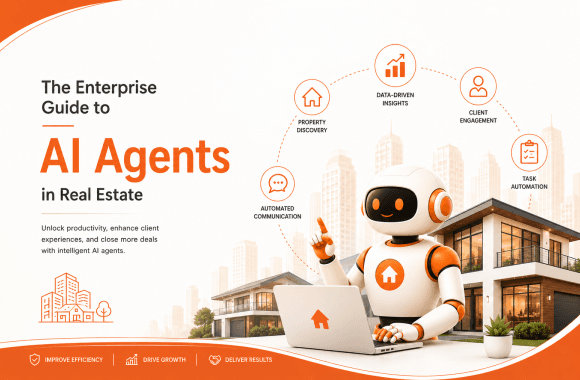
This enterprise guide explains AI agents in real estate for 2026, covering what they are, how they differ from regular AI tools, and where they create the most value. It details the five-layer architecture enterprises need, compares traditional and agentic AI, and lays out a staged deployment plan with governance built in. Backed by McKinsey, JLL, and real enterprise examples like Hines, it shows how to unlock 10% to 30% workflow gains. The goal is to help enterprises scale agents safely instead of stalling in pilots.
AI agents in real estate are autonomous software systems that complete multi-step tasks on their own, like triaging a maintenance ticket, assigning a vendor, and updating the resident, all without a human clicking through each step. They mark the shift from AI that helps you understand to AI that helps you get the work done. For enterprises, that shift is where the real money lives.
This is not a small upgrade. McKinsey reports that coordinating agents across a full workflow, instead of solving one step, can improve outcomes like net operating income, operating costs, and cycle times by 10%, 20%, or even 30%. Early enterprise deployments already show maintenance time savings above 30% and lead response times more than 90% faster. I have watched single-task tools plateau while agentic systems kept compounding. This guide explains what AI agents are, where they create value, the architecture you need, and how to deploy them at scale without losing control.
What are AI agents in real estate?
AI agents in real estate are autonomous systems that plan and execute multi-step workflows inside your core business tools. Unlike a chatbot that answers one question, an agent can read a request, decide what to do, take action across systems, and escalate when needed. They matter because they automate entire processes, not single tasks.
The simplest way to picture it: a regular AI tool is a smart calculator, while an agent is a junior employee who finishes the whole job. The agent works inside your CRM, property system, and accounting tools, handing off between them the way a person would. That autonomy is what makes the enterprise impact so large.
How do AI agents differ from regular AI tools?
AI agents differ from regular AI tools because they act, not just answer. A standard tool drafts a listing or summarizes a lease when asked. An agent chains many steps together with little supervision, moving from "help me understand" to "help me get it done." That autonomy is the defining feature of agentic AI in 2026.
The practical difference shows up in outcomes. A chatbot answers a maintenance question; an agent logs the ticket, checks vendor availability, books the repair, and notifies the resident. Because the agent owns the full loop, it removes far more manual work. This is why enterprises see workflow-level gains that single tools never delivered.
Where do AI agents create the most value in real estate?
AI agents create the most value in four enterprise domains: maintenance and facilities, leasing and renewals, investing and asset management, and construction and capital expenditures. These areas combine high volume with clear rules, which is exactly where autonomous workflows shine. They are the first places enterprise real estate firms deploy agents.
The early results are concrete. According to McKinsey's agentic AI research, enterprise deployments have shown time savings above 30% on maintenance tasks, renewal-rate improvements between 3% and 7%, and lead response times more than 90% faster. Across the sector, McKinsey estimates generative and agentic AI could create $110 billion to $180 billion or more in value. Asset managers like Hines are already piloting agents in development and asset management, per StackAI.
The enterprise architecture for AI agents
Enterprise AI agents need a layered architecture to work reliably and safely. A solid agentic system rests on five layers, each with a clear job. Skipping any one of them is how pilots stall before they scale.
Factual layer: organizes clean data as a single source of truth.
Orchestration layer: plans workflows, routes work, and manages escalation.
Action layer: executes tasks by integrating directly into core systems.
Control layer: provides governance, audit trails, and permission limits.
Building-block layer: offers reusable routines to scale across the business.
The control layer is the one enterprises cannot skip. It sets the boundaries on what an agent may do, especially around financial transactions, and it keeps an audit trail for every action. Without it, autonomy becomes risk. With it, you get speed and accountability together.
Traditional AI vs agentic AI: a quick comparison
The contrast is sharpest side by side. This table shows how agents change enterprise real estate work.
Dimension | Traditional AI tools | AI agents (agentic) |
Scope | One task | Full multi-step workflow |
Supervision | Human clicks each step | Largely autonomous |
Systems | Standalone | Acts across core systems |
Mindset | Help me understand | Help me get it done |
Impact | Task-level savings | 10-30% workflow gains |
The takeaway is clear. Traditional tools speed up steps, while agents own outcomes. The enterprises pulling ahead in 2026 are building toward the right column, one workflow at a time.
How do you deploy AI agents at enterprise scale?
Deploy AI agents by starting with one high-value workflow, proving it end to end, then reusing the building blocks across the business. Pick a domain like maintenance, build the five-layer foundation, and scale only after the first agent delivers. This staged path works because it proves value and governance before you bet the portfolio on it.
Follow these steps for an enterprise rollout:
Clean and centralize your data first, since agents fail on messy inputs.
Choose one high-volume workflow, such as maintenance triage or renewals.
Build the control layer early to set permissions and audit trails.
Pilot with a small team and measure against a clear baseline.
Reuse working components to scale into the next domain.
The biggest mistake enterprises make is launching agents on dirty data with no governance. As McKinsey notes, the industry must change its operating model to capture the value, which means structure and metrics shift alongside the technology. Our agentic AI consulting and AI for real estate operators resources detail the rollout.
What governance do AI agents require?
AI agents require strong governance because autonomy without limits is dangerous. The control layer must define what an agent can do, log every action, and cap financial permissions. Governance is non-negotiable in real estate because agents touch leases, payments, and tenant data that carry legal weight.
Three guardrails matter most: permission limits so agents cannot exceed their authority, audit trails so every action is traceable, and human escalation for anything sensitive or ambiguous. Fair-housing and data-privacy rules still apply to autonomous decisions, so screening and pricing agents need human review. The winners, McKinsey observes, own their data learning loops and use agents to quietly move work while people focus on judgment and negotiation.
The bottom line on AI agents in real estate
The key takeaway is that AI agents in real estate move enterprises from automating single tasks to automating whole workflows, unlocking 10% to 30% gains in NOI, cost, and cycle time, but only when built on clean data, a layered architecture, and strong governance. Start with one workflow, prove it, then scale through reusable building blocks.
Your next step is to choose one high-value domain, most firms start with maintenance or renewals, and map its full workflow end to end. Then build the data and control layers before you turn an agent loose. That foundation is what separates enterprises that scale agents from those stuck in permanent pilot mode.
Do not chase the flashiest agent platform. The winners in 2026 are the firms that own their data, govern their agents tightly, and let autonomy handle the repetitive work so their people focus on the moments that matter. Build the foundation, start narrow, and expand only what proves itself.
Ready to design your agentic roadmap?
Explore our agentic AI consulting services and book a strategy call.
- AI agents in real estate automate full multi-step workflows, not just single tasks.
- They mark the shift from "help me understand" to "help me get it done."
- Coordinated agents can improve NOI, cost, and cycle times by 10% to 30% (McKinsey).
- Early gains: 30%+ maintenance time saved, 3-7% renewal lift, 90%+ faster lead response.
- The four highest-value domains are maintenance, leasing, asset management, and capex.
- Enterprise agents need a five-layer architecture, with the control layer non-negotiable.
- Governance, permission limits, and audit trails make autonomy safe.
- Start with one workflow, prove it, then scale through reusable building blocks.
Why trust Noseberry
Our content is written by practicing real-estate and PropTech professionals, fact-checked by a dedicated editorial team, and reviewed against the latest industry data before publication.
- 10+ years of industry expertise
- All facts independently verified
- No sponsored rankings in guides
- Updated when the industry changes
Frequently Asked Questions
What are AI agents in real estate?
AI agents in real estate are autonomous software systems that complete multi-step workflows on their own, such as triaging a maintenance ticket, booking a vendor, and updating the resident. Unlike a chatbot that answers one question, an agent acts across your core systems. They automate entire processes, which is why enterprises see workflow-level gains.
How are AI agents different from regular AI tools?
AI agents act, while regular AI tools only answer. A standard tool drafts a listing when asked; an agent chains many steps together with little supervision, moving from "help me understand" to "help me get it done." Because agents own the full workflow, they remove far more manual work than single-task tools ever could.
Where do AI agents add the most value in real estate?
AI agents add the most value in four domains: maintenance and facilities, leasing and renewals, investing and asset management, and construction and capital expenditures. These combine high volume with clear rules. Early deployments show maintenance time savings above 30%, renewal gains of 3% to 7%, and lead response more than 90% faster.
What architecture do enterprise AI agents need?
Enterprise AI agents need five layers: factual (clean data), orchestration (workflow planning), action (system integration), control (governance and audit), and building-block (reusable routines). The control layer is essential because it sets permission limits and logs every action. Skipping layers is the most common reason agentic AI pilots stall before they scale.
Are AI agents safe to use in real estate operations?
AI agents are safe when governed properly. They need permission limits, audit trails, and human escalation for sensitive decisions. Fair-housing and privacy rules still apply, so screening and pricing agents require human review. Autonomy without governance is the real danger, which is why the control layer is non-negotiable in any enterprise deployment.
How much value can AI agents create for real estate enterprises?
AI agents can improve outcomes like net operating income, operating costs, and cycle times by 10% to 30% when coordinated across a full workflow, per McKinsey. Across the sector, generative and agentic AI could create $110 billion to $180 billion or more in value. The gains come from automating whole processes, not just single tasks.
How do enterprises start deploying AI agents?
Enterprises start by cleaning their data, choosing one high-volume workflow like maintenance triage, and building the control layer early. Pilot with a small team, measure against a baseline, then reuse working components to scale. Starting narrow proves both value and governance before you commit the wider portfolio to autonomous agents.
Related insights
 Real Estate
What should a PMS do for small-scale property managers?
The ideal PMS for a small-scale property manager (typically 10 to 500 units) should do ten things well: capture every rent payment automatically, log every maintenance ticket with photo evidence and vendor dispatch, hold every tenant lease and document in one searchable place, generate owner and investor statements in one click, run automated rent reminders and late-fee escalation, screen tenants with credit and eviction history, sync with the operator's accounting stack (QuickBooks, Xero), work on mobile so field checks and unit walks happen on a phone, integrate with a website for listing marketing and online applications, and produce broker-visible dashboards that let the manager see occupancy, delinquency, and cash flow at a glance. AppFolio Property Manager Core, Buildium, DoorLoop, Rentec Direct, and Hemlane are the platforms most adopted at this scale in 2026, at $1.40 to $4 per unit per month. This post covers what the ideal PMS should do, which platforms actually deliver it, and how to pick without overpaying.
August 22, 2026 Real Estate
Which AI tools work best for real estate developers in 2026?
The best AI tools for real estate developers in 2026 fall into eight categories that map to the developer lifecycle: land sourcing and site selection (Cherre, Reonomy, HouseCanary, LandGate), feasibility and financial modelling (Northspyre, TestFit, custom Excel plus GPT), design and architectural planning (Autodesk Forma, Higharc, Cove.tool, Snaptrude), construction management and progress tracking (Procore AI, Autodesk Construction Cloud, Buildots, Doxel, OpenSpace), pre-launch marketing and renders (Restb.ai, MidJourney, Adobe Firefly), off-plan sales CRM (Salesforce, HubSpot, Follow Up Boss, Rechat), ESG and net-zero analytics (Measurabl, Enertiv, Aquicore), and handover to operations (BIM AI, tenant portal AI). Used well, they cut construction cost 10 to 20 percent, compress design cycles 30 to 50 percent, and lift off-plan sales conversion 20 to 40 percent. Used badly, they burn subscription budget and produce plans that do not build. This post walks through each category, which tools actually work, and how to sequence adoption.
August 22, 2026 Real Estate
ADA & WCAG Accessibility Compliance for Real Estate Websites: What Operators Must Fix Before They Get Sued
This blog breaks down ADA and WCAG accessibility compliance for real estate websites, focused on what actually creates legal exposure. It explains why WCAG 2.1 Level AA has become the practical legal standard even without a formal Title III regulation for private businesses. It walks through the six accessibility failures responsible for 96% of all detected errors across the web, using real listing-page examples. It also warns against relying on accessibility overlay widgets, citing the FTC's 2025 action against accessiBe over deceptive compliance claims. The piece closes with a step-by-step audit process, an in-house versus compliance-partner comparison, and a 10-question FAQ section.
August 20, 2026
Ready to book a 30-minute strategy call?
We'll map the right digital moves for your real estate business, no pitch deck, no commitment.