
Noseberry Digitals
Acceptance of Blockchain Technology in Real Estate: Current Adoption & Future Scope
Published March 31, 2026|6 min read
Real estate has always been asset-heavy, paperwork-driven, and slow to change. Property transactions involve multiple intermediaries, long verification cycles, manual documentation, and a high dependency on trust. Despite digital tools improving listings and payments, the core transaction layer still struggles with transparency and efficiency. This gap is where blockchain in real estate is steadily gaining acceptance, not […]
Real estate has always been asset-heavy, paperwork-driven, and slow to change. Property transactions involve multiple intermediaries, long verification cycles, manual documentation, and a high dependency on trust. Despite digital tools improving listings and payments, the core transaction layer still struggles with transparency and efficiency. This gap is where blockchain in real estate is steadily gaining acceptance, not as hype, but as infrastructure.
This article explains how blockchain technology in real estate is being adopted today, where it is delivering real value, and what its future scope realistically looks like. The goal is clarity, not speculation.
Why Real Estate Is Ready for Blockchain Adoption
Real estate has three structural characteristics that make it a strong candidate for blockchain adoption:
First, transactions are high-value and infrequent, which makes trust and verification critical. Second, records such as titles, deeds, and leases must remain tamper-proof for decades. Third, the ecosystem involves many stakeholders who rarely share a single source of truth.
Traditional databases can digitize records, but they still rely on central authorities and manual reconciliation. Blockchain introduces a shared, immutable ledger that changes how ownership, verification, and settlement are handled.
The acceptance of blockchain in real estate is therefore driven less by innovation pressure and more by operational necessity.
Current Adoption of Blockchain in Real Estate
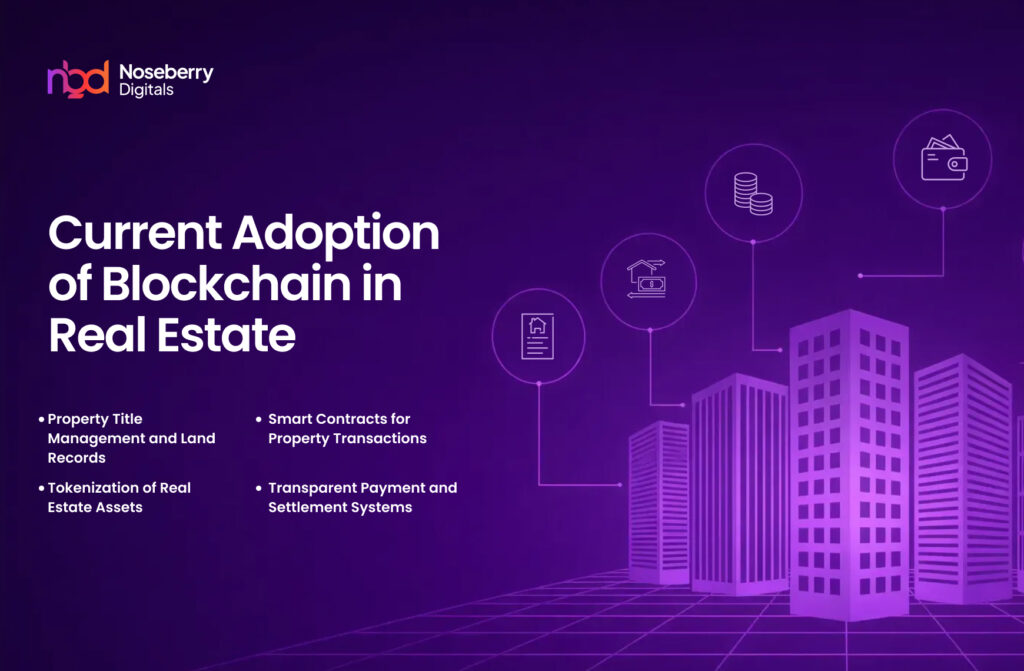
Property Title Management and Land Records
One of the earliest and most practical uses of blockchain technology in real estate is land and title record management. Property ownership disputes often arise from duplicated records, manual errors, or unauthorized changes.
Blockchain-based land registries create a single, tamper-resistant history of ownership. Each transaction is time-stamped and verifiable, reducing fraud and eliminating ambiguity around title authenticity. While full-scale national adoption is still limited, pilot programs and controlled deployments are already showing measurable efficiency gains.
Smart Contracts for Property Transactions
Smart contracts automate transaction logic that traditionally depends on lawyers, escrow services, and manual approvals. In real estate, they are used to automate:
- Sale agreements once conditions are met
- Lease execution and renewals
- Security deposit handling
- Milestone-based payments in construction projects
Instead of relying on trust between parties, smart contracts enforce rules automatically. This reduces delays, human error, and disputes. Adoption today is strongest in commercial leasing, developer-buyer agreements, and cross-border transactions.
Tokenization of Real Estate Assets
Tokenization allows physical property or real estate funds to be represented as digital tokens on a blockchain. Each token represents fractional ownership, enabling smaller investors to participate in traditionally illiquid assets.
This is one of the most discussed applications of blockchain in real estate, but also one of the most regulated. Current adoption is cautious and largely limited to private placements, commercial assets, and regulated investment platforms.
Tokenization is not replacing traditional ownership yet, but it is changing how capital enters the real estate market.
Transparent Payment and Settlement Systems
Real estate payments often involve multiple steps, currencies, and intermediaries. Blockchain-based settlement systems provide real-time visibility into payment status, reduce reconciliation errors, and simplify cross-border transfers.
In markets with high international investment activity, blockchain-enabled payment rails are increasingly used alongside traditional banking systems rather than replacing them outright.
Practical Benefits Driving Acceptance
The growing acceptance of blockchain in real estate is tied to tangible benefits rather than theoretical advantages.
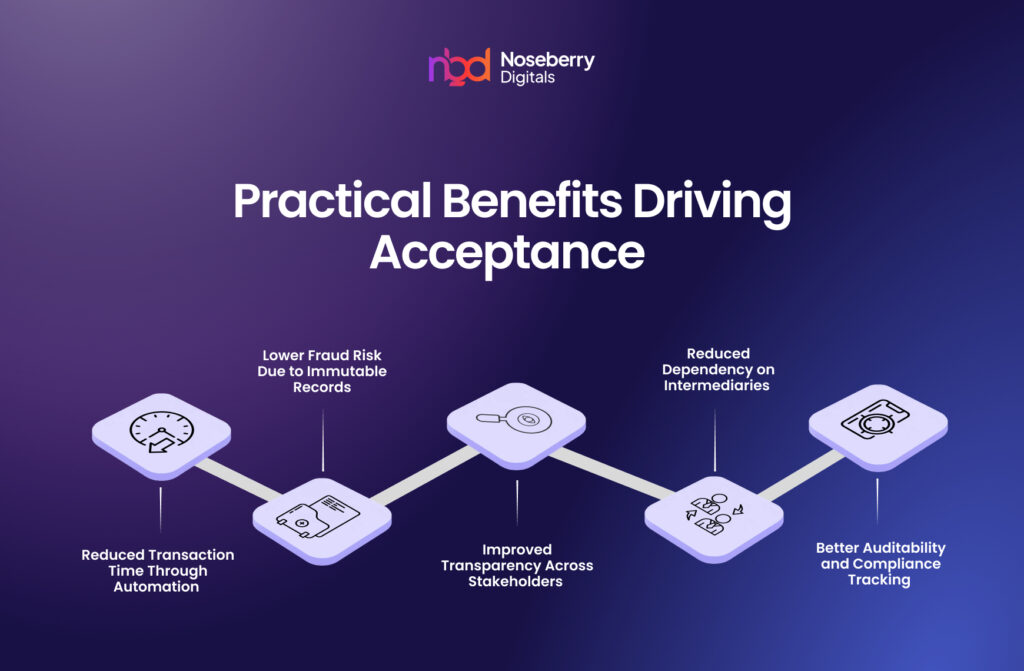
Reduced Transaction Time Through Automation
Blockchain automates verification, approvals, and settlements using smart contracts. This removes manual delays and shortens property transactions from weeks to days. Faster execution also reduces deal drop-offs and holding costs.
Lower Fraud Risk Due to Immutable Records
Once property data is recorded on a blockchain, it cannot be altered without traceability. This makes ownership records tamper-proof and significantly reduces title fraud, document manipulation, and duplicate registrations.
Improved Transparency Across Stakeholders
All authorized parties access the same real-time data on a shared ledger. This eliminates mismatched records, improves coordination, and reduces disputes caused by information gaps.
Reduced Dependency on Intermediaries
Blockchain embeds trust directly into the transaction process through cryptographic verification and smart contracts. This lowers reliance on manual intermediaries, reduces costs, and simplifies settlement workflows.
Better Auditability and Compliance Tracking
Every transaction is permanently time-stamped and traceable. This creates a clear audit trail, simplifies compliance reporting, and improves regulatory confidence for developers, investors, and institutions.
What matters is not that blockchain is decentralized, but that it reduces friction in processes that have remained unchanged for decades.
Limitations and Challenges Slowing Adoption
Despite its potential, blockchain technology in real estate faces real constraints.
Legal recognition remains inconsistent across regions. Property laws are jurisdiction-specific, and blockchain records must align with local regulatory frameworks to be enforceable.
Integration is another challenge. Real estate systems like property management software, government registries, and banking platforms were not built for decentralized infrastructure. Bridging these systems requires technical and organizational effort.
There is also a skills gap. Real estate professionals often lack blockchain literacy, while blockchain developers may not fully understand real estate workflows. Adoption accelerates only when both sides align.
A Practical Framework to Evaluate Blockchain Use in Real Estate
Not every real estate problem needs blockchain. A practical evaluation framework helps avoid unnecessary complexity.
Blockchain is most effective when:
- Multiple parties need shared, verifiable data
- Records must be tamper-proof over long periods
- Manual reconciliation causes delays or disputes
- Trust between parties is limited
Blockchain is less effective when:
- A single authority already manages data efficiently
- Transaction volume is very low
- Regulatory clarity is missing
This distinction is critical for meaningful adoption.
Future Scope of Blockchain in Real Estate
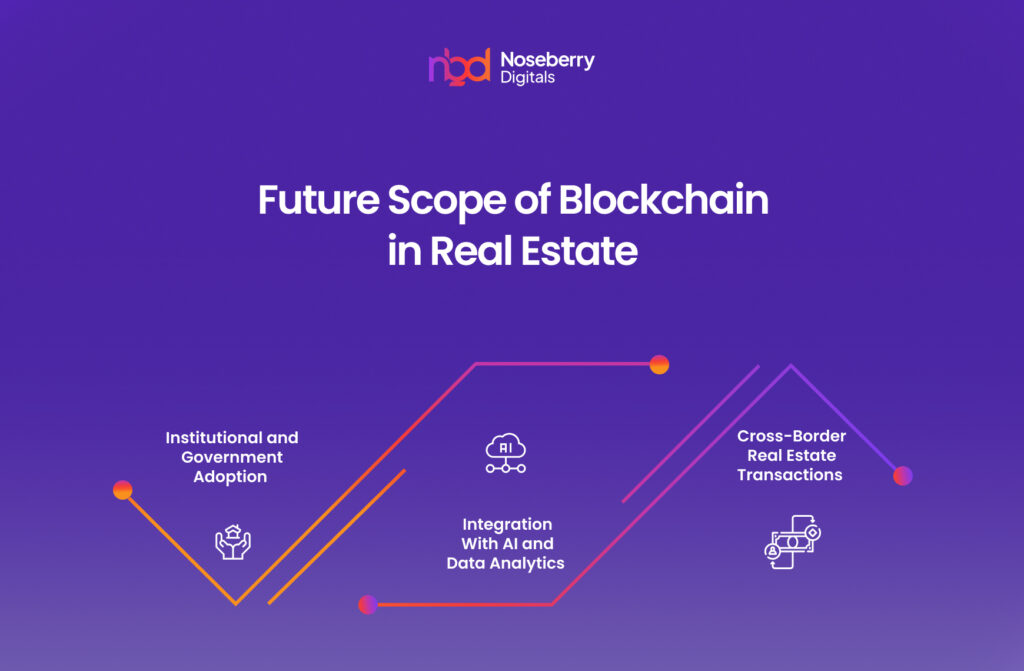
Institutional and Government Adoption
The next phase of growth will come from institutions and governments adopting blockchain-backed registries and compliance systems. When public records integrate blockchain verification layers, private adoption follows naturally.
This shift will likely be incremental rather than disruptive, starting with parallel systems before full migration.
Integration With AI and Data Analytics
Blockchain creates reliable data. AI turns that data into insight. The future scope of blockchain in real estate lies in its integration with analytics, risk modeling, and automated compliance monitoring.
Verified transaction histories enable better valuation models, fraud detection, and investment analysis. This combined approach delivers more value than blockchain alone.
Cross-Border Real Estate Transactions
International real estate transactions face challenges around trust, currency exchange, and legal verification. Blockchain-based identity, documentation, and settlement systems are well-suited for this complexity.
As regulatory frameworks mature, cross-border property investments are likely to be one of the strongest growth areas.
Conclusion
The acceptance of blockchain in real estate is no longer theoretical. It is already reshaping how records are stored, how transactions are executed, and how trust is established between parties. However, adoption remains pragmatic and selective, closely tied to regulation, compliance requirements, and real-world operational constraints.
Rather than replacing existing systems overnight, blockchain technology in real estate is emerging as an enabling layer. When integrated through Real Estate Software Development, it reduces friction, improves transparency, and strengthens data integrity across property records, transactions, and asset management workflows.
The future scope of blockchain in real estate depends less on innovation alone and more on thoughtful system integration, legal alignment, and demonstrable business value. As part of modern Real Estate Software Development strategies, blockchain is positioning the industry for more intelligent, secure, and data-driven operations-without disrupting the foundations that already work.
Also Read : How Real Estate Software Development Companies Are Leading the AI Revolution in 2025
Why trust Noseberry
Our content is written by practicing real-estate and PropTech professionals, fact-checked by a dedicated editorial team, and reviewed against the latest industry data before publication.
- 10+ years of industry expertise
- All facts independently verified
- No sponsored rankings in guides
- Updated when the industry changes
Related insights
 Real Estate
What should a PMS do for small-scale property managers?
The ideal PMS for a small-scale property manager (typically 10 to 500 units) should do ten things well: capture every rent payment automatically, log every maintenance ticket with photo evidence and vendor dispatch, hold every tenant lease and document in one searchable place, generate owner and investor statements in one click, run automated rent reminders and late-fee escalation, screen tenants with credit and eviction history, sync with the operator's accounting stack (QuickBooks, Xero), work on mobile so field checks and unit walks happen on a phone, integrate with a website for listing marketing and online applications, and produce broker-visible dashboards that let the manager see occupancy, delinquency, and cash flow at a glance. AppFolio Property Manager Core, Buildium, DoorLoop, Rentec Direct, and Hemlane are the platforms most adopted at this scale in 2026, at $1.40 to $4 per unit per month. This post covers what the ideal PMS should do, which platforms actually deliver it, and how to pick without overpaying.
August 22, 2026 Real Estate
Which AI tools work best for real estate developers in 2026?
The best AI tools for real estate developers in 2026 fall into eight categories that map to the developer lifecycle: land sourcing and site selection (Cherre, Reonomy, HouseCanary, LandGate), feasibility and financial modelling (Northspyre, TestFit, custom Excel plus GPT), design and architectural planning (Autodesk Forma, Higharc, Cove.tool, Snaptrude), construction management and progress tracking (Procore AI, Autodesk Construction Cloud, Buildots, Doxel, OpenSpace), pre-launch marketing and renders (Restb.ai, MidJourney, Adobe Firefly), off-plan sales CRM (Salesforce, HubSpot, Follow Up Boss, Rechat), ESG and net-zero analytics (Measurabl, Enertiv, Aquicore), and handover to operations (BIM AI, tenant portal AI). Used well, they cut construction cost 10 to 20 percent, compress design cycles 30 to 50 percent, and lift off-plan sales conversion 20 to 40 percent. Used badly, they burn subscription budget and produce plans that do not build. This post walks through each category, which tools actually work, and how to sequence adoption.
August 22, 2026 Real Estate
ADA & WCAG Accessibility Compliance for Real Estate Websites: What Operators Must Fix Before They Get Sued
This blog breaks down ADA and WCAG accessibility compliance for real estate websites, focused on what actually creates legal exposure. It explains why WCAG 2.1 Level AA has become the practical legal standard even without a formal Title III regulation for private businesses. It walks through the six accessibility failures responsible for 96% of all detected errors across the web, using real listing-page examples. It also warns against relying on accessibility overlay widgets, citing the FTC's 2025 action against accessiBe over deceptive compliance claims. The piece closes with a step-by-step audit process, an in-house versus compliance-partner comparison, and a 10-question FAQ section.
August 20, 2026
Ready to book a 30-minute strategy call?
We'll map the right digital moves for your real estate business, no pitch deck, no commitment.